


There is no single national number for an intensive outpatient program (IOP), and any page that gives you one is averaging very different programs. The total depends on how many hours a week you attend, how many weeks you stay, what the program includes, and what your health plan pays. The most useful move is to learn those variables, then ask a program for a written estimate based on your plan. Below, we explain how IOP is billed, what changes the total, and which questions give you a real answer. We do not publish dollar amounts here, because an honest figure depends on your plan and your treatment needs.
TL;DR
- IOP totals vary because programs differ in weekly hours, length of stay, staffing, and what is bundled into the bill.
- The median length of stay for adults who complete IOP is 81 days, so the number of weeks matters as much as the weekly rate.
- Federal guidance says all Marketplace plans must cover substance use disorder treatment, but your deductible, coinsurance, and network decide what you pay.
- Ask any program what is billed together, what is billed separately, and what payment options exist, then get the answers in writing.
- At SOZO Recovery Center, our admissions team can walk through your plan with you before you commit to anything.
Table of Contents
- What an IOP Is, and Why That Shapes the Bill
- What Drives the Total
- How Insurance Treats IOP
- Why the Number of Weeks Matters More Than the Weekly Rate
- IOP Compared With the Levels Around It
- Questions to Ask Before You Enroll
- Paying When Insurance Does Not Cover All of It
- Our Perspective: Choosing Care for the Whole Man
- Intensive Outpatient Care at SOZO
- FAQ
- Sources
What an IOP Is, and Why That Shapes the Bill
An intensive outpatient program is structured addiction treatment that lets a man live at home, or in sober living, while attending several sessions a week. SAMHSA describes IOP as serving three roles: primary treatment, step-down care after residential or withdrawal management, and step-up care from standard outpatient. That matters for cost, because the same program can be a man’s first stop or the middle of a longer path.
The traditional minimum is nine hours of treatment a week. SAMHSA’s TIP 47 panel notes that programs in practice provide anywhere from 6 to 30 hours per week, depending on what a client needs. A program at the lower end of that range and one at the upper end are both called IOP, yet they deliver very different amounts of clinical time. When you compare totals, compare hours first.
If you are still deciding whether this level of care fits, our guide on whether intensive outpatient treatment is right for your recovery walks through the signs. Our overview of the key facts and benefits of an intensive outpatient program covers the schedule in more detail.
What Drives the Total
Six things move an IOP bill up or down. Knowing them lets you read any estimate you are given.
Hours per week and number of weeks
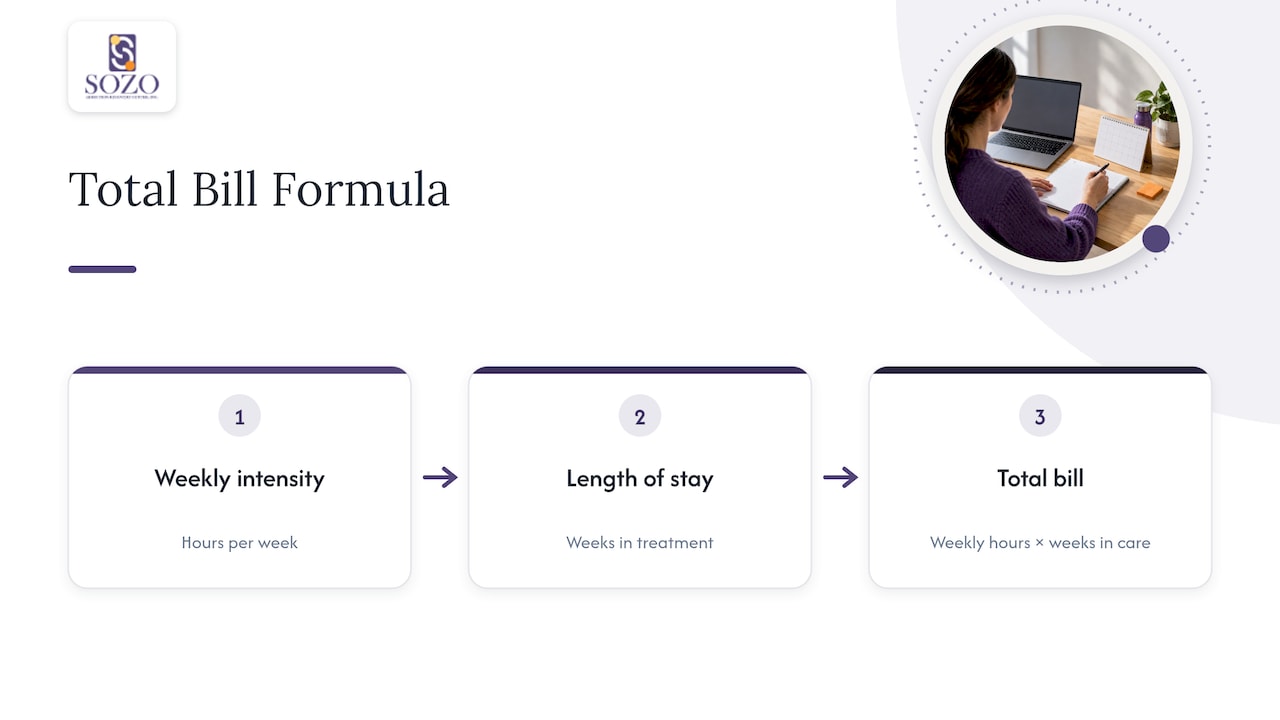
The total is roughly the weekly intensity multiplied by the length of stay. A program that meets for nine hours a week and one that meets for far more will not bill the same, and a man who stays through the full median course of about 81 days will see a larger total than one who steps down after a few weeks. Length of stay is clinical, not a pricing choice. It follows how a man is progressing, which is why a good program reassesses rather than assigning a fixed term on day one.
What is bundled into the bill
Some programs fold group therapy, individual sessions, family sessions, case management, and drug screening into one bill. Others bill them separately. NIAAA’s guidance for people choosing alcohol treatment says providers should explain which services are covered by insurance or billed separately, along with typical course costs, duration, and payment options. That is your checklist, and it applies to drug treatment as well.
Clinical complexity
A man who also lives with depression, anxiety, or trauma needs clinicians trained in both substance use and mental health. Dual diagnosis care involves more specialized staff time, and programs that provide it reflect that in how they structure and bill their services. At SOZO, dual diagnosis and personalized care are part of treatment planning, so we assess both sides from the start instead of adding them later.
Setting and amenities
A clinic in a hospital system, a community mental health center, and a small retreat-style program all run on different overhead. Luxury amenities add to a bill. A plain, well-staffed program with strong clinical care does not need them.
Where you live while you attend
IOP covers treatment, not housing. If a man needs a stable, alcohol-free and drug-free home while he attends, sober living is a separate line. Our comparison of sober living and residential treatment explains how the two differ and why some men pair sober living with IOP.
Your plan’s design
Two men in the same program can owe different amounts. A deductible that has not been met, a coinsurance percentage, a copay per visit, and whether the program is in your network all change what lands on your statement. The next section covers this.
How Insurance Treats IOP
The short answer is that most plans cover some form of IOP for substance use, but the amount you pay depends on your plan’s terms.
Three pieces of federal policy shape this:
- Essential health benefits. HealthCare.gov states that all Marketplace plans cover mental health and substance use services as essential health benefits. Treatment for substance use disorder is on that list.
- Parity. The Mental Health Parity and Addiction Equity Act, as described by the Michigan Department of Insurance and Financial Services, requires coverage for substance use disorder to be no more restrictive than coverage for medical and surgical care. Deductibles, copayments, coinsurance, and out-of-pocket limits are meant to be comparable.
- Medicare. Medicare Part B covers intensive outpatient program services. After the Part B deductible, you pay coinsurance on the Medicare-approved amount, and the page explains how copayments apply in hospital outpatient settings. For federally qualified health centers and rural health clinics, CMS billing guidance says the benefit includes individual and group therapy, family counseling, diagnostic services, patient training, and certain drugs, and physician certification requires at least nine therapeutic hours per week.
Coverage rules for private plans vary by state and by employer. If you want to understand how plans generally handle outpatient therapy, this explainer on insurance coverage for therapy shows the kinds of questions that decide what a plan pays: network status, authorization, and the documentation a plan expects.
What we accept at SOZO
SOZO is fee-for-service. Men pay privately or through private insurance, and we work with plans that include BlueCross BlueShield, Ambetter, and QualChoice. Whether your specific plan pays for your specific program is something we confirm with you directly, because the answer sits in your policy and not in a general rule.
Why the Number of Weeks Matters More Than the Weekly Rate
Men often ask for a per-day or per-month figure, which is a natural way to compare. But a per-day number hides the variable that most changes the total: how long treatment lasts.
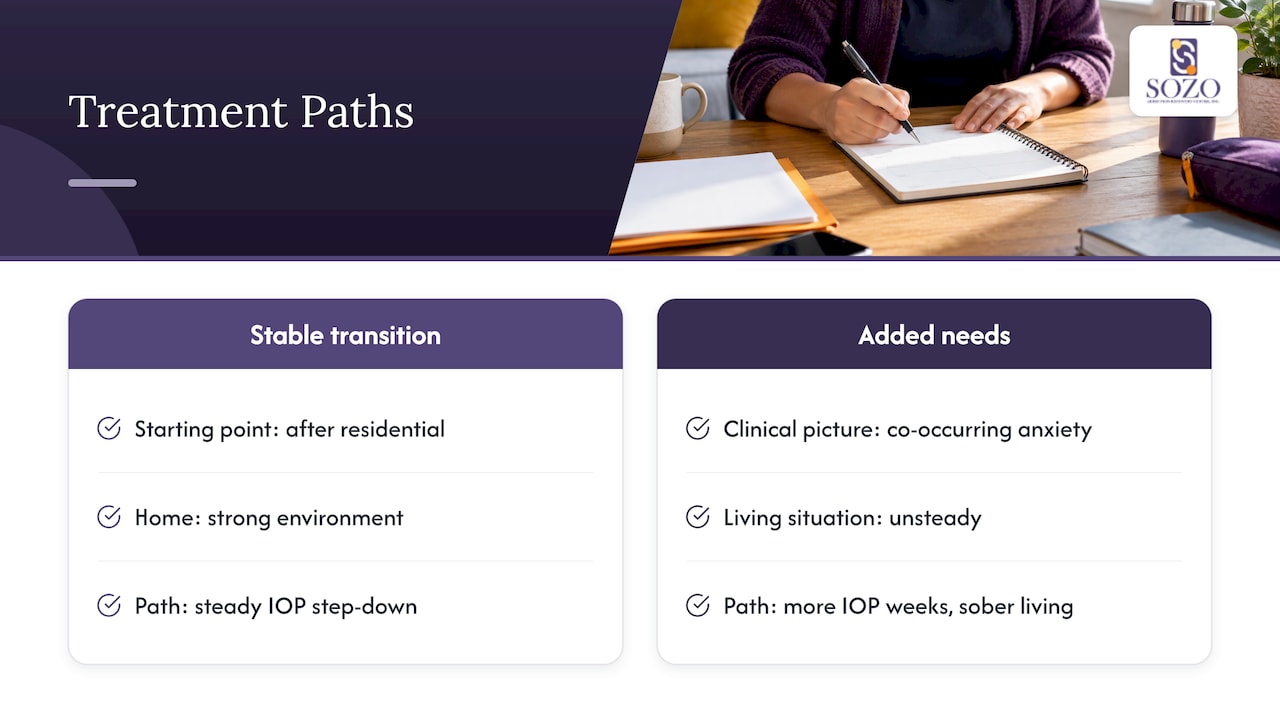
Consider two examples, described in general terms and not as real clients. One man arrives after residential care, stable, with a strong home environment. He may step down through IOP and then into standard outpatient at a steady pace. Another man arrives with a co-occurring anxiety disorder and an unsteady living situation. He may need more weeks in IOP, with sober living alongside. Neither is spending more because of a pricing choice. Each is following what his clinical picture calls for.
This is why programs that use the ASAM Continuum of care place men by need, not by habit. Our guide to ASAM levels of care shows how placement works, and why moving between levels is a normal part of recovery.
SAMHSA’s clinical guidance states that for clients appropriately placed in IOP, outcomes are comparable to inpatient treatment at nearly half the cost. The key words are “appropriately placed.” A careful assessment is the first step toward a sound financial decision as well as a clinical one.
IOP Compared With the Levels Around It
The table shows how the levels differ in what they ask of a man’s week. It compares structure, not dollar amounts, because totals depend on the factors above.
| Level | Typical structure | Where a man lives | Billing tends to reflect |
|---|---|---|---|
| Residential | Full-day structure, around the clock support | On site | Housing, meals, 24-hour staffing, clinical care |
| Partial hospitalization | Several hours a day, most days of the week | Home or sober living | Clinical hours at the highest outpatient intensity |
| Intensive outpatient | Several sessions a week, often at least nine hours | Home or sober living | Weekly clinical hours and length of stay |
| Outpatient | One or two sessions a week | Home | Fewer clinical hours over a longer period |
The partial hospitalization program sits one step above IOP in intensity, and our IOP versus outpatient comparison explains the step below it. Moving down the table usually means fewer clinical hours per week, but a man may stay at each level for months.
Questions to Ask Before You Enroll
A clear estimate is a reasonable thing to request. Use these questions with any program, ours included.
- How many hours per week does the program run, and what is the usual length of stay?
- Which services are in the base bill, and which are billed separately, such as drug screens, individual sessions, or family sessions?
- Are you in network with my plan, and will you verify my benefits before I start?
- Does my plan require prior authorization, and who handles it?
- What is my deductible status, and how will coinsurance or copays apply to each visit?
- If my plan has an out-of-pocket maximum, how close am I to it this year?
- What payment options exist if part of the bill falls to me?
- Will I get a written estimate, and how will changes in my treatment plan affect it?
These track what NIAAA says a provider should explain. A program confident in its billing practices will answer them plainly.
Paying When Insurance Does Not Cover All of It
Some men have high deductibles, plans that exclude certain levels of care, or no insurance. That does not close the door.
- Ask about private pay arrangements. Programs that accept private pay can often explain how payment is scheduled.
- Check your plan’s out-of-pocket limit. Once met, many plans pay more of covered care for the rest of the plan year.
- Use health savings accounts where you have them. Many men can use pre-tax funds toward qualified medical expenses. Confirm with your plan administrator.
- Ask about community options. Community mental health centers may adjust what they charge by income, and some states offer treatment funding. Your state health department can point you to local options.
- Talk with family. Many men are supported by a parent, spouse, or church, and a direct conversation about the plan often makes that support easier to give.
We would rather you ask than put treatment off because of a worry about the bill. Call our admissions team and tell us your situation.
Our Perspective: Choosing Care for the Whole Man
We have sat with many men and their families at the point where the question of cost comes up. It usually arrives right after the question of whether treatment will work. Both deserve honest answers.
Our view is that the best financial decision is the right level of care at the start. A man placed too low can lose months. A man placed well, and moved through levels as he grows, tends to spend his time and resources on treatment that fits. That is why we build personalized plans around the ASAM Continuum and reassess as he progresses.
We also believe a bill should never be a surprise. We explain what a program includes, we verify benefits with you, and we talk through what falls to you before you sign. Our intensive outpatient program is built for men who need real structure while they keep up with work, family, and faith. Our approach brings biblical principles, the 12-step model, and clinical care for co-occurring mental health conditions into one plan, in a small and peaceful setting in Hot Springs, Arkansas.
Recovery asks a lot of a man. We want the financial side to be one less thing he carries alone.
Ty
Intensive Outpatient Care at SOZO
SOZO Recovery Center offers a faith-based men’s addiction treatment program in Hot Springs, Arkansas. Our intensive outpatient program combines clinical care with spiritual guidance and the 12-step model, and it connects with our other levels: residential, partial hospitalization, outpatient, sober living, dual diagnosis care, and medical detox placement referrals.
If you want to see how our program is set up for working men, read about men’s intensive outpatient treatment in Arkansas. When you are ready to talk about your plan and your options, contact SOZO Recovery Center and our team will explain what to expect.
FAQ
How much does an IOP cost?
It depends on weekly hours, length of stay, what is bundled, the setting, and your plan. Published averages blend very different programs, so they rarely match your situation. Ask a program for a written estimate based on your benefits.
Will my insurance cover an IOP?
Most plans cover some substance use treatment, and HealthCare.gov states that Marketplace plans must include it as an essential health benefit. What you owe depends on your deductible, coinsurance or copay, and network status. Have the program verify your benefits before you start.
How long does a typical IOP last?
SAMHSA reports a median stay of 81 days for adults who complete IOP treatment. Some men stay shorter or longer depending on progress, and many step down to outpatient care afterward. Duration is one of the biggest drivers of the total.
How is IOP billed?
Programs generally bill by session or by day of treatment, either as one bundled amount or with some services billed separately. NIAAA advises asking which services are billed separately and what payment options exist. Ask for the structure in writing.
Does Medicare cover intensive outpatient treatment?
Yes. Medicare Part B covers intensive outpatient program services, and after the deductible you pay coinsurance on the Medicare-approved amount. Your Medicare plan details and the provider’s setting determine the exact amount.
Sources
- Clinical Issues in Intensive Outpatient Treatment for Substance Use Disorders, SAMHSA
- Substance Abuse: Clinical Issues in Intensive Outpatient Treatment, TIP 47, SAMHSA
- Mental health and substance abuse coverage, HealthCare.gov
- Mental Health Parity and Addiction Equity Act of 2008, Michigan DIFS
- Intensive Outpatient Program Services, Medicare.gov
- MM13264 Billing Requirements for Intensive Outpatient Program Services, CMS
- What About Costs and Insurance, NIAAA Alcohol Treatment Navigator