


A partial hospitalization program (PHP) is day treatment for addiction: a man spends most of the day in structured clinical care, then goes home or to a sober living residence at night. What a PHP costs depends on four things: how many days he attends, what the program includes, whether he has a co-occurring mental health condition, and what his health plan pays after deductibles, copayments and coinsurance. Programs do not all bill the same way, so any number you read online is a rough guide at best. The reliable figure comes from the program and the insurer, in writing, before treatment starts.
This guide explains what drives the total, how to read your benefits, and which questions to ask so a man can start care with a clear picture. We do not list dollar amounts here, because an honest estimate has to be built around one man’s plan and one man’s needs.
TL;DR
- A PHP is the most intensive step of day treatment. Medicare, for example, expects at least 20 hours of therapeutic services per week for partial hospitalization.
- The total comes from daily program charges multiplied by the number of treatment days, then reduced by what insurance pays.
- What a man owes personally depends on his deductible, copayments, coinsurance and whether the program is in his network.
- Co-occurring mental health care, medical needs and housing can change the plan and the total.
- Ask for a written benefits check from the program and a call to the insurer before the first day.
Table of Contents
- What a partial hospitalization program is
- What makes up the total
- How insurance changes what a man pays
- How long a PHP lasts and why it matters for the total
- Comparing PHP with other levels of care
- Questions to ask before treatment starts
- Where families can help
- Our perspective
- Getting a clear estimate from SOZO
- FAQ
- Sources
What a partial hospitalization program is
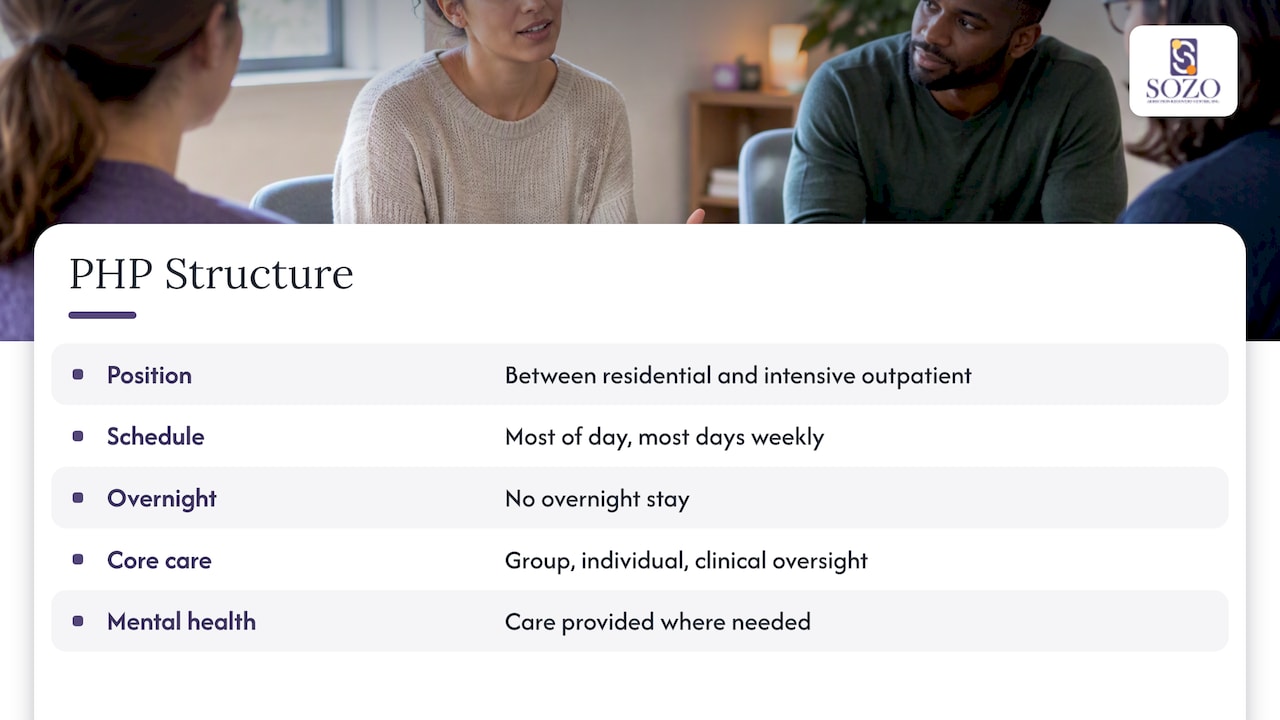
PHP sits between residential treatment and intensive outpatient care. A man attends treatment for most of the day on most days of the week. He receives group therapy, individual counseling, clinical oversight and, where needed, mental health care. He does not stay overnight in the treatment setting.
In the ASAM Continuum model that guides our personalized treatment plans, this is a step-down from 24-hour care and a step-up from a few sessions a week. For a man who has finished residential treatment, PHP keeps the structure while giving him back his evenings. For a man who needs more than weekly counseling but has a stable place to sleep, it can be where care begins. You can read how our day program works in our PHP explainer or on the Partial Hospitalization program page.
What makes up the total
Search results for this topic show wide ranges, and that is not an accident. Out-of-pocket amounts vary because program charges and insurance benefits differ from one plan and one provider to the next. Four building blocks decide the number.
The daily or weekly program charge
Most programs set a rate per treatment day or per week. That rate reflects the hours of clinical care, the staff on site, the size of the groups and what is bundled in. Some programs include meals, transportation or case management in the charge. Others bill those separately. When you compare two programs, compare what each rate includes, not only the rate.
The number of treatment days
Duration is the biggest multiplier. A man who attends five days a week for several weeks will have a different total from one who steps down to fewer days after a short stay. Length of stay is set by clinical need, not by a template. The ASAM criteria look at withdrawal risk, medical and mental health conditions, readiness to change, relapse risk and the home environment. As those needs ease, the plan changes, and so does the total.
Services outside the daily charge
Some items are often billed apart from the program charge:
- Lab work and drug screens
- Psychiatric evaluation and medication management
- Medical detox, which usually takes place before PHP in a medical setting
- Housing, such as sober living, if the man does not live nearby
Asking whether these are included keeps surprises off the final statement. At SOZO, medical detox is arranged through placement referrals, and sober living is a separate program that can pair with day treatment.
Co-occurring mental health care
Many men who struggle with alcohol or drugs also live with depression, anxiety, trauma or another condition. Treating both together is called dual diagnosis care, and it can mean more psychiatric time and a more detailed plan. It often also keeps a man from cycling back through treatment, because the condition that fed the drinking or drug use is being addressed too. Our dual diagnosis and personalized care page explains how we build those plans.
How insurance changes what a man pays
Insurance is the second half of the equation. The program charge sets the starting point, and the plan decides how much of it moves to the man.
Terms that decide the out-of-pocket amount
| Term | What it means for a PHP stay |
|---|---|
| Deductible | The amount a man pays before the plan starts paying its share |
| Copayment | A set amount per visit or per day of care |
| Coinsurance | A percentage of the allowed charge a man pays after the deductible |
| Out-of-pocket maximum | The yearly limit on what a man pays for covered care |
| Network status | In-network programs usually mean lower personal costs than out-of-network |
| Prior authorization | Approval the plan may require before PHP begins |
Two men can attend the same program for the same number of days and owe very different amounts because of these terms. A man who has already met his deductible this year, for instance, may pay far less than one starting treatment in January.
Medical necessity and hours
Plans usually approve PHP when a clinician documents that a man needs it. Medicare, as one public benchmark, requires at least 20 hours of therapeutic services per week for partial hospitalization. Private plans write their own rules, but a similar level of weekly intensity is a common reference point. This is why a thorough assessment at admission matters: the clinical record is what supports the authorization.
Plans we work with
Our model is fee-for-service, paid by private pay or private insurance. We work with plans including BlueCross BlueShield, Ambetter and QualChoice. Acceptance does not mean every plan pays the same, so the benefits check below is what tells a man where he stands. Our admissions team can verify benefits with you through the admissions process.
Paying without insurance
A man without a plan still has options. National survey data from SAMHSA found that most treatment facilities accept self-payment, and a majority use sliding-fee scales, though that report reflects 2012 survey data and arrangements differ by program. In Arkansas, public programs can also be a path. We explain the steps in our guide to starting rehab through DHS without insurance.
How long a PHP lasts and why it matters for the total
There is no single length. A man might spend a few weeks in PHP and then step down to intensive outpatient care, where he attends fewer hours but keeps his weekly rhythm. Others stay longer because of a co-occurring condition, a difficult home setting or a history of relapse.
Think of the total as a staircase. Each step down, from residential to PHP, from PHP to intensive outpatient, then to outpatient care, usually brings fewer weekly hours and a different charge structure. Planning the whole staircase at admission, rather than one step at a time, gives a man and his family a more honest picture of the road ahead. It also keeps the gains of early treatment from being lost in a gap between levels.
Comparing PHP with other levels of care
Cost questions often come down to which level fits. A higher level is not always better, and a lower one is not always a saving. The right level is the one that matches a man’s needs today.
| Level | Typical structure | Where a man sleeps | Often fits |
|---|---|---|---|
| Residential | Round-the-clock care | At the facility | Early recovery, unstable home, higher withdrawal or relapse risk |
| Partial hospitalization | Most of the day, most days | Home or sober living | Step-down from residential, or a need for daily clinical care |
| Intensive outpatient | Several sessions a week | Home or sober living | A man managing work and family while in treatment |
| Outpatient | Fewer weekly sessions | Home | Ongoing support after higher levels |
If you are weighing day treatment against a live-in stay, our pages on residential treatment and sober living versus residential treatment walk through the differences. For men who need housing while attending day programming, sober living is part of what we offer.
Questions to ask before treatment starts
A clear estimate comes from the right questions, asked of both the program and the insurer.
Ask the program
- What is the charge per treatment day or week, and what does it include?
- What is billed separately, such as labs, psychiatric visits or medications?
- How many days does the clinical team expect, and how is that reviewed?
- Is the program in network with my plan?
- Do you handle prior authorization and benefits verification?
- What does the step-down plan look like, and how do charges change at each level?
- If I have a co-occurring condition, is that care part of the program?
Ask the insurer
- Does my plan cover partial hospitalization for substance use disorder?
- What is my deductible, and how much of it have I met this year?
- What are my copayment and coinsurance for this level of care?
- What is my out-of-pocket maximum, and how much have I used?
- Is prior authorization required, and what does the plan need from the clinician?
- Are there limits on the number of days or visits?
Write down the date, the name of the representative and the reference number for each call. Ask for the answers in writing when you can. Our guide on verifying rehab benefits in Arkansas and reducing out-of-pocket spending gives a four-step process for this.
Where families can help
Often a wife, parent or sibling makes the first calls. That is a real act of love, and it also helps to know a man must be willing to take part in treatment. Families can gather insurance cards, note policy numbers, and list any mental health diagnoses or medications. If the man is not yet ready, our action plan for getting a man into rehab in Arkansas offers a patient way to begin the conversation.
Our perspective
We have sat with many men and their families at the kitchen-table stage of this decision, when the question is not only what treatment is, but what it will ask of them.
Our view is that a man should not have to choose between clinical care and his faith. At SOZO, personalized plans informed by the ASAM Continuum are built together with the 12-step model and biblical principles, and dual diagnosis care sits inside the same plan, not beside it. Because we design each plan around one man, we do not publish a single number. A total only means something once we know his level of care, his length of stay and his benefits.
We believe that is the more honest way to talk about cost. A man who understands what drives the total can plan, ask good questions and focus on what matters: getting well. Our small, peaceful, retreat-like setting in Hot Springs is built for that kind of focus, and our team walks families through benefits so they are not left to decode them alone.
Ty
Getting a clear estimate from SOZO
If you are considering day treatment for a man in your life, or for yourself, we can help you see the full picture. Our admissions team reviews his needs, checks his benefits and explains how a PHP could fit with residential care, intensive outpatient, medical detox placement referrals and sober living. We will tell you what is included and what is billed separately, so there are no surprises.
Learn more on our Partial Hospitalization page, or reach out through SOZO Recovery Center to begin a confidential conversation.
FAQ
How much does a partial hospitalization program cost?
It varies with the program’s daily charge, the number of treatment days, the services included and the man’s insurance benefits. Two men in the same program can owe different amounts because of their deductibles, copayments and coinsurance. The most dependable figure comes from a written benefits check by the program and a call to the insurer.
Does insurance cover PHP for addiction treatment?
Many plans cover partial hospitalization when a clinician documents medical necessity, but coverage depends on the individual plan. Some require prior authorization. We work with plans including BlueCross BlueShield, Ambetter and QualChoice, and our admissions team can verify benefits before treatment begins.
How long does a PHP last?
Length depends on clinical need, including withdrawal risk, mental health conditions, home environment and progress. Many men step down to intensive outpatient care after PHP as their needs ease. The treatment team reviews the plan regularly rather than setting a fixed number of days in advance.
What if a man does not have insurance?
He still has options. Self-payment is accepted by most treatment facilities, and some programs use sliding scales. In Arkansas, state resources can also help a man start care. Call our admissions team to talk through what fits his situation.
Is PHP the same as residential treatment?
No. In a PHP a man attends treatment for most of the day and sleeps elsewhere, such as at home or in sober living. Residential treatment provides care around the clock at the facility. A clinical assessment shows which level fits a man today.
Sources
- MLN1986542: Medicare & Mental Health Coverage (CMS)
- The N-SSATS Report: Recovery Services Provided by Substance Abuse Treatment Facilities (SAMHSA)