


Thinking errors in addiction are automatic, distorted thoughts that make using sound reasonable and recovery sound pointless. Clinicians also call them cognitive distortions, and 12-step rooms call them “stinking thinking.” A man can learn to notice them, question them and replace them with honest thoughts. That skill is a core part of cognitive-behavioral therapy (CBT), and it is something we teach and practice alongside spiritual guidance and clinical care.
This guide explains what these errors are, shows what each one sounds like, and walks through a practical method for challenging them. It also covers when a thought pattern is a sign that a man needs more support than he can give himself.
TL;DR
- Thinking errors are habitual, distorted thoughts such as rationalizing, minimizing, catastrophizing and all-or-nothing thinking that keep a man stuck in use or push him toward relapse.
- “Stinking thinking” is the recovery-room name for the same thing. Words like “always” and “never” are a common tell.
- The method is simple: catch the thought, write it down, question it, then write a more honest replacement.
- A single lapse is information, not a verdict. Treating it as a total collapse is itself a thinking error.
- If harmful thoughts, cravings or use are disrupting work, family or health for two weeks or more, it is time to talk with a professional.
Table of Contents
- What thinking errors in addiction are
- Common thinking errors and what they sound like
- How thinking errors drive relapse
- What “stinking thinking” means in recovery
- A four-step way to challenge a thinking error
- Our perspective: faith, clinical care and the thinking behind the steps
- When thoughts and cravings call for professional support
- Choosing the right level of care
- Support at SOZO Recovery Center
- FAQ
- Sources
What thinking errors in addiction are
A thinking error is a thought that feels true in the moment but bends the facts. It usually shows up automatically, with no effort, which is why it is so convincing. A man does not decide to think “one drink won’t hurt.” The thought simply arrives, often at the exact moment he is tired, stressed or lonely.
The research behind this goes back decades. Aaron Beck, who developed cognitive theory in the 1960s, found that the thinking of patients who misused substances tended to underestimate the risks of using and to include permission-giving thoughts, as described in the Wiley reference work on cognitive therapy. Those two patterns, shrinking the risk and granting permission, still sit at the center of most lists of thinking errors.
A peer-reviewed review of CBT for substance use disorders, published in PubMed Central by McHugh, Hearon and Otto, names specific distortions in this population, including rationalizing use and giving up. It also notes that CBT targets them through cognitive restructuring and psychoeducation. In plain terms: a man learns what the distortions are, then practices testing them against reality.
Two points are worth holding onto.
- Having these thoughts is not a moral flaw. They are common in early recovery and often survive well past detox. A 2026 dissertation from PCOM suggests, in its results and literature review, that distorted cognitions may persist despite treatment or length of abstinence. That is a reason to build a lasting habit of checking thoughts, not a reason for discouragement.
- Some automatic thoughts are partly true. The skill is not forcing positive thinking. It is sorting what is accurate from what is exaggerated.
Common thinking errors and what they sound like
The lists you find online vary from five errors to a dozen or more. The labels differ, but the patterns overlap. Here are the ones we see most often in men entering recovery, with the kind of inner voice that goes with each.
| Thinking error | What it does | What it can sound like |
|---|---|---|
| Rationalizing | Builds a reason that makes use sound fair | “I had a brutal week. I earned this.” |
| Permission-giving | Grants an exception just this once | “One drink won’t change anything.” |
| Minimizing | Shrinks the size of the problem | “Everybody drinks like this. It isn’t that serious.” |
| Catastrophizing sobriety | Predicts a bleak, empty life without the substance | “Life without it will be dull and lonely.” |
| All-or-nothing thinking | Sees only total success or total collapse | “I slipped once, so the whole thing is ruined.” |
| Overgeneralizing | Turns one event into a permanent rule | “I never get anything right. I always blow it.” |
| Giving up | Treats effort as pointless | “Why even try?” |
| “Should” statements | Piles on rigid demands and guilt | “I should be over this by now.” |
Rationalizing and permission-giving
These are the classic pair. The McHugh review cited above lists thoughts such as using once, one drink doing no harm, and deserving to use after a bad day as examples of rationalizing use. Notice the structure: a real feeling (exhaustion, frustration) gets attached to a conclusion it does not support. The day was hard is true. Therefore I deserve to use is the leap.
Minimizing
Minimizing sounds reasonable because it borrows from what is normal around a man: coworkers, friends, a culture that jokes about drinking. Simply Psychology’s CBT and addiction guide lists minimization among the thought patterns that maintain use, next to permission-giving thoughts and catastrophizing sobriety. Minimizing is also close kin to denial. If you recognize it in yourself, our piece on overcoming addiction denial goes deeper.
Catastrophizing sobriety
This one runs in the opposite direction. Instead of shrinking the problem, it inflates the cost of recovery. A man imagines never relaxing, never celebrating, never being fun again. The same guide names this pattern, and the fix is rarely an argument. It is evidence: sober weeks, sober moments that went fine, and the real people who live full lives in recovery.
All-or-nothing and overgeneralizing
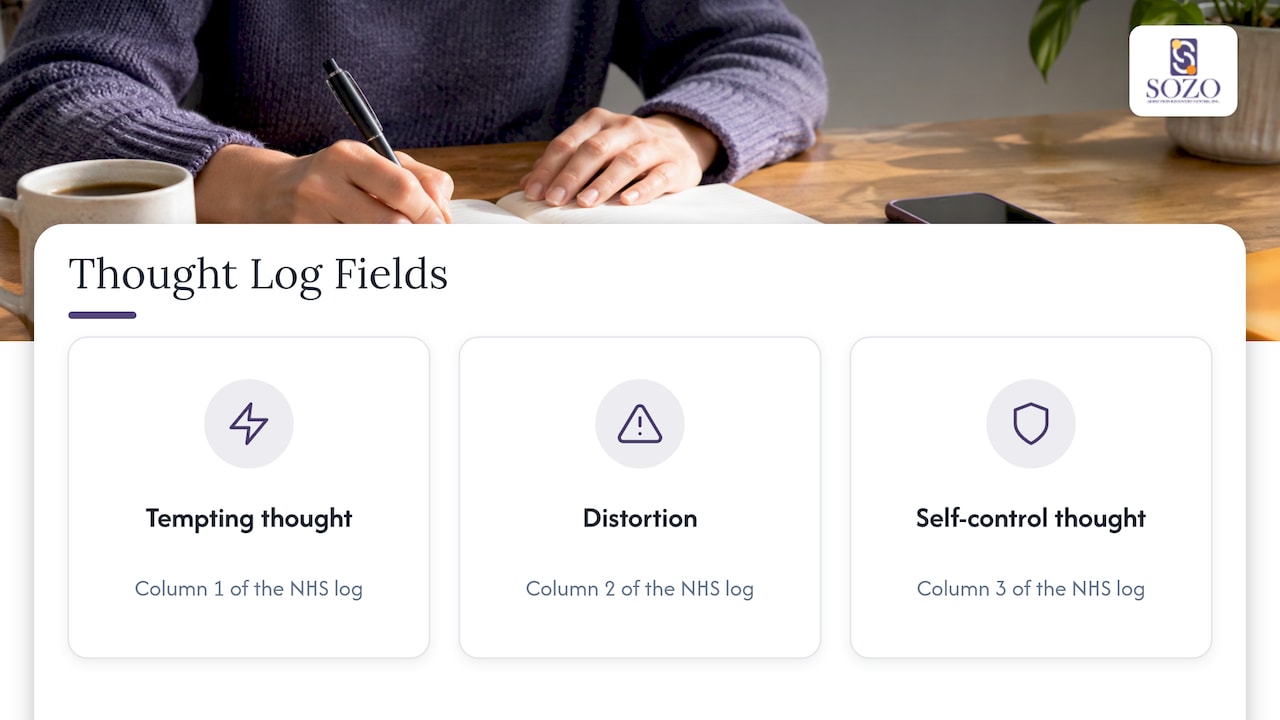
Both turn gray into black and white. David Burns’ list of distortions, reproduced on an NHS habit and addiction log, is a handy reference, and the log itself gives you columns to record the tempting thought, the distortion and a self-control thought. We will come back to that format below.
“Should” statements
Should-thinking looks like discipline but works like a weight. Sam Louie, a licensed counselor, notes in Psychology Today that people in early recovery often lean on thinking errors, and that therapists challenge “should” and “shouldn’t” by guiding clients toward taking more responsibility. There is a relapse link too. Marlatt’s work, summarized in the Simply Psychology guide, holds that risk rises when a life has too many obligations and too few pleasures, when “I should” overwhelms “I want.” A recovery plan that is all duty and no restoration invites exactly that imbalance.
How thinking errors drive relapse
The thoughts are not just background noise. They sit between a trigger and a decision. A trigger, such as a stressful phone call, a certain street or an old friend, does not automatically lead to use. The SAMHSA Counselor’s Treatment Manual makes this point directly: by stopping thoughts about using, a client can choose not to use. The thought is the link in the chain a man can actually grab.
If you want to map your own triggers, start with common addiction triggers and how men manage them, then pair it with a plan for stopping a craving in minutes.
The lapse that becomes a collapse
The most dangerous thinking error shows up right after a slip. Marlatt called it the Abstinence Violation Effect. A man has one drink and the thought arrives: I have blown it completely, so I might as well keep going. The Simply Psychology summary of Marlatt’s model explains that CBT reframes a lapse as a single event that carries useful information rather than a total loss. The PCOM dissertation’s literature review likewise associates catastrophic beliefs about a lapse, guilt and shame with relapse.
What this means practically: the first hour after a lapse matters more than the lapse. A man who calls his sponsor, a counselor or a program the same day has interrupted the spiral. A man who sits alone with “it’s all over” is feeding it. For the broader picture, see our guide to relapse warning signs.
A surprising wrinkle
Not every risk is a bad thought. A 2022 study by Jakubiec and colleagues in PubMed Central found that among patients with substance use disorders, stronger verbal fluency and resistance to interference were linked to a greater tendency to use when craving. Sharp, articulate minds can build very persuasive arguments for using. That is one more reason to write thoughts down and test them outside your own head, with other people.
What “stinking thinking” means in recovery
In 12-step circles, “stinking thinking” is the everyday phrase for negative, distorted self-talk. Psychologist Patrick McElwaine describes it in a June 2025 Psychology Today article as negative rumination heard in recovery rooms, and ties it to cognitive errors such as overgeneralization. He points to the words “always” and “never” as common markers, and says such thoughts feed hopelessness and shame. He also describes a tool called RAP, which restructures a negative thought into one that is realistic, adaptive and positive.
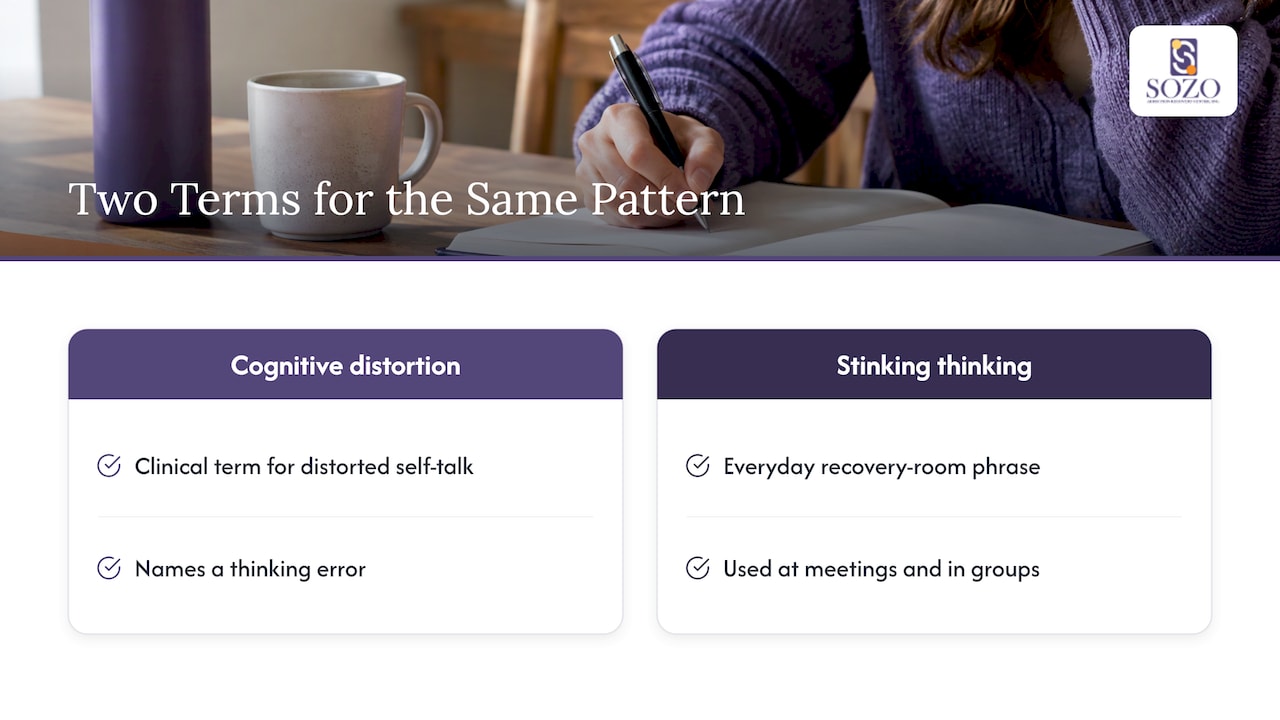
The two vocabularies describe the same thing. Cognitive distortion is the clinical term. Stinking thinking is the one men actually use at a meeting or in a group. A man does not need to pick one. He needs a way to hear the thought and name it.
A quick test: listen for absolute words. “Always,” “never,” “everyone,” “nobody,” “completely,” “ruined.” Real life rarely deals in absolutes, so when one shows up, slow down.
A four-step way to challenge a thinking error
The most useful tools are simple and written down. SMART Recovery’s Dispute Unhelpful Beliefs worksheet uses three steps: write the unhelpful belief, ask a question that challenges it, then write a more helpful belief that is honest rather than overly positive and supports your long-term goals. Its sample challenge questions include whether the belief is always true, whether you would say it to a friend, and what another way of looking at it might be.
Here is that approach as four steps a man can use today.
- Catch it. Notice the mood shift or craving, then ask: what was I just telling myself?
- Name it. Write the exact thought in one sentence. Then label the pattern: rationalizing, minimizing, all-or-nothing, a “should.”
- Question it. Ask the three questions above. Add one more: what would I tell a younger man in my group who said this?
- Replace it. Write a thought that is accurate and that you could say with a straight face. Not “everything is great.” Something like “Today was hard, and I have handled hard days sober before.”
A worked example
Say a man has been sober for 40 days and has a rough week at work.
- Thought: “I have earned a drink. One won’t matter.”
- Pattern: Rationalizing and permission-giving.
- Question: Has one ever stayed one? What happened the last time I told myself that? What do I actually need right now: relief, rest, or someone to talk to?
- Replacement: “I am worn out, and I need rest and a call to my sponsor. A drink would add a problem, not solve one.”
The replacement is not magic. It is a better-informed thought, and it points to an action: pick up the phone, go to a meeting, eat, sleep.
Keep a thought log
The NHS log mentioned earlier is a simple template: one column for the tempting thought, one for the distortion, one for a self-control thought. A notebook works. So does a notes app. Review it weekly with a counselor or sponsor. Patterns appear quickly, and most men find they have three or four favorite errors that repeat.
Pair it with a prevention plan
A thought log is strongest when it feeds a written plan. Our guide to creating a relapse prevention plan shows how to put triggers, warning thoughts and first responses on one page, so the decision is already made before a hard moment arrives.
Our perspective: faith, clinical care and the thinking behind the steps
We have watched men arrive believing that their thoughts were simply who they were. Part of our work is helping a man see that a thought is something he has, not something he is.
At SOZO we combine clinical care with spiritual guidance, and we do not treat them as rivals. Cognitive tools teach a man to catch and test a distorted thought. The 12 steps and biblical principles give him something to build on once the thought is cleared: humility in place of self-justification, honesty in place of minimizing, service in place of isolation. Our approach is designed to treat the whole man, and our dual diagnosis care addresses anxiety, depression and other mental health conditions that often make distortions louder.
We also believe the steps were never the destination. They are the training. A man who practices naming a thought, bringing it into the light with a counselor or brother in recovery, and choosing a truer one is practicing the same habit the steps ask for every day.
Our programs are built on personalized plans informed by the ASAM Continuum, so a man gets the level of support that fits his situation, in a small and peaceful setting in Hot Springs, Arkansas.
Ty
When thoughts and cravings call for professional support
Self-help tools are valuable, and they have limits. Some situations call for a clinician, a treatment program or both.
SAMHSA says it may be time to ask for help when you have had two or more weeks of changes in thoughts, mood or body that make it hard to manage work, school, home or relationships. Signs include thoughts focused only on getting and using alcohol or drugs, needing to use more often to avoid feeling sick, and consequences from behavior due to substance use.
The National Institute of Mental Health lists similar guidance for mood: severe symptoms lasting two weeks or more, such as feeling hopeless, worthless or guilty, losing interest in things you usually enjoy, or struggling to concentrate or make simple decisions. If you are having thoughts of suicide or urges to hurt yourself, call or text 988 right away, or call 911 if you are in immediate danger.
Harvard Health adds that unwanted thoughts are worth taking to a mental health professional when they begin to disrupt daily life, and notes that CBT is often successful in helping people manage intrusive thoughts.
A few practical signals that a man should reach out sooner rather than later:
- He is stopping and restarting use despite promises to himself.
- He is using a substance to cope with anxiety, low mood or trauma.
- Withdrawal is a possibility. Stopping some substances, alcohol in particular, can be medically risky, so a detox decision belongs with a medical professional.
- Family members are noticing and worried.
Families reading this for a son, husband or brother: the same tools apply. A calm conversation that names a pattern (“I noticed you said you always mess things up”) tends to work better than an argument about whether the drinking is serious.
Choosing the right level of care
The right level depends on how much structure a man needs, how stable his home is, and whether mental health conditions are in the mix. A few ways our programs line up:
- Medical detox placement: when withdrawal needs medical oversight, we help with placement for medical detox before treatment begins.
- Residential: round-the-clock structure away from daily triggers. Learn more about what residential treatment involves.
- Partial hospitalization and intensive outpatient: several days of treatment each week with a return home in the evening. See how day treatment works and what intensive outpatient includes.
- Outpatient and sober living: ongoing support while a man works, rebuilds relationships and practices new thinking habits in a sober home. Our overview of sober living versus residential treatment can help you compare.
What shapes the total cost of care is the level of care, the length of stay and the individual treatment plan, and we are glad to walk a man or his family through it. Private pay and private insurance, including BlueCross BlueShield, Ambetter and QualChoice, are the ways our services are paid for.
Support at SOZO Recovery Center
If you recognize your own thinking in this article, you do not have to sort it out alone. SOZO Recovery Center in Hot Springs, Arkansas, offers faith-based treatment for men that blends biblical principles with the 12-step model and clinical dual diagnosis care. Each plan is personalized, so a man works on distorted thinking, cravings and any co-occurring mental health concerns together.
To talk through options, start with our dual diagnosis and personalized care page, or reach us through the SOZO Recovery Center home page. A conversation costs nothing but a few minutes, and it can be the step that changes how the next week goes.
FAQ
What are thinking errors in addiction?
They are automatic, distorted thoughts that make substance use seem reasonable or recovery seem hopeless. Examples include rationalizing (“I earned it”), minimizing (“it’s not that bad”) and all-or-nothing thinking (“one slip ruins everything”). Treatment based on CBT teaches a man to notice these thoughts and test them against facts, as described in the McHugh review.
What are the most common thinking errors?
Lists differ, but the same handful appear again and again: rationalizing, permission-giving, minimizing, catastrophizing, all-or-nothing thinking, overgeneralizing, giving up and “should” statements. Most men have two or three favorites that repeat, and a thought log shows which ones they are.
Is stinking thinking the same as a cognitive distortion?
For practical purposes, yes. Stinking thinking is the plain-language phrase used in 12-step rooms, while cognitive distortion is the clinical label. Psychology Today describes stinking thinking as negative rumination that often includes absolutes such as “always” and “never.”
Do thinking errors go away after treatment?
Not completely, and that is normal. Research suggests distorted cognitions may persist even after treatment or long abstinence. The goal is not to never have the thought. It is to recognize it quickly and respond with a truer one.
When should I get professional help for these thoughts?
If thoughts about using, hopelessness or substance use have been disrupting work, family or health for two weeks or more, talk with a clinician or a treatment program. SAMHSA’s guidance describes the signs. For thoughts of suicide or self-harm, call or text 988 immediately.
Sources
- Cognitive-Behavioral Therapy for Substance Use Disorders (McHugh, Hearon and Otto)
- Cognitive Therapy (Beck), Wiley Online Library
- Habit and Addiction Log, NHS
- CBT for Addiction, Simply Psychology
- Addiction: When Apologies Aren’t Enough, Psychology Today
- Counselor’s Treatment Manual, SAMHSA
- Just a Slip: Cognitive Distortions Associated with Lapse, PCOM
- The Executive Functioning Paradox in Substance Use Disorders, PubMed Central
- Stinking Thinking and What Recovery Has Taught Me, Psychology Today
- Dispute Unhelpful Beliefs, SMART Recovery
- Signs You Need To Seek Help, SAMHSA
- Do I Need Help? National Institute of Mental Health
- Managing Intrusive Thoughts, Harvard Health