


Anxiety disorders and substance use disorders commonly occur together, create a self-reinforcing cycle, and are best treated with coordinated, integrated care. Either condition can come first, so don’t assume you know which caused which. If you or someone you love is in crisis, call or text 988 for support, call 911 for a medical emergency, and never stop heavy alcohol or benzodiazepine use abruptly without medical supervision.
TL;DR:
- Anxiety can develop or worsen faster when it drives substance use, increasing dependence and relapse risk if untreated.
- Differentiating primary anxiety from substance-induced anxiety relies on symptom timing, history, and abstinence duration, typically requiring careful assessment.
- Full evaluation should include trauma, withdrawal risk, social functioning, support systems, and should be conducted by providers experienced in dual diagnosis care.
- Integrated treatment combining behavioral therapies, medication management, and family or peer support yields better outcomes than sequential approaches.
- Men often delay seeking help due to stigma and cultural barriers; peer and family involvement significantly improve engagement and long-term recovery success.
Table of Contents
- Anxiety and Addiction: How Often They Occur Together
- Why Anxiety and Addiction Reinforce Each Other
- Anxiety Symptoms vs. Substance-Induced Anxiety: Telling Them Apart
- What a Full Assessment Covers and When to Get Help Immediately
- Treating Anxiety and Addiction Together: What Actually Works
- Medication Safety When Anxiety and Substance Use Disorder Overlap
- The Levels of Care: From Detox to Long-Term Support
- Why Men Often Delay Getting Help, and What Helps
- Staying Well After Treatment Ends
- A Faith-Based, Clinically Integrated Path for Men
- Start With an Honest Conversation About What You Need
- Sources
- FAQ
Anxiety and Addiction: How Often They Occur Together
Anxiety and addiction overlap often enough that clinicians expect to find one when they’re screening for the other. Generalized anxiety disorder, panic disorder, social anxiety disorder, and phobia-related conditions all show elevated rates among people in substance use treatment, and the reverse holds too: anxiety disorders and substance use disorders commonly co-occur, often complicating diagnosis because the symptoms overlap so closely.
The comorbidity changes the clinical picture in a few specific ways:
- Dependence tends to develop faster when anxiety symptoms drive substance use.
- Relapse risk climbs because untreated anxiety often becomes the trigger for a return to use.
- Suicide risk rises when the two conditions compound each other, especially without treatment.
- Treatment becomes more complex, since standard single-diagnosis protocols frequently miss the interaction between the two.
A key figure clinicians rely on: the National Institute of Mental Health identifies generalized anxiety disorder, panic disorder, and social anxiety disorder as the presentations most frequently seen alongside substance use, which is why intake evaluations increasingly screen for both from day one rather than treating whichever symptom shows up first.
Why Anxiety and Addiction Reinforce Each Other
Three overlapping pathways explain most cases of co-occurring anxiety and addiction, and they are not mutually exclusive. A given man might experience all three at different points in his history.
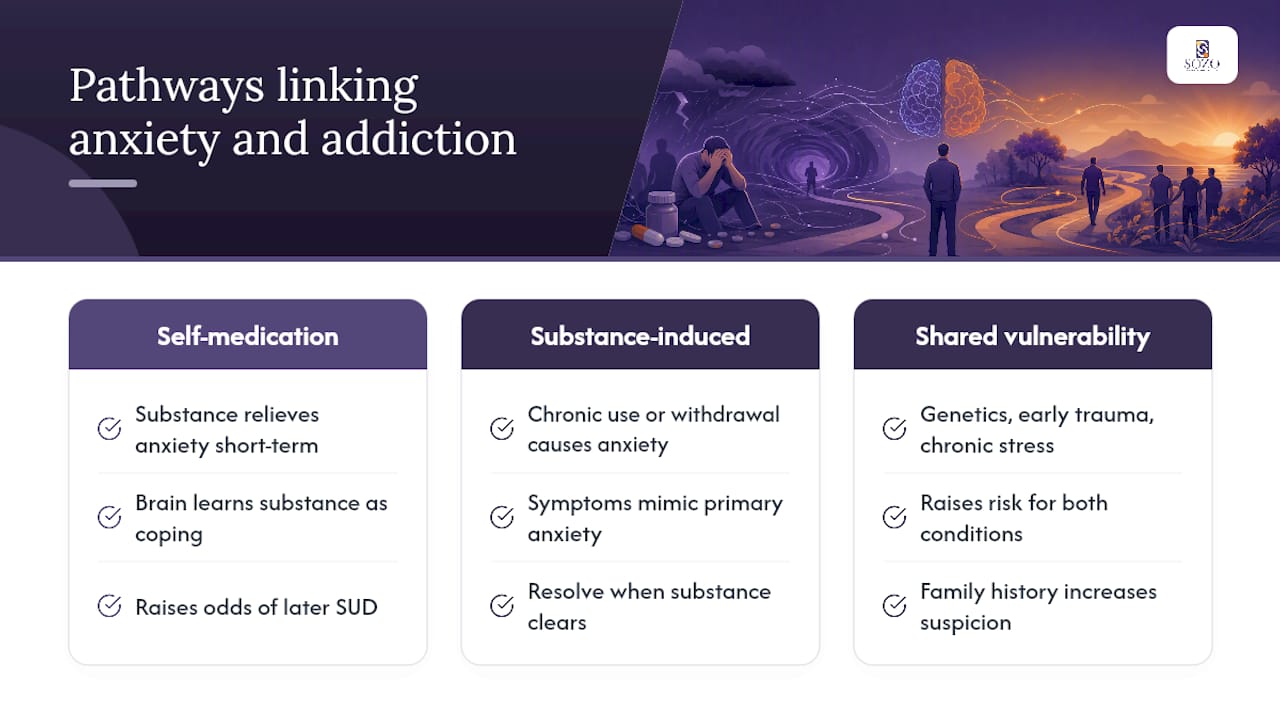
Self-medicating anxiety is the pathway most people recognize instinctively. Alcohol or drugs quiet racing thoughts or physical tension in the short term, so the brain learns to reach for a substance every time anxiety spikes. Longitudinal research backs this up directly: self-medicating anxiety with alcohol or drugs raises the odds of later, persistent substance use disorder, not just occasional heavy use.
Substance-induced anxiety runs the opposite direction. Chronic use, intoxication, or withdrawal from stimulants, alcohol, or cannabis can generate anxiety symptoms that look clinically identical to a primary anxiety disorder but resolve, at least partially, once the substance clears the body.
Shared vulnerability ties both patterns together. Genetics, early trauma, and chronic stress exposure raise the risk for both anxiety and addiction independently, which is why family history of either condition should raise a clinician’s suspicion for both.
The mechanism that keeps the cycle running is straightforward: intoxication brings relief, withdrawal brings a rebound of anxiety and irritability, and that negative state fuels the next craving. Over repeated cycles, the negative affect that follows withdrawal becomes a learned trigger for craving, which is exactly why therapy that teaches new coping skills matters more than willpower alone.
Anxiety Symptoms vs. Substance-Induced Anxiety: Telling Them Apart
Getting the diagnosis right matters because treatment differs depending on whether anxiety is a standalone disorder or a byproduct of substance use. Typical anxiety symptoms include persistent worry, restlessness, muscle tension, difficulty concentrating, sleep disruption, and a sense of dread that isn’t tied to a specific event, according to NIMH’s clinical overview.
Signs that point toward intoxication or withdrawal rather than a primary anxiety disorder include:
- Autonomic symptoms (racing heart, sweating, tremor) that appear within hours of last use
- Anxiety that intensifies and eases in step with use and abstinence, rather than staying constant
- No anxiety history before substance use began
- Symptoms that fade substantially after a sustained period of abstinence
Clues favoring a primary anxiety disorder include symptoms that predated any substance use, a family history of anxiety disorders, and anxiety that persists well beyond the acute withdrawal window. Clinicians generally want to observe symptoms during an extended abstinence period, since differentiating substance-induced anxiety from a primary disorder often depends on timing and behavior during abstinence rather than symptoms alone. Abstinence windows vary by substance, roughly days for short-half-life drugs like alcohol or stimulants and several weeks for longer-acting substances, but these are general guides a clinician adjusts case by case, not fixed rules.
What a Full Assessment Covers and When to Get Help Immediately
A thorough evaluation for co-occurring anxiety and substance use goes well beyond a quick symptom checklist. It should include:
- A complete substance and medication timeline, including prescriptions, over-the-counter products, supplements, and nicotine use, since this history directly shapes withdrawal-safety planning.
- Withdrawal risk screening, particularly for alcohol and benzodiazepines, which carry the most dangerous withdrawal profiles.
- Trauma history, since undiagnosed PTSD frequently underlies both anxiety and substance use.
- Suicidality screening, done directly and without euphemism.
- Functional assessment covering work, relationships, and daily responsibilities.
- Review of existing supports, including family, peer groups, and prior treatment attempts.
Look for providers experienced specifically in dual diagnosis care rather than generalists, since validated screening tools and treatment planning differ meaningfully when two conditions are in play at once.
Some situations require immediate action rather than a scheduled evaluation. Call or text 988 or call 911 for overdose, severe withdrawal symptoms like seizures or hallucinations, chest pain, an inability to stay safe, or any suicidal thoughts. Waiting for a scheduled appointment in any of these situations is not safe.
Treating Anxiety and Addiction Together: What Actually Works
Treating anxiety and addiction as separate problems, one after the other, tends to underperform compared to treating them at the same time. SAMHSA recommends integrated treatment that coordinates providers, combines behavioral therapy with medication when appropriate, and adjusts pacing to the person’s readiness rather than a fixed protocol. Programs built this way consistently outperform sequential models, where a man finishes detox, waits, then starts anxiety treatment separately.
Several specific therapies carry solid evidence for this combination:
- Cognitive behavioral therapy (CBT) targets the distorted thinking patterns that drive both anxiety and cravings.
- Motivational interviewing helps build internal motivation for change rather than relying on external pressure.
- Contingency management reinforces sobriety milestones with tangible rewards, which research consistently shows improves retention.
- Trauma-focused therapies, including Prolonged Exposure, Cognitive Processing Therapy, and EMDR, address underlying PTSD when it’s present. Patients can often begin trauma-focused work before achieving full abstinence, as long as safety planning is in place first.
Family involvement and peer support groups add another layer that individual therapy alone doesn’t cover. A man recovering in isolation, without people who understand both his addiction and his anxiety, faces a much steeper climb.
Pro Tip: If a treatment program offers only individual counseling with no group or family component, ask directly how it addresses the isolation that often accompanies both anxiety and addiction. Isolation is one of the most reliable relapse triggers.
Medication Safety When Anxiety and Substance Use Disorder Overlap
Medication decisions get more complicated once addiction enters the picture, and this is where the wrong choice can do real damage.
SSRIs and SNRIs remain the first-line medication choice for many anxiety disorders, including generalized anxiety disorder and social anxiety disorder. They carry low abuse potential, though patients should expect it to take several weeks before feeling the full benefit.
Benzodiazepines deserve a much harder look in anyone with a substance use history. VA/DoD guidance advises against routine benzodiazepine use for PTSD, citing tolerance, dependence, and dangerous interaction risks, cautions that apply even more forcefully when a substance use disorder is already present. If a benzodiazepine is genuinely necessary, it should come with close monitoring and a defined short-term plan, never an open-ended prescription.
- Buspirone offers an alternative with substantially lower dependence risk than benzodiazepines, making it a reasonable option worth discussing with a prescriber.
- Medication decisions in this population work best as a team effort between addiction medicine and psychiatry, not a single prescriber working in isolation.
Anyone currently on a benzodiazepine who also has a substance use history should discuss a supervised tapering plan with a physician before making any changes.
The Levels of Care: From Detox to Long-Term Support
Treatment for co-occurring anxiety and addiction typically moves through a sequence rather than a single fixed program, and the right entry point depends on how unstable things are right now.
- Medical detox manages acute withdrawal safely, particularly critical for alcohol and benzodiazepines given their seizure risk.
- Residential treatment provides 24/7 structure for men who need round-the-clock support and separation from triggers.
- Partial hospitalization offers intensive daily treatment while allowing the person to return home at night.
- Intensive outpatient (IOP) steps care down further, usually several sessions a week, for people stable enough to manage daily responsibilities.
- Standard outpatient and sober living support the maintenance phase, where the focus shifts from stabilization to sustaining progress.
The right question at each stage isn’t just “is he sober,” but whether he’s functioning, sleeping, working, and managing anxiety without a substance as his backup plan. A full breakdown of program types can help families understand which level fits a given situation.
Why Men Often Delay Getting Help, and What Helps
Men face specific barriers to seeking treatment for co-occurring anxiety and addiction that don’t always get named directly. Stigma around admitting anxiety, combined with cultural expectations that men should handle problems independently, reduces help-seeking significantly even when symptoms are severe.
Peer support from other men who’ve been through similar struggles tends to break through resistance that clinical language alone doesn’t. Family involvement, when handled with care rather than confrontation, also improves engagement substantially.
When evaluating a faith-based program that claims to address dual diagnosis, ask specific questions:
- Does clinical staff use an established framework like ASAM criteria to personalize treatment plans?
- Is spiritual support offered alongside licensed clinical care, not instead of it?
- What happens if a client’s anxiety symptoms turn out to be substance-induced rather than a standalone diagnosis?
Staying Well After Treatment Ends
Recovery from co-occurring anxiety and addiction doesn’t end at discharge. It depends on skills and structure that carry forward into daily life.
- Urge management techniques, like delaying action and identifying triggers, reduce the odds that a craving turns into a relapse.
- Sleep regulation matters more than most people expect, since poor sleep intensifies both anxiety and cravings.
- Medication adherence, when a prescriber has recommended ongoing treatment, should stay consistent rather than tapering off independently.
- Peer groups and sober living environments provide accountability that’s hard to replicate alone.
- Family involvement in ongoing recovery correlates with better long-term outcomes across most studies of this population.
Pro Tip: Track anxiety symptoms and cravings on the same log for the first few months after treatment. Most men discover the two rise and fall together, which makes early intervention on anxiety a direct relapse-prevention tool.
The strongest predictor of long-term success isn’t how severe the addiction was at intake. It’s whether both conditions received coordinated, ongoing attention rather than one being treated as an afterthought.
A Faith-Based, Clinically Integrated Path for Men
Men dealing with both anxiety and addiction need care that treats the two together, not a program that treats sobriety first and hopes anxiety sorts itself out. Sozorecoverycenter builds treatment plans around dual diagnosis care informed by ASAM criteria, pairing licensed clinical treatment with the kind of spiritual support that helps many men stay engaged. Services span medical detox placement, residential care, intensive outpatient, and sober living, each matched to where a man actually is, not where a program assumes he should be. A man ready for an honest evaluation can start with admissions.
Ty
Start With an Honest Conversation About What You Need
Sozorecoverycenter offers something most standard rehab programs don’t: a small, faith-informed setting in Hot Springs, Arkansas, where clinical dual-diagnosis care and biblical principles work side by side instead of competing for attention.
That combination matters most for men whose anxiety and addiction have been feeding each other for years, since a program that only addresses substance use tends to leave the anxiety piece to resolve itself, and it rarely does. Sozorecoverycenter’s residential treatment program builds a personalized plan using ASAM criteria from intake forward, so the clinical picture drives the pace rather than a fixed calendar. For men who need a safe medical withdrawal before anything else, medical detox placement connects them to appropriate care first. Initial intake typically covers insurance verification, which the center handles directly with insurance providers alongside private-pay options. If you’re ready to talk through what treatment could look like for you or a man in your family, start the admissions process today.
This article is general information, not a substitute for advice from a qualified doctor. Consult a qualified healthcare professional about your own circumstances before acting on anything here.
Sources
- Anxiety Disorders: National Institute of Mental Health (NIMH)
- SAMHSA evidence-based practices kit: integrated treatment for co-occurring disorders
- Anxiety and Substance Use Disorders: A Review: PMC
FAQ
How does anxiety affect people with addiction?
Anxiety often drives the urge to use substances as a coping mechanism, and it commonly resurfaces during withdrawal, creating a cycle where relief and rebound feed each other. Left untreated, anxiety is one of the most common triggers for relapse after a period of sobriety.
How do you manage urges to use when anxiety spikes?
Delaying the urge for even a few minutes, naming the trigger out loud, and using a grounding technique like slow breathing all interrupt the automatic link between anxiety and cravings. Cognitive behavioral therapy teaches these skills directly and is one of the most consistently effective approaches for co-occurring anxiety and addiction.
Which comes first, anxiety or addiction?
Either can come first. Self-medication happens when anxiety leads to substance use, while substance-induced anxiety happens when heavy use or withdrawal creates anxiety symptoms that didn’t exist before. Timing and behavior during abstinence usually determines which pathway applies to a given person.
What is the most harmful habit for anxiety?
Using alcohol or benzodiazepines to self-treat anxiety tends to backfire hardest, since both substances relieve symptoms short-term but worsen anxiety and dependence with repeated use. Self-medicating anxiety this way is linked to higher rates of persistent substance use disorder compared to other coping strategies.
Does Sozorecoverycenter treat anxiety and addiction together?
Yes. Sozorecoverycenter’s dual diagnosis programming is built around ASAM-informed personalized plans that address anxiety and addiction concurrently rather than sequentially, combining clinical care with faith-based support.