


Personalized treatment plans, often called precision medicine, use a patient’s genetics, biomarkers, behavior, and health history to tailor care instead of applying the same protocol to everyone. This approach improves the odds of benefit, reduces adverse effects, and adapts as new data comes in. Personalization ranges from a clinician adjusting a dose based on how a patient responds to fully data-driven plans built on genetic testing, wearable data, and formal statistical models.
TL;DR:
- Personalization relies heavily on comprehensive data, including genetic tests, biomarkers, clinical history, social factors, and digital monitoring, to tailor treatment effectively.
- Formal frameworks like treatment matching and the 3DP model guide structured personalization, but clinician judgment remains valuable, especially when supported by validated tools.
- Evidence shows small but meaningful improvements from personalization, with formal methods outperforming informal clinical tailoring, yet results are often limited by trial biases and small sample sizes.
- In practice, personalized plans involve staged assessments, regular outcome measurement, and iterative adjustments, primarily in specialty settings like psychiatry and oncology.
- Access is uneven, with higher costs and resource requirements often limiting personalized care to academic centers, underscoring the importance of asking providers about their measurement and adjustment processes.
Table of Contents
- What Data Goes Into a Personalized Treatment Plan?
- How Do Clinicians Structure Custom Treatment Strategies?
- What Does the Evidence Actually Show?
- How Are Personalized Plans Built in Real Clinical Settings?
- How Do Plans Adapt Over Time?
- What Are the Benefits, Risks, and Access Limitations?
- How Can You Access a Personalized Treatment Plan?
- How SOZO Recovery Center Applies Personalized Treatment Plans
- An Honest Take on the Promise and Limits of Personalization
- Start Your Personalized Recovery Plan at SOZO Recovery Center
- Sources
- FAQ
What Data Goes Into a Personalized Treatment Plan?
A personalized plan is only as good as the information feeding it. Clinicians and care teams draw from several layers of data, and the depth of that data usually determines how precise the plan can get.
Genomic and pharmacogenomic testing looks at how a person’s DNA affects drug metabolism. It’s most useful when a medication has a known genetic interaction. Psychiatric medications and certain chemotherapy drugs are common examples where a genetic test can flag a patient as a fast or slow metabolizer before the first dose is even prescribed.
Multi-omics profiling goes further, layering proteomics and metabolomics on top of genomics. This level of detail tends to show up in specialty and research settings rather than routine primary care, because it’s expensive and requires specialized interpretation. A narrative review of personalized medicine across neonatal, oncology, and cardiology cases found multi-omics integration is already reshaping how specialists diagnose and treat complex conditions.
Beyond the lab, plans lean heavily on:
- Clinical history: comorbidities, prior treatment responses, and full medication lists.
- Social determinants: housing stability, income, and access to transportation or care.
- Digital data: wearable metrics like heart rate variability and sleep quality.
- Symptom diaries: app-based tracking that captures day-to-day fluctuations a single office visit would miss.
In psychiatry, this might mean combining a pharmacogenetic panel with weekly symptom check-ins through an app. In oncology, it often means molecular profiling of a tumor to identify which targeted therapy has the best chance of working. Both examples point to the same principle: the more relevant data a team has, the less guessing is involved.
How Do Clinicians Structure Custom Treatment Strategies?
Formal personalization frameworks separate a genuinely tailored plan from one that just feels individualized. Three concepts matter here.
Treatment Matching ™ assigns a patient to one of several pre-defined treatment options based on characteristics known to predict a better response. Individually Tailored (IT) strategies go a step further, building a plan from modular components chosen specifically for that patient rather than picking from a fixed menu. Neither approach is inherently superior. TM is easier to standardize and study; IT offers more flexibility but demands more clinical judgment and data.
A related model, sometimes called the 3DP framework, breaks personalization into three dimensions:
- Timing: when an intervention starts, adjusts, or ends.
- Level: the intensity or dose calibrated to the individual.
- Structure: which specific components or modules make up the plan.
Adaptive platform trials build on these ideas by testing multiple treatment arms simultaneously and reallocating patients toward what’s working, using far fewer participants than a traditional trial to find an effective match. Researchers have described a “leapfrog” approach where each round of adaptive testing pushes practice past what current standard care alone could achieve, according to a review of precision mental health care.
Clinician intuition still plays a role, and it always will. But intuition without structure tends to drift toward whatever the clinician saw work last, not necessarily what the evidence supports for this patient.
Pro Tip: Ask your provider whether their personalization process is “formal” (using validated matching criteria or measurement tools) or based mainly on clinical judgment. Both have value, but formal processes are easier to verify and adjust.
What Does the Evidence Actually Show?
The honest answer: personalization helps, but the average effect is modest, not dramatic.
A meta-analysis of personalized psychological interventions found a small but statistically significant effect size (d ≈ 0.22) compared with standardized treatment, with component-level personalization producing larger effects than broader matching strategies.
That number can look unimpressive on its own. But a small average effect across a large population still translates into meaningfully more people improving, especially when the personalization targets specific treatment components rather than individualizing everything at once.
A few caveats matter for interpreting this evidence honestly:
- Many of the underlying studies carry a real risk of bias, often because blinding personalized treatment is difficult by design.
- Sample sizes in individual trials tend to be small, which widens the uncertainty around any single result.
- Research is concentrated in a handful of academic centers, which raises questions about how well findings generalize to community clinics.
- Formal personalization methods tend to perform better than informal, clinician-only tailoring according to available evidence.
The practical takeaway is that personalization isn’t a guaranteed fix, and it isn’t hype either. It’s a real, replicable improvement over generic treatment, and it tends to matter more in specific components of care than as a blanket approach applied everywhere at once.
How Are Personalized Plans Built in Real Clinical Settings?
Theory is one thing. What happens in an actual clinic or treatment center looks a bit more procedural.
In primary care, personalized health planning models typically start with a structured risk assessment, often covering genetics, lifestyle, and current health status, followed by a shared conversation between patient and care team about priorities. Implementation studies in primary care settings show this model working best when a nurse, health coach, or care coordinator, not just the physician, owns the follow-up.
Specialty settings look different:
- Psychiatry: pharmacogenetic testing informs medication choice, paired with routine outcome monitoring to track symptom change week to week.
- Oncology: molecular tumor profiling feeds into a multidisciplinary team decision, where oncologists, pathologists, and sometimes genetic counselors weigh in together before finalizing a regimen.
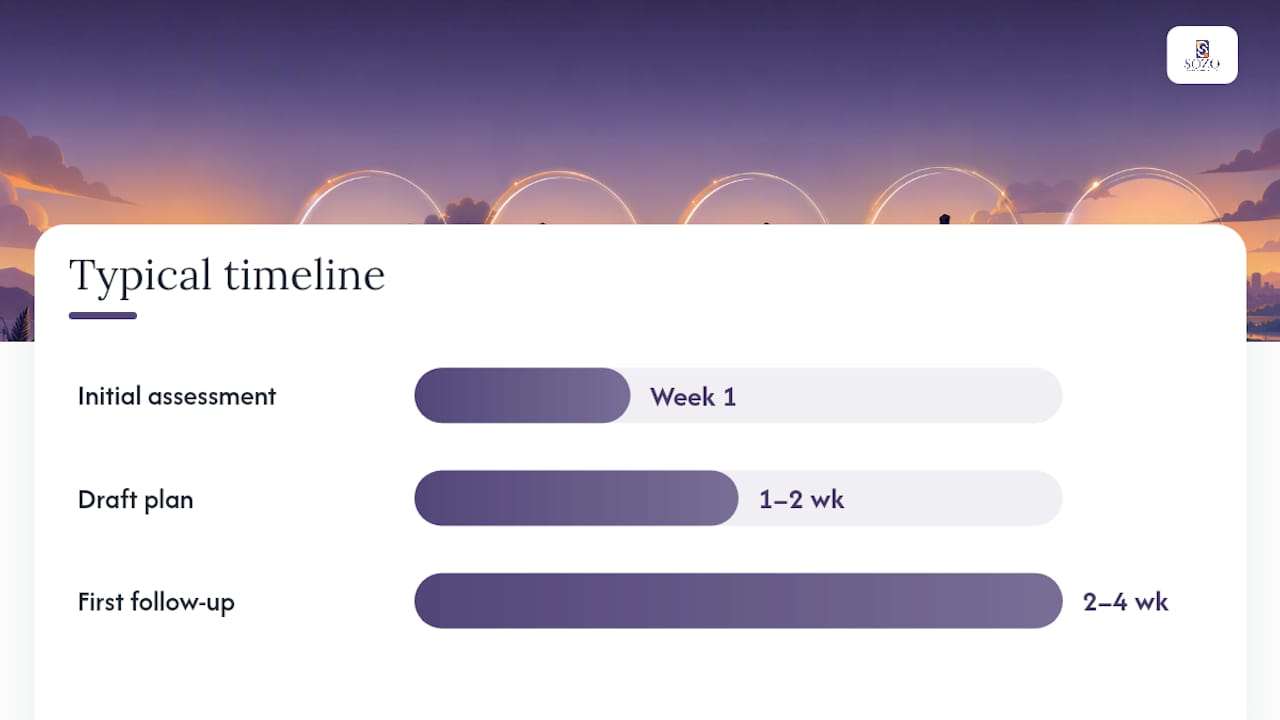
A typical timeline runs something like this: initial assessment and data collection in week one, a draft plan presented within one to two weeks, and a first follow-up check within two to four weeks to see whether early response matches expectations. Programs that operate as centers of excellence tend to share a few traits: dedicated case coordination, access to specialized testing, and a formal process for revisiting the plan on a set schedule rather than only when something goes wrong.
How Do Plans Adapt Over Time?
Personalization isn’t a one-time event. It’s a loop, and the loop only works if someone is actually measuring outcomes.
Measurement-based care means collecting outcome data on a regular cadence, weekly or biweekly is common in mental health treatment, using standardized questionnaires, app check-ins, or wearable metrics. A review of precision mental health care identifies this kind of routine outcome monitoring as essential for adaptive care, not optional add-on tracking.
Here’s roughly how the decision process works once that data starts coming in:
- Establish a baseline during intake using validated symptom or health measures.
- Track change at fixed intervals, comparing current scores against the baseline and against expected trajectories.
- Apply a decision rule: intensify treatment if progress stalls, switch approaches if there’s no meaningful change after a set period, or step down care if goals are met.
- Document the decision so the next provider or the same provider six months later understands why the plan shifted.
Two problems show up often enough to name directly. Assessment fatigue is real. Ask a patient to fill out five questionnaires every single week and engagement drops fast. And many programs simply lack clear discontinuation protocols, so patients stay on ineffective courses of treatment longer than they should, largely because no one defined in advance what “not working” looks like.
Pro Tip: Before starting any personalized program, ask what specific measure they’ll use to track your progress and how often you’ll complete it. If they can’t answer clearly, the “personalization” may be more marketing language than a working monitoring loop.
What Are the Benefits, Risks, and Access Limitations?
The upside of personalized treatment plans is straightforward: better fit between patient and intervention, fewer wasted treatment cycles, and fewer avoidable side effects. At a population level, that translates into more efficient use of limited healthcare resources, since fewer patients cycle through ineffective options before finding what works.
The risks deserve equal attention:
- Privacy: genetic and biometric data collection raises real questions about who has access and for how long.
- Algorithmic bias: models trained on non-representative data can misjudge outcomes for underrepresented groups.
- False reassurance: a negative genetic test result doesn’t guarantee a good outcome; it only rules out one variable.
- Cost: specialized testing and multidisciplinary coordination aren’t cheap, and coverage varies widely by plan.
Access remains uneven. Specialist-level personalization tends to concentrate in academic medical centers and major cities, and barriers around validation, interoperability, and workforce readiness slow how quickly these approaches reach smaller clinics. Insurance coverage for genetic testing or advanced monitoring tools also varies by policy, so it’s worth confirming coverage before assuming a test is included. Readers weighing inpatient mental health coverage specifically may find it useful to review how insurance handles emergency and inpatient treatment before committing to a program.
Before enrolling anywhere, ask directly: What evidence supports this specific personalization method? How is my data protected? What isn’t covered by insurance, and what will I pay out of pocket?
How Can You Access a Personalized Treatment Plan?
Getting a genuinely personalized plan, rather than a generic one with a personalized label attached, takes some preparation on your end.
- Gather your records first. Pull together medication history, prior diagnoses, and a written symptom timeline before your first appointment. This alone often speeds up assessment by weeks.
- Ask specific questions, not general ones. Ask whether the provider uses pharmacogenetic testing, routine outcome monitoring, or a multidisciplinary team, rather than asking if care is “personalized,” a word that means different things to different providers.
- Set realistic expectations on testing. Genetic panels and biomarker testing can take one to three weeks to return results, and cost varies widely depending on what’s ordered and your coverage.
- Read program descriptions critically. Look for language about ongoing measurement and plan adjustment, not just an initial assessment. A program that measures once at intake and never again isn’t practicing adaptive personalization, whatever it calls itself.
The goal isn’t to become your own diagnostician. It’s to walk into a provider relationship informed enough to recognize the difference between a plan that adapts and one that just sounds tailored.
How SOZO Recovery Center Applies Personalized Treatment Plans
Addiction and co-occurring mental health disorders are a clear case where one-size-fits-all treatment tends to fail. Sozorecoverycenter builds its programs around the ASAM Continuum criteria, a clinical framework that assesses withdrawal risk, biomedical conditions, emotional and behavioral needs, readiness for change, and relapse potential to determine the right level of care for each man who walks through the door.
For men facing both addiction and a mental health diagnosis, that assessment shapes a dual-diagnosis plan that treats both conditions together rather than in sequence. What sets SOZO apart is how it pairs that clinical structure with faith-based support:
- Individualized care plans informed by ASAM criteria and clinical assessment.
- Integrated treatment for co-occurring substance use and mental health conditions.
- Biblical principles woven into the 12-step recovery model rather than offered as a separate track.
- Ongoing plan adjustment as a man progresses through residential, outpatient, or sober living stages.
At intake, expect a clinical evaluation, a conversation about faith background and personal goals, and a plan that gets revisited as treatment progresses, not set once and left untouched.
An Honest Take on the Promise and Limits of Personalization
Precision medicine has earned its momentum. The research on measurement-based care, adaptive trials, and component-level tailoring is genuinely encouraging, and the direction of travel is clear. But it’s worth resisting the urge to treat “personalized” as a synonym for “guaranteed better.”
The evidence points to modest average effects that add up to something real, not a dramatic overhaul of outcomes for every single patient. What actually separates strong personalization from marketing language is whether a program measures progress on a set schedule and has a defined process for changing course when something isn’t working. A plan that adjusts is fundamentally different from a plan that was simply built to look individual on day one.
If you’re evaluating a treatment program for yourself or someone you care about, ask about the monitoring loop before you ask about the philosophy. The philosophy matters, but the loop is what determines whether the plan actually adapts when your circumstances do.
Ty
Start Your Personalized Recovery Plan at SOZO Recovery Center
Most addiction treatment programs offer a single track and hope it fits. Sozorecoverycenter builds each man’s plan around ASAM-informed assessment from day one, then adjusts it as he moves through residential care, outpatient programming, or sober living, so the plan changes with him instead of staying fixed.
Services include residential and outpatient treatment, dual-diagnosis care for men facing both addiction and mental health conditions, and sober living support that carries the plan forward past initial treatment. Admission starts with a clinical assessment covering substance use history, mental health screening, and personal goals, the same categories that shape any well-built personalized plan, paired here with a faith-based framework built on biblical principles and the 12-step model. If you or someone you love is weighing whether it’s time to reach out, review the early warning signs of addiction, then start the admissions process at SOZO Recovery Center to talk through what a personalized plan would look like for your situation.
Sources
- Efficacy of personalized psychological interventions: a systematic review and meta-analysis
- Treatment personalization and precision mental health care: where are we and where do we want to go?
- Tailored Therapeutic Strategies for Fetuses, Neonates, Pediatrics, Geriatrics, Athletes, and Critical Cases in the Era of Personalized Medicine
This article is general information, not a substitute for advice from a qualified doctor. Consult a qualified healthcare professional about your own circumstances before acting on anything here.
FAQ
What Is a Personalized Treatment Plan?
A personalized treatment plan uses a patient’s genetics, biomarkers, clinical history, and lifestyle to tailor care instead of applying a standard protocol, with the goal of improving response and reducing side effects.
What Is a Personalized Care Plan?
A personalized care plan is a broader term covering the same idea applied across medical and behavioral health settings. It documents a patient’s specific goals, risks, and interventions, and it gets revisited as circumstances change.
What Are the 4 P’s of Personalized Medicine?
Personalized medicine is often described using four goals: predictive, preventive, personalized, and participatory care, meaning treatment aims to anticipate risk, prevent disease before it worsens, tailor intervention to the individual, and actively involve the patient in decisions.
What Is a Personalized Treatment Plan With AI?
AI-supported personalized treatment plans use models that combine patient data with clinical evidence to help generate treatment recommendations. Frameworks like MedPlan show early promise for producing plans aligned with clinical documentation standards, though this technology remains an assistive tool rather than a replacement for clinician judgment.
Does SOZO Recovery Center Offer Personalized Treatment Plans?
Yes. Sozorecoverycenter builds individualized plans using ASAM Continuum criteria, integrating clinical assessment, dual-diagnosis care, and faith-based support that adjusts as a man progresses through treatment.