


Anonymity in Alcoholics Anonymous means two things at once. Privately, it protects a man from being identified as an alcoholic by anyone but himself. Publicly, it keeps the fellowship from turning into a stage for individual recognition, so that principles come before personalities. A.A. describes anonymity as working at both the personal and the public level, and understanding the difference answers most of the questions men and families ask.
If you are new to meetings, this guide explains what stays private, what you may share, how the Traditions apply to social media and the press, and where Rule 62 fits in.
TL;DR
- Anonymity protects every member’s privacy: what you hear in a meeting and who you see there stays there.
- At the public level, A.A. members do not give their full name or show their face as A.A. members in press, radio, film or online.
- Tradition Twelve calls anonymity the spiritual foundation of all the Traditions, because it asks each of us to put principles before personalities.
- You can always share your own story. The request is that you do not identify other people as members.
- Rule 62 is a humorous saying about humility, not a formal A.A. regulation.
Table of Contents
- What Anonymity Means in Alcoholics Anonymous
- Why Anonymity Is Called a Spiritual Principle
- Tradition Eleven and Tradition Twelve
- What You May Share and What Stays Private
- Anonymity Online and on Social Media
- Examples of Respecting and Breaking Anonymity
- Rule 62: Where It Fits
- Does Anonymity Ever Get in the Way?
- Our Perspective
- Support Beyond the Meeting Room
- FAQ
- Sources
What Anonymity Means in Alcoholics Anonymous
The word sounds simple, yet it carries two layers of meaning. A.A. explains that at the personal level, anonymity protects members from identification as alcoholics, which matters most to newcomers who fear stigma, job consequences or family judgment. At the public level, it makes sure that no one uses the fellowship for personal gain or recognition and that every member stands on equal footing.
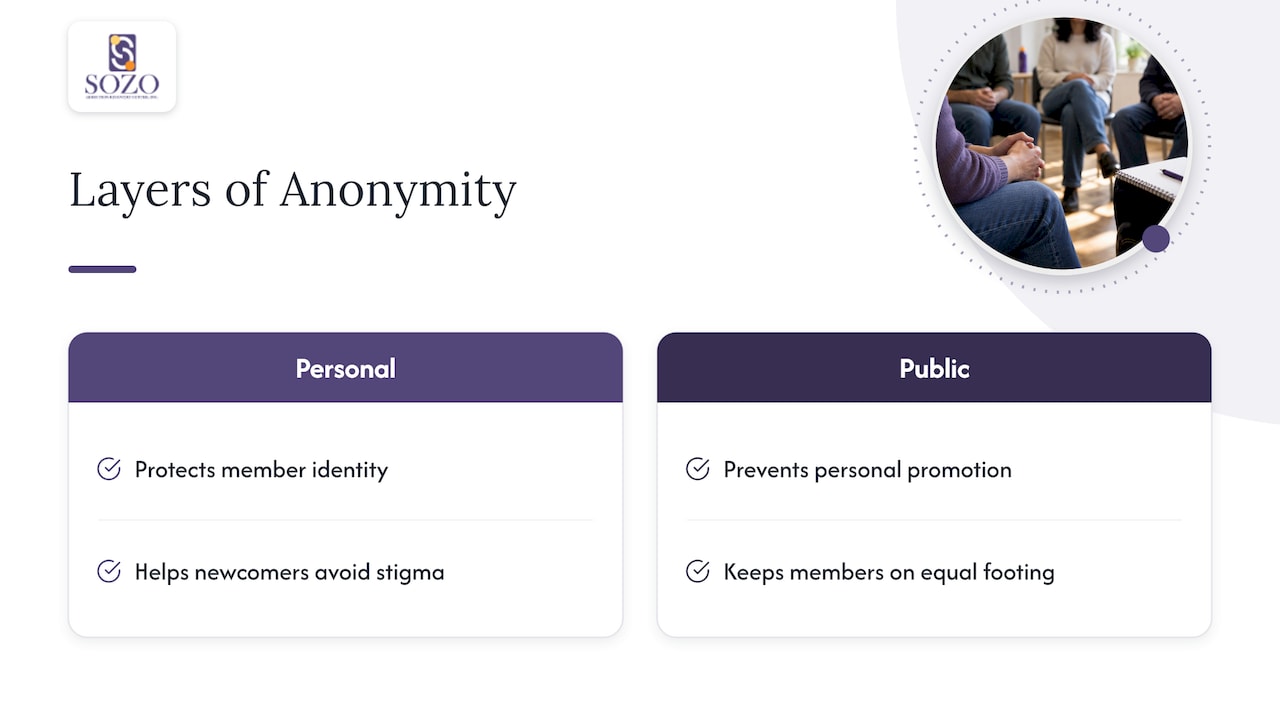
Think of it as a door with two locks. One keeps a man’s private struggle private while he finds his footing. The other keeps the fellowship’s name from being used to build anyone’s reputation.
The A.A. FAQ pamphlet states that no one has the right to break another member’s anonymity. That sentence is the reason a man can walk into a room of strangers and say what he could not say to his own family.
Personal anonymity: a safe place to start
For a man in early recovery, shame is often louder than any craving. Knowing that his name will not travel beyond the room lowers the cost of the first honest sentence. He can say what he did, what he lost and what he fears, without wondering whether it will reach his employer, his church or his neighbors.
This is also why many men find the first meeting less frightening than expected. Everyone there has the same reason to protect everyone else.
Public anonymity: humility in practice
The public level is less about secrecy and more about attitude. A.A. members may speak publicly as recovering alcoholics, but they do so as individuals and not as spokesmen for the fellowship. No one is the face of A.A. That arrangement protects the fellowship if a well-known member relapses, and it protects the member from the temptation to treat sobriety as a personal brand.
Why Anonymity Is Called a Spiritual Principle
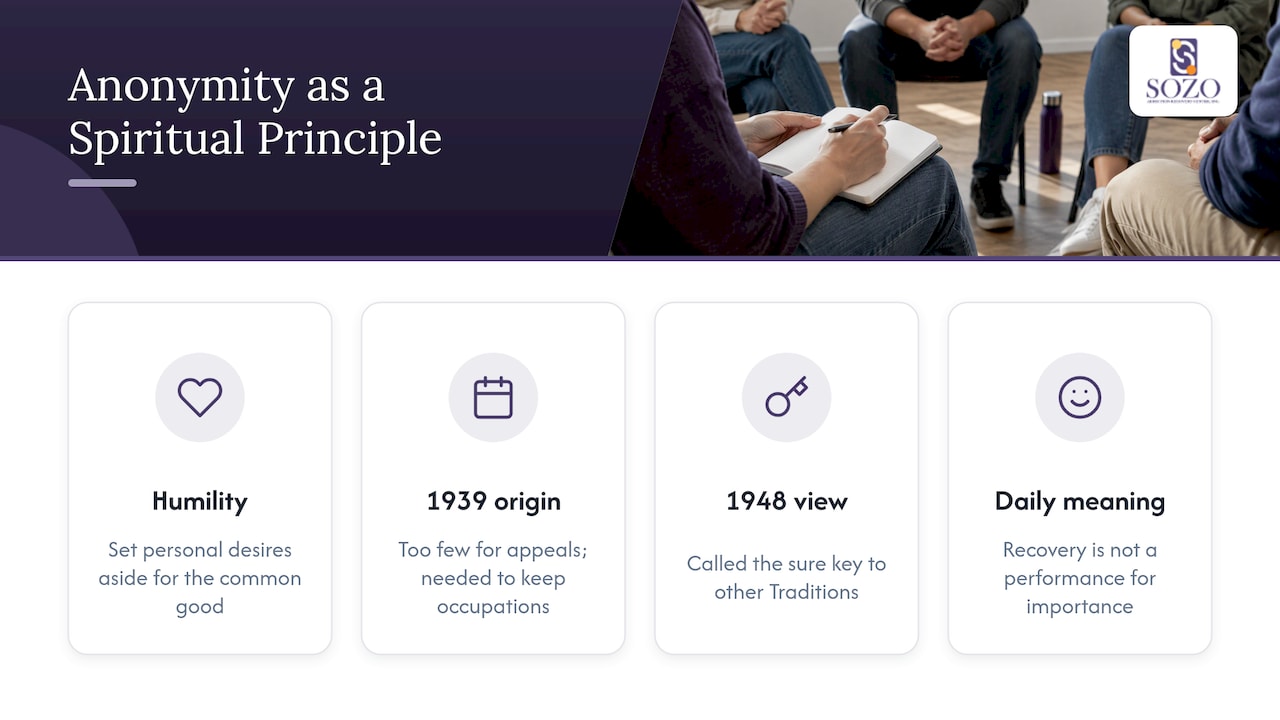
A.A.’s own text on Tradition Twelve says anonymity is a spiritual principle because it asks members to practice real humility and set personal desires aside for the common good. The Tradition’s short form reads that anonymity is the spiritual foundation of all the Traditions, reminding us to place principles before personalities.
The same chapter notes a practical origin. The 1939 Big Book foreword explained that early members stayed anonymous partly because they were too few to handle the personal appeals that might follow publication, and because they needed to carry on their occupations.
In 1948, Bill W. described anonymity as the sure key to the other Traditions, standing for prudence and self-effacement. A local A.A. office puts the daily meaning plainly: recovery is not a performance for importance, but a life lived with humility.
For men who come from a faith background, this language will sound familiar. Humility, service and setting self-will down are old ideas. If you wonder how the program’s spiritual language fits with your own beliefs, our article on whether AA is religious walks through it.
Tradition Eleven and Tradition Twelve
Two of the Twelve Traditions carry the anonymity principle.
| Tradition | What it says in short | What it means in practice |
|---|---|---|
| Eleven | Public relations rest on attraction rather than promotion, and personal anonymity is kept at the level of press, radio and films | Members do not give full names or show faces as A.A. members in media |
| Twelve | Anonymity is the spiritual foundation of all the Traditions | Principles come before personalities, in meetings and in public |
Tradition Eleven is the one that governs interviews, podcasts and posts. According to A.A., it asks members to maintain personal anonymity at the level of press, radio and films, meaning no full name and no face identified as an A.A. member.
What You May Share and What Stays Private
The cleanest rule of thumb is this: your story is yours, and other people’s stories are theirs.
What you can do
- Tell your own story, including to family, friends, your pastor or your employer, if you choose.
- Speak in public as a person in recovery. A.A. says members may appear in radio, TV and online interviews as recovered alcoholics, so long as their A.A. membership is not revealed.
- Speak at non-A.A. gatherings as a member. Members usually use first names only in that setting.
What stays private
- Who you saw at a meeting.
- What another member shared, including to a spouse, a coworker or a group chat.
- Another man’s membership, even when you think he would not mind.
Anonymity is also a request to people outside the rooms. Fellowship literature from Australia explains that it asks everyone, including family, friends and community members, not to identify individuals as A.A. members. If you are a wife, brother or son of a man in recovery, that includes you. You can say you are proud of him in your own words without naming the fellowship or the meeting.
Anonymity Online and on Social Media
Phones changed the practical side of this principle. A.A. states that members are responsible for their own anonymity and for that of others on social media and online platforms, where a post can amount to publishing at the public level.
In plain terms:
- Do not post photos from meetings that show faces.
- Do not tag another man as a member of A.A., or check in at a meeting location in a way that identifies him.
- Think before you write “my A.A. group” next to your full name on a public profile. That pairs your identity with membership.
- Keep group chats for meeting logistics, and ask before adding anyone.
- Share your recovery journey in terms of your own experience, and do not speak for the fellowship.
A small habit helps: before posting, ask whether the post would let a stranger identify a person as an A.A. member. If it could, leave it out or rewrite it.
Examples of Respecting and Breaking Anonymity
A.A. says respecting the principle includes protecting your own and others’ anonymity online and not revealing a member’s full name or face when speaking publicly as a member. Breaking it can include revealing A.A. membership in public or using the affiliation for recognition, power or personal gain.
| Situation | Respects anonymity | Breaks anonymity |
|---|---|---|
| A local news interview | Speaking as a man in recovery, no mention of A.A. membership with full name | Giving a full name and face as an A.A. member |
| Family dinner | Saying, “I’m doing well in my recovery” | Telling relatives who else attends your meeting |
| Social media | Posting about your own sobriety date without naming the fellowship | Posting a group photo from a meeting |
| Business | Offering services on your professional merits | Advertising your business using A.A. membership to win trust |
Professionals have a version of this too. A.A. guidance suggests that people working in the field avoid the title “A.A. counselor,” with “alcoholism counselor” preferred. The distinction is helpful for families. A peer in the rooms shares experience, while a clinician provides treatment. If you are curious how professional help is structured, this overview of the individual counseling process and its stages shows how a counselor-client relationship typically unfolds.
Rule 62: Where It Fits
People searching for the anonymity tradition often run into “Rule 62,” so it is worth clearing up. It is not a rule about anonymity at all. A.A.’s own history says a group in West Virginia that wanted to build a foundation with a club, hospital and research center ignored advice not to, and one founder then mailed cards to groups printed with “Charleston AA Group Rule # 62”. Inside was the message “Don’t take yourself so damn seriously!”
The joke was that there had been 61 other rules. The saying survives because it pairs well with anonymity: both are reminders that no member is more important than the whole.
Does Anonymity Ever Get in the Way?
Some men worry that secrecy feeds shame. The spirit of the principle is different. Anonymity is not hiding from the truth. A man can be fully honest about his addiction with his family, his pastor, his clinicians and his sponsor. What the Traditions ask is that no one breaks another person’s privacy, and that no one turns the fellowship into a platform.
For many men, that structure is what makes honesty possible in the first place.
Our Perspective
We see anonymity every week in the lives of the men we serve. A man arrives at our center in Hot Springs carrying more than his addiction. He carries the worry of who will find out, what his employer will think and whether his church will still receive him. The principle of anonymity takes some of that weight off before the real work begins.
We believe the principle also trains something deeper. When a man learns to share his story without needing credit and to protect another man’s story without being asked, he practices humility and service. Those are the same virtues our faith-based program is built around. Our approach combines biblical principles with the 12-step model, and anonymity fits naturally in that blend. It teaches a man that recovery is not a performance, and that he belongs to something larger than his own story.
At SOZO, we pair that spiritual foundation with clinical care. Our treatment plans are informed by ASAM criteria and include dual diagnosis care for men who face mental health challenges alongside addiction. In a small, peaceful setting, a man can be honest about all of it, knowing his privacy is respected. Our design is meant to give men room to heal and to rebuild trust, first with themselves and then with the people they love.
Ty
Support Beyond the Meeting Room
Meetings are valuable, and for many men they are not the whole answer. If you or a son, husband or brother is struggling with alcohol or drugs, structured care can add clinical support, daily routine and a community of men who understand.
At SOZO Recovery Center in Hot Springs, Arkansas, we offer a faith-based men’s program that includes residential treatment, partial hospitalization, intensive outpatient and outpatient levels of care, sober living, and dual diagnosis care. We also help with medical detox placement when it is needed. Each plan is personalized, and we treat every man’s privacy with the same respect the Traditions ask for in the rooms.
If you are weighing options, our guide to sober living versus residential treatment can help you sort out which level fits. To talk with our team, start at sozorecoverycenter.com.
FAQ
What is the spiritual principle of anonymity?
It is the practice of placing principles before personalities. A.A. describes it as asking members to practice genuine humility and put the common good ahead of personal desires. Bill W. called it the sure key to the other Traditions.
Can I tell my family I attend A.A.?
Yes. Anonymity protects your privacy, and you decide how much to share about your own recovery. The principle asks that you do not identify other members. Your family is likewise asked not to identify you or anyone else as a member outside the family.
Can I post about my recovery on social media?
You can share your own experience, but A.A. treats online posting as potential publishing at the public level. Avoid full names and faces tied to A.A. membership, and never post about another person’s attendance. When in doubt, keep the post focused on your own story and leave the fellowship’s name out of it.
What does Rule 62 mean in A.A.?
Rule 62 is a humorous saying: “Don’t take yourself so damn seriously.” It began with a card mailed by a member of a West Virginia group, and it is a reminder of humility rather than an official rule.
Does anonymity apply to treatment centers?
Anonymity is a principle of the fellowship, while treatment centers follow their own privacy obligations. At SOZO, we treat each man’s information with care and discuss privacy questions directly during admission.
Sources
- A.A. and Anonymity, Alcoholics Anonymous
- Twelve Traditions, Tradition Twelve
- About Anonymity in Alcoholics Anonymous, NHAA
- Understanding Anonymity, SCV Central Office of AA
- Frequently Asked Questions About A.A.
- Understanding Anonymity, A.A. Great Britain
- Alcoholics Anonymous and Anonymity: A Principle for Everyone
- Where did “Rule 62” come from?
- Individual counseling process and stages