


Yes, your addiction treatment records carry strong federal protection. Two frameworks work together: 42 CFR Part 2, written specifically for substance use disorder records, and HIPAA, the broader health privacy law. Part 2 sets a stricter bar than HIPAA alone. Exceptions to it are narrow by design, and some states add protections on top. The sections ahead cover the scope, the recent rule changes, and the practical steps that keep your information where it belongs.
TL;DR:
- Federal law protects addiction treatment records more strictly under 42 CFR Part 2 than HIPAA, with narrow exceptions such as emergencies and court orders.
- A single, comprehensive consent form now covers treatment, payment, and operations, but patients should review it carefully to understand who will receive their information.
- Disclosures without consent are only permitted in limited cases, primarily emergencies, child abuse reports, or court orders with specific legal standards.
- Regular everyday risks, like insurance EOB statements or family plans, pose potential confidentiality breaches unless patients request special arrangements.
- Treatment records remain inaccessible to employers and most civil or criminal proceedings without a valid, court-approved order, and violations can lead to penalties and fines.
Table of Contents
- Understanding Rehab Confidentiality Laws Under 42 CFR Part 2
- HIPAA Versus Part 2: Why the Difference Matters
- The 2024–2026 Part 2 Final Rule: What Changed
- When Rehab Records Can Be Disclosed Without Consent
- Everyday Privacy Risks: Insurance, Family Plans, and Employers
- What to Do If Your Confidentiality Is Violated
- The Public Health Case for Strict Confidentiality
- How Patient Consent and the TPO Single-Consent Option Work
- Records in Court: Legal Limits and Penalties for Violations
- Secure Communication and Technology Safeguards in Treatment
- Staff Training and Compliance Programs That Actually Work
- Your Right to Access Your Own Treatment Records
- Confidentiality Protections for Minors in Treatment
- How SOZO Recovery Center Protects Your Privacy From the First Call
- Where to Verify These Rules Yourself
- A Publisher’s Note on Why This Guide Exists
- Sources
- FAQ
Understanding Rehab Confidentiality Laws Under 42 CFR Part 2
Federal law backs this protection with real teeth. The statute is 42 U.S.C. § 290dd-2, and its implementing regulation, 42 CFR Part 2, restricts what any federally assisted addiction treatment program can say about you, to whom, and under what conditions. The HHS overview of Part 2 confirms this operates alongside HIPAA rather than replacing it.
“Federally assisted” sounds narrow, but the bar is low. A program qualifies if it receives federal funding directly, is licensed or certified by a state agency that itself gets federal money, or is tax-exempt, among other triggers. In practice, this covers the overwhelming majority of rehab centers, hospitals with addiction units, and outpatient clinics in the country.
Once you’re covered, the protection is broad. Part 2 shields:
- Intake and admission records, including the fact that you sought help at all
- Clinical notes, diagnoses, and treatment plans
- Billing and payment records tied to your care
- Written and electronic communications about your treatment
Protection starts at first contact, meaning the moment you call to schedule an appointment, and it’s critical to follow call recording rules under GDPR for medical practices to maintain compliance and protect patient privacy. Federal confidentiality regulations apply whether the program is residential, outpatient, a standalone detox unit, or a hospital-based SUD service.
HIPAA Versus Part 2: Why the Difference Matters
HIPAA sets the national floor for protected health information (PHI). Its Privacy Rule allows providers to share your records fairly freely for treatment, payment, and operations, often called TPO, without asking you each time. That flexibility makes sense for a broken arm. It becomes a liability when the record in question says “substance use disorder.”
Part 2 tightens that flexibility specifically for SUD records. Where HIPAA might let a hospital share your chart with a billing contractor without a second thought, Part 2 requires the disclosure to trace back to valid patient consent, and it follows the information downstream through a rule called redisclosure restriction.
- HIPAA: broad TPO sharing allowed by default across most health information
- Part 2: consent-based sharing, with tighter limits even after you’ve agreed once
- Redisclosure: anyone who lawfully receives your Part 2 records generally cannot pass them along again without your separate permission
The practical effect: a therapist coordinating your care with a primary doctor is fine under both frameworks. A billing office forwarding your SUD diagnosis to a third party after using a single TPO consent is exactly the scenario the newer rules had to address.
The 2024–2026 Part 2 Final Rule: What Changed
The final rule fact sheet from HHS lays out the biggest overhaul to Part 2 in years, and most provisions carried a compliance date in early 2026.
- A single consent now covers treatment, payment, and health care operations together, instead of requiring separate authorizations for each use
- Certain de-identified data can be disclosed for public health research without triggering full Part 2 consent requirements
- Breach notification and some enforcement mechanisms now align more closely with HIPAA’s existing structure
- SUD counseling notes retain their own heightened protection layer
Pro Tip: Read a TPO consent form before signing, not after. A single signature now authorizes more downstream sharing than it used to, so ask your provider exactly which entities will receive your information under that one consent.
The trade-off is real. Easier coordination of care comes with a wider door for information to travel once you’ve signed. That doesn’t mean you should refuse the consent. It means you should read it.
When Rehab Records Can Be Disclosed Without Consent
Exceptions exist, and they are deliberately few. According to HHS guidance on Part 2, disclosure without written patient consent is permitted only in these situations:
- Medical emergencies. A bona fide emergency threatening your health allows a provider to share necessary information with treating personnel, though programs must document the nature of the emergency.
- Child abuse reporting. State mandatory reporting laws override Part 2 for the initial report, but the receiving agency generally cannot redisclose that information further.
- Court orders. A judge must find “good cause,” weigh your privacy interest against the public need, and limit the order’s scope. You are typically entitled to notice and a chance to object before the order is granted.
A subpoena or search warrant alone almost never clears this bar. The eCFR text of Part 2 makes clear that law enforcement needs a court order specifically issued under Part 2 procedures, not a standard subpoena, to compel disclosure.
Everyday Privacy Risks: Insurance, Family Plans, and Employers
Federal law protects your records on paper. The leaks that actually happen tend to come from ordinary paperwork, not legal loopholes.
The most common one is the Explanation of Benefits statement. If you’re on a parent’s or spouse’s insurance plan, an EOB listing a treatment facility’s name can land in the policyholder’s mailbox before you’ve told anyone. Several states address this directly by letting patients request confidential communications or redirect EOB mail to a separate address.
- Ask your insurer about confidential communication requests before treatment starts
- Consider paying out-of-pocket for sensitive visits if the coverage tradeoff isn’t worth the exposure
- On a family plan, request that billing correspondence route to you directly, not the primary policyholder
Employers face real limits too. The ADA restricts what they can ask about medical conditions, and FMLA can protect job-protected leave for treatment. Voluntary rehab attendance does not create a criminal record. Treatment is medical information, not a legal proceeding, and the common fear that it “goes on your record” is usually unfounded. Court-ordered treatment, tied to a criminal case, is a different animal entirely and can appear in court records.
What to Do If Your Confidentiality Is Violated
Start by confirming your provider’s status. Ask directly whether the program falls under Part 2, and request the written Patient Notice every Part 2 program must provide at admission, a document SAMHSA’s support resources can help you cross-reference if you’re unsure.
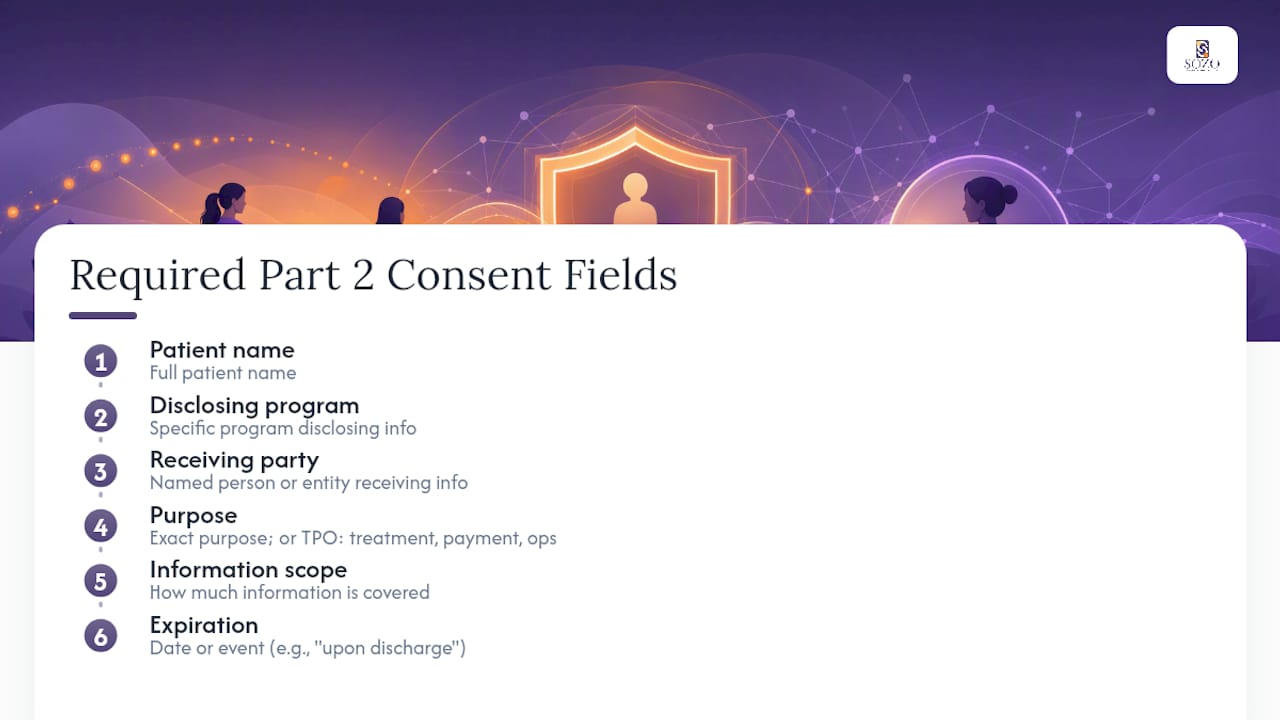
- Review your consent forms. A valid Part 2 consent names who is disclosing, who is receiving, what information, and for what purpose, with an expiration date or event.
- Revoke consent in writing if needed. You can limit or withdraw permission at any time going forward, though it won’t undo disclosures already made.
- Document the disclosure. Note the date, who disclosed what, and to whom, as soon as you learn of it.
- File a complaint. HIPAA violations go to the HHS Office for Civil Rights; Part 2 concerns can be raised through SAMHSA guidance channels or your state attorney general.
- Consult an attorney if the disclosure caused real harm, such as job loss or housing denial.
Violating programs face real consequences, including federal fines and, in serious cases, criminal penalties for willful violations. That liability is precisely why most legitimate programs treat consent paperwork as seriously as they do.
The Public Health Case for Strict Confidentiality
Confidentiality rules aren’t bureaucratic caution. They exist because fear of exposure keeps people out of treatment.
Part 2’s core function is a privacy shield designed to prevent treatment records from being used against patients in law enforcement, employment, or housing decisions, according to the Legal Action Center’s analysis. That protection is precisely what makes it safer for someone to walk through the door in the first place.
A man who worries his employer will find out he sought help for opioid use is a man who delays calling. Strict confidentiality removes one more excuse to wait.
How Patient Consent and the TPO Single-Consent Option Work
Consent is the mechanism that makes every other Part 2 protection functional. Nothing leaves a Part 2 program’s files without your authorization, except in the narrow exceptions already covered.
A valid consent form under Part 2 must specify several things clearly: your name, the specific program disclosing information, the specific person or entity receiving it, the exact purpose of the disclosure, how much information is covered, and either an expiration date or an expiration event (such as “upon discharge”). A vague, open-ended authorization doesn’t meet this standard.
The 2024 final rule’s biggest practical shift was consolidating treatment, payment, and health care operations into one signature. Previously, a program might need separate consents to bill your insurer, coordinate with your primary care doctor, and conduct internal quality review. Now a single TPO consent can cover all three.
This is genuinely convenient. It also means you should read that one form more carefully than you might have skimmed three shorter ones. Ask your intake coordinator which specific parties fall under “operations” for that program; the term can stretch to cover contracted billing services, auditors, or quality-assurance reviewers you wouldn’t automatically think of.
You retain the right to limit the scope of that consent. You can ask that it exclude a specific family member, restrict it to a named provider only, or set a shorter expiration than the program’s default. A program can decline to treat you if you refuse consent altogether for treatment purposes, but they cannot force you to consent to disclosures beyond what’s needed for your care.
Records in Court: Legal Limits and Penalties for Violations
Part 2 does more than keep your file private day to day. It also restricts how that file can be used if you ever end up in a legal proceeding, civil or criminal.
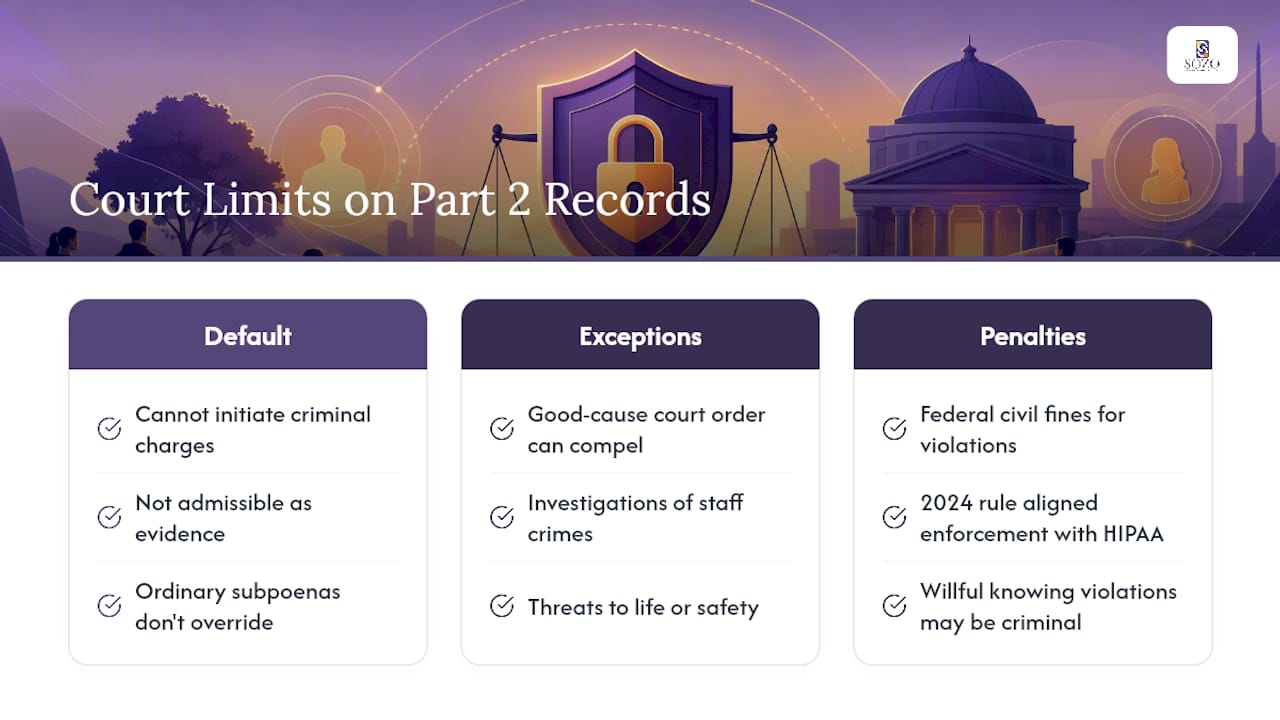
Records protected under Part 2 generally cannot be used to initiate or substantiate criminal charges against a patient, nor can they be introduced as evidence in most civil or criminal proceedings without a qualifying court order. This is a deliberate design choice: lawmakers wanted people to seek treatment without fear that doing so would hand prosecutors or opposing counsel a weapon.
That protection has limits. A court order meeting the “good cause” standard, discussed earlier, can still compel disclosure in specific, narrow circumstances, such as investigating a crime committed by program staff or addressing a threat to life. But the everyday subpoena in a custody dispute or a civil lawsuit does not automatically override Part 2. Attorneys unfamiliar with addiction treatment law sometimes assume standard subpoena power applies here; it doesn’t, and a program’s compliance staff should push back on any request that skips the court-order process.
Violations carry consequences that scale with severity. Programs found to have improperly disclosed protected information can face federal fines, and the 2024 final rule aligned enforcement more closely with HIPAA’s penalty structure, giving federal regulators sharper tools than before. Willful, knowing violations can trigger criminal penalties in addition to civil fines. For patients, remedies typically run through the complaint channels covered earlier rather than a private lawsuit, though state law sometimes provides additional avenues.
Secure Communication and Technology Safeguards in Treatment
Confidentiality law was written for paper files. Most rehab programs today run on electronic health records, patient portals, and telehealth platforms, and the same Part 2 and HIPAA protections extend to all of it.
Encrypted electronic health record systems are now standard at compliant programs, and that encryption matters at rest (when data sits in a database) and in transit (when it’s being sent between systems). A program that emails your treatment summary to your primary care doctor over an unencrypted connection is creating exactly the kind of exposure the regulations exist to prevent.
Telehealth introduced its own set of risks that didn’t exist when Part 2 was first written. A counseling session conducted over video on an unsecured platform, or text-based check-ins sent through a non-encrypted messaging app, can undermine confidentiality even when the underlying consent paperwork is airtight. Ask any telehealth-based program what platform they use and whether it meets HIPAA’s technical safeguard requirements; a legitimate provider should answer that question without hesitation.
For patients, the practical takeaway is simple: use the communication channel your program provides rather than defaulting to personal text or email for sensitive details. Patient portals exist specifically because they offer audit trails and encryption that a regular inbox doesn’t. If a program asks you to communicate treatment details over a channel that feels informal or insecure, that’s worth raising directly with their compliance staff.
Staff Training and Compliance Programs That Actually Work
Confidentiality law is only as strong as the staff enforcing it day to day. A well-designed compliance program treats Part 2 and HIPAA training as an ongoing operational habit, not a box checked once during onboarding.
Effective programs train every staff member who might touch patient information, not just clinicians, on what qualifies as protected information and how redisclosure restrictions work. Front desk staff scheduling appointments, billing personnel handling claims, and even facilities staff who might overhear a conversation all need a working understanding of what they can and cannot share, and with whom.
Written policies matter more than good intentions. A functioning compliance program documents its consent procedures, maintains a clear process for responding to court orders and subpoenas, and designates a specific staff member or officer responsible for privacy compliance. Regular audits catch small breaches, such as a misdirected fax or an overly broad email chain, before they become larger problems.
Training also needs to keep pace with regulatory change. The 2024 final rule shifted several operational details, from consent consolidation to breach notification timelines, and programs that didn’t update their internal training alongside those changes risk falling out of compliance even with good intentions. Refresher training tied to actual rule changes, rather than a generic annual repeat, tends to catch staff up faster.
Your Right to Access Your Own Treatment Records
Confidentiality laws restrict who else can see your records. They don’t restrict your own access to them.
Under HIPAA, you generally have the right to request and receive a copy of your medical records, including those from mental health and, with some nuance, substance use treatment. Part 2 adds a layer of specificity for SUD records: programs must have a clear process for patients to request their own information, and denial of a patient’s own access request is rare and typically tied to specific safety concerns, such as risk of harm from certain psychotherapy notes.
There’s an important distinction between reviewing your own records and having them released to a third party on your behalf. Requesting your own file is a more straightforward process than authorizing a program to send that file elsewhere. If you want your records forwarded to a new provider, a family member, or an attorney, that still requires a proper Part 2 consent naming that specific recipient.
Programs can charge a reasonable, cost-based fee for copying and providing records, and they typically have a set window (commonly 30 days) to respond to a HIPAA access request. If a program is dragging its feet or refusing outright, that’s a legitimate basis for a complaint to the HHS Office for Civil Rights, which handles both HIPAA and, increasingly, Part 2 access disputes under the aligned enforcement framework.
Confidentiality Protections for Minors in Treatment
Minors in addiction treatment sit at a genuinely complicated intersection of federal privacy law and state consent rules, and the answer changes depending on where you live.
Part 2 generally protects a minor’s SUD treatment records the same way it protects an adult’s, but state law determines whether a minor can consent to treatment without parental involvement in the first place. Many states allow minors to consent to their own substance use treatment starting at a certain age or under specific circumstances, and in those states, the minor, not the parent, typically holds the right to control disclosure of those records.
This creates a real tension for parents who are paying for or arranging a minor’s care. A parent might reasonably expect full access to their child’s treatment information, but if state law lets the minor consent independently, Part 2 can limit what the program shares with that parent without the minor’s separate authorization. Programs handling adolescent treatment need to know their specific state’s consent-age rules cold, because getting this wrong creates liability in both directions: either violating the minor’s rights or improperly withholding information a parent is legally entitled to.
Because these rules vary meaningfully by state, and because adolescent treatment involves distinct clinical and legal considerations beyond adult care, checking your specific state’s statutes, or asking a program directly how they handle minor consent, is worth doing before treatment begins rather than after a disclosure question comes up.
How SOZO Recovery Center Protects Your Privacy From the First Call
Everything covered above is the law. What matters to you is how a program actually applies it the day you pick up the phone. Certain addiction treatment centers operate confidential admissions processes in line with federal Part 2 and HIPAA requirements, meaning your initial inquiry, intake information, and treatment records receive strict protections.
That starts before you ever set foot in Hot Springs, Arkansas. Reaching out through confidential admissions doesn’t commit you to anything, and the information you share during that first conversation is treated as protected from the moment you make contact. If insurance coverage is part of your decision, how coverage from BlueCross BlueShield, Ambetter, and QualChoice applies to treatment is worth reviewing so you know what to expect from your carrier’s paperwork, including EOB considerations. From there, residential treatment offers a structured, faith-integrated environment where privacy and personalized care work together rather than against each other. If you’re ready to talk, that first call is the next step, and it stays between you and the person who answers.
Where to Verify These Rules Yourself
Federal privacy law changes, and reading the primary source beats relying on secondhand summaries.
- HHS Part 2 guidance explains how Part 2 and HIPAA interact, with the full official overview here.
- SAMHSA’s support finder helps locate licensed programs and check program status.
- The eCFR publishes the current regulatory text of Part 2 in full.
- Legal Action Center offers a plain-language primer on patient rights.
A Publisher’s Note on Why This Guide Exists
This guide exists because too many men delay calling for help out of fear that treatment will follow them into a job application, a custody hearing, or a background check. That fear is usually based on a misunderstanding of how strong these protections actually are. If you’re weighing whether to reach out, know that a confidential conversation about admissions costs you nothing and commits you to nothing.
— Ty
This article is general information, not a substitute for advice from a qualified doctor. Consult a qualified healthcare professional about your own circumstances before acting on anything here.
Sources
- Understanding Confidentiality of Substance Use Disorder (SUD) Patient Records or “Part 2” — HHS
- Appendix B—Federal Confidentiality Regulations – NCBI Bookshelf
- The fundamentals of 42 CFR Part 2 — Legal Action Center
- Is rehab confidential? Records, employment, and insurance — LegalClarity
FAQ
Are Rehab Records Confidential Under Federal Law?
Yes. Addiction treatment records are protected by both HIPAA and the stricter, SUD-specific 42 CFR Part 2, which covers intake, clinical notes, and billing records from your first contact with a program.
What Are the Federal Confidentiality Requirements for Substance Abuse Programs?
Federally assisted SUD programs must obtain valid written patient consent before disclosing identifying information, with only narrow exceptions for medical emergencies, mandatory child abuse reporting, and Part 2-specific court orders. The 2024 final rule also allows a single consent covering treatment, payment, and operations together.
Does HIPAA Apply to Rehab Facilities?
Yes, HIPAA applies as the baseline privacy law for most rehab facilities, but Part 2 layers stricter, SUD-specific rules on top for programs that qualify as federally assisted. Where the two conflict, the more protective standard, usually Part 2, controls how records can be shared.
What Are Examples of a Rehab Confidentiality Violation?
Common violations include a billing office sharing your SUD diagnosis with a third party beyond the scope of your consent, a staff member disclosing your attendance to a family member without authorization, or a program failing to redirect insurance EOBs after you requested confidential communications. Any disclosure exceeding what a signed consent form actually authorizes can qualify as a violation.