


Alcohol withdrawal symptoms typically begin within 6 to 24 hours after the last drink, peak in intensity between 24 and 72 hours, and mostly resolve within five to seven days for physical symptoms, though psychological effects can linger for weeks or months. Anyone with a history of seizures or delirium tremens needs medical supervision during this window, not a solo attempt at home. Clinicians often use the DSM-5 framework and tools like the CIWA-Ar scale to gauge severity, and a monitored option through a center like Sozorecoverycenter can make the difference between a rough week and a dangerous one.
TL;DR:
- Seizures typically occur between 8 and 48 hours after the last drink, with delirium tremens usually appearing from 48 to 72 hours and sometimes as late as day eight.
- The risk of severe withdrawal symptoms, such as seizures and DTs, is higher in individuals with a history of these events, heavy long-term drinking, or medical complications like liver disease.
- Medical detox often involves CIWA-Ar assessments and benzodiazepines, with inpatient care recommended for those with prior seizures, DTs, or serious health conditions.
- Mood and sleep disturbances can persist for weeks or months post-acute withdrawal, and about 5% of people experience sustained anxiety or depression that benefit from dual-diagnosis care.
- Individuals with a history of seizures, DTs, or heavy drinking should avoid solo detox, seek supervised treatment, and be prepared to provide detailed history and symptoms to healthcare providers.
Table of Contents
- Alcohol Withdrawal Timeline: Hour by Hour Through the First Weeks
- Symptoms of Alcohol Withdrawal by Severity
- Seizures and Delirium Tremens: The Red Flags That Mean Call for Help
- What Determines How Bad Your Withdrawal Gets
- How Doctors Manage Alcohol Detox Safely
- Sobriety Depression and PAWS: The Weeks That Follow Detox
- When to Get Emergency Help and What to Tell Clinicians
- Staying Safe During the First Weeks of Withdrawal
- How Clinical Programs Screen for and Manage Withdrawal Risk
- What the Research Actually Tells Us to Prioritize
- Get Supervised Detox Support at Sozorecoverycenter
- Sources
- FAQ
Alcohol Withdrawal Timeline: Hour by Hour Through the First Weeks
The first 72 hours carry the most risk, and knowing what tends to happen when helps you recognize whether what you’re feeling is expected or a warning sign. The pattern below reflects what clinical reviews describe as the typical course of alcohol withdrawal syndrome, though your own experience may shift earlier or later depending on how much and how long you drank.
- 0 to 6 hours: Early, mild signs appear first: shaky hands, a racing heart, sweating, and a low hum of anxiety that wasn’t there the day before.
- 6 to 12 hours: Tremor becomes more noticeable, sleep gets harder to find, and irritability sets in.
- 12 to 24 hours: Some people start seeing or hearing things that aren’t there. This alcoholic hallucinosis is unsettling but distinct from full delirium tremens.
- 8 to 48 hours: This is the seizure risk window. Generalized convulsions are most likely to strike here, often without warning.
- 24 to 72 hours: Most people hit their peak here. Delirium tremens, when it happens, most often shows up in this stretch, though it can appear as late as day five to eight.
- Days 4 to 7: Physical symptoms usually start easing for most people, but monitoring should continue if anything still feels off.
- Weeks 2 through 12: Mood swings, disrupted sleep, and cravings can linger well into this stretch as the brain recalibrates.
That last phase matters more than most people expect walking into detox. The acute crisis fades fast, but the quieter symptoms that follow, explained in more detail below, often determine whether someone stays sober.
Symptoms of Alcohol Withdrawal by Severity
Not every case of withdrawal looks the same, and severity tends to track closely with the timing windows described above. Recognizing which tier you’re in helps you and any medical staff decide how urgently to act.
- Mild symptoms show up first and rarely require emergency intervention on their own: hand tremors, nausea, headache, mild anxiety, and trouble sleeping. These often appear within the first 12 hours.
- Moderate symptoms bring the autonomic nervous system into the picture: a faster heart rate, elevated blood pressure, vivid or disturbing dreams, and anxiety that starts interfering with daily function. This tier tends to build through the 24 to 48 hour mark.
- Severe symptoms are medical emergencies: generalized tonic-clonic seizures, hallucinations paired with confusion, dangerously high body temperature, and the extreme agitation that marks delirium tremens. These cluster in the 24 to 72 hour window, occasionally stretching to day eight.
A person can move through all three tiers in under three days, or stall out in the mild-to-moderate range the entire time. What determines which path someone takes has less to do with willpower and more to do with drinking history, which the factors section below breaks down.
Seizures and Delirium Tremens: The Red Flags That Mean Call for Help
Seizures are most likely to strike between 8 and 48 hours after the last drink, and they often arrive without much warning. Delirium tremens (DTs) typically emerges later, usually between 48 and 72 hours, though clinical literature notes it can appear as late as day five to eight in some cases.

Delirium tremens occurs in an estimated 3 to 5% of people with alcohol withdrawal syndrome, and without medical treatment, both seizure and fatality risk climb sharply. That statistic sounds small until you consider how many people attempt withdrawal without any supervision at all.
Certain signs mean it’s time to call 911 or get to an emergency room immediately, not wait it out:
- Convulsions or any loss of consciousness
- Severe confusion or disorientation about time, place, or identity
- A fever that feels dangerously high
- Hallucinations that persist and worsen rather than pass
- Any period of unresponsiveness
If you or someone you’re with ends up in an ER, tell staff exactly how long it’s been since the last drink, roughly how much and how long the person has been drinking, and whether there’s any history of prior seizures or DTs. That information changes how fast clinicians move.
What Determines How Bad Your Withdrawal Gets
Two people who drank the same amount last night can have wildly different withdrawal experiences, and the reasons usually trace back to a handful of measurable factors.
- How much and how long you drank. Heavier, longer-term drinking produces a more entrenched dependence, and the body reacts more violently when the alcohol disappears.
- A history of prior complicated withdrawal. Anyone who has had a seizure or DTs before is at meaningfully higher risk of it happening again, sometimes called the kindling effect.
- Age and liver health. Older adults and people with liver disease tend to process withdrawal more slowly and with more complications.
- Nutritional deficiencies, especially thiamine. Long-term heavy drinking depletes thiamine, raising the risk of serious neurological complications during detox.
- Other substances in the mix. Concurrent benzodiazepine or opioid use complicates withdrawal and raises risk substantially.
Pro Tip: If you’ve ever had a seizure during a past attempt to quit, treat that history as a permanent flag. Tell any doctor or detox staff upfront. It changes the entire treatment plan, and supervised tapering reduces seizure and DT risk far more reliably than trying to grit it out alone.
How Doctors Manage Alcohol Detox Safely
Medical teams don’t guess their way through withdrawal. They lean on structured tools and a fairly standardized set of interventions, whether the setting is inpatient or outpatient.
Clinicians typically use the CIWA-Ar scale to score symptom severity and decide how aggressively to medicate. Benzodiazepines remain the first-line treatment because they prevent seizures and reduce the likelihood of DTs. Alongside that, thiamine replacement, IV fluids, and electrolyte correction are routine, not optional extras, because they guard against Wernicke encephalopathy and other complications that heavy drinking sets up.
- Vital signs and symptom scores checked on a regular schedule
- Medication doses adjusted based on response, not a fixed schedule
- Referral to ongoing addiction treatment once the acute phase passes
Whether someone needs inpatient, medically monitored care or can manage outpatient detox depends largely on history and current risk. A prior seizure, DTs, serious medical comorbidity, or lack of a stable support system usually tips the decision toward inpatient care. For a broader look at how to weigh those options, see this guide on choosing an alcohol recovery program.
| Setting | Best fit for | What to expect |
|---|---|---|
| Inpatient/monitored | History of seizures or DTs, serious health conditions, no home support | Round-the-clock monitoring, medication taper, direct referral to further treatment |
| Outpatient detox | Mild to moderate history, stable home environment, reliable check-ins | Scheduled visits, medication as needed, close phone or in-person follow-up |
Sobriety Depression and PAWS: The Weeks That Follow Detox
The acute crisis passes, but for a lot of people, the harder part is what comes next. Post-acute withdrawal syndrome, often shortened to PAWS, brings waves of low mood, a flat inability to feel pleasure, anxiety, and disrupted sleep that can stretch across weeks or months rather than days.
Among more than 1,000 people tracked weekly during their first six weeks of sobriety, roughly 70% improved quickly, about 25% improved more gradually, and close to 5% experienced sustained anxiety and depression that didn’t resolve on its own.
That last group is small, but it’s real, and it’s the reason dual-diagnosis screening matters so much in early recovery. Depression during this stretch is often driven by alcohol-related neurochemical depletion rather than a separate psychiatric illness, and it tends to ease as the brain’s chemistry rebalances.
Signs worth flagging to a clinician rather than waiting out:
- Mood that isn’t improving at all after four to eight weeks
- Anhedonia severe enough to disrupt work or relationships
- Any thoughts of self-harm
- Anxiety that intensifies rather than fades
When to Get Emergency Help and What to Tell Clinicians
Certain symptoms mean you stop watching and start moving. Get to an emergency room or call 911 if you see any of the following:
- Seizures of any kind, even brief ones
- Hallucinations paired with confusion or disorientation
- Fainting or unresponsiveness
- Thoughts of suicide or self-harm
- A dangerously high fever
- Vomiting that won’t stop
Once there, give staff four pieces of information right away: time since the last drink, how much and how long the person has been drinking, any prior history of seizures or DTs, and every medication or substance currently in their system. Expect the emergency team to move toward benzodiazepines, bloodwork, close monitoring, and possible admission if seizures or DTs are suspected.
Staying Safe During the First Weeks of Withdrawal
A few practical habits lower risk substantially during early detox, whether you’re doing it under medical supervision or at home with support.
- Never detox alone if you’re a heavy or long-term drinker; arrange supervised care or have someone with you around the clock.
- Stay hydrated, and never mix sedatives or other substances with alcohol as you’re stopping.
- Prioritize nutrition, especially thiamine, and protect your sleep schedule as much as possible.
- Line up support before you start: a sober contact, a meeting, a therapist, and a clear plan for getting to an ER if red flags show up.
Pro Tip: If tapering seems appealing because “quitting cold feels too intense,” don’t try to script your own dose reduction. Medical tapering works because someone is adjusting it based on your response in real time, not guesswork.
How Clinical Programs Screen for and Manage Withdrawal Risk
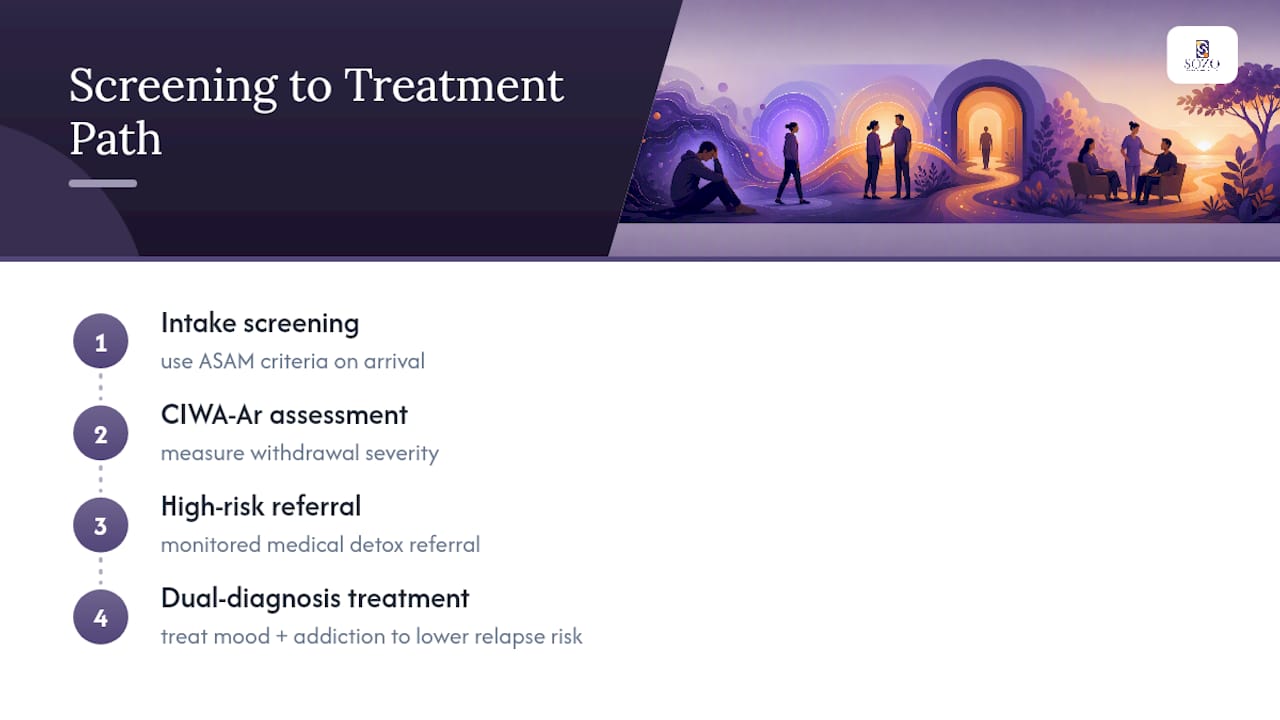
Programs built around ASAM criteria screen incoming clients for withdrawal risk before treatment begins, using tools like CIWA-Ar to decide who needs a monitored medical detox referral first. When mood symptoms persist past the acute phase, dual-diagnosis treatment lowers relapse risk considerably more than addressing addiction alone.
What the Research Actually Tells Us to Prioritize
Most guidance on alcohol withdrawal fixates on the seizure and DTs window, and for good reason. But the research suggests the bigger blind spot is what happens after day seven, when the physical crisis has passed and nobody’s watching as closely anymore.
The UNMC data showing that roughly a third of people in early sobriety experience meaningful anxiety or depression should reframe how families think about the first six weeks. The acute detox gets all the attention because it’s dramatic and time-boxed. The mood symptoms that follow are quieter, and quieter is exactly why they get missed until someone relapses.
Conventional advice tends to treat detox as the finish line. It isn’t. If anything, the data argues that screening for mood trajectory in week two or three matters as much as the CIWA-Ar score did in hour twelve. A person who isn’t improving by week four needs a different conversation than “give it time.” That’s where dual-diagnosis care earns its place, not as an add-on but as the piece most programs shortchange.
Ty
Get Supervised Detox Support at Sozorecoverycenter
If you’ve read this far because you or someone you love has a history of seizures, prior DTs, or a drinking pattern heavy enough to make solo detox risky, the honest answer is that you need eyes on you during the first 72 hours, not just good intentions. Sozorecoverycenter is built for exactly that gap: a faith-based men’s program in Hot Springs, Arkansas, that arranges medical detox placement referrals before treatment even begins, then moves clients into residential or outpatient dual-diagnosis care once the acute risk has passed.
Every plan starts with an ASAM-informed assessment, so the level of care matches actual risk instead of guesswork, and clients who need ongoing mood support get it through dual-diagnosis treatment paired with 12-step and biblical recovery principles rather than a program that treats detox as the whole job. Intake staff work with most major insurance carriers, including BlueCross BlueShield, Ambetter, and QualChoice, and can walk you through what your coverage looks like before you commit to anything. If you’re weighing whether now is the time, start the admissions process and talk through the first step with someone who can answer specific questions about your situation.
This article is general information, not a substitute for advice from a qualified doctor. Consult a qualified healthcare professional about your own circumstances before acting on anything here.
Sources
- One in three can’t escape anxiety and depression of early sobriety | UNMC Newsroom
- Alcohol withdrawal syndrome: NCBI Bookshelf (clinical review)
FAQ
How long does alcohol withdrawal usually last?
Physical symptoms typically peak between 24 and 72 hours and mostly resolve within five to seven days, though mood swings and disrupted sleep can linger well into weeks or months.
When does alcohol withdrawal peak?
Most people hit their most intense symptoms between 24 and 72 hours after the last drink, which is also when seizure and delirium tremens risk is highest.
What is PAWS in alcohol recovery?
Post-acute withdrawal syndrome refers to lingering mood swings, anxiety, and sleep disruption that can continue for weeks or months after the acute detox phase ends.
When should someone go to detox instead of quitting at home?
Anyone with a history of seizures or delirium tremens, heavy or long-term drinking, serious health conditions, or no reliable support at home should pursue medically monitored detox rather than stopping alone.
Is depression after detox normal?
Yes, mild to moderate mood symptoms are common in early sobriety, but close to 5% of people experience sustained depression or anxiety that benefits from dual-diagnosis treatment rather than waiting it out.