


Men-only rehab programs offer stronger peer bonding, greater emotional safety, gender-informed clinical care, integrated treatment for co-occurring mental health conditions, and scheduling that fits around a man’s job. SAMHSA’s TIP 56 outlines why these elements matter, and we built our program at SOZO Recovery Center around exactly this research.
TL;DR:
- Men-only treatment programs foster greater honesty and bond-building by reducing stigma and encouraging disclosure among men with shared experiences.
- Integrating on-site co-occurring mental health care and vocational support leads to higher retention and better long-term abstinence through structured, personalized treatment.
- Outpatient programs with flexible scheduling, including evening sessions, suit employed men better than residential care, which is reserved for those with higher withdrawal risks.
- Family therapy and addressing physical health issues like sleep and nutrition improve recovery motivation and reduce relapse triggers in early sobriety.
- Carefully screening and choosing programs with licensed staff, clear aftercare plans, and integrated dual diagnosis care increases chances of successful, sustained recovery.
Table of Contents
- 1. Why the Core Benefits of Men-Only Rehab Matter
- 2. What Research Says About These Benefits and Where Evidence Is Limited
- 3. How Men’s Programs Turn Research Into Daily Practice
- 4. How to Evaluate a Men’s Rehab Program Before You Commit
- 5. How SOZO Recovery Center Applies These Benefits
- 6. Why Physical Health Gets Attention Alongside Sobriety
- 7. How Rehab Reshapes a Man’s Role as a Father and Family Member
- 8. Why Stigma Keeps Men From Seeking Help
- 9. Which Men Benefit Most From a Men-Only Program
- Next Steps if You’re Considering Treatment at SOZO Recovery Center
- FAQ
- Sources
1. Why the Core Benefits of Men-Only Rehab Matter
A man walking into treatment for the first time carries more than a substance use problem. He often carries years of learned silence, a reluctance to name what hurts, and a deep discomfort with appearing weak in front of others. Men-only programs are structured around that reality rather than against it.
- Relatability and peer bonding. When the man across the circle has faced the same pressures, the same silence, and the same shame, disclosure comes easier. A group of men who have all hidden a drinking problem from coworkers or lied to a spouse about pills recognizes itself in each other’s stories, and that recognition lowers the walls that stigma builds.
- Emotional safety and fewer distractions. Removing romantic dynamics from the treatment environment lets men focus on the work instead of managing attraction, jealousy, or old relationship patterns that can surface in mixed settings. That safety extends to physical boundaries and privacy, which matters for men working through trauma.
- Gender-informed clinical approaches. Men frequently express depression, grief, or trauma as irritability, anger, or withdrawal rather than sadness. TIP 56 notes that effective programs adapt relapse-prevention and motivational strategies to account for this pattern, often favoring direct, action-oriented approaches alongside individual counseling rather than relying on group work alone.
- Integrated dual diagnosis care. Treating a mental health condition alongside substance use reduces the odds of relapse, since an untreated anxiety disorder or undiagnosed PTSD often becomes the trigger that pulls a man back to using.
- Vocational support and structure. Programs that help men rebuild work identity and confidence see better completion rates, because a return to steady employment gives recovery a tangible purpose beyond sobriety itself.
- Aftercare continuity. Sober living homes, alumni networks, and ongoing family sessions extend the gains made during active treatment into the months when relapse risk is highest.
Pro Tip: Ask your treatment team how group sessions encourage participation rather than just scheduling them. Men often need direct prompts and structured turns to speak, not just an open floor.
Pro Tip: When evaluating vocational supports, ask whether staff help with resume building and job search during treatment or only after discharge. Earlier support tends to translate into steadier employment outcomes.
2. What Research Says About These Benefits and Where Evidence Is Limited
The case for men-only treatment rests on a handful of government and clinical sources that converge on similar conclusions.
- SAMHSA’s TIP 56 ties better outcomes to programs that integrate individual counseling and vocational support alongside group therapy, and it links employment improvement during treatment to higher completion rates and better abstinence outcomes.
- SAMHSA’s advisory on intensive outpatient treatment finds that flexible scheduling and vocational support improve engagement, and that outcomes for appropriately placed clients can be comparable to residential care.
- NCBI’s review of treatment modalities reports that group therapy performs about as well as individual therapy for many substance use disorders, but notes that men in programs offering weekly individual counseling showed significantly lower substance use twelve months after treatment, according to the National Treatment Improvement Evaluation Study.
Men who receive weekly individual counseling alongside group work show measurably lower substance use a year after treatment, based on findings summarized by NCBI. That gap is worth asking about when comparing programs that lean entirely on group formats.
None of this evidence proves that men-only treatment outperforms mixed-gender care in every case. Much of it is observational, drawn from program evaluations rather than randomized trials, and it describes associations between program features and outcomes rather than guaranteed causes. The honest takeaway is that gender-specific design, individual counseling, and vocational integration are consistently linked to stronger outcomes for men, even if no single study proves the mechanism beyond doubt.
3. How Men’s Programs Turn Research Into Daily Practice
The benefits described above come from specific, observable program features, not vague philosophy. Here is what to look for and why each piece exists.
- Gender-specific group design reduces the self-censoring that happens when men worry about how disclosures will land with women present, which in turn increases honest participation.
- Trauma-informed staff training helps clinicians recognize anger or detachment as possible trauma responses rather than simple defiance, which SAMHSA’s resource on men and depression identifies as a common pattern.
- Dual-diagnosis clinicians on staff mean a co-occurring condition gets diagnosed and treated in the same setting as the addiction, instead of being referred out and lost to follow-up.
- Flexible IOP scheduling, including evening sessions, lets a man keep his job while attending treatment several times a week.
- Vocational services connect treatment directly to resume work, interview practice, or job placement support.
- Family and couples therapy rebuilds trust with people a man’s addiction affected most, without requiring that work to happen inside mixed treatment groups.
Each feature trades off against something else. Residential treatment offers the deepest immersion and fewest outside pressures, but it asks a man to step away from work and family for a period. Outpatient formats preserve more of daily life but demand more self-direction. Neither is categorically superior. The right fit depends on withdrawal risk, home environment stability, and how much structure a man needs to stay engaged.
4. How to Evaluate a Men’s Rehab Program Before You Commit
Six questions separate a program built on this evidence from one that only markets itself that way.
- Does the clinical staff diagnose and treat co-occurring mental health conditions on-site, or refer them elsewhere?
- How are groups composed and facilitated, and what training do facilitators have in working with men specifically?
- What credentials do counselors and medical staff hold, and are they licensed in the state where care is delivered?
- What does aftercare look like after discharge, including sober living and alumni support?
- Can treatment intensity step down from residential to partial hospitalization to intensive outpatient without starting over at a new facility?
- What vocational or employment support exists during treatment, not just after?
Residential care tends to fit men with significant withdrawal risk, unstable housing, or a home environment that works against recovery. Intensive outpatient fits men who are medically stable, have a supportive home, and need to keep working or caring for family while in treatment, a placement approach consistent with the ASAM continuum of matching intensity to individual need. Watch for admissions teams that promise a guaranteed outcome or skip a real clinical assessment before placement. Those are warning signs, not confidence.
Pro Tip: Ask directly how the program involves family during treatment and what the handoff to aftercare looks like on paper, not just in conversation.
5. How SOZO Recovery Center Applies These Benefits
Our program at SOZO Recovery Center offers residential treatment, partial hospitalization, intensive outpatient, outpatient, sober living, and dual diagnosis care built around the ASAM criteria, which means placement is based on individual clinical need rather than a single fixed path. We built our intensive outpatient program with scheduling flexibility in mind, so employed men can keep working while attending structured sessions. Every program integrates biblical principles with the 12-step model, giving men a faith-centered framework alongside clinical dual diagnosis care in a small, men-only setting.
6. Why Physical Health Gets Attention Alongside Sobriety
Addiction takes a toll on the body that recovery alone does not automatically reverse. Men entering treatment often carry undiagnosed sleep disorders, poor cardiovascular markers from years of substance use, and nutritional deficits that sap energy and mood during early recovery. A program that only addresses the psychological and spiritual side of addiction misses a piece that affects how a man feels day to day.
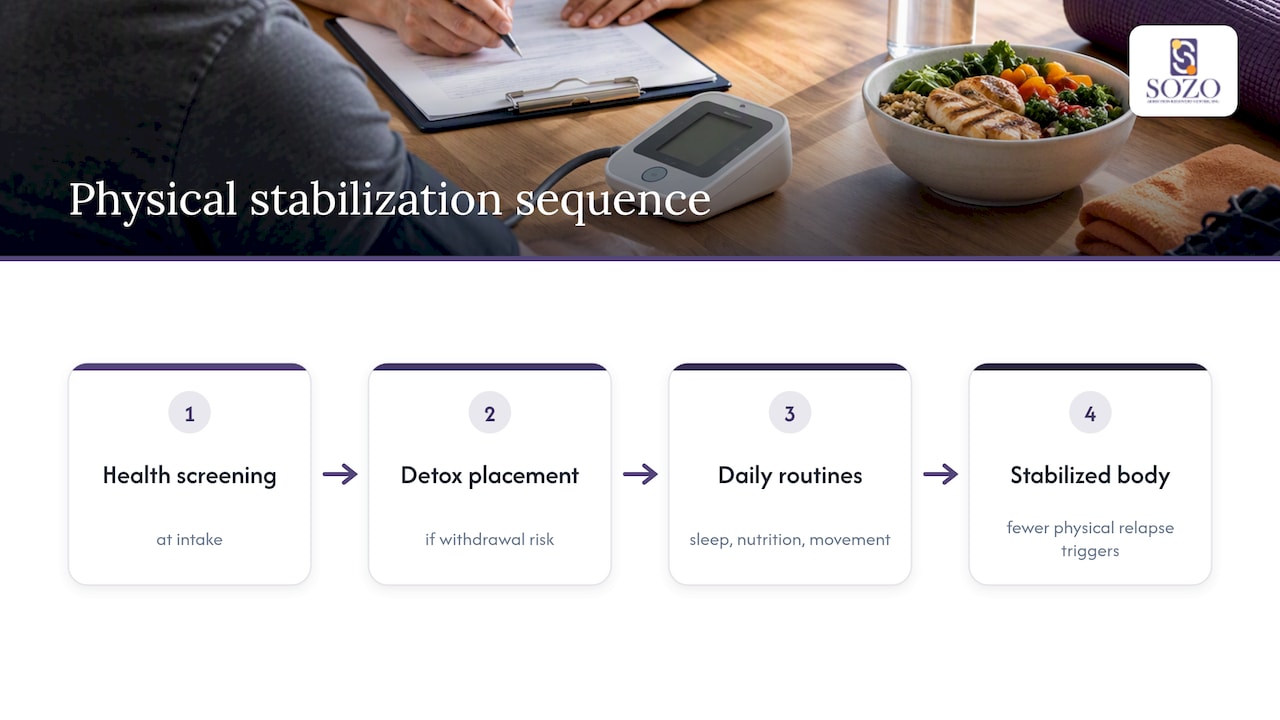
Physical health screening at intake, access to medical detox placement when withdrawal risk requires it, and structured routines around sleep, nutrition, and movement give the body a chance to stabilize alongside the mind. This matters because physical discomfort, whether it is fatigue, poor sleep, or lingering withdrawal symptoms, is a common relapse trigger in early sobriety. Addressing it directly, rather than treating it as secondary to the “real” work of recovery, gives a man one less obstacle standing between him and a steady routine. Men’s programs that build physical wellness into daily structure, not just as an afterthought, tend to produce men who leave treatment with more stamina for the harder emotional work still ahead.
7. How Rehab Reshapes a Man’s Role as a Father and Family Member
Addiction rarely stays contained to the person using. Children notice absence, unpredictability, and broken promises long before they understand the cause, and spouses carry the weight of covering for a partner who is not present even when he is in the room. Treatment that addresses this directly, rather than leaving it for a man to sort out alone after discharge, changes what recovery means to the people who depend on him.
Family therapy sessions built into treatment give a man practical tools to rebuild trust rather than just apologize for the past. Resources on faith-based family counseling point to the role that shared values and structured communication play in repairing a marriage strained by addiction, a dynamic that applies directly to fatherhood as well. A man who completes treatment with a clearer sense of what fatherhood requires of him, consistency, presence, and follow-through, often finds that his relationship with his children becomes one of the strongest motivators for staying sober. Programs that treat family repair as part of clinical care, not an optional add-on, tend to see that motivation translate into longer-term engagement with recovery.

8. Why Stigma Keeps Men From Seeking Help
Many men delay treatment for months or years because asking for help feels like an admission of weakness, a message reinforced by cultural expectations that men handle problems alone. That hesitation is not a personal failing so much as a predictable response to the pressure described in SAMHSA’s guidance on men’s behavioral health needs, which identifies gender role stress as a real barrier to men entering care.
Men-only environments lower that barrier in a direct way: there is no audience of women to perform strength in front of, which for many men removes one layer of the pressure that kept them from admitting the problem existed. Confidential intake processes, privacy around work and family obligations, and admissions conversations that focus on practical next steps rather than judgment all chip away at the hesitation that keeps men on the sidelines. The goal is not to erase stigma entirely but to build a path into treatment that does not require a man to clear that hurdle before he can get help.
9. Which Men Benefit Most From a Men-Only Program
In our experience, men-only treatment fits best for those whose struggle is tangled up with masculinity itself: the executive who cannot admit vulnerability at work, the father who expresses grief as anger, the man who needs his job intact while he gets care. Mixed-gender treatment can be the better fit for men whose trauma involves same-gender perpetrators or who simply respond better in that setting. If you are unsure which category describes you, the screening checklist above is the place to start.
Next Steps if You’re Considering Treatment at SOZO Recovery Center
Choosing a program comes down to matching the level of care to where you actually are right now, not where you think you should be.
- Residential treatment fits higher-intensity needs where stepping away from daily life gives recovery room to take hold.
- Intensive outpatient works for employed men who need structured treatment without leaving the job behind, with evening scheduling built around a full-time week.
- Sober living supports the transition after primary treatment, extending structure into daily independent life.
- Dual diagnosis care addresses a co-occurring mental health condition alongside addiction in the same clinical plan.
Reaching out starts with a confidential conversation, by phone or through our website, where our team walks through your situation and points you toward the level of care that fits. If you are ready to talk through options for yourself or someone you love, you can explore our residential treatment program or reach out directly to begin the intake conversation.
This article is general information, not a substitute for advice from a qualified doctor. Consult a qualified healthcare professional about your own circumstances before acting on anything here.
FAQ
What are the benefits of going to rehab?
Rehab gives you structured clinical care for addiction, often paired with treatment for co-occurring mental health conditions, along with peer support and relapse-prevention skills you build with trained staff. SAMHSA’s guidance ties integrated individual counseling, group work, and vocational support to stronger completion and abstinence outcomes.
Is therapy beneficial for men?
Yes, though men often respond best to a mix of individual counseling and group therapy rather than group work alone. Research summarized by NCBI found men receiving weekly individual counseling had lower substance use twelve months after treatment.
What is a men’s recovery home?
A men’s recovery home, often called sober living, is a structured residence for men who have completed primary treatment and need ongoing accountability and community while rebuilding daily routines. It typically includes house rules, peer support, and connections to ongoing outpatient care or alumni networks.
How long does the average person stay in rehab?
Length of stay depends on individual clinical need and the level of care, ranging from several weeks in residential treatment to months of step-down outpatient support. Placement decisions are generally guided by frameworks like the ASAM continuum, which matches treatment intensity and duration to a person’s specific risks and progress.