


Spiritual relapse happens when a person in recovery drifts from the beliefs, practices, and sense of purpose that supported their sobriety, often well before any substance returns. Research tied to the Drug Abuse Treatment Outcome Study found that stronger religious and spiritual engagement was associated with less substance use across several substances, which means this quiet drift matters. It is reversible, and catching it early, alongside clinical care, is what keeps it from becoming something harder to recover from.
TL;DR:
- Spiritual relapse often begins with subtle pattern changes like skipping routines, avoiding community, and losing purpose, which can last weeks before substance use resumes.
- Continued spiritual engagement, especially weekly religious service attendance, is associated with less substance use, but its protective effect diminishes without ongoing support.
- Practicing active spiritual habits such as gratitude, service, or mindfulness daily significantly improves recovery outcomes, but consistency over time is crucial.
- Combining spiritual practices with clinical treatment, including therapy and medication, offers the most effective prevention for relapse, especially for co-occurring mental health conditions.
- A written, personalized relapse prevention plan that addresses triggers, routines, contacts, and ongoing care can catch early warning signs and prevent full relapse.
Table of Contents
- What spiritual relapse looks like: signs and early stages
- Research snapshot: what NIDA, DATOS, and SAMHSA show
- A step-by-step spiritual relapse prevention plan you can write
- Spiritual practices tied to better outcomes
- Integrating spiritual care with clinical treatment and safety planning
- How SOZO Recovery Center puts spiritual relapse prevention into practice
- The role of personal belief and individual differences in spiritual relapse risk
- Trauma, mental health, and spiritual relapse
- Real examples of spiritual relapse and recovery
- How to engage a spiritual counselor or mentor effectively
- Why shame-based messaging increases relapse risk
- Author perspective and compassionate next steps
- How SOZO Recovery Center supports faith-integrated relapse prevention
- FAQ
- Sources
What spiritual relapse looks like: signs and early stages
Spiritual relapse is not the same as a substance lapse. A substance lapse is a single use after a period of abstinence. A full relapse is a return to a pattern of use. Spiritual relapse sits before both of these. It is the erosion of the inner resources, routines, and relationships that make sobriety sustainable, and it can go on for weeks before a man picks up again.
We think of it as a slow leak rather than a sudden break. A man stops praying or meditating most mornings. He skips a meeting, then another, telling himself he is busy. He stops calling his sponsor or mentor, and the silence starts to feel normal. None of this looks dangerous in isolation. Together, it strips away the structure that kept him steady. This drift can look like the signs of a dry drunk in a man who has stopped drinking.
The warning signs tend to cluster in a recognizable pattern:
- Dropping daily routines like prayer, meditation, or quiet reflection without replacing them with anything
- Avoiding fellowship, meetings, or church community, often with excuses that sound reasonable
- Losing a sense of purpose or direction, describing recovery as something to get through rather than something meaningful
- Increased secrecy about thoughts, struggles, or daily choices
- Persistent shame or self-criticism that goes unspoken and unaddressed
Any one of these signs on its own is not a crisis. A man can have an off week. What matters is the pattern: when two or three of these signs show up together and last more than a week or two, that is the moment to treat it as an early warning rather than a passing mood. A simple self-check, done weekly, can catch this long before it becomes a substance problem. Ask whether this week looked like a typical recovery week or whether something quietly slipped.
Research snapshot: what NIDA, DATOS, and SAMHSA show
The evidence connecting spirituality to relapse risk is strong enough to take seriously, though it comes with real limits worth naming plainly.
The most cited evidence comes from the Drug Abuse Treatment Outcome Study, a large federal study whose data was analyzed for links between religiosity, spirituality, and substance use outcomes. Participants with stronger spiritual and religious engagement reported notably less substance use than nonspiritual participants, with weekly attendance at religious services showing the strongest association, according to the DATOS analysis. Crack cocaine use was a notable exception to this pattern. The study design was observational, which means it shows an association rather than proof that spirituality alone caused the lower use. Still, the consistency across alcohol, cocaine, heroin, and marijuana makes it one of the more durable findings in this field.
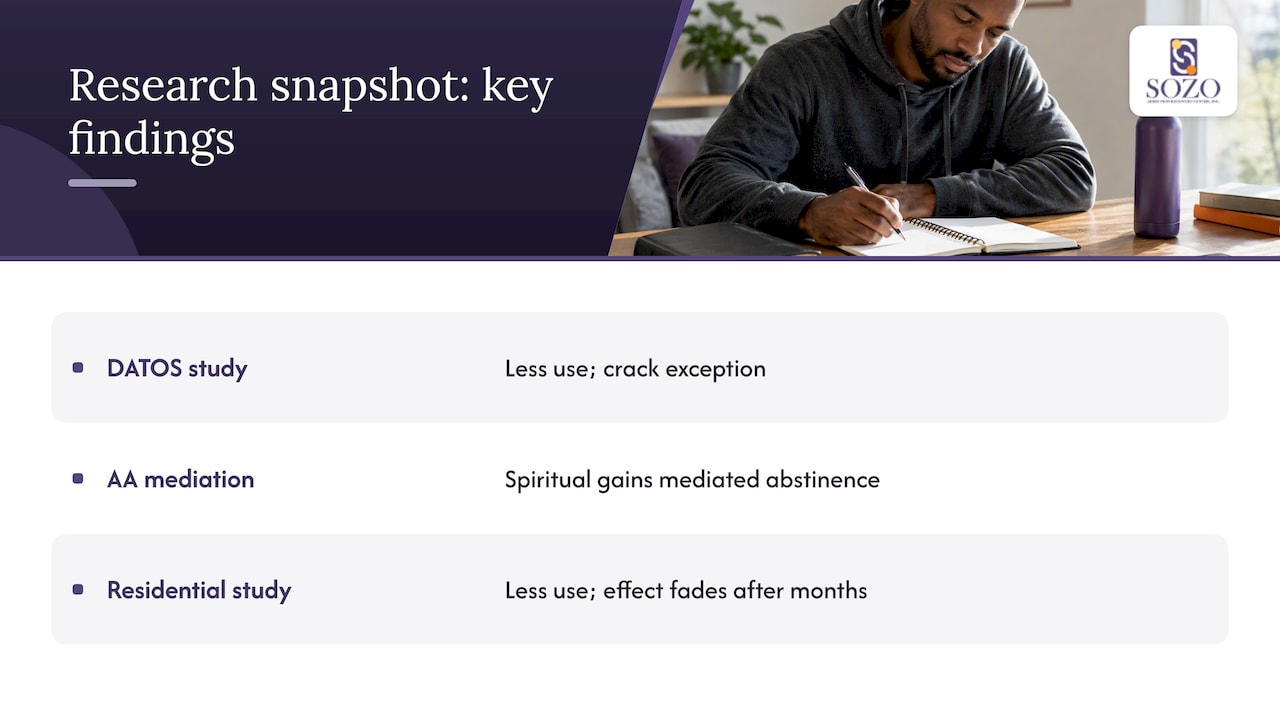
A separate line of research looked at why twelve step involvement helps people stay sober. A study following participants found that gains in spiritual practices mediated the relationship between AA involvement and improved abstinence outcomes, tracking percent days abstinent and drinks per drinking day across 246 participants. In plain terms, attending meetings alone was not what helped. What helped was the spiritual practice that meeting attendance tended to build: gratitude, humility, service, and a changed relationship to one’s own will. That distinction shapes how we think about prevention. The practices are the mechanism, not just the meetings.
A third study, following 262 adults entering residential treatment, found that higher spiritual well-being predicted less frequent substance use during early recovery, but the effect diminished by about three and a half months after treatment without continued support. This is the caveat that matters most for prevention planning: spiritual well-being is not a one-time inoculation. It fades without maintenance, the same way physical conditioning fades without continued exercise.
Addiction involves brain circuits for reward, stress, and self-control, and relapse is often a signal that treatment needs to be adjusted rather than a sign of moral failing.
National Institute on Drug Abuse
NIDA’s own explanation of addiction is the frame that should sit underneath all of this: spiritual practices may strengthen coping and connection, but they do not replace evidence-based treatment, and they cannot substitute for care of a co-occurring mental health condition. Spirituality is an adjunct. It works alongside clinical care, never instead of it.
A step-by-step spiritual relapse prevention plan you can write
A written plan beats a mental intention every time, because intentions fade under stress and a piece of paper does not. SAMHSA’s own relapse prevention guidance lays out the core elements, and we recommend building yours around five parts.
- Name your triggers. List the specific situations, people, emotions, or times of day that tend to pull you away from your practices. Example: Sunday evenings, after visiting family, when work stress peaks.
- Write a recovery goal in your own words. Not “stay sober,” which is too broad to act on, but something like “pray or sit in silence for ten minutes before checking my phone each morning.”
- List your daily and weekly practices. Be specific and measurable. Example: Morning prayer five days a week, one meeting or service attendance weekly, one call to a sponsor or mentor every Sunday.
- Name your contacts. Write down the actual names and numbers of the people you will call when a trigger hits, not just “someone from the group.” A sponsor, a pastor, a counselor, a sober friend.
- Schedule your continuing care before you need it. Put your next counseling appointment, your next step meeting, and your next check-in with a spiritual mentor on the calendar now, not when things start slipping.
Review the plan every two to four weeks, even when things feel steady. A plan written once and filed away loses its usefulness fast. A plan revisited regularly stays matched to where you actually are.
Pro Tip: Keep the plan on one page, somewhere you will actually see it: a phone note, a card in your wallet, taped inside a journal. A plan you have to search for is a plan you will not use in a hard moment.
When a lapse does happen, whether spiritual or substance related, the plan should include what to do next. That means calling a contact within 24 hours, being honest rather than minimizing what happened, and scheduling a check-in with a counselor or spiritual mentor rather than waiting to see if things improve on their own. Waiting is usually where a small slip turns into something bigger.
Spiritual practices tied to better outcomes
The research points to a short list of practices that show up again and again, and the common thread is that they are active, not passive. Reading about gratitude does not build gratitude. Practicing it does.
- Community and fellowship: social bonding through meetings, church, or peer groups gives a man accountability and belonging that willpower alone cannot provide.
- Gratitude: a short daily list of specific things, not general ones, trains attention away from grievance and scarcity.
- Forgiveness: of others and of oneself, which research on twelve step mediation suggests is one of the practices that actually drives improved outcomes, not just attendance.
- Service: helping another person in recovery shifts focus outward and reinforces a sense of purpose.
- Humility: regularly acknowledging limits and asking for help, which counters the isolation that often precedes relapse.
- Mindfulness and loving-kindness meditation: secular practices with evidence supporting their use for stress reduction, useful for men who do not identify with a specific faith tradition but still want structured reflection.
Pro Tip: Pick one practice from this list and do it daily for two weeks before adding a second. Spreading five new habits across one week usually means none of them stick.
The right mix depends on the man. Someone grounded in a specific faith tradition will build around prayer, scripture, and worship community. Someone who does not identify as religious can build the same structure around mindfulness, service, and secular fellowship. The content of the practice matters less than the consistency of showing up to it. Twelve step alternatives exist for men whose beliefs do not fit the traditional model, and choosing a path that actually matches what you believe makes the daily practices easier to sustain than forcing a fit that does not feel honest.
Integrating spiritual care with clinical treatment and safety planning
Spiritual practice works best when it sits inside a clinical framework rather than apart from one. SAMHSA’s recovery guidance frames recovery around four dimensions: health, home, purpose, and community, and spiritual relapse prevention touches all four. A written plan that only addresses prayer or meeting attendance but ignores medication management, therapy appointments, or housing stability is missing half the picture.
Certain moments call for escalating to clinical reassessment rather than relying on spiritual support alone:
- A lapse into substance use, however brief, warrants a same-week check in with a counselor or treatment provider.
- A sudden drop in mood, sleep, or functioning alongside spiritual withdrawal may point to an untreated mental health condition that needs medication review.
- Persistent thoughts of self-harm or hopelessness require immediate clinical contact, not just spiritual counsel.
- A pattern of isolation lasting more than two weeks is a signal to involve both a clinician and a trusted spiritual contact at the same time.
Clergy and spiritual mentors serve recovery best when they coordinate with clinicians rather than operate as a separate track. A pastor who knows a man is also seeing a therapist for trauma, and who checks in with that broader plan in mind, supports recovery more effectively than one working from faith alone. Shared continuing care items work well in practice: a weekly counseling session paired with a weekly meeting with a spiritual mentor, both tracking the same written relapse prevention plan, both aware of the other’s role.
How SOZO Recovery Center puts spiritual relapse prevention into practice
We built our program around the belief that spiritual care and clinical care should never run on separate tracks. Every man who comes through our residential treatment program gets a treatment plan informed by ASAM criteria, addressing both addiction and any co-occurring mental health condition, alongside structured spiritual mentoring that treats faith as a working part of recovery rather than an afterthought.
Our approach to merging spiritual and therapeutic practices means a man leaves with more than a discharge summary. He leaves with a written relapse prevention plan, a relationship with a spiritual mentor who understands his clinical history, and a daily rhythm of practices built during treatment rather than assembled after the fact. We pair this with structured spiritual guidance that continues into sober living and outpatient care, so the routines built in residential treatment do not disappear the day a man walks out the door.
Service work and community engagement are part of the structure, not an extra, because research on twelve step mediation and spiritual well-being point to the same conclusion: practices sustained together outlast practices attempted alone.
The role of personal belief and individual differences in spiritual relapse risk
Spiritual relapse risk is not identical from one man to the next, because the beliefs underneath recovery are not identical either. A man raised in a specific faith tradition may experience spiritual relapse as a drift from prayer and scripture. A man without a religious background may experience something functionally similar: a loss of meaning, purpose, or connection to something larger than his own cravings, even without religious language attached to it.
This is part of why the DATOS findings, strong as they are, come with limits. The study measured religiosity and spirituality broadly, and individual variation in how deeply held a belief is, how it was formed, and whether it was imposed or chosen all shape how protective it actually is. A belief system adopted under family pressure tends to offer less resilience than one a man has worked through and claimed as his own.
The practical takeaway is that a prevention plan copied from someone else rarely holds. The specific practices, language, and community a man chooses should reflect what he genuinely believes, not what looks right on paper. A plan built on borrowed conviction is the first thing to slip when stress arrives.
Trauma, mental health, and spiritual relapse
Unaddressed trauma and mental health conditions are some of the strongest drivers of spiritual relapse, because both tend to produce the same symptoms: isolation, shame, loss of purpose, and a diminished capacity for the trust that spiritual community requires.
NIDA’s research on addiction describes stress as one of the core contributors to relapse, operating through the same brain circuits involved in reward and self-control. Trauma keeps those stress circuits activated long after the original event, which means a man carrying unprocessed trauma is working against a harder baseline even before any spiritual or substance trigger appears. Spiritual practice can help regulate some of that stress, but it is not a substitute for trauma-focused therapy when trauma is driving the pattern.
This is where dual diagnosis care matters. A man whose spiritual withdrawal is actually a symptom of untreated depression, anxiety, or post-traumatic stress needs that condition named and treated clinically, not just addressed through more prayer or more meetings. Spiritual practice works best as a companion to that treatment, offering meaning and community while clinical care addresses the underlying condition directly.
Real examples of spiritual relapse and recovery
A common pattern looks like this: a man finishes residential treatment feeling strong, attends meetings faithfully for the first month, then gradually lets his morning prayer routine slide as work picks back up. He tells himself he is still fine because he has not used. Three months later, following the pattern the residential well-being study found, his sense of purpose has faded along with his routines, and he feels flat rather than grateful. He has not relapsed on substances, but the spiritual ground underneath his sobriety has thinned.
What changes the trajectory in cases like this is almost always the same: someone notices and says something. A sponsor who asks directly why meetings have stopped. A mentor who names the drop in energy before it becomes a crisis. A written plan that flagged the warning signs early enough to act on them.
The men who recover from a spiritual relapse without a substance slip are rarely the ones who willed their way back. They are the ones who treated the warning signs as real information, reached out before shame took over, and rebuilt the routine deliberately rather than waiting for motivation to return on its own.
How to engage a spiritual counselor or mentor effectively
A spiritual mentor works best when the relationship has structure, not just goodwill. Look for someone who will ask direct questions about your actual practices, not just your general state of mind, and who is willing to coordinate with your clinical team rather than operate separately from it.
A few things make this relationship more effective:
- Share your written relapse prevention plan with your mentor so the conversations have something concrete to track.
- Set a regular meeting cadence, weekly or biweekly, rather than only reaching out during a crisis.
- Be specific about what kind of support you need: accountability, scripture study, prayer partnership, or simply someone checking whether you showed up to your routines.
- Give your mentor permission to ask hard questions and to follow up when you go quiet.
A good mentor will also recognize when something is outside their role and point you back toward a counselor or clinician. That handoff is a sign of a healthy relationship, not a failure of the spiritual support itself. For men exploring faith-based trauma competencies, resources like SAMHSA’s trauma-informed principles for ministry give clergy and mentors a framework for recognizing when a deeper clinical need sits underneath a spiritual struggle.
Why shame-based messaging increases relapse risk
Punitive spiritual messaging, the kind that frames struggle or relapse as evidence of weak faith or moral failure, tends to make relapse more likely rather than less. Shame drives secrecy, and secrecy is one of the clearest early warning signs of spiritual relapse described earlier in this article. A man who believes disclosure will bring judgment stops disclosing, and the practices that depend on honest community, confession, accountability, service, start to erode quietly.
SAMHSA’s guidance for clergy and pastoral ministers explicitly encourages collaboration with treatment professionals and warns against shame-based approaches, recommending instead that spiritual leaders respond to struggle with the same compassion NIDA recommends for clinical relapse: treat it as information, not as proof of failure.
Safer pastoral practice looks like this: clergy and mentors who ask open questions rather than deliver verdicts, who normalize struggle as part of a recovery process rather than treating it as disqualifying, and who actively refer a man to clinical care when the struggle points toward something deeper than a spiritual lapse. The goal of a spiritual mentor is to keep the door open, not to guard it.
Author perspective and compassionate next steps
Spiritual relapse is not a verdict on anyone’s character. It is a signal, the same way a check engine light is a signal, and the men who do best are the ones who treat it that way rather than as proof they were never really going to make it.
If you notice the signs in yourself today, we would ask you to do three small things before the day ends: write down one recovery value that still matters to you, call one person you trust and tell them honestly where you are, and put one spiritual practice on tomorrow’s calendar, even a small one. None of that fixes everything. It restarts the structure.
Ty
How SOZO Recovery Center supports faith-integrated relapse prevention
We built our programs around the conviction that spiritual relapse prevention works best when it is written into clinical treatment from the start, not added on afterward. Each level of care maps to a different part of the prevention plan described throughout this article:
- Residential treatment builds the daily practices and written relapse prevention plan in a structured, distraction-free setting.
- Partial hospitalization and intensive outpatient keep clinical and spiritual support active while a man rebuilds independence.
- Sober living reinforces routines and fellowship in a lower-intensity, community-based environment.
- Dual diagnosis care addresses co-occurring mental health conditions that often sit underneath spiritual withdrawal.
If any part of this article describes where you are right now, reach out and talk with our admissions team about residential treatment or whichever level of care fits your situation. A conversation costs you nothing but a few minutes, and it is the first concrete step toward a plan built specifically for you.
FAQ
What are the three stages of relapse in addiction?
Clinicians generally describe relapse as emotional, mental, and physical stages, where emotional relapse involves withdrawal and poor self-care, mental relapse involves active thoughts of using, and physical relapse is the act itself. Spiritual relapse often overlaps with the emotional stage, showing up as withdrawal from routines and community before any thoughts of substance use appear.
Why do people relapse after years of sobriety?
Long-term sobriety can bring a false sense of security that leads to dropping protective routines like meetings, prayer, or check-ins with a sponsor, which the residential well-being study suggests fade without ongoing reinforcement. Stress, unaddressed trauma, and untreated mental health conditions can also resurface years later and erode the spiritual and practical supports that kept someone stable.
How many times do people relapse before recovery sticks?
There is no fixed number, since recovery is highly individual and addiction is understood as a chronic, relapsing condition according to NIDA. What matters more than the count is whether each setback leads to an adjusted treatment and spiritual plan rather than being treated as a final failure.
Is relapse a part of recovery?
Relapse is common enough that clinical guidance treats it as a signal to adjust care rather than evidence that treatment failed, consistent with NIDA’s framing of addiction as a chronic disorder. Spiritual relapse, specifically, is considered a reversible warning sign that, when caught early and addressed alongside clinical support, does not have to lead to a substance relapse at all.
Sources
- NIDA-Drug Addiction Treatment Outcome Study (DATOS) Relapse as a Function of Spirituality/Religiosity
- About Recovery | SAMHSA
- Drugs, brains, and behavior: The science of addiction | NIDA