


Inhalers used as prescribed, including albuterol rescue inhalers, are not chemically or clinically addictive. That is the clear clinical consensus. A man who reaches for his rescue inhaler during an asthma flare is not feeding an addiction; he is treating a medical condition. That said, two related issues deserve honest attention: physiological dependence and recreational misuse. Both are real, both carry risks, and both can intersect with broader substance or behavioral health concerns. If you are a man navigating recovery and wondering whether your inhaler use is part of a larger pattern, this guide is written for you. Sozorecoverycenter is available to support men whose inhaler concerns overlap with addiction or mental health challenges.
Table of Contents
- Are inhalers addictive, or is something else going on?
- How albuterol rescue inhalers work and what overuse actually signals
- What inhaled corticosteroids do and how they can affect your mood
- Recreational misuse of inhalers: what it looks like and why it matters
- Red flags that suggest you need professional support
- How clinicians typically respond to inhaler overuse
- Practical tips for using inhalers safely every day
- Key Takeaways
- Why whole-person care changes everything for men in this situation
- A perspective worth sitting with
- Sozorecoverycenter’s dual-diagnosis programs for men
- Useful sources and further reading
- FAQ
Are inhalers addictive, or is something else going on?
Understanding the difference between addiction, dependence, and tolerance is the foundation of this entire conversation.
Addiction is compulsive drug-seeking behavior that continues despite serious negative consequences, driven by changes in brain reward pathways. Physiological dependence means the body has adapted to a substance and may respond with withdrawal if it is removed suddenly. Tolerance means a person needs more of a substance over time to achieve the same effect.
Using an albuterol inhaler regularly does not meet the clinical definition of addiction. A man whose asthma is poorly controlled may feel he cannot breathe without his rescue inhaler nearby. That feeling is real, but it reflects inadequate disease management, not a pharmacological addiction. The distinction matters because the clinical fix is different: adjust the maintenance therapy, not the behavior.
- Addiction: compulsive use despite harm, driven by reward-circuit changes
- Physiological dependence: body adaptation with potential withdrawal (seen with corticosteroids, not albuterol)
- Tolerance: diminishing response requiring higher doses over time
- Psychological reliance: using a rescue inhaler more than needed because anxiety about breathing drives the behavior
The ASAM Continuum model, which guides dual-diagnosis care at Sozorecoverycenter, draws exactly these distinctions when assessing whether a man needs addiction treatment versus medical management.
How albuterol rescue inhalers work and what overuse actually signals
Albuterol is a short-acting beta-2 agonist. It relaxes the muscles around the airways within minutes, opening them up during an acute asthma episode. Used as prescribed, it is not chemically addictive. The problem arises when a man reaches for it more and more often, not because he is chasing a high, but because his underlying asthma is out of control.

Approximately 25% of albuterol users take more than is prescribed or clinically needed. That figure points to a widespread gap between prescribed use and real-world behavior.
| Rescue Inhaler Use Pattern | Clinical Meaning | Recommended Action |
|---|---|---|
| As needed, fewer than 2 days/week | Well-controlled asthma | Continue current plan |
| 3 or more days/week | Poor asthma control; higher ED risk | See clinician; review maintenance therapy |
| Daily or multiple times daily | Severely uncontrolled; possible misuse | Urgent medical evaluation |
| Borrowed from others or used without diagnosis | Possible recreational misuse | Addiction screening warranted |
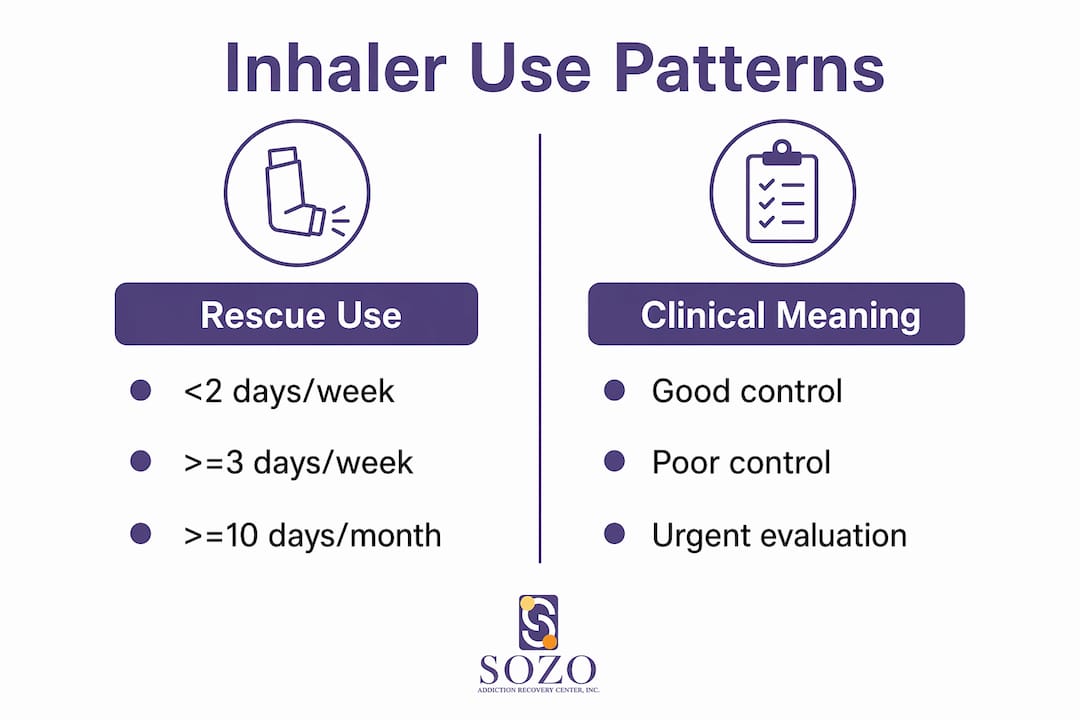
Using a rescue inhaler three or more days per week is a recognized clinical threshold that signals poor asthma control and a significantly higher risk of emergency department visits and hospitalizations. The cycle is self-reinforcing: poor control leads to more rescue use, which can worsen symptoms over time, which leads to even more use.
Pro Tip: Keep a simple log, even a note on your phone, recording every time you use your rescue inhaler. Share that log at every medical appointment. Frequency data is one of the clearest signals a clinician has for adjusting your care plan.
What inhaled corticosteroids do and how they can affect your mood
Inhaled corticosteroids (ICS), such as fluticasone or budesonide, are controller medications, not rescue drugs. They reduce airway inflammation over time and are the FDA-indicated first-line treatment for persistent asthma. They do not cause addiction. However, at higher doses or with poor inhaler technique, they can produce systemic effects that matter for men managing co-occurring mental health conditions.
Clinicians recommend using the lowest effective ICS dose and proper technique to minimize systemic exposure. Key side effects to watch for include:
- Adrenal suppression: high-dose ICS can suppress the hypothalamic-pituitary-adrenal axis, affecting cortisol levels and stress response
- Mood changes: some patients report irritability or low mood, particularly with fluticasone at higher doses
- Oral candidiasis: preventable by rinsing the mouth after each use
- Dysphonia: voice changes from laryngeal muscle effects, reported in a significant proportion of ICS users per NCBI StatPearls data
- Bone density effects: relevant for long-term, high-dose use
If you notice mood shifts after starting or increasing an ICS, tell your prescribing clinician. Do not stop the medication suddenly, as abrupt discontinuation of high-dose ICS can trigger adrenal insufficiency.
Recreational misuse of inhalers: what it looks like and why it matters
Recreational inhaler misuse is a distinct clinical problem, separate from prescribed therapeutic use. Some individuals inhale the propellant from metered-dose inhalers to achieve a brief euphoric or dissociative effect. Others use albuterol at extreme doses seeking stimulant-like sensations. Neither practice is safe, and both carry serious medical risks.
In a sample of youth, 23.6% of those who had used an asthma inhaler reported using it to get high, representing 88 of 373 participants surveyed.
That figure reflects a pattern seen in clinical literature: inhaler misuse clusters with other substance use. Adolescents and high-risk groups who misuse inhalers are more likely to smoke cigarettes and marijuana, binge drink, and report greater psychiatric distress. Misuse is rarely an isolated behavior.
Acute medical harms from extreme inhaler abuse include:
- Cardiac arrhythmias and tachycardia
- Hallucinations and psychosis
- Hypokalemia (dangerously low potassium)
- Aggression and behavioral dysregulation
Clinical case literature documents extreme overuse, involving many dozens of doses daily, with symptoms including aggression, hallucinations, and electrolyte disturbances. These are not theoretical risks. Men with prior substance use disorders may be at higher risk for this kind of diversion, which is why safe-storage guidance and substance-use screening belong in any dual-diagnosis care plan.
Red flags that suggest you need professional support
Not every man who uses his rescue inhaler frequently has an addiction problem. But certain patterns warrant a conversation with a clinician or an addiction specialist.
Watch for these warning signs:
- Using your rescue inhaler three or more days per week consistently
- Feeling that you cannot function emotionally without your inhaler nearby, beyond physical need
- Borrowing inhalers from others or obtaining them outside a prescription
- Combining inhaler use with alcohol, cannabis, or other substances
- Experiencing psychiatric distress, anxiety, or depression alongside frequent inhaler use
- Using an inhaler without an asthma diagnosis
When inhaler use intersects with substance misuse or unmanaged mental health symptoms, the clinical response is not simply “use it less.” It requires a whole-person assessment that addresses the medical, behavioral, and spiritual dimensions of a man’s life.
The ASAM Continuum provides a structured framework for exactly this kind of assessment. Sozorecoverycenter integrates that framework into its dual-diagnosis care for men, pairing medical evaluation with faith-based support. If you recognize these red flags in yourself, reaching out to a counseling resource or an addiction specialist is a grounded, courageous next step.
Pro Tip: When you call a treatment center or clinician, bring your inhaler log. It gives the care team concrete data and shortens the time to an accurate assessment.
How clinicians typically respond to inhaler overuse
When a patient presents with frequent rescue inhaler use, a clinician’s response follows a clear sequence:
- Review inhaler technique to confirm the medication is being delivered correctly; poor technique is a common, correctable cause of inadequate control.
- Assess controller medication adherence to determine whether the maintenance regimen is being followed as prescribed.
- Adjust maintenance therapy by stepping up ICS dose, adding a long-acting beta-agonist, or switching formulations based on symptom severity.
- Consider spacer or nebulizer alternatives when technique issues persist or when a patient has difficulty coordinating inhalation.
- Screen for comorbid anxiety or depression, since both conditions worsen perceived breathlessness and can drive overuse independent of actual lung function.
- Establish a written asthma action plan with clear thresholds for when to use rescue medication, when to call a clinician, and when to go to the emergency department.
- Schedule short-term follow-up within two to four weeks to review peak flow measurements, symptom frequency, and rescue inhaler use logs.
When medical management alone does not resolve the pattern, and especially when psychiatric distress, other substance use, or behavioral concerns are present, the appropriate next step is a referral to dual-diagnosis treatment.
Practical tips for using inhalers safely every day
Safe inhaler use is a skill, and small habits make a meaningful difference in outcomes.
- Technique: exhale fully before inhaling, then breathe in slowly and deeply; hold for ten seconds after each puff
- Use a spacer with metered-dose inhalers to improve drug delivery and reduce throat deposition
- Store inhalers securely in a consistent location, away from heat and out of reach of others in the household
- Never share your inhaler. Sharing creates infection risk, removes a critical usage-tracking tool, and can enable misuse by others
For men in recovery, separating anxiety-driven breathlessness from genuine respiratory symptoms is worth practicing. Slow diaphragmatic breathing, grounding exercises, and prayer or meditation can reduce the panic response that sometimes mimics an asthma attack. Sozorecoverycenter’s faith-based approach incorporates these practices as part of whole-person care.
Pro Tip: Never share your inhaler with another person, even in what feels like an emergency. Sharing removes your ability to track your own use and may expose the other person to a medication dose that is wrong for their condition.
Key Takeaways
Inhalers are not chemically addictive when used as prescribed, but overuse is a real clinical signal that deserves attention and a clear response.
| Point | Details |
|---|---|
| Not chemically addictive | Albuterol and other prescribed inhalers do not cause clinical addiction when used as directed. |
| Overuse signals poor control | Using a rescue inhaler 3 or more days per week indicates uncontrolled asthma and higher emergency risk. |
| Recreational misuse is dangerous | 23.6% of youth inhaler users reported using one to get high; misuse links to psychiatric distress and other substance use. |
| Dual diagnosis matters | When inhaler misuse coexists with substance or mental health issues, whole-person assessment using the ASAM Continuum is the appropriate clinical response. |
| Sozorecoverycenter | Offers faith-based, dual-diagnosis care for men in Hot Springs, Arkansas, integrating medical referrals with spiritual and community support. |
Why whole-person care changes everything for men in this situation
A perspective worth sitting with
The medical answer to “are inhalers addictive” is clear and reassuring. But the more important question is often the one underneath it: Why am I reaching for this so often? In clinical practice, frequent rescue inhaler use is sometimes the first visible symptom of something deeper, unmanaged anxiety, untreated depression, or a substance use pattern that has not yet been named.
Men in recovery are particularly attuned to this kind of signal. They know what it feels like to use something, anything, to manage a feeling that has not been addressed at its root. That awareness is not a liability. It is a form of wisdom. The man who notices he is using his inhaler more than he should, and asks why, is already doing the harder work.
What conventional medical guidance sometimes misses is the spiritual and relational dimension of that question. Adjusting a maintenance medication is necessary. It is rarely sufficient. Men who carry trauma, anxiety, or co-occurring addiction alongside a respiratory condition need care that speaks to all of it, not just the lung function numbers. That is the premise behind faith-based, dual-diagnosis programs: that healing is not compartmentalized, and that a man’s relationship with God, community, and purpose is part of the clinical picture.
Sozorecoverycenter’s dual-diagnosis programs for men
For a man whose inhaler use has become entangled with substance misuse, anxiety, or a broader addiction pattern, the path forward is not just a medication adjustment. It is a structured, whole-person assessment and a care plan that addresses every dimension of what he is carrying.
Sozorecoverycenter, located in Hot Springs, Arkansas, offers faith-based dual-diagnosis treatment for men that integrates medical evaluation, individualized treatment planning based on ASAM criteria, and spiritual support grounded in biblical principles and the 12-step model. Programs span residential, intensive outpatient, partial hospitalization, and sober living levels of care. When medical stabilization is needed first, Sozorecoverycenter coordinates with medical providers to ensure that transition is safe and supported. If you are ready to take an honest look at what is driving your use patterns, recognizing the signs is the first step. Reach out to Sozorecoverycenter’s admissions team to begin that conversation.
Useful sources and further reading
The following sources informed this guide. Discussing them with your clinician is encouraged.
- PMC: Albuterol overuse and asthma outcomes — clinical data on overuse thresholds and emergency risk
- PMC: Inhaled corticosteroids and systemic effects — safety profile and mood-related side effects
- PMC: Inhaler misuse among adolescents — prevalence and psychiatric correlates
- Medical News Today: Is albuterol addictive? — clinical perspectives on dependence vs. addiction
- WebMD: Albuterol and addiction — patient-facing guidance on tracking and technique
- NCBI StatPearls: Inhaled corticosteroids — FDA indications, dosing, and adverse effects
- ScienceDirect: Salbutamol inhaler misuse — case literature on extreme abuse and acute harms
For men whose inhaler concerns intersect with addiction or mental health, Sozorecoverycenter’s inhalant addiction treatment overview is a grounded starting point.
FAQ
Are inhalers habit-forming if used every day?
Prescribed inhalers are not habit-forming in the clinical sense. Daily rescue inhaler use signals poorly controlled asthma that needs a medication adjustment, not an addiction intervention.
What is the difference between inhaler dependence and addiction?
Dependence means the body or mind has come to rely on a substance for normal function; addiction involves compulsive use despite harm. Frequent albuterol use reflects the former, not the latter.
When should a man seek addiction help related to inhaler use?
Seek professional evaluation when inhaler use involves getting high, combines with other substance use, or is accompanied by psychiatric distress. Sozorecoverycenter offers dual-diagnosis assessments for men in exactly this situation.
Can inhaled corticosteroids cause mental health symptoms?
At higher doses, ICS can affect the adrenal axis and contribute to mood changes. Using the lowest effective dose and proper technique, including a spacer, reduces this risk significantly.
Is recreational inhaler misuse common?
Among youth who have used an asthma inhaler, 23.6% reported using one to get high. Misuse is associated with other substance use and higher psychiatric distress across multiple studies.
Recommended
- Inhalant Addiction: Treatment Options & Recovery Strategies
- Recognizing Addiction Signs in Men: A Guide by SOZO Recovery
- Signs to Seek Help for Addiction Recovery
Questions people ask
Are inhalers addictive?
Clinical consensus shows that prescribed inhalers do not cause chemical addiction. Men still face risks regarding physiological dependence and recreational misuse.
Can you get addicted to albuterol inhaler?
Albuterol rescue inhalers do not cause chemical addiction when people use them as prescribed. A man using his inhaler during an asthma flare treats a medical condition.
Are asthma inhalers addictive?
Clinicians agree that prescribed inhalers do not cause clinical addiction. Men in recovery still face risks involving physiological dependence and recreational misuse.
Questions people ask
Are inhalers addictive?
Clinical consensus shows that prescribed inhalers lack chemical addiction. A man treats a medical condition when he uses a rescue inhaler during an asthma flare.
Can albuterol be addictive?
Albuterol rescue inhalers lack clinical addiction risks when patients use them as prescribed. These devices still carry risks regarding physiological dependence and recreational misuse.
Are asthma inhalers addictive?
Using an asthma inhaler treats a medical condition. True addiction involves compulsive drug-seeking behavior that continues despite serious negative consequences.