


An accountability partner in recovery is a peer who agrees to check in on a specific commitment you make, like staying sober, attending meetings, or following a treatment plan. Research on scheduled check-ins shows goal completion rates rise 65 to 95 percent when someone else is watching. If you want one, the fastest path is a direct ask: propose a 30-day trial with a set weekly check-in, and see how it feels before committing further.
TL;DR:
- Regular, scheduled check-ins with an accountability partner can increase goal completion by up to 95 percent and extend treatment retention by approximately 35 percent.
- The role of an accountability partner is narrowly focused on tracking specific actions, not processing emotions or offering clinical advice.
- A successful partnership is built on reliability, honesty, emotional steadiness, and compatible scheduling, with a trial period recommended to test fit.
- Structured routines, clear communication, and specific commitments help maintain accountability and prevent partnerships from failing prematurely.
- Peer accountability works best when integrated with clinical care, alumni support, and professional treatment for high-risk or co-occurring conditions.
Table of Contents
- Why an Accountability Partner Changes Recovery Outcomes
- How an Accountability Partner Differs From a Sponsor, Coach, or Therapist
- Where to Find a Recovery Accountability Partner
- Building a Weekly Check-In That Actually Sticks
- What to Look For in a Recovery Partner (and How to Test the Fit)
- When an Accountability Partnership Isn’t Working
- How Structured Programs Reinforce Peer Accountability
- Staying Motivated Without Burning Out Your Partner
- What Successful Accountability Partnerships Actually Look Like
- Communicating Without Letting Small Friction Become a Breakup
- Asking for Help Isn’t a Weakness. It’s the Strategy.
- When Peer Support Isn’t Enough: Structured Care at SOZO
- Sources
- FAQ
Why an Accountability Partner Changes Recovery Outcomes
The mechanism is simple. When you tell another person you’re going to do something, and that person expects a report back, the stakes shift from private to social. Skipping a commitment stops being a quiet decision between you and your own willpower. It becomes something you’ll have to explain out loud.
That shift produces measurable results. People with a named accountability partner report goal completion increases of 65 to 95 percent, and those with a partner stay in formal treatment programs roughly 35% longer than those without one. Retention matters more than almost any other single variable in recovery. The people who leave treatment early are often the people who relapse soonest.
Beyond the numbers, a recovery support partner changes daily behavior in three concrete ways:
- Reduced isolation. Addiction thrives in secrecy; a regular check-in forces connection even on days you’d rather disappear.
- Earlier help-seeking. A partner who expects to hear from you will notice silence faster than a therapist you see once a week.
- Better plan adherence. Structured reporting keeps you following through on the boring, unglamorous parts of a treatment plan, like sleep schedules and meeting attendance.
Statistic Callout: Scheduled check-ins with a named partner correlate with a 65 to 95 percent lift in goal completion and about 35% longer retention in formal treatment. That is not a marginal edge. It is close to doubling your odds of finishing what you started.
How an Accountability Partner Differs From a Sponsor, Coach, or Therapist
Confusing these roles is one of the fastest ways to burn out a peer relationship or miss the clinical care you actually need. An accountability partner has one narrow job: track actions, not emotions. They ask whether you went to the meeting, whether you made the call, whether you’re still clean this week. They are not there to process your grief, diagnose a co-occurring disorder, or work you through the 12 steps line by line.
Here’s how the roles split:
- Sponsor: A specific 12-step role, typically someone further along in recovery, who guides you through the steps and shares lived experience with the program.
- Coach: Often paid, more directive, and focused on goal strategy across broader life areas, not just sobriety.
- Therapist: A clinical professional trained to treat mental health conditions, trauma, and co-occurring disorders, usually licensed and covered by insurance.
- Accountability partner: A peer, usually unpaid, focused narrowly on whether you did the thing you said you’d do.
The strongest setups combine all three: a partner for daily and weekly friction, a sponsor for step work, and a clinician for anything clinical. None of them replaces the others.
Where to Find a Recovery Accountability Partner
Finding a recovery buddy works better when you fish in the right pond first. Not every well-meaning friend or family member makes a good fit, even when they love you and want to help.
Look in this order:
- Recovery meetings and alumni networks. People who’ve sat in the same rooms understand relapse triggers without a lecture. Alumni groups from a treatment program often have built-in structure for this already.
- Outpatient program peers. If you’re in intensive outpatient or partial hospitalization, you’re seeing the same people multiple times a week. That built-in rhythm makes accountability almost automatic.
- Trusted friends or family, chosen carefully. This can work, but only with someone willing to hold a boundary, not just cheer you on.
- Online habit apps and recovery forums. Digital options widen the pool if your local network is thin, though they require more intentional structure to stick.
Once you’ve identified a candidate, the ask matters more than most people think. Keep it short and specific:
“I’m working on staying accountable to my recovery plan. Would you be willing to check in with me once a week for the next 30 days? Nothing complicated, just a few minutes to see how I’m doing and hold me to what I said I’d do.”
Before you start, confirm four things together: a shared goal you’re both clear on, a check-in rhythm (weekly is standard), a channel (text, call, or in person), and a backup contact in case one of you is unreachable during a crisis.
Pro Tip: Don’t ask someone to be your accountability partner “indefinitely.” Framing it as a 30-day trial lowers the pressure on both sides and gives you an easy, guilt-free exit if the fit is wrong.
Building a Weekly Check-In That Actually Sticks
Most accountability partnerships that fail, fail fast. Structured, scheduled check-ins prevent the common three-week collapse that unstructured “let’s just talk when we can” arrangements almost always hit. A script removes the guesswork.
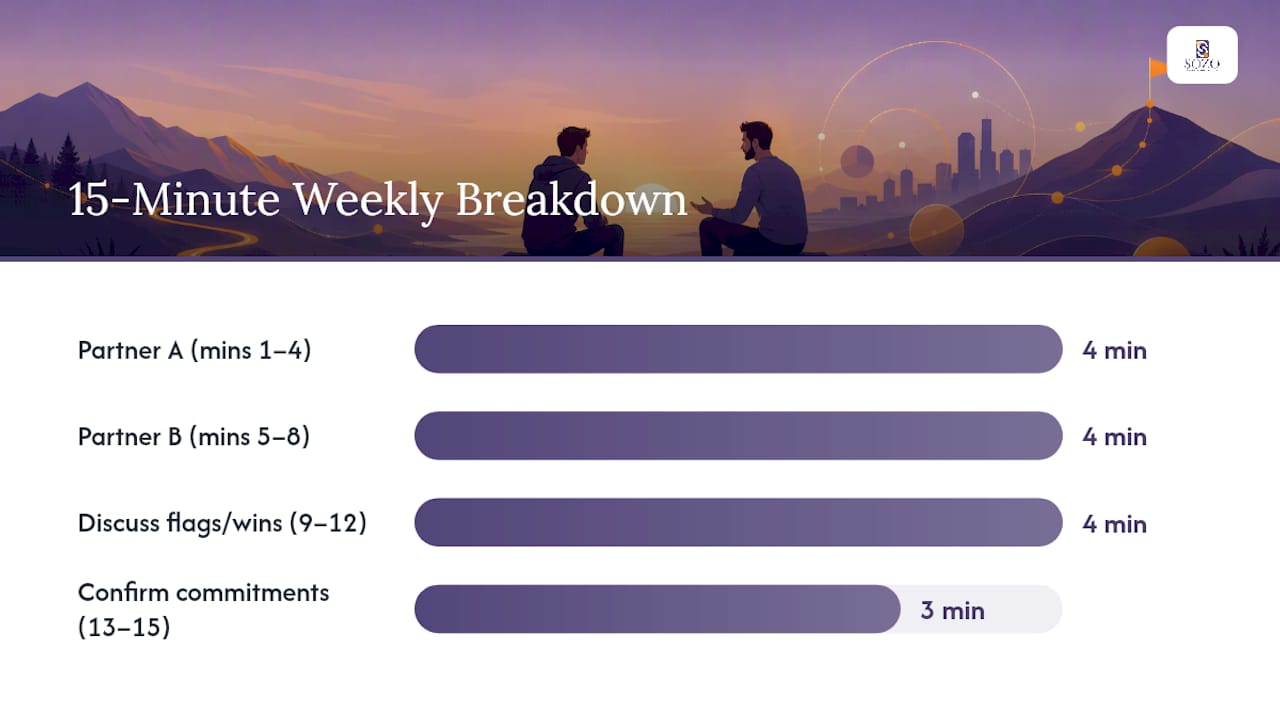
Try this 15-minute weekly format, timeboxed and taken in turns:
- Minute 1 to 4: Partner A answers four questions: What did you commit to last week? Did you follow through? What got in the way, if anything? What’s your commitment for this week?
- Minute 5 to 8: Partner B answers the same four questions.
- Minute 9 to 12: Discuss any red flags, close calls, or wins together.
- Minute 13 to 15: Confirm next week’s commitments out loud and lock in the next check-in time.
Between weekly calls, a quick daily signal keeps things from drifting. A simple text code works well. Something like “GREEN” for a solid day, “YELLOW” for a rough one, and “RED” for active cravings or crisis gives your partner a fast read without a full conversation every time. Agree in advance on what RED means for response time, and always have a backup contact in case your partner is unreachable.
For tracking, keep it simple. A shared Google Doc or Notion page with one line per day works better than a complicated app. A basic habit tracker or a recurring calendar block also does the job. The tool matters less than whether you both actually use it every week.
Pro Tip: Set your weekly check-in for the same day and time every week, ideally the same slot as another anchor habit, like right after a meeting. Anchoring it to something already fixed on your calendar cuts the odds you’ll skip it.
What to Look For in a Recovery Partner (and How to Test the Fit)
Not every willing volunteer makes a good partner. Some non-negotiables matter more than personality:
- Reliability. Someone who shows up on time, consistently, even when it’s inconvenient.
- Willingness to be honest. A partner who softens every hard truth to avoid conflict will let you drift. Conflict-avoidant people often make poor accountability partners precisely because they won’t push back when you need it.
- Emotional steadiness. Someone who isn’t drowning in their own crisis every week and can hold space for yours.
- Compatible schedule. If your check-in windows never align, the best intentions won’t save the arrangement.
Match on intensity and rhythm, not identity. A peer facing similarly high stakes in their own recovery, or their own goals generally, tends to hold the relationship steadier than someone who has nothing on the line themselves.
Run a real 30-day trial. Set one measurable commitment each, agree on what counts as a miss versus a genuine emergency, and put a review date on the calendar before you start. At day 30, ask each other plainly: is this working?
When an Accountability Partnership Isn’t Working
Some warning signs show up early if you’re paying attention:
- Dread creeping in before every check-in.
- Constant cheerleading with zero honest feedback.
- One person carrying all the initiative.
- Boundaries getting crossed, like a partner venting about their own crisis during your check-in slot.
Three fixes are worth trying before you walk away. Renegotiate the scope if it’s grown too broad. Shrink the commitments if either of you is overreaching. Add a backup support, like a sponsor or clinician, if the partnership alone can’t hold the weight.
If none of that helps, end it without guilt. A recovery accountability group or a new partner is not a failure. It’s a correction.
How Structured Programs Reinforce Peer Accountability
Peer accountability works best as one piece of a larger support network for addiction, not the whole structure. Federal recovery guidance lists peer support tools as part of the recommended continuum of care for substance use disorders, alongside clinical treatment, not instead of it. Each level of care at SOZO, from residential through outpatient, includes a men’s group, and we explain how group therapy for addiction works.
Programs built around this idea supply what an informal partnership can’t: alumni networks that outlast treatment, structured check-in schedules, and a clinical safety net for the moments a peer relationship isn’t equipped to handle. At SOZO Recovery Center, treatment plans built on the ASAM Continuum model pair clinical care with peer and family support structures so accountability doesn’t rest on one person’s shoulders alone.
For most men in recovery, the strongest setup combines both:
- Weekly peer check-ins for the daily grind of staying on track.
- Program-based alumni or aftercare support for structure that doesn’t depend on one relationship holding.
- Clinical care on standby for co-occurring mental health issues or high relapse risk.
Staying Motivated Without Burning Out Your Partner
Motivation dips are normal, but they’re also where most partnerships quietly die. The fix isn’t more enthusiasm. It’s lowering the cost of showing up on a bad week.
Set a “floor” commitment from day one, the smallest possible action that still counts as following through. On a good week, you might report five clean days and two workouts. On a bad week, the floor might just be “I didn’t use, and I showed up to the call.” Counting the floor as a real success, not a consolation prize, keeps both partners honest instead of performative.
Burnout usually hits the listener, not the talker. If every check-in turns into a 45-minute venting session, the partner doing the listening will start dreading the call, even if they never say so. Keep the script’s timebox real. Fifteen minutes, four questions, done. If something bigger comes up, name it directly: “I need more than our usual check-in this week, can we set aside extra time?” That request respects the boundary instead of quietly blowing past it.
Rotate who leads the check-in each week if you notice one person always initiating. Shared ownership prevents the relationship from tipping into one person managing the other, which is exhausting for both sides and rarely sustainable past a month or two.
What Successful Accountability Partnerships Actually Look Like
The partnerships that last share a pattern: they start small, they stay specific, and they survive because both people have something at stake.
A common setup involves two men in outpatient treatment together who agree to text each morning: one word, “up,” meaning they got out of bed and started the day sober. It sounds almost too simple to matter, but the small, repeatable action, done daily, builds the habit of checking in before anything more complicated gets layered on top.

Another pattern shows up in alumni networks, where former clients from the same program pair off after discharge specifically because they already share a check-in rhythm from treatment. The transition from structured clinical support to informal peer accountability goes more smoothly when the habit of reporting in was already built during care.
What both examples share isn’t luck. It’s structure that existed before motivation ran out, and a shared stake that kept either person from disappearing without consequence.
Communicating Without Letting Small Friction Become a Breakup
Every accountability partnership hits friction eventually. What separates a partnership that survives from one that quietly dissolves is how the friction gets named.
Say the specific thing, not the vague feeling. “You didn’t respond to my text for three days and I felt forgotten” lands better than “you don’t seem that invested anymore.” Vague complaints invite defensiveness. Specific ones invite a fix.
Separate the miss from the person. A missed check-in is a logistics problem, not proof your partner doesn’t care. Ask what got in the way before assuming the worst.
Address conflict inside the relationship, not around it. If something feels off, say so at the next scheduled check-in rather than letting it fester for three weeks and exploding later. The weekly script exists partly for this reason: it gives you a built-in moment to raise friction before it calcifies.
Agree ahead of time on how you’ll disagree. Some pairs decide that any real conflict gets a five-minute pause before responding, just to avoid saying something in frustration that undercuts the whole arrangement. Simple ground rules, set before you need them, keep small friction from becoming the reason the partnership ends.
Asking for Help Isn’t a Weakness. It’s the Strategy.
The men who struggle most with accountability aren’t the ones who lack willpower. They’re the ones who never learned to ask plainly for what they need. Try this next week: pick one person, name one specific commitment, and ask for a 30-day trial using the script above. If you’re facing a co-occurring disorder or a history of relapse despite peer support, pair that ask with professional care, not instead of it.
Ty
When Peer Support Isn’t Enough: Structured Care at SOZO
A weekly check-in with a peer can carry you a long way, but it has limits. If you’re facing detox needs, a co-occurring mental health diagnosis, or a pattern of relapse that peer accountability alone hasn’t fixed, that’s the signal to bring in clinical support. SOZO Recovery Center offers residential, outpatient, and dual diagnosis treatment for men, built on personalized plans informed by the ASAM Continuum model and grounded in both the 12-step model and biblical principles.
Programs like this give you what an informal partnership can’t supply on its own: medical detox referrals, licensed clinical care, and a structured recovery community that continues through aftercare and alumni support. If your peer accountability system has hit its ceiling, or you’re starting from a point where clinical stabilization has to come first, SOZO’s admissions process is the next concrete step. Reach out to talk through your options and see if structured, faith-based care is the right fit for where you are right now.
This article is general information, not a substitute for advice from a qualified doctor. Consult a qualified healthcare professional about your own circumstances before acting on anything here.
Sources
- An accountability partner makes you vastly more likely to succeed (Entrepreneur)
- The secret to doing hard things (NPR)
- Recovery support tools and resources (SAMHSA)
FAQ
Can you give me an example of an accountability partner?
Two peers in outpatient treatment who text each other every morning with a single word confirming they’re sober and out of bed is a common, simple example. Another is two alumni from the same treatment program pairing up for a weekly 15-minute call using a shared check-in script.
What does an accountability partner do?
An accountability partner checks in on specific commitments you’ve made, like meeting attendance or sobriety, and asks direct questions about follow-through rather than processing emotions or offering clinical guidance.
What is the role of accountability in addiction recovery?
Accountability turns private commitments into social ones, which research links to a 65 to 95 percent lift in goal completion and roughly 35% longer treatment retention. That structure also complements the peer support tools federal recovery guidance recommends within a full continuum of care.
What are the qualities of a good accountability partner?
Reliability, honesty even when it’s uncomfortable, emotional steadiness, and a compatible check-in schedule matter more than shared identity or history. Avoid choosing someone who is conflict-avoidant, since they tend to enable avoidance rather than challenge it.