


Grief during recovery is common, and it can act as a relapse trigger when a man tries to numb it instead of moving through it. The safest immediate step is to use a short, pre-written trigger plan: pause, ground yourself, and reach out to a sponsor, peer, or clinician before the feeling turns into a craving. If the pain becomes unmanageable or thoughts turn toward self-harm, call 988 right away.
TL;DR:
- Avoidant coping strategies such as social withdrawal and wishful thinking increase the risk of prolonged grief and substance cravings in recovery.
- Approach-oriented coping, like talking about loss and finding meaning, predicts better long-term outcomes and reduces relapse risk.
- A short trigger plan, including pauses, deep breathing, and support contact, effectively manages grief spikes and prevents impulsive substance use.
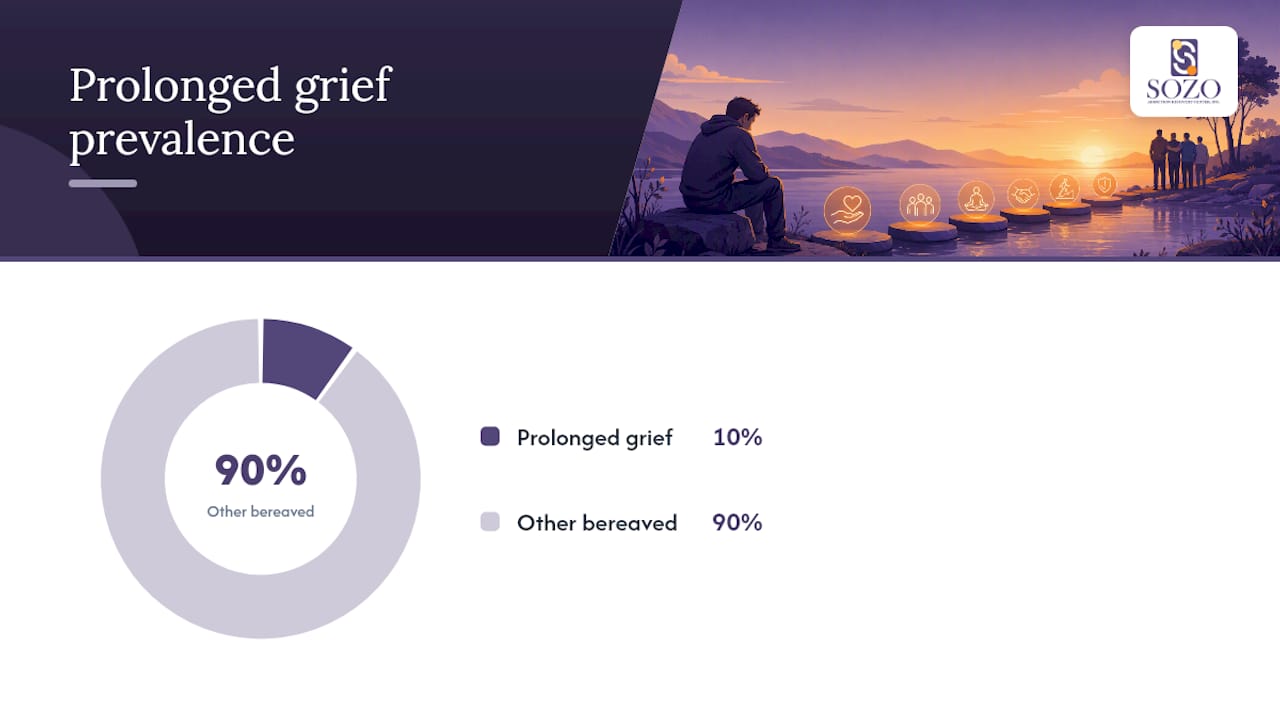
- Up to 10% of bereaved adults experience prolonged grief, especially after traumatic or sudden losses, which increases the risk of alcohol misuse.
- Integrating grief work into personalized, dual-diagnosis treatment plans offers the best support for men managing both addiction and complicated or prolonged grief.
Table of Contents
- How grief shows up in recovery: signs, types of loss, and timeline
- Why grief raises relapse risk: mechanisms and research
- Approach-oriented vs. avoidant coping: what helps and what harms
- Concrete relapse-safe steps and a trigger plan for grief spikes
- When grief becomes prolonged or complicated, and how to respond
- How faith-based, personalized care can support grieving men
- Grieving without relapsing: a short reflection
- Structured support for grief during addiction recovery
- Sources
- FAQ
How grief shows up in recovery: signs, types of loss, and timeline
Grief rarely announces itself with a clean label. In early sobriety, it often surfaces as a tangle of feelings and behaviors that a man may not immediately connect to loss at all.
- Emotional signs: yearning for what was lost, waves of sadness, guilt over past choices, or unexpected anger.
- Behavioral signs: withdrawing from friends and family, restlessness, or noticeable changes in sleep and appetite.
- Physical signs: fatigue, tension, or a heaviness in the chest that shows up during quiet moments.
Recovery brings its own category of loss that never touches a funeral home. A man may grieve the identity he built around drinking or using, a marriage strained past repair, custody of his children, or simply the freedom to numb out whenever life got hard. These losses are real, even when no one sends flowers.
There is no fixed timeline for any of this. Some men move through acute grief in weeks; for others, waves continue for months, softening gradually rather than disappearing on a schedule. What matters is direction, not speed: if sadness is easing over time and daily functioning is holding steady, that is normal grief doing its slow work. Red flags that call for follow-up include grief that keeps intensifying past six months, an inability to hold down basic routines, or thoughts of using as the only way to cope. Those signs deserve attention long before they become a full relapse.
Why grief raises relapse risk: mechanisms and research
Grief does not cause relapse on its own. What raises the risk is how a man responds to it, and the research on this is specific.
Avoidant coping, meaning social withdrawal, wishful thinking, and self-criticism, shows up repeatedly in studies of substance use disorder samples as a predictor of complicated grief. When a man pushes the pain down instead of processing it, the feelings do not vanish. They resurface as loneliness, a loss of meaning, and mood swings, three states closely tied to substance craving. Grief also strips away routine and connection at the exact moment a man needs both to stay grounded, which is part of why unresolved loss is such a common relapse setup.
The scale of this risk is not small. Among bereaved adults generally, about 1 in 10 experience prolonged grief, and that rate climbs after traumatic or sudden losses, the kind many men in recovery are carrying. Prolonged grief in that research is also linked to a higher risk of alcohol misuse, which is exactly the overlap that makes grief-aware relapse prevention necessary rather than optional.
Prolonged grief affects roughly 1 in 10 bereaved adults, with higher rates after traumatic loss and an associated rise in alcohol misuse risk. For a man already managing addiction, that overlap means grief support is not a side conversation. It belongs inside the recovery plan itself.
Approach-oriented vs. avoidant coping: what helps and what harms
The clearest finding across the grief and addiction research is also the most practical: how a man copes with loss predicts whether that loss leads to healing or to relapse.
Approach-oriented coping means leaning into the loss rather than around it: seeking information, talking with people who understand, and working toward meaning making. Prospective research on adults bereaved by suicide and overdose found that approach-based coping predicted better long-term outcomes, largely because it helped people build meaning from what happened. Avoidant coping predicted the opposite: higher rates of prolonged grief and posttraumatic stress symptoms.
Common avoidant patterns to watch for:
- Isolating from sponsors, family, or recovery groups.
- Wishful thinking that avoids the reality of the loss.
- Turning to substances, even briefly, to blunt the feeling.
Three skill sets consistently show up in effective, grief-focused CBT approaches: cognitive reappraisal of guilt or blame, behavioral activation to rebuild routine, and gradual exposure to avoided reminders so they lose their grip. Alongside these, DBT skills like Radical Acceptance and the ABC PLEASE framework help regulate the emotional spikes that often precede impulsive substance use. Mindfulness grounding, simple breath work or a five-senses check, gives a man something concrete to do in the first sixty seconds of a wave of grief.
Pro Tip: When a wave of grief hits, name it out loud, “This is grief, not a reason to use,” before doing anything else. Naming the feeling separates it from the craving.
Concrete relapse-safe steps and a trigger plan for grief spikes
A trigger plan works best when it is short enough to remember under stress. Clinical formats used in substance use disorder samples follow a similar sequence, and it holds up well in daily life.
- Pause as soon as you notice the wave building, before reacting.
- Breathe, using a slow four-count inhale and six-count exhale to interrupt the spike.
- Contact two supports, ideally a sponsor or peer and a clinician, not just one.
- Ground yourself with a mindfulness exercise or DBT Opposite Action, doing the thing that counters the urge to isolate or use.
- Remove access to substances or high-risk environments for the next few hours.
- Delay major decisions until the wave passes, since grief distorts judgment temporarily.
Beyond the moment-to-moment plan, a small toolbox helps: a breathing app, a list of grounding exercises, and substance-free memorial rituals like journaling, planting something in memory of a person or a former life, or donating in someone’s name.
Writing a one-page trigger plan takes fifteen minutes and pays off for months. List two or three emergency contacts by name and number, your top three grounding techniques, and the nearest safe place to go. Keep it somewhere you will actually find it at 2 a.m.
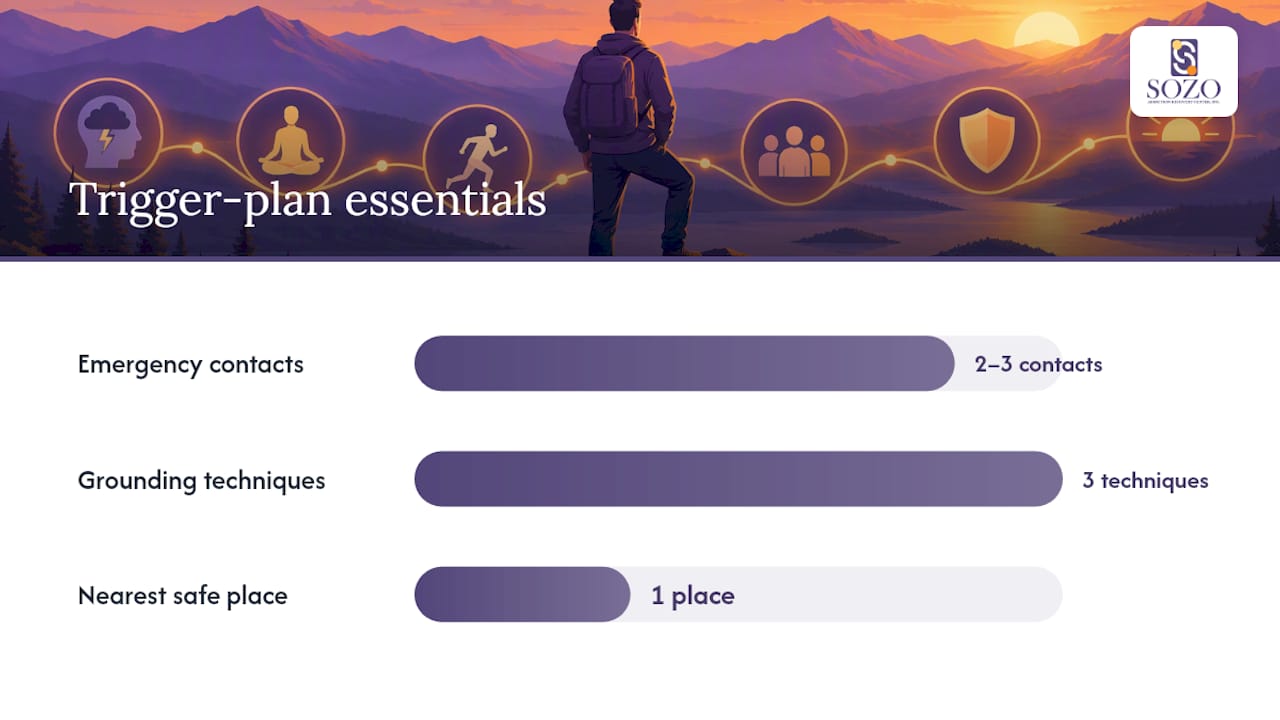
Pro Tip: Store your trigger plan as a photo on your phone’s lock screen. A plan you cannot find in the moment is not a plan.
When grief becomes prolonged or complicated, and how to respond
Most grief eases with time, but a portion of it does not, and recognizing the difference matters for safety.
Clinical markers of prolonged grief include yearning or preoccupation that persists past six months to a year, an inability to resume normal roles at work or home, and a sense that life has lost meaning entirely. About 1 in 10 bereaved adults meet criteria for prolonged grief, and the rate rises further after sudden or traumatic loss.
- Grief-focused CBT has the strongest evidence base for treating prolonged grief directly.
- Integrated approaches that combine grief therapy with SUD care address both conditions instead of treating them separately.
- DBT-informed skills support emotion regulation between therapy sessions.
- Peer support, especially from people with lived experience, reduces isolation around losses that carry stigma, such as overdose or suicide.
Grief-focused therapies remain the best-supported treatment for prolonged grief, while bereavement support groups alone have more limited evidence on their own. If cravings intensify, sleep collapses, or thoughts turn toward self-harm, that is the moment to call 988 or seek emergency care rather than waiting to see if it passes.
How faith-based, personalized care can support grieving men
Spiritual practice gives grief somewhere to go besides isolation. Prayer, scripture reflection, and a faith community offer structured meaning making, the same mechanism research on approach-oriented coping points to as protective against prolonged grief. Peer support adds another layer, connecting a man to others who understand both loss and addiction without judgment.
A personalized, ASAM-informed treatment plan can fold grief goals directly into recovery work rather than treating them as separate tracks. When grief overlaps with intense cravings, suicidal thoughts, or an unstable living situation, a higher level of care such as residential treatment or partial hospitalization may offer the structure and safety a man needs while he works through both grief and dual diagnosis conditions.
Before choosing a program, ask directly: Does the clinical team write grief goals into the treatment plan? Is there dual-diagnosis capacity for co-occurring depression or trauma? What does peer support look like day to day? These questions separate programs that treat grief as an afterthought from ones that build it into care from day one.
Grieving without relapsing: a short reflection
A man in his fourth month of sobriety once described the anniversary of his father’s death as the hardest day of his recovery so far, harder than his first thirty days combined. The grief hit fast, and so did the old pull toward a drink to soften it. He used his trigger plan instead: he called his sponsor before the second wave hit, sat with the discomfort for an hour, then asked his counselor to build grief work into his sessions going forward.
Two things carried him through. He reached out before the craving became unbearable, not after. And he treated the grief as something to work through with help, not something to outrun alone.
Ty
Structured support for grief during addiction recovery
Carrying grief and addiction at the same time is heavier than either one alone, and you should not have to sort out which one to address first. SOZO Recovery Center builds grief-informed, dual-diagnosis care directly into personalized treatment plans, so the loss you are carrying becomes part of the work rather than something set aside until sobriety feels stable enough to handle it.
Depending on where you are, different levels of care fit different needs:
- Residential treatment offers round-the-clock structure when grief and cravings are both intense.
- Partial hospitalization or intensive outpatient care provides structured therapy while you keep living at home.
- Dual-diagnosis and personalized care addresses grief alongside depression, anxiety, or trauma in one coordinated plan.
Whatever program you consider, ask how grief work gets integrated into the treatment plan, not just offered as a separate group. If you are ready to talk through your options, reach out to SOZO’s admissions team to find the level of care that fits where you are right now.
Sources
The clinical claims in this article draw on peer-reviewed research and government crisis guidance, listed here for anyone who wants to read further.
- 988 Suicide & Crisis Lifeline (FCC)
- Coping Strategies and Complicated Grief in a Substance Use Disorder Sample
This article is general information, not a substitute for advice from a qualified doctor. Consult a qualified healthcare professional about your own circumstances before acting on anything here.
FAQ
What are the three C’s of grief?
The “three C’s” is not a formal clinical term found in the peer-reviewed grief research cited here, and definitions vary depending on the source. Rather than relying on an informal framework, focus on approach-oriented coping strategies like meaning making and social connection, which have stronger research support for reducing prolonged grief.
What is cumulative grief syndrome?
Cumulative grief refers to experiencing multiple losses close together or without fully processing earlier ones, a pattern common for men in recovery who may be grieving relationships, identity, and specific people all at once. It is not a formal diagnosis in the sources reviewed here, but the underlying risk, unprocessed loss piling up and increasing avoidant coping, is well supported by research on complicated grief in substance use disorder samples.
Which organ holds grief?
Grief is not stored in a single organ; it is a psychological and physiological response that shows up throughout the body, including tension, fatigue, and disrupted sleep. The clinical focus is on managing its emotional and behavioral effects through approach-oriented coping and grief-focused therapy rather than locating it anatomically.
How long does grief last?
Grief timelines vary widely, with many people easing gradually over weeks to months as functioning improves. When yearning, preoccupation, or impairment persists well beyond that window, it may meet criteria for prolonged grief, which affects about 1 in 10 bereaved adults and responds best to grief-focused therapy.
When should I call a crisis line for grief-related distress?
Call 988 if grief brings thoughts of self-harm, an urge to use that feels uncontrollable, or a sense that you cannot keep yourself safe. Counselors are available 24/7 to help de-escalate the moment and connect you to follow-up care.