


The single most effective holiday sobriety strategy is a short, pre-made relapse prevention plan combined with real-time connection to support like a sponsor or meeting. Tonight, that means three things: pick your exit time before you arrive, text your sponsor or a sober friend before you walk in, and have a non-alcoholic drink in hand from the first minute. Add the HALT check (Hungry, Angry, Lonely, Tired) and a standing 12-step meeting on your calendar, and you have covered the ground that matters most.
TL;DR:
- A pre-made relapse prevention plan that includes an event schedule, a refusal script, and a support contact list is crucial for holiday sobriety.
- Controlling the environment by bringing non-alcoholic drinks and having an exit strategy helps avoid high-risk situations.
- Managing HALT states by eating, staying calm, connecting with supportive people, and setting clear boundaries reduces craving intensity.
- Regularly scheduled meetings, sponsor check-ins, and support from sober peers are essential for maintaining accountability during the season.
- Quick coping tools like paced breathing and grounding techniques can help outlast cravings during high-risk moments.
Table of Contents
- Practical Holiday Sobriety Strategies for Every Event
- Build a One-Page Holiday Relapse Prevention Plan
- Manage Triggers and the HALT Warning Signs
- Lean on Meetings, Sponsors, and Sober Peers
- Fast Coping Tools for High-Risk Moments
- What to Do Immediately After a Slip
- When Self-Management Isn’t Enough: SOZO’s Approach
- A Final Word on Getting Through This Season
- Get Structured Support Before the Holidays Test You
- Sources
- FAQ
Practical Holiday Sobriety Strategies for Every Event
Every holiday gathering has the same three failure points: walking in unprepared, staying too long, and facing pressure without a script. Fix those three and most of the risk disappears.
- Plan ahead. Decide which invitations you’re accepting, write a one-line refusal (“I’m good, thanks, driving tonight”), and pick your exit time before you leave the house.
- Control your environment. Bring your own non-alcoholic drink so you’re never empty-handed, sit or stand away from the bar or drink table, and skip “rounds” that pressure you to keep pace with drinkers.
- Build in accountability. Check in with someone before the event and again after, arrange your own transportation so you’re never stuck, and bookend the night with a meeting.
A few smaller habits reinforce all three:
- Ask the host if you can bring a dessert or dish. It gives you a job, and jobs keep hands and minds occupied.
- Rehearse your refusal line out loud once before you go. It sounds less scripted when you actually need it.
- Keep your phone charged and your support person’s number one tap away.
None of this requires explaining your recovery to anyone. It requires having a plan tighter than the moment that tests it.
Build a One-Page Holiday Relapse Prevention Plan
A written relapse prevention plan works because it moves decisions out of the moment, when your judgment is least reliable, and into a calmer hour when you can think clearly. Clinicians recommend mapping out the event, time window, and exit strategy in advance rather than improvising once you’re standing in someone’s kitchen.
Your one-pager needs six things:
- The event and time window you’re committing to.
- Your sober drink of choice, decided beforehand.
- A refusal script, memorized, not improvised.
- An exit strategy and a backup exit if the first one falls through.
- Transportation you control, not transportation you’re waiting on.
- Which meeting comes before or after, and who you’re checking in with.
Schedule your recovery activities the same way you’d schedule the party itself. If a gathering has no safe exit and no support nearby, it’s fine to decline. Telling a host “I can’t make it this year” is a complete sentence. You don’t owe anyone your reasoning, and boundaries stated plainly draw less pressure than boundaries explained at length.
Manage Triggers and the HALT Warning Signs
Hungry, Angry, Lonely, Tired: those four states lower your defenses against cravings faster than almost anything else during the holidays, which is exactly why counselors return to HALT every winter. A skipped meal, a tense conversation with a relative, or a late night of travel can each independently make a craving feel stronger than it is.
Counter each state directly:
- Hungry or thirsty: Eat before you arrive and keep water in hand; don’t let a party be your first meal of the day.
- Angry: Step outside for two minutes before responding to a comment that stings.
- Lonely: Position yourself near people who know your situation, not the corner of the room.
- Tired: Set a hard end time and honor it, even if the party is still going.
Pro Tip: Leaving early without an apology is a legitimate relapse-prevention tool, not a social failure. Recovery professionals call it the French exit, and using it protects your sober social window better than gutting out an extra hour to be polite.
Lean on Meetings, Sponsors, and Sober Peers
Holidays intensify isolation for a lot of men in recovery, and isolation is where relapse quietly builds momentum. Peer connection measurably reduces that isolation, which is why most support systems work best when they’re scheduled, not left to chance.
Layer your support before the season gets busy:
- Look up AA/NA holiday marathon meetings in your area; many groups add extra sessions from Thanksgiving through New Year’s.
- Use virtual meetings when travel or family obligations make in-person attendance hard.
- Call your sponsor before a high-risk event, not just after a hard one.
- Identify one sober buddy you can text mid-party if the room starts to feel like too much.
- If you’re in an intensive outpatient program, ask your counselor about adjusted holiday scheduling now, before the calendar fills up.
Set specific check-in times rather than a vague “I’ll call if I need to.” A 6 p.m. text and a 10 p.m. text, agreed on in advance, does more than an open-ended promise.
Fast Coping Tools for High-Risk Moments
Cravings feel permanent in the moment, but they typically peak and fade within 15 to 20 minutes. Your job isn’t to defeat the craving. It’s to outlast it.
A few CBT and DBT tools do that reliably:
- Cognitive reframing: Name the thought (“one drink won’t hurt”) and counter it with the actual consequence you’ve lived before.
- Paced breathing: Four seconds in, six seconds out, repeated for a minute. Slower breathing measurably lowers stress response, which is exactly the state a craving thrives on.
- 5-4-3-2-1 grounding: Name five things you see, four you hear, three you can touch, two you smell, one you taste. It pulls your brain out of the craving loop and into the room.
Sleep, food, and hydration aren’t extras. They’re the baseline that keeps decision fatigue from stacking on top of an already stressful night. Small rituals help too: a mocktail with a real garnish, an hour of volunteering on a hard anniversary, a walk around the block instead of a second helping of dessert.
What to Do Immediately After a Slip
A slip is not the end of your recovery. It’s information, and how you respond in the next hour matters more than the slip itself.
- Stop using immediately and do not get behind the wheel.
- Hydrate, eat something, and get to a safe place to rest.
- Watch for dangerous withdrawal signs, tremors, seizures, severe confusion, and treat any of those as a medical emergency, not something to wait out.
- Call your sponsor and get to a meeting as soon as you’re able.
- Write down what led to the slip while it’s fresh, then revise your plan with that information.
Some situations call for more than self-correction. Repeated slips, withdrawal symptoms, or any concern about overdose risk mean it’s time for a clinician’s evaluation, not another round of willpower.
When Self-Management Isn’t Enough: SOZO’s Approach
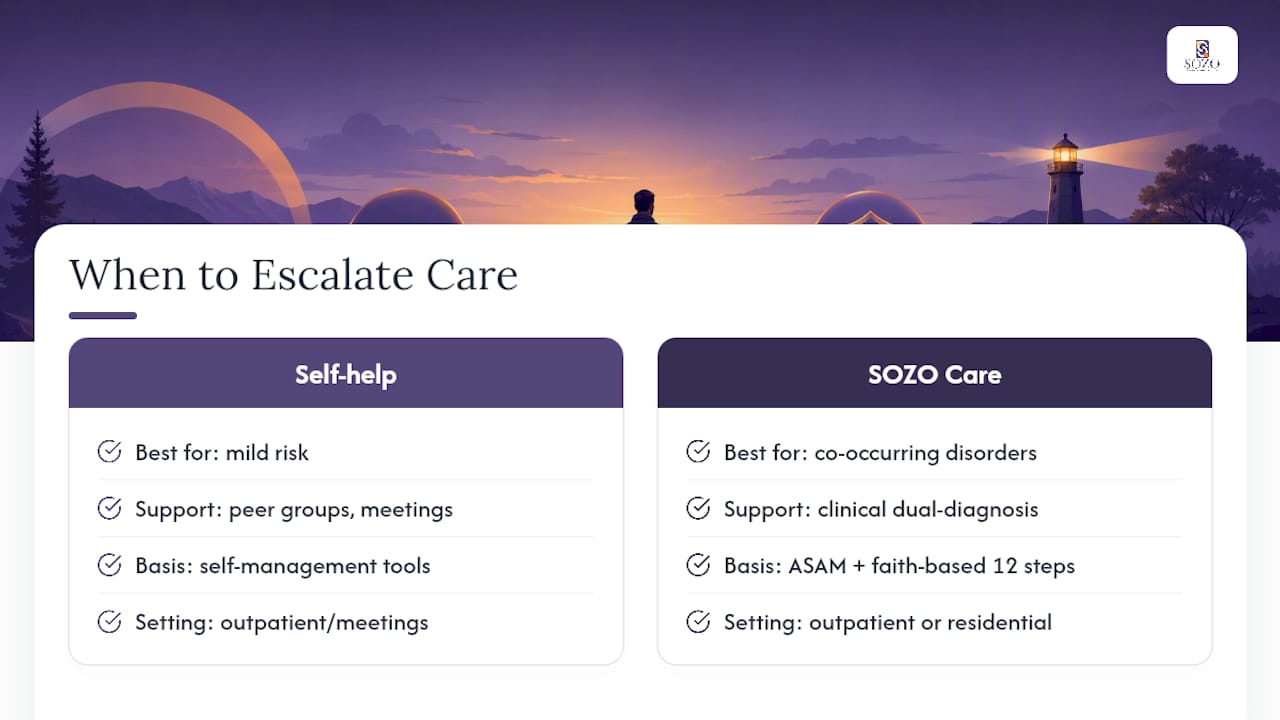
Some men enter the holidays already stretched thin by co-occurring depression, anxiety, or trauma, and self-help tools alone won’t hold that weight. SOZO Recovery Center builds personalized treatment plans using the ASAM Continuum criteria, pairing dual-diagnosis clinical care with a faith-based recovery model rooted in the 12 steps and biblical principles.
If you’ve had more than one holiday slip, if withdrawal risk is on the table, or if the season has surfaced mental health symptoms you can’t manage with meetings alone, outpatient or residential treatment is the more appropriate path over another attempt at pure self-management. SOZO’s model exists for exactly that gap between willpower and clinical need.
A Final Word on Getting Through This Season
The men who make it through the holidays sober aren’t the ones with the most willpower. They’re the ones who made HALT a habit before the season started, not a rule they remembered mid-craving. If you only build one thing from this article, build that. For a deeper look at how it works, the HALT framework is worth ten minutes of your time before your next event.
Ty
Get Structured Support Before the Holidays Test You
If self-management hasn’t held through past holiday seasons, SOZO Recovery Center offers something a checklist can’t: a clinical team and a faith-based structure built around your specific risk profile, not a generic plan. Where a relapse prevention worksheet gives you tactics for one night, SOZO’s dual diagnosis treatment addresses the depression, anxiety, or trauma often sitting underneath the cravings themselves.
SOZO’s programs, residential, outpatient, intensive outpatient, partial hospitalization, and sober living, are built on ASAM-informed assessments, so treatment matches where you actually are, not a one-size plan. Every program integrates the 12 steps with Christian principles for men who want their recovery and their faith moving in the same direction.
If you’re in crisis right now, call or text 988 for the Suicide and Crisis Lifeline, or call 911 for a medical emergency. If you’re ready to talk about treatment before the holidays hit hard, start the admissions process at SOZO today.
Sources
- Practical tips for staying sober during the holidays | AP News
- Holiday Relapse Prevention Plan | Cenikor
- How to stay sober during the holidays | Hazelden Betty Ford
- 12 tips to maintain your recovery during the holidays | Psychology Today
This article is general information, not a substitute for advice from a qualified doctor. Consult a qualified healthcare professional about your own circumstances before acting on anything here.
FAQ
How do you maintain sobriety during the holidays?
Build a one-page plan covering the event, your exit time, a refusal script, and your support contacts, then run a HALT check before anything that feels risky.
What are the three P’s of sobriety?
Definitions vary across programs, but the version most often cited centers on planning, people, and place, meaning preparing ahead, choosing supportive people, and controlling the environment you put yourself in.
What is the hardest week of sobriety?
For many people in recovery, the stretch from Christmas through New Year’s Day is the hardest week of the year, since back-to-back gatherings and disrupted routines compound HALT states day after day.
What should you do on vacation while sober?
Keep your routine anchors intact: research local meetings before you travel, pack a non-alcoholic drink option, and check in with your sponsor on the same schedule you would at home.