


Celebrate Recovery 12 Steps is a Christ-centered recovery framework that pairs the traditional 12-step model with eight biblical principles drawn from the Beatitudes in Matthew 5. The program addresses a broad range of struggles, including substance use, codependency, grief, and anger, making it far more than a sobriety program. Where secular recovery models use open-ended language about a “Higher Power,” Celebrate Recovery names Jesus Christ explicitly, giving participants a specific spiritual anchor. That clarity is the program’s defining strength. Sozorecoverycenter integrates this same Christ-centered foundation into its faith-based treatment model for men.
What are the 12 Steps of Celebrate Recovery and their biblical foundations?
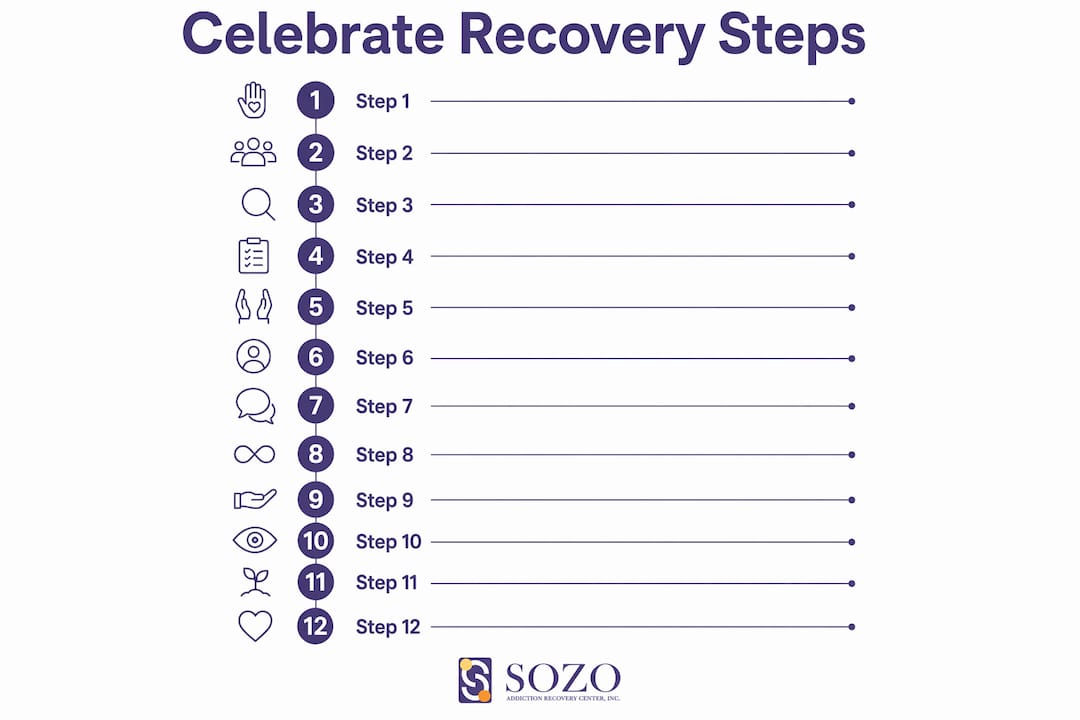
The CR 12 steps adapt the original recovery framework by weaving scripture directly into each step. This is not cosmetic. Every step carries a verse that grounds the spiritual action being asked of the participant.
| Step | Core Action | Key Scripture |
|---|---|---|
| 1 | Admit powerlessness over hurts, habits, and hang-ups | Romans 7:18 |
| 2 | Believe God can restore sanity and wholeness | Philippians 2:13 |
| 3 | Turn life and will over to Jesus Christ | Romans 12:1 |
| 4 | Take a searching moral inventory | Lamentations 3:40 |
| 5 | Confess wrongs to God, self, and another person | James 5:16 |
| 6 | Become ready for God to remove character defects | James 4:10 |
| 7 | Humbly ask God to remove shortcomings | 1 John 1:9 |
| 8 | List those harmed and become willing to make amends | Luke 6:31 |
| 9 | Make direct amends where possible | Matthew 5:23 to 24 |
| 10 | Continue personal inventory and promptly admit wrongs | 1 Corinthians 10:12 |
| 11 | Seek through prayer and meditation to know God’s will | Colossians 3:16 |
| 12 | Carry the message to others and practice these principles | Galatians 6:1 |
The steps were never the destination. They were the training. Each one asks a man to move from self-reliance toward surrender, and the scripture attached to each step is not decorative. Romans 7:18, cited in Step 1, reads: “I know that nothing good lives in me, that is, in my sinful nature.” That verse does what no secular step can: it names the spiritual condition underneath the behavior. The 12 steps paired with scripture make spiritual transformation foundational, not optional.
The language difference from secular models is also significant. Where traditional programs say “a Power greater than ourselves,” the 12 steps of CR say “Jesus Christ.” That specificity matters to men who want their faith to be the center of recovery, not a vague spiritual concept they define themselves.
How do the 8 recovery principles complement the 12 steps in Celebrate Recovery?
The 8 principles from the Beatitudes provide the daily spiritual framework that keeps recovery alive between step work. Many participants focus entirely on the steps and miss this. The principles are where long-term change actually takes root.
Each principle corresponds to a Beatitude from Matthew 5:3 to 10 and translates it into a recovery posture:
- Principle 1: Realize you are not God. Admit powerlessness. (Matthew 5:3)
- Principle 2: Earnestly believe God exists and can restore you. (Matthew 5:4)
- Principle 3: Consciously choose to commit your life to Christ. (Matthew 5:5)
- Principle 4: Openly examine and confess your faults. (Matthew 5:6)
- Principle 5: Voluntarily submit to change. (Matthew 5:7)
- Principle 6: Evaluate all relationships and offer forgiveness. (Matthew 5:8)
- Principle 7: Reserve a daily time with God for self-examination. (Matthew 5:9)
- Principle 8: Yield yourself to God to be used in service. (Matthew 5:10)
The principles guide daily surrender, confession, forgiveness, and service. That is the practical side of recovery that the steps alone cannot cover. A man can complete all 12 steps and still struggle daily if he has no framework for living spiritually between meetings. The 8 principles fill that gap by encouraging practical spirituality critical for long-term recovery.
Pro Tip: Print the 8 principles and keep them somewhere visible each morning. Reading one principle before prayer sets a spiritual intention for the day and reinforces the habit of surrender before the pressures of daily life begin.
What does a typical Celebrate Recovery meeting look like?
Celebrate Recovery meetings follow a consistent format that balances community worship with personal accountability. Understanding the structure removes the fear of walking through the door for the first time.
A standard meeting moves through these stages:
- Large group worship. The meeting opens with music and prayer, creating a shared spiritual atmosphere before any personal sharing begins.
- Teaching or testimony. A leader shares a lesson from the CR curriculum or a personal testimony of recovery. This grounds the meeting in biblical truth and lived experience.
- Small group breakout. Participants divide into gender-specific, issue-specific groups for confidential sharing. Anonymity is protected. What is shared in the room stays in the room.
- Accountability and encouragement. Small groups close with prayer and mutual support. No one is required to share. Observation is fully accepted, especially for newcomers.
Beyond the standard weekly meeting, Celebrate Recovery offers Step Study groups. Step Study groups are gender-specific, multi-month commitments that work through the 12 steps in sequence using a Bible-based curriculum. They require consistent attendance and active participation. That commitment is what builds the trust necessary for real honesty. Open Share groups, by contrast, are drop-in friendly and focus on sharing around a topic rather than progressing through the steps.
Most meetings are free to attend, hosted by local churches. Step Study participants typically purchase study guides and participant workbooks, which involve a small cost. The church-based setting is intentional. It places recovery inside a community of faith, not apart from it.
What are the key differences between Celebrate Recovery and secular 12-step programs?
The most significant difference is theological. Celebrate Recovery names Jesus Christ as the Higher Power. Secular programs leave that definition open to the individual. That distinction shapes everything from the language of the steps to the goal of the program itself.
| Feature | Celebrate Recovery | Secular 12-step programs |
|---|---|---|
| Higher Power | Jesus Christ, explicitly named | Defined by the individual |
| Scripture | Integrated into every step | Not included |
| Principles | 8 Beatitude-based principles | Not present |
| Setting | Church-based community | Varied, often community centers |
| Scope | Addiction, emotional wounds, relational issues | Primarily substance use |
| Goal | Spiritual transformation and sobriety | Sobriety and behavioral change |
The scope difference is also worth noting. Secular programs focus primarily on substance use. Celebrate Recovery addresses what the program calls “hurts, habits, and hang-ups,” which includes grief, anger, codependency, and emotional wounds that often sit underneath addiction. Recovery emphasizes identifying deep emotional wounds rather than focusing only on behavior change.
“The specificity of Jesus as Higher Power strengthens spiritual outcomes and differentiates Celebrate Recovery from traditional 12-step models. For men who want their faith at the center of healing, that clarity is not a limitation. It is the foundation.”
The goal of spiritual transformation, not just sobriety, is what separates the two models most deeply. A man can stop drinking and still carry the same wounds, the same shame, and the same broken patterns. Celebrate Recovery asks him to set down that weight through Christ, not just through willpower. For men who want to understand how faith and traditional recovery compare in practice, the distinction is worth exploring carefully.
How can someone new start with the Celebrate Recovery program?
Starting is simpler than most men expect. The first step is finding a local group, which the Celebrate Recovery website allows by zip code search. Most churches that host the program welcome anyone who walks in, regardless of church membership or religious background.
Here is what a newcomer can expect and do to engage well:
- Attend without pressure. Newcomers are not required to speak during their first meeting. Listening and observing is fully encouraged. The program values personal readiness over performance.
- Gather the materials. The CR participant guides and step study workbooks are available for purchase online and through the hosting church. Having the literature makes the curriculum accessible between meetings.
- Commit to Step Study when ready. Open Share groups are a good starting point. Step Study groups require a deeper commitment, but that commitment is where the most significant growth happens.
- Build daily spiritual practices. Prayer, scripture reading, and reflection on the 8 principles between meetings sustain the work done inside the group. Recovery does not pause when the meeting ends.
- Be patient with the process. The steps are not a checklist. They are a way of living. Men who approach them with patience and honesty consistently report the deepest change.
Pro Tip: Pair your Celebrate Recovery work with a resource on spiritual integration and healing to deepen the daily practice between meetings. The steps work best when they are part of a broader spiritual rhythm, not an isolated weekly event.
Celebrate Recovery complements but does not replace professional medical or psychiatric treatment. Men dealing with addiction alongside mental health conditions benefit most when community support and clinical care work together. The program is a powerful community anchor, and it is most effective when it sits alongside, not instead of, professional treatment.
Key Takeaways
The celebrate recovery 12 steps work because they pair structured biblical accountability with daily spiritual principles, giving men both a framework for change and a community to sustain it.
| Point | Details |
|---|---|
| Christ-centered foundation | Jesus Christ is named explicitly as the Higher Power, providing clear spiritual accountability. |
| Dual-track structure | The 12 steps and 8 Beatitude-based principles work together, covering both step work and daily spiritual living. |
| Broad scope of healing | The program addresses addiction, emotional wounds, codependency, and grief, not only substance use. |
| Community and commitment | Step Study groups require consistent attendance, building the trust needed for honest, lasting change. |
| Complement to clinical care | Celebrate Recovery works best alongside professional treatment, not as a replacement for it. |
What I’ve learned about why the steps alone are never enough
The most common mistake I see men make with Celebrate Recovery is treating the 12 steps as a finish line. They work through the curriculum, complete their step study, and then quietly drift. The steps gave them a structure. The 8 principles were supposed to give them a life. When men skip the principles, they lose the daily anchor that keeps the work alive.
The Christ-centered language is not a barrier for men who are skeptical of faith. In my experience, it is often the opposite. Naming Jesus Christ as the Higher Power removes the ambiguity that keeps some men stuck in secular programs, endlessly defining what they believe without ever committing to it. That clarity pulls the fuel line out of denial.
What I find most underappreciated is the emotional healing focus. Secular programs target behavior. Celebrate Recovery targets the wound underneath the behavior. A man who has never grieved his childhood, never named his shame, and never offered or received forgiveness will not stay sober through willpower alone. The steps and principles together ask him to do the harder, deeper work.
For men who also carry a mental health diagnosis, the program is most powerful when it runs alongside clinical care. Community accountability and biblical teaching create the right environment for healing. Professional treatment addresses what the community cannot. The two are not in competition. They are partners.
Ty
Sozorecoverycenter: faith-based recovery for men in Arkansas
Sozorecoverycenter, located in Hot Springs, Arkansas, offers men a treatment program that integrates biblical principles with clinical care informed by the ASAM Continuum model. The center addresses both addiction and mental health conditions through personalized plans that include 12-step recovery work alongside dual diagnosis treatment.
Men who are ready to move beyond community support into structured, professional care will find that Sozorecoverycenter’s approach mirrors the spiritual foundation of Celebrate Recovery while adding the clinical depth that lasting sobriety requires. The center’s faith-based rehab in Arkansas program is built for men who want their faith at the center of treatment, not as an afterthought. If you or someone you care about is ready to take that step, the admissions process at Sozorecoverycenter is the right place to start.
FAQ
What are the 12 steps of Celebrate Recovery based on?
The 12 steps of CR adapt the traditional recovery framework by pairing each step with a specific Bible verse, making scripture foundational to the recovery process rather than supplemental.
How is Celebrate Recovery different from AA?
Celebrate Recovery explicitly names Jesus Christ as the Higher Power and integrates the 8 Beatitude-based principles alongside the steps, while secular programs like AA leave the definition of a Higher Power open to the individual.
Do I have to share at my first Celebrate Recovery meeting?
No. Newcomers are encouraged to listen and observe until they feel comfortable. The program values personal readiness and builds trust gradually, so there is no pressure to share personal stories immediately.
What is a Step Study group in Celebrate Recovery?
A Step Study group is a gender-specific, multi-month commitment that works through the 12 steps in sequence using a Bible-based curriculum, requiring regular attendance and active participation to build trust and progress.
Can Celebrate Recovery replace professional addiction treatment?
Celebrate Recovery complements professional medical and psychiatric treatment but does not replace it. Men dealing with addiction and mental health conditions benefit most when community support and clinical care work together.