


The 12-step program is defined as a spiritual recovery framework rooted in biblical principles, designed to guide men from addiction toward lasting freedom through surrender, accountability, and reliance on God. Programs like Celebrate Recovery formally align each step with specific scripture, while resources like The Life Recovery Bible map devotional passages to every stage of healing. The connection between 12 steps and the Bible is not coincidental. The original founders of Alcoholics Anonymous drew directly from biblical texts, including the Sermon on the Mount and the Book of James, to shape the program’s core values. For men seeking a Christ-centered path out of addiction, this framework offers something willpower alone never can.
How do the 12 steps correspond to biblical principles and scripture?
Each of the 12 steps reflects a specific biblical teaching. Celebrate Recovery formally pairs each step with scripture, grounding recovery in the person of Jesus Christ rather than a vague spiritual concept. That pairing gives men a concrete anchor for each stage of the process.
The table below maps each step to its core biblical theme and a key verse:
| Step | Biblical Theme | Key Scripture |
|---|---|---|
| 1. Admitting powerlessness | Honesty about sin | Romans 7:18 |
| 2. Believing in a Higher Power | Faith in God’s power | Philippians 4:13 |
| 3. Turning will over to God | Surrender | Proverbs 3:5 to 6 |
| 4. Moral inventory | Self-examination | Lamentations 3:40 |
| 5. Admitting wrongs | Confession | James 5:16 |
| 6. Ready for God to remove defects | Willingness | 1 John 1:9 |
| 7. Humbly asking God to remove shortcomings | Humility | James 4:10 |
| 8. Making a list of those harmed | Accountability | Luke 6:31 |
| 9. Making direct amends | Repentance and restoration | Matthew 5:23 to 24 |
| 10. Continuing personal inventory | Perseverance | 1 Corinthians 10:12 |
| 11. Prayer and meditation | Communion with God | Philippians 4:6 to 7 |
| 12. Carrying the message | Service | Galatians 6:1 to 2 |
The themes running through these steps are not new to Christianity. Confession, repentance, humility, and service are the same disciplines found in the Beatitudes and throughout Paul’s letters. The steps were never the destination. They were the training ground for a life shaped by biblical character.
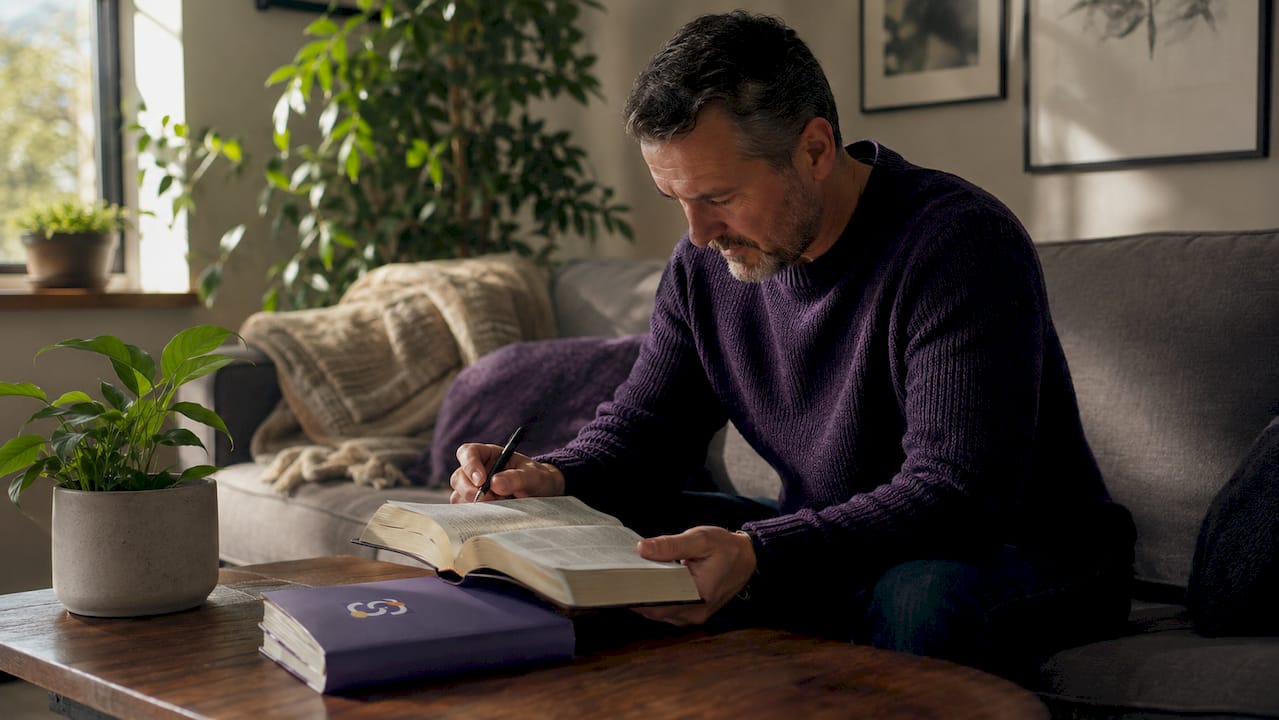
What makes this framework powerful is its sequence. A man does not jump to making amends before he has examined himself honestly. He does not ask God to remove his shortcomings before he has admitted they exist. The order mirrors the biblical pattern of conviction, confession, and restoration found throughout the Psalms and the New Testament.
Pro Tip: When studying the 12 steps alongside scripture, read the corresponding verse before each step meeting, not after. Letting the Word frame the step deepens understanding and keeps God at the center of the work.
What historical and theological foundations connect AA and Celebrate Recovery with the Bible?
The biblical roots of the 12-step model go back to the program’s founding. AA founders drew directly from the Sermon on the Mount, 1 Corinthians 13, and the Book of James when shaping the program’s spiritual framework. These texts were not decorative references. They formed the theological backbone of how early members understood surrender, love, and character change.
That foundation produced what early AA literature called “deflation at depth.” This spiritual transformation described the moment a man stops relying on his own strength and genuinely yields to God. It is the same posture described in Isaiah 66:2 and James 4:6. The language was different, but the movement of the soul was identical.
Celebrate Recovery took that foundation and made it explicitly Christ-centered. Over 29,000 churches worldwide now host Celebrate Recovery programs, each one naming Jesus Christ as the Higher Power rather than leaving that concept open-ended. That specificity matters theologically. It closes the gap between general spirituality and Christian faith.
Key strengths of faith-based 12-step adaptations include:
- Scriptural accountability: Every step is measured against a biblical standard, not just personal progress.
- Community structure: Church-based groups provide consistent, ongoing relationships rather than anonymous drop-in attendance.
- Christ as the center: Naming Jesus as Higher Power removes ambiguity about the source of healing.
- Pastoral oversight: Many faith-based groups include trained leaders who can address spiritual and emotional needs together.
The Life Recovery Bible builds on this history by mapping scripture directly to each step with devotional annotations. This resource makes spiritual surrender more intuitive by connecting clinical recovery language with biblical truth in one place. For a man new to both faith and recovery, that integration removes a significant barrier.
Pro Tip: If you are new to Celebrate Recovery, attend three consecutive meetings before deciding whether it fits. The community dynamic builds slowly, and the scriptural depth becomes clearer after the first few sessions.
How can men practically integrate scripture with the 12-step process?
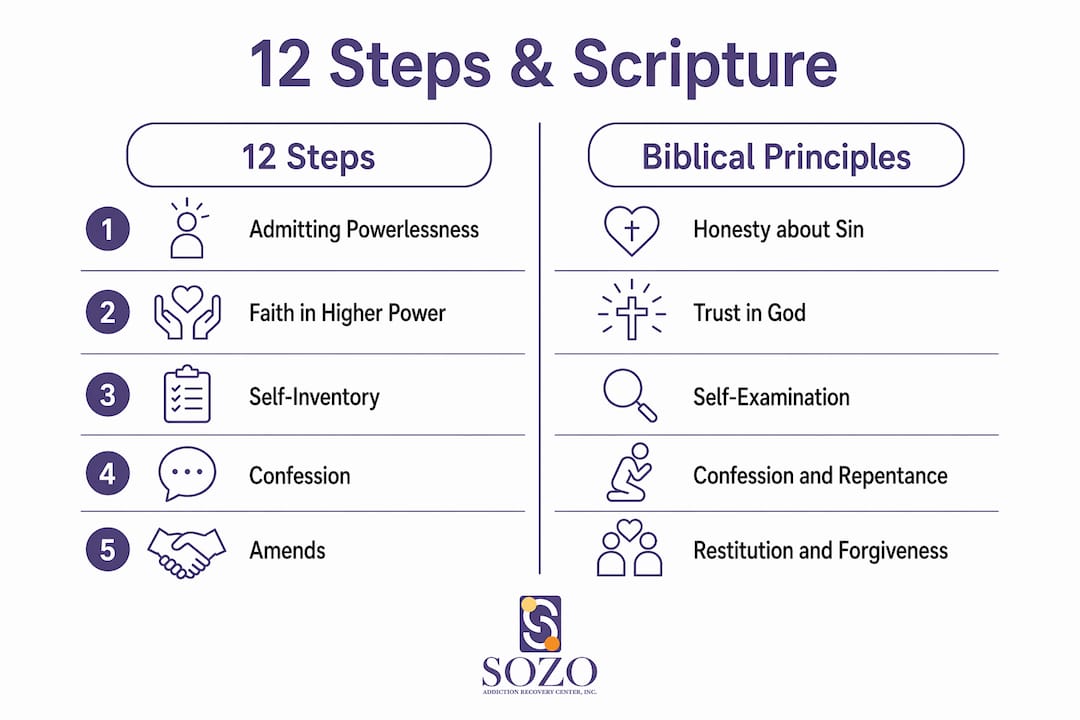
Knowing the biblical parallels is one thing. Living them out daily is another. Practical faith-based recovery blends scripture study, prayer, humility, confession, and community support into a daily rhythm that sustains sobriety over time. The goal is not a one-time spiritual experience. It is a pattern of living.
Here is a practical framework for daily integration:
- Start each day with the step’s scripture. Read the verse corresponding to the step you are currently working. Sit with it for five minutes before the day begins. This practice keeps the step active rather than theoretical.
- Use The Life Recovery Bible for devotional study. This devotional Bible pairs scripture reflections with each step, giving men a structured way to engage the Word alongside their recovery work.
- Practice confession with a sponsor or accountability partner. James 5:16 does not describe private confession to God alone. It describes confession to one another. A sponsor who shares your faith can hold both the step and the scripture accountable.
- Attend a Celebrate Recovery group weekly. Community accountability is not optional in sustained healing. Isolation is where relapse grows. A weekly group provides the relational structure that scripture consistently calls men toward.
- Apply ancient scriptural teachings daily through prayer and service. Steps 11 and 12 are not endpoints. They are the ongoing practices that keep a man spiritually alive and connected to others in recovery.
The virtues the steps develop, including humility, honesty, and forgiveness, are not personality traits a man manufactures. They are fruits of the Spirit described in Galatians 5:22 to 23. The steps create the conditions for those fruits to grow. Scripture explains why they matter and where they come from.
A common pitfall is treating the steps as a checklist rather than a way of life. A man who completes Step 9 and considers himself done has missed the point entirely. The steps are meant to be revisited, deepened, and lived out in community over years, not weeks.
What theological nuances arise when blending the 12 steps with Christian faith?
The 12-step model was shaped by both psychological insight and biblical truth. That dual origin creates some tensions worth understanding clearly.
The most significant theological question is the identity of the Higher Power. In secular 12-step settings, that term is deliberately vague. For a Christian man, leaving it undefined creates a spiritual problem. Celebrate Recovery resolves this by naming Jesus Christ explicitly, which aligns the program with orthodox Christian belief and removes the ambiguity that concerns many pastors and counselors. If you wonder whether AA is religious, we share what AA says about itself.
Other nuances to hold carefully:
- Forgiveness of God vs. forgiving God: Some recovery language encourages participants to “forgive God” for pain they experienced. This framing is theologically problematic. God does not sin and does not require forgiveness. What men often need is to release their anger toward God through honest prayer, which is a different and biblically supported practice found throughout the Psalms.
- Psychological origin vs. spiritual application: The steps draw on early 20th-century psychology as well as scripture. That does not disqualify them. It means a man should engage them with discernment, measuring each principle against biblical truth rather than accepting every element uncritically.
- Leadership qualifications: Successful integration requires moving beyond intellectual assent to active daily spiritual practice. Groups led by unqualified individuals can drift from scripture or create unhealthy dependency. Men benefit from groups with trained facilitators who are accountable to a church or ministry.
- Humility as the foundation: The 12 steps emphasize humility and confession as principles rooted in the Beatitudes. A man who approaches the steps with pride intact will find them frustrating. A man who approaches them with genuine brokenness will find them life-giving.
The steps work best when a man treats them as a spiritual discipline, not a self-help program. The difference is not semantic. One relies on God. The other relies on the man.
Key Takeaways
The most effective approach to faith-based recovery integrates specific biblical scripture with each of the 12 steps, practiced daily within an accountable Christian community.
| Point | Details |
|---|---|
| Biblical roots are foundational | AA founders drew from the Sermon on the Mount and James; Celebrate Recovery made that connection explicit. |
| Each step maps to scripture | Programs like Celebrate Recovery pair every step with a specific verse, grounding recovery in God’s Word. |
| Community is non-negotiable | Sustained healing requires weekly group accountability, not solo scripture reading alone. |
| Name Jesus as Higher Power | Faith-based recovery works best when Christ is identified specifically, not left as a vague spiritual concept. |
| Daily practice over theory | The steps must be lived through prayer, confession, and service, not simply understood intellectually. |
Why I believe biblical integration changes everything in recovery
I have seen men walk through the 12 steps with gritted teeth, treating each one like a task to cross off a list. They finish Step 12 and feel relieved it is over. Then, six months later, they are back at Step 1. The steps without scripture are a framework without a foundation.
What changes when a man brings the Bible into the process is the source of power. He stops trying to fix himself and starts yielding to something greater. That shift, what early AA called “deflation at depth,” is not a moment of weakness. It is the most honest thing a man can do. Proverbs 3:5 does not say “lean on your own understanding when you feel strong enough.” It says trust God with all your heart. The steps, read through scripture, make that trust concrete and daily.
The men I have seen sustain sobriety long-term share one thing: they did not graduate from the steps. They kept working them, kept showing up to community, and kept letting scripture correct their thinking. The spiritual guidance that sobriety requires is not a supplement to the 12-step process. It is the engine of it.
If you are exploring this path, do not wait until your theology is perfect. Start where you are, bring your Bible, and find a community that names Jesus as the source of healing. The rest will follow.
Ty
Faith-based recovery support at Sozorecoverycenter
Men who want to integrate biblical principles with professional addiction treatment have a specific option in Hot Springs, Arkansas. Sozorecoverycenter offers a men’s program that pairs the 12-step recovery model with scripture-based care and dual diagnosis treatment under the ASAM Continuum model. The program does not treat faith as an add-on. It is woven into every part of the clinical and spiritual process.
For men ready to move from understanding the steps to living them inside a structured, faith-centered environment, Sozorecoverycenter provides the community, clinical support, and biblical grounding that lasting sobriety requires. Learn more about faith-based rehab in Arkansas and what a Christ-centered recovery program looks like in practice.
FAQ
What is the connection between the 12 steps and the Bible?
The 12 steps are grounded in biblical principles including confession, humility, repentance, and service. AA founders drew directly from the Sermon on the Mount and the Book of James when shaping the program.
What Bible verses are used in the 12-step program?
Key verses include Romans 7:18 for Step 1, Philippians 4:13 for Step 2, and James 5:16 for Step 5. Celebrate Recovery formally pairs each step with a specific scripture to root recovery in Christ.
What is Celebrate Recovery and how does it differ from AA?
Celebrate Recovery is a Christ-centered 12-step program hosted in over 29,000 churches worldwide. It differs from AA by naming Jesus Christ explicitly as the Higher Power rather than leaving that concept open to personal interpretation.
What is The Life Recovery Bible?
The Life Recovery Bible is a devotional Bible that maps scripture reflections to each of the 12 steps. It helps men connect biblical truth with their recovery work through structured, step-by-step study.
Can the 12 steps replace church or pastoral care?
The 12 steps complement but do not replace church community or pastoral guidance. Faith-based recovery works best when step work is supported by qualified leadership and ongoing spiritual accountability within a church or ministry setting.