


A Christian 12 step program is a faith-centered recovery system that explicitly names Jesus Christ as the Higher Power, blending biblical teachings with structured peer support to address addiction, emotional wounds, and mental health challenges. Unlike secular recovery models that reference a vague “higher power,” this approach anchors every step in scripture and Christian community. Programs like Celebrate Recovery have grown to reach over 1.5 million participants in about 35,000 churches worldwide as of Q2 2026. That scale reflects a genuine hunger for recovery pathways that speak to the whole person, including faith.
How does a Christian 12 step program work?
A Christ-centered 12 step recovery program adapts the original 12 steps of Alcoholics Anonymous and pairs each one with specific Bible passages. The result is a structured framework where spiritual surrender is not abstract. It is grounded in the person of Jesus Christ and the authority of scripture.
The backbone of most faith-based 12 step programs is the 8 Recovery Principles drawn from the Beatitudes in Matthew 5:3 to 10. These principles guide participants through humility, confession, moral inventory, and service in a sequence that mirrors the 12 steps but speaks directly to Christian theology. Each principle connects a specific human struggle to a specific promise from Jesus.
The core spiritual actions in a Christian 12 step program include:
- Admission: Acknowledging powerlessness over sin and addiction, echoing Matthew 5:3, “Blessed are the poor in spirit.”
- Surrender: Turning will and life over to Jesus Christ as Lord and Savior, not a generic spiritual force.
- Moral inventory: A written, honest account of wrongs done and wounds received, grounded in 1 John 1:9.
- Confession: Sharing that inventory with God and another trusted person, reflecting James 5:16.
- Amends: Making direct restitution where possible, guided by Matthew 5:23 to 24.
- Ongoing accountability: Regular check-ins with a sponsor or accountability partner rooted in Proverbs 27:17.
Pro Tip: Start with the 8 Recovery Principles before tackling the full 12 steps. Understanding the Beatitudes first gives each step a clear spiritual purpose rather than a mechanical task.
The steps were never the destination. They were the training. A man who works through them honestly finds that the process reshapes his character, not just his behavior.
What is Celebrate Recovery and why is it the leading Christian 12 step program?
Celebrate Recovery is the most widely recognized faith-based 12 step program in the United States. Founded by Pastor John Baker at Saddleback Church in 1991, it has grown into a global movement with 1.5 million participants across 35,000 churches worldwide as of 2026. That reach makes it the single largest Christ-centered recovery community in existence.
The program uses 12 steps adapted from AA paired with the 8 Recovery Principles based on the Beatitudes. Every step and principle is anchored to a specific scripture, so participants are never working from abstraction alone. The curriculum is comprehensive, covering addiction, trauma, codependency, and behavioral compulsions within a single unified framework.
Meeting formats
Celebrate Recovery operates through two primary formats:
- Open Share Groups: Weekly meetings open to anyone. Participants share their struggles in a safe, structured setting. No prior commitment is required to attend.
- Step Study Groups: Longer, curriculum-based groups that typically run several months. These focus on deep personal inventory, accountability, and sustained spiritual growth.
Step Study groups typically last several months, focusing on personal inventory and ongoing accountability. This gradual approach reflects the program’s understanding that lasting recovery is built over time, not in a single breakthrough moment.
Digital support
The Celebrate Recovery app provides a meeting locator, daily devotionals, accountability tools, and step-by-step guidance tied to the program’s principles. The app supports in-person participation rather than replacing it. Digital tools serve as a companion resource, but the vital fellowship happens face to face.
| Feature | Celebrate Recovery |
|---|---|
| Founded | 1991, Saddleback Church |
| Global reach | 35,000 churches, 1.5 million participants |
| Core framework | 12 steps + 8 Beatitude-based principles |
| Meeting types | Weekly Share Groups and multi-month Step Study Groups |
| Higher Power | Jesus Christ, explicitly named |
| Digital tool | Celebrate Recovery app |
Who can participate in a faith-based 12 step program?
Christian 12 step programs address a broad range of struggles beyond substance addiction, including emotional wounds, trauma, codependency, grief, and mental health challenges. The phrase used most often is “hurts, habits, and hang-ups.” That framing is intentional. It signals that no one’s struggle is too small or too shameful to bring into the room.
Participation is open to anyone, regardless of where they stand in their faith. Many participants attend as observers initially, assessing the program’s spiritual fit at their own pace without pressure to conform to doctrine. A man who is skeptical about faith but desperate for community will find a seat at the table.
The program also offers gender-specific and issue-specific small groups. These smaller settings allow for deeper, safer sharing on topics like sexual addiction, domestic abuse, grief, or eating disorders. The specificity matters because a man struggling with alcohol and a woman processing childhood trauma need different spaces to speak honestly.
Pro Tip: If you are attending for the first time, go as an observer. Sit, listen, and let the community speak for itself before you decide whether to commit to a Step Study group.
A critical distinction: faith-based 12 step programs are community support platforms, not clinical treatment. Celebrate Recovery is church-centered and does not replace professional addiction medicine, psychiatric care, or dual diagnosis treatment. For men managing both addiction and mental health conditions, clinical care and community support work best together.
How does the Christian 12 step program differ from secular approaches?
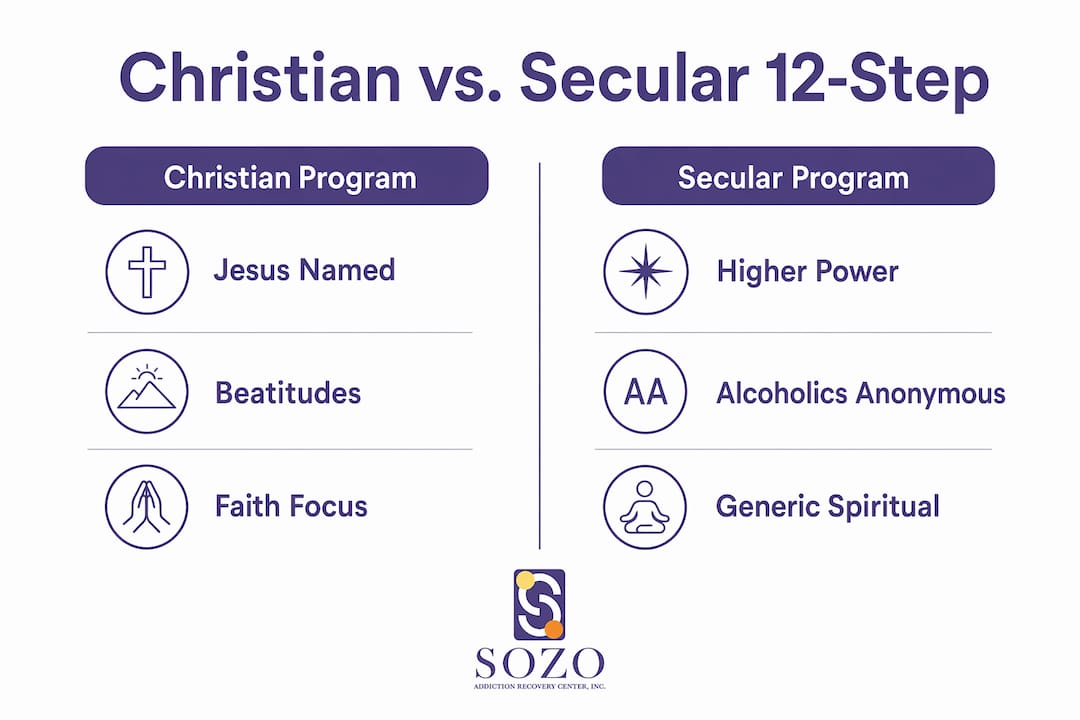
The most significant difference is specificity. Celebrate Recovery explicitly names Jesus Christ as the Higher Power rather than leaving that concept open to personal interpretation. That specificity is not a barrier. For men who hold Christian faith, it is the very thing that makes surrender feel real rather than theoretical.
Secular 12 step programs use the phrase “a power greater than ourselves” deliberately, to remain accessible across belief systems. That openness serves many people well. But for a man whose faith is central to his identity, surrendering to an unnamed force can feel hollow. Naming Jesus Christ as the source of grace and healing changes the emotional weight of that surrender entirely. A man of faith deserves a straight answer, and we give what AA says about religion in its own words.
The differences extend beyond language:
- Scripture integration: Every step in a Christian program is paired with a Bible verse. Secular programs use no scripture.
- Community context: Christian programs operate within a church body, connecting recovery to worship, discipleship, and service.
- Goal beyond sobriety: Faith-based programs aim for discipleship and spiritual transformation, not only abstinence. Sobriety is the floor, not the ceiling.
- Accountability structure: Sponsors and accountability partners in Christian programs share a theological framework, which deepens the relational bond.
For a side-by-side look at how faith-based and traditional rehab approaches compare, Sozorecoverycenter’s guide on faith vs. traditional rehab offers a clear breakdown of both pathways.
How can a man start and sustain a Christian 12 step program?
Starting is simpler than most men expect. The Celebrate Recovery app includes a meeting locator that identifies nearby church-based groups by zip code. Most meetings welcome walk-ins with no registration required. Showing up is the entire first step.
Once a man decides to engage more deeply, the path forward follows a clear sequence:
- Attend an Open Share Group. These weekly meetings introduce the program’s culture, language, and community without requiring any commitment.
- Connect with a sponsor or accountability partner. This relationship is the engine of sustained recovery. A sponsor who shares your faith provides both practical guidance and spiritual accountability.
- Enroll in a Step Study group. This is where the deeper work happens. Over several months, participants work through the 12 steps and 8 principles with a small, consistent group.
- Use digital tools between meetings. The Celebrate Recovery app’s daily devotionals and accountability features keep the work alive between in-person sessions.
- Serve the community. Many long-term participants become sponsors, group leaders, or volunteers. Service is not optional in Christian recovery. It is part of the healing.
Pro Tip: Pair your Step Study group with a 12-step faith-based resource that explains the biblical grounding behind each step. Understanding the “why” behind each step makes the work feel purposeful rather than procedural.
Understanding how biblical recovery principles connect to daily spiritual practice can also strengthen a man’s commitment between meetings. The steps are not a checklist. They are a way of living.
Key Takeaways
A Christian 12 step program works because it combines the proven structure of 12-step recovery with the specific, personal grace of Jesus Christ, creating a framework that addresses addiction, mental health, and spiritual growth together.
| Point | Details |
|---|---|
| Christ as Higher Power | Christian programs name Jesus Christ explicitly, giving surrender a specific, personal spiritual anchor. |
| Scripture-grounded steps | Each of the 12 steps pairs with a Bible verse, connecting recovery actions to biblical authority. |
| Celebrate Recovery’s scale | Over 1.5 million participants in 35,000 churches make it the largest Christ-centered recovery community. |
| Broad scope of support | These programs address addiction, trauma, codependency, and mental health, not substance abuse alone. |
| Clinical care still needed | Faith-based programs support recovery but do not replace professional addiction or psychiatric treatment. |
What I’ve learned about faith and recovery after years of watching men heal
The men who struggle most in secular recovery programs are often not resistant to change. They are resistant to surrendering to something that does not feel real to them. When a man’s faith is the deepest thing he carries, asking him to hand his life over to an unnamed force is like asking him to pray to no one. It does not land.
What I have observed, again and again, is that naming Jesus Christ as the Higher Power does something specific to a man’s willingness. It pulls the fuel line out of his shame. Shame thrives in abstraction. It loses power when a man believes he is known by name, forgiven by name, and held by something with a face.
The common misconception about Christian recovery programs is that they are only for people who already have strong faith. That is wrong. Many men walk into Celebrate Recovery as skeptics. They come because someone they trust invited them, or because they have run out of other options. The community meets them where they are. Faith, for many, grows inside the program rather than being a prerequisite for it.
Families also underestimate how much these programs can help them. A wife or parent attending a Share Group alongside a man in recovery finds language for their own wounds. The “hurts, habits, and hang-ups” framework applies to everyone in the room, not just the person with the most visible struggle.
The steps were never meant to be finished. They were meant to be practiced. A man who works them honestly for a year is a different man than he was at the start. Not because the steps changed him, but because honesty, community, and grace did.
Ty
Faith-based recovery for men at Sozorecoverycenter
Sozorecoverycenter, located in Hot Springs, Arkansas, offers men a recovery program that integrates Christian 12 step principles with clinical dual diagnosis care. The center uses the ASAM Continuum model to build personalized treatment plans that address both addiction and mental health conditions at the same time.
For men who need more than a weekly meeting, Sozorecoverycenter provides structured residential care grounded in biblical principles and supported by licensed clinical staff. The combination of scripture-based recovery and professional treatment is what sets this program apart from community-only models. If you or someone you love is ready to take the next step, the admissions team at Sozorecoverycenter is available to walk you through the process and answer every question.
FAQ
What is a Christian 12 step program?
A Christian 12 step program is a faith-based adaptation of traditional 12-step recovery that explicitly names Jesus Christ as the Higher Power and anchors each step in biblical scripture. Celebrate Recovery is the most widely known example, operating in 35,000 churches worldwide.
How is Celebrate Recovery different from Alcoholics Anonymous?
Celebrate Recovery names Jesus Christ as the Higher Power rather than using a generic spiritual concept, and it pairs each step with a specific Bible verse. It also adds 8 Recovery Principles based on the Beatitudes, expanding the framework beyond the original AA model.
Do I need to be a Christian to attend Celebrate Recovery?
Many participants attend as observers or newcomers who are still exploring faith, with no pressure to conform to doctrine immediately. The program welcomes anyone struggling with hurts, habits, or hang-ups, regardless of where they stand spiritually.
What issues does a faith-based 12 step program address?
These programs address substance addiction, emotional wounds, trauma, codependency, grief, and mental health challenges. The scope goes well beyond alcohol or drugs, making the program relevant to a wide range of personal struggles.
Can a Christian 12 step program replace professional treatment?
A faith-based 12 step program is a community support resource, not a clinical treatment program. Men managing addiction alongside mental health conditions benefit most when they combine community participation with professional care, such as the dual diagnosis services offered at Sozorecoverycenter.
Recommended
- 12 Step Recovery for Men: The Faith-Based Practice Behind Lasting Sobriety: SOZO Addiction Recovery Center
- Faith-Based Rehab in Arkansas: Find Hope and Healing at SOZO Recovery Center
- Transform Your Life: Faith-Based Rehab Solutions | SOZO Recovery
- Christian Drug Rehab in Arkansas for Men | SOZO Recovery