


Volunteering in recovery gives a man something early sobriety often lacks: a reason to show up, people who expect him, and a way to turn attention outward when his own mind is loud. Research on 12-step members links helping others with better odds of staying sober. Service works best as a companion to clinical care and a sober community, never a replacement for them. This guide covers what the evidence says, what service can look like, how to begin, and how to keep it healthy.
TL;DR
- A study of people who helped others during recovery found 40 percent stayed sober over the following year, compared with 22 percent of those who did not.
- Service can be small: setting up chairs, making coffee, greeting a newcomer. It can also grow into sponsoring, community projects, or peer support work.
- Start with one commitment, protect your recovery routine first, and talk with your counselor or sponsor before taking on more.
- Volunteering supports treatment. Peer support is described by professionals as a complement to professionally directed care, not a substitute for it.
Table of Contents
- Why Service Matters in Early Recovery
- What the Research Says About Helping Others
- The Everyday Benefits Men Report
- Kinds of Service Work to Consider
- How to Get Started Without Overreaching
- Protecting Your Sobriety While You Serve
- Volunteering Supports Treatment, It Does Not Replace It
- Our Perspective
- Where SOZO Fits
- FAQ
- Sources
Why Service Matters in Early Recovery
Early sobriety is a strange season. The substance is gone, and what it covered up is suddenly in the room: guilt, restlessness, unpaid obligations, long empty hours. Many men describe the first months as being left alone with themselves.
Service changes the direction of attention. Instead of asking only “How am I doing?”, a man asks “Who needs a hand today?” That shift is not a distraction from recovery. It is one of the oldest practices inside it. The 12th step of the 12-step model is about carrying the message to others, and the traditions of fellowship rest on members doing small, steady, unglamorous work for one another.
At SOZO Recovery Center in Hot Springs, Arkansas, we see service as part of how a man rebuilds. Our approach combines biblical principles, the 12-step model, and clinical care, and giving back is a natural fit with all three. Humility and service are not extras at the end of treatment. They are part of the training.
What the Research Says About Helping Others
It is fair to be careful with claims here, so let us stick to what has been studied.
Staying sober longer. Researchers at Case Western Reserve University analyzed data from Project MATCH, a large treatment study. In a 2004 analysis, 40 percent of alcoholics who helped other alcoholics during recovery avoided drinking in the 12 months after three months of treatment, while 22 percent of those who did not help others stayed sober. These are results for a specific group in a specific study, but the direction is encouraging.
Lasting habit, lower depression. A 2009 follow-up by the same research team found that 94 percent of those who helped others at any point during the 15-month study kept doing so as part of their recovery, and reported lower levels of depression. Service, in other words, tends to stick once a man starts.
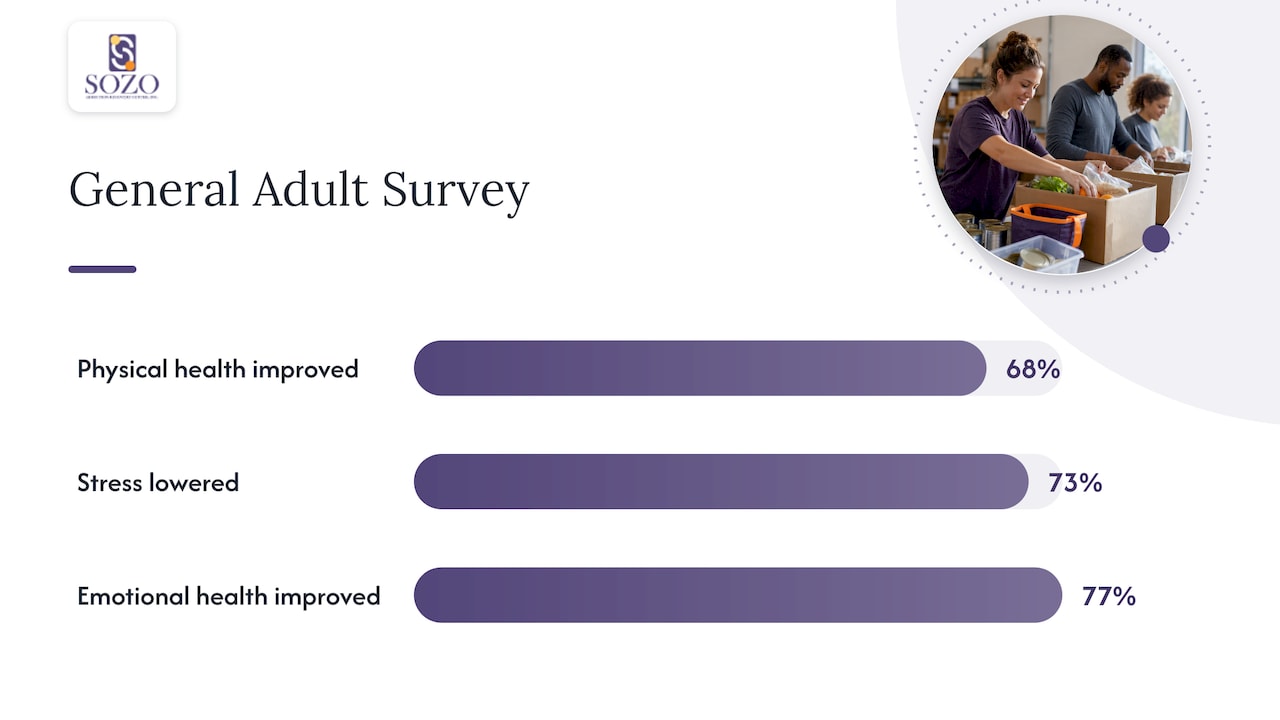
Feeling better overall. A 2010 survey of 4,582 American adults, reported by Greater Good at UC Berkeley, found that 68 percent said volunteering made them feel physically healthier, 73 percent said it lowered their stress, and 77 percent said it improved their emotional health. That survey covered adults in general, not only people in recovery, so read it as a supporting picture and not as a recovery statistic.
It is accessible. Researcher Maria Pagano has pointed out that service is something almost anyone can do. It does not demand a lot of introspective work, which can be hard for someone newly sober and still in a fog. A man who cannot yet put words to what he feels can still stack chairs.
The Everyday Benefits Men Report
Beyond the studies, recovery organizations describe a consistent list of gains. NCADD lists feeling needed and valued, broadening sober social contacts, learning new skills, building self-esteem and confidence, finding renewed purpose, and feeling part of something larger.
In plain terms, here is what those look like in a man’s week:
- Structure. A Tuesday evening shift is a fixed point. It fills hours that used to belong to drinking or using.
- Sober friendships. People you serve alongside see you at your steadiest, and they notice when you are absent.
- Self-respect, rebuilt by consistency. Trust with family and employers returns slowly. Showing up on time, week after week, is how a man proves it to himself first.
- A new identity. He is no longer only a man with a problem. He is the one who runs the sound board, drives the van, or greets new faces.
- Perspective. Seeing someone else’s hard season has a way of making gratitude concrete.
A man who has set down a weight rarely wants to pick it back up when he is busy carrying something worthwhile.
Kinds of Service Work to Consider
Service is wider than most men first assume. It helps to think in three circles: inside the fellowship, inside the community, and inside faith life.
Service inside 12-step fellowship
This is where most men begin because it asks for no résumé. Alcoholics Anonymous notes that most members take part by attending meetings, but there are many ways to serve, including maintaining meeting places, arranging meetings, answering calls for help, and providing literature. Narcotics Anonymous literature describes similar tasks: making coffee, setting up chairs, cleaning up afterward, greeting newcomers, speaking at meetings, and sponsoring.
The progression usually looks like this:
- Arrive early and set up chairs or make coffee.
- Greet newcomers and sit with someone who looks uneasy.
- Take on a group role, such as secretary or literature person.
- Share your story at a meeting when you and your sponsor agree you are ready.
- Sponsor another man once you have worked the steps yourself.
Each rung teaches something. The steps were never the destination. They were the training.
Service in the community
There is plenty of ordinary good to do. Food banks, shelters, park clean-ups, tutoring and literacy programs, and animal shelters all welcome steady volunteers. In the Hot Springs area, for example, Project HOPE Food Bank supplies food pantries, soup kitchens, children’s homes, and shelters across Garland County and nearby counties, and it invites volunteers. Check with any organization directly for current openings and schedules.
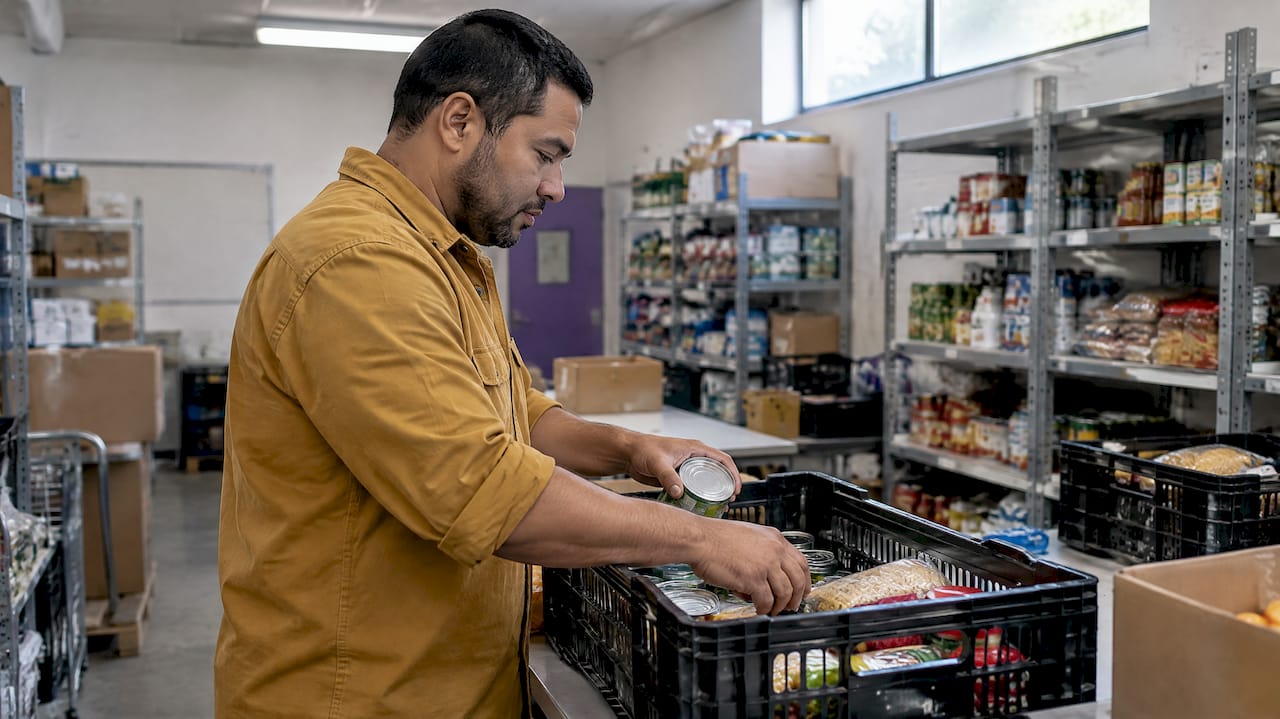
Community work has a quiet advantage. It puts a man alongside people who are not in recovery, which reminds him that a good life includes more than recovery meetings.
Service through faith
For men who draw strength from their faith, a congregation or ministry offers natural openings: greeting, meal preparation, transportation, youth programs, outreach. Serving in this setting joins spiritual growth with practical action. We write more about this connection in our piece on how Christian recovery and community support fuel healing.
Peer support work
Some men discover they want to make helping others a career. Peer support specialists use lived experience and training to support others through treatment and recovery. Mental Health America reports that 49 states and the District of Columbia have training and certification programs. Requirements typically include specialized training hours, lived experience, a high school diploma or equivalent in most states, and demonstrated time in recovery, usually one to two years. The same source notes that volunteer peer support roles exist with community organizations that may not require formal certification.
It also helps to know how the roles differ. According to a guide from the Community Collaborative for Change in Western New York, a peer specialist supports you in exploring pathways to recovery and building on your strengths, but does not diagnose, provide counseling, or act as a 12-step sponsor. A sponsor guides you through a fellowship. A counselor treats the disorder. A peer walks alongside.
How to Get Started Without Overreaching
The most common mistake is trying to do too much, too soon. A better approach is gradual.
- Talk first. Tell your counselor, sponsor, or a trusted person in your program that you want to serve. They know your stage and your stress points.
- Pick one thing. One weekly commitment you can keep is worth more than five you will drop.
- Start near recovery. Service connected to meetings or your recovery community tends to be a safer first step than a setting full of reminders of past use.
- Match the task to your season. Mental Health America advises reflecting on where you are in your own recovery and how ready you are to share your experiences before taking peer roles. That honesty applies to every kind of service.
- Ask what is expected. Know the hours, the duties, and who your point of contact is before you say yes.
- Review after a month. Is your sleep, mood, and meeting attendance steady? If so, consider adding a little. If not, scale back without shame.
Protecting Your Sobriety While You Serve
Service should add stability, not strain. A few practical habits keep it that way. These are general suggestions for men in recovery. For your own triggers and risk factors, your counselor and sponsor are the right people to ask.
Choose settings with low exposure. If a certain place, group of people, or kind of event was tied to your use, wait on it, or bring a sober friend. Serving at a venue that sells alcohol, for example, is a poor fit in the early months.
Set limits on time. Decide in advance how many hours per week you will give, and write it down. Meetings, therapy, sleep, work, and family come first. If you are in an intensive outpatient or partial hospitalization program, your schedule already has a clear shape, and any service has to fit around it.
Practice saying no kindly. Wanting to help can slide into taking on everyone’s problems. A short, warm answer works: “I can do Thursday evenings, but not more right now.”
Know your role. If someone asks you for medical advice, counseling, or help in a crisis beyond your training, point them to a professional or a helpline and tell your sponsor. Being a good volunteer includes knowing where your job ends.
Watch for warning signs. Skipped meetings, poor sleep, irritability, resentment, or a feeling that your service is the only thing keeping you sober are signals to slow down and talk to someone. If a craving or relapse thought builds, contact your sponsor, counselor, or treatment team right away.
Keep your own recovery first. A man cannot carry a message he is no longer living. Service is a way of strengthening your footing, not a way of avoiding your own work.
Volunteering Supports Treatment, It Does Not Replace It
Some men hope that helping others will be enough on its own. Professional guidance is clear that peer and service activities work best alongside clinical care. NAADAC, the association for addiction professionals, states that peer-based recovery support may serve as an adjunct or alternative to professionally directed treatment, but will never and should never fully replace it as a means of initiating recovery. SAMHSA describes peer support as nonclinical recovery support that can enhance substance use disorder treatment, extend related services, and improve outcomes.
For a man with a co-occurring condition such as depression, anxiety, or trauma, this matters even more. Service can lift mood and add meaning, but it does not treat a mental health disorder. Dual diagnosis care addresses both sides together, so that neither is left to undermine the other.
If you are still using, struggling to stop, or coming out of withdrawal, the first step is medical and clinical. Detox needs supervision, and a plan for what comes after it matters. Service can be built into that plan once you are stable.
Our Perspective
We have watched men arrive at SOZO carrying more shame than they could name. Most believed they had nothing left to offer anyone. What we have seen, again and again, is that recovery turns a corner when a man is given something real to do for someone else.
That is why our program combines clinical care, dual diagnosis support, the 12-step model, and biblical principles in a small, peaceful, retreat-like setting for men. Our personalized plans, informed by the ASAM Continuum, are designed to treat the whole man: his substance use, his mental health, and his spirit. Community engagement and volunteer work are part of how we hope a man learns that he is needed.
We do not believe service is a shortcut. We believe it is a discipline, practiced best by a man who is receiving good care, working his steps, and surrounded by brothers who know his story. When treatment gives him a steady foundation, service gives it direction.
Ty
Where SOZO Fits
If you are reading this because you want a recovery that includes both healing and purpose, our team can help you find the right level of care. We offer residential treatment, partial hospitalization, intensive outpatient, outpatient care, sober living, medical detox placement, and dual diagnosis care for men, each shaped by a personalized plan. Cost depends on the level of care, length of stay, and your insurance benefits, and our admissions team can walk through what applies to you.
If you are not sure which level fits, our guide to sober living versus residential treatment is a good place to start. If you are weighing how to keep working or caring for family while in treatment, read about intensive outpatient care for Arkansas men. When you are ready to talk, reach out to SOZO Recovery Center.
After treatment, service often becomes part of a longer plan. Our article on staying sober after rehab describes how aftercare, community, and routine work together, and our piece on support systems and sobriety explains why the people around you matter.
FAQ
Can I volunteer in early recovery?
Often yes, and many men find it helpful, but start small and talk with your counselor or sponsor first. Simple tasks tied to meetings, such as setting up chairs or greeting newcomers, are common starting points. Protect your treatment schedule and meeting attendance before adding other commitments.
What is the difference between service work and peer support?
Service work covers any act of helping, from making coffee at a meeting to volunteering at a food bank. Peer support is a more defined role in which someone uses lived experience and training to support others, and many states offer certification. A peer supporter does not provide counseling or medical advice, and is not the same as a sponsor.
How much should I volunteer?
There is no set number, but fewer hours that you can keep reliably beat a heavy load that wears you down. Many men begin with a few hours a week. Review it after a month with someone who knows your recovery, and adjust if sleep, mood, or meeting attendance slips.
Can volunteering replace rehab?
No. Professional guidance describes peer and service activities as supports that complement professionally directed treatment, not as a replacement for it. If you need detox, residential care, or help with a co-occurring mental health condition, start with a clinical assessment.
Does volunteering help if I am in a faith-based program?
For many men it does. Serving others lines up naturally with the spiritual side of recovery, and it can strengthen the sense of purpose and community that faith-based care aims to build. Your treatment team can help you find service that fits your beliefs and your stage of recovery.
Sources
- Helping Others Helps Alcoholics Stay on the Road to Recovery, Case Western Reserve University
- Staying Sober through Service, Greater Good, UC Berkeley
- Volunteer, NCADD
- Participating in A.A., Alcoholics Anonymous
- How to Become a Peer Support Specialist, Mental Health America
- What to Expect in Working with a Peer, CCCWN
- Peer-Based Recovery Support Services, NAADAC
- Incorporating Peer Support Into Substance Use Treatment, SAMHSA
- Project HOPE Food Bank