


Yes, the Family and Medical Leave Act (FMLA) can protect your job while you get treatment for addiction. It applies when you work for a covered employer, meet the eligibility tests, and receive treatment from a health care provider, or from a treatment provider on a provider’s referral. Time away because of using a substance does not qualify. Time away for treatment can.
For a man weighing residential care, a day program, or an evening schedule, that distinction matters. Below, we walk through how the rule works, which levels of care tend to fit, how to ask for leave, and what the law does not protect.
TL;DR
- FMLA gives eligible employees up to 12 workweeks of unpaid, job-protected leave in a leave year for their own serious health condition, and substance abuse treatment can qualify.
- The treatment must be provided by a health care provider or by a provider of health care services on referral from a health care provider.
- You generally need 12 months with your employer, 1,250 hours in the past 12 months, and a worksite with 50 or more employees within 75 miles.
- Your employer cannot take action against you for using FMLA leave for treatment, but an established, evenly applied policy on substance use can still apply.
- A man can also use FMLA to care for a spouse in inpatient treatment.
Table of Contents
- Does FMLA Apply to Addiction Treatment?
- Who Qualifies for FMLA Leave
- Which Levels of Care Fit the Rules
- How to Request FMLA Leave for Treatment
- What FMLA Does Not Protect
- Using FMLA to Support a Husband in Treatment
- Our Perspective
- Starting the Conversation With SOZO
- FAQ
- Sources
Does FMLA Apply to Addiction Treatment?
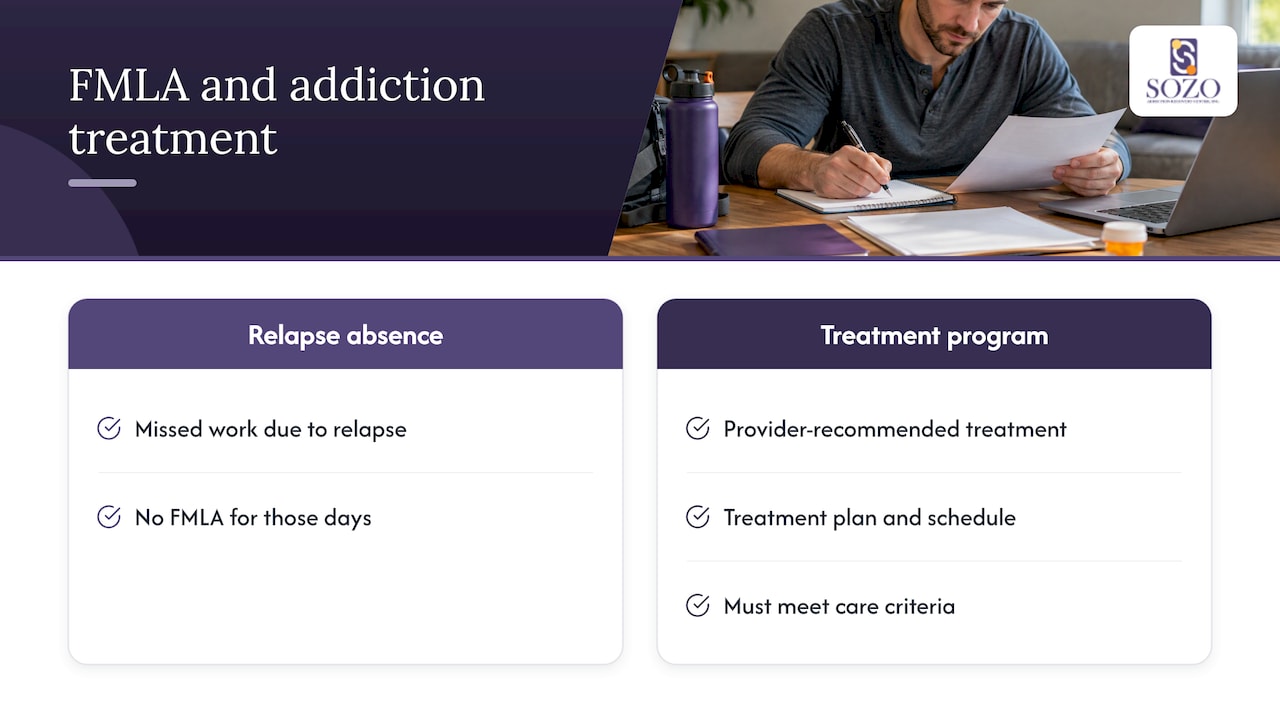
It can. Under the federal regulation on this subject, substance abuse may be a serious health condition when the conditions for inpatient care or continuing treatment are met. The same rule draws a firm line: leave may be taken for treatment, not for an absence caused by use of the substance.
That line shapes how you should think about timing. A man who has missed work because of a relapse has not earned FMLA protection for those missed days. A man who is entering a program on a health care provider’s recommendation, with a treatment plan and a schedule, is in a very different position.
The law defines a serious health condition as an illness, injury, impairment, or physical or mental condition that involves inpatient care or continuing treatment. Incapacity means being unable to work, attend school, or perform regular daily activities because of the condition, its treatment, or recovery from it. Addiction treatment is judged against those same tests.
Who Qualifies for FMLA Leave
Two questions come first: is your employer covered, and are you eligible?
Covered employers
The Department of Labor (DOL) explains that covered employers include private-sector employers with 50 or more employees in 20 or more workweeks in the current or previous calendar year. Public agencies, including federal, state, and local government employers, are covered regardless of size. So are local educational agencies.
Eligible employees
Per the DOL, an employee must meet all four of these tests:
- Work for a covered employer.
- Have worked 1,250 hours during the 12 months before leave starts.
- Work at a location where the employer has 50 or more employees within 75 miles.
- Have worked for the employer for 12 months, which need not be consecutive.
If you meet them, you can take up to 12 workweeks in the FMLA leave year for your own serious health condition. During that leave, the DOL says employers must continue group health benefits under the same conditions as if you had not taken leave, and restore you to the same or a virtually identical position when you return.
Twelve weeks is a ceiling, not a requirement. Many men use far less, especially in step-down programs.
Which Levels of Care Fit the Rules
FMLA does not name programs. It asks whether your situation meets the inpatient-care route or the continuing-treatment route. Here is how that tends to play out across levels of care. Your provider and your employer make the final call on your facts.
Inpatient and residential care
The DOL’s guidance on mental health conditions says that inpatient care includes an overnight stay in a hospital or other medical care facility, with a treatment center for addiction given as an example. A residential stay, and the medical detox that often comes before it, is the clearest fit. If you are not sure what a stay involves, our page on what residential treatment is lays out the daily rhythm.
Partial hospitalization, intensive outpatient, and outpatient
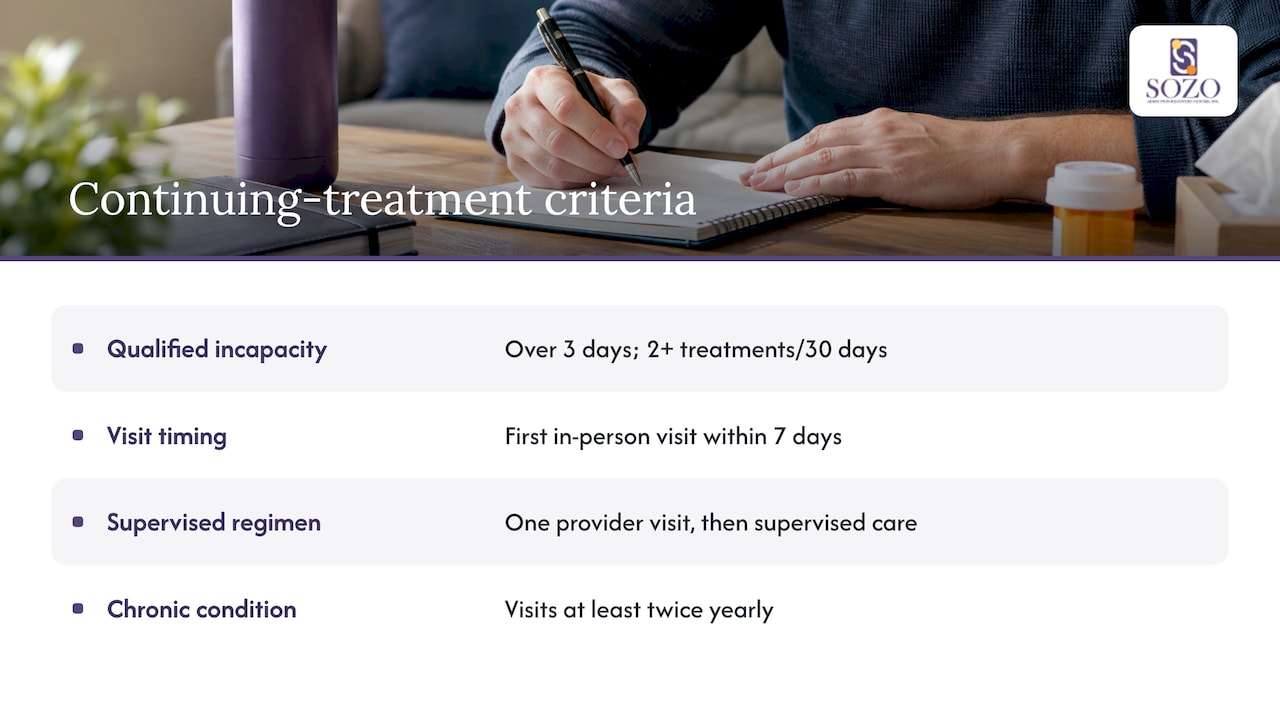
When you go home at night, the continuing-treatment route usually applies. Under the regulation, continuing treatment includes incapacity of more than three full consecutive days with treatment two or more times within 30 days, with the first or only in-person visit within seven days. It also includes one provider visit that results in a supervised regimen of continuing treatment, and chronic conditions needing visits at least twice a year.
The DOL’s mental health fact sheet describes continuing treatment as multiple appointments with a provider, or a single appointment and follow-up care such as prescription medication, outpatient rehabilitation counseling, or behavioral therapy. That language is why structured day and evening programs can qualify when the other requirements are met.
At SOZO, a man can find these steps laid out on our pages for partial hospitalization, intensive outpatient, and outpatient treatment. If you are comparing the two lighter options, this IOP and outpatient comparison may help you decide how much schedule you can actually protect.
Co-occurring mental health conditions
Many men entering treatment also live with anxiety, depression, or trauma. The DOL notes that chronic conditions such as anxiety or depression that cause occasional incapacity and need treatment at least twice a year can qualify. That can matter when your provider documents both the substance use disorder and the mental health condition. Our dual diagnosis and personalized care approach treats the two together.
How to Request FMLA Leave for Treatment
The process is more manageable when you take it in order.
- Get a clinical assessment first. A health care provider recommends the level of care. Our guide to the ASAM levels of care explains how that recommendation is made.
- Tell your employer, in the way your employer’s policy asks. Check your handbook or ask human resources how to request FMLA. You generally do not need to say the word “addiction” in the first conversation. You need to say you have a medical need for leave and are working with a provider.
- Give notice as early as you can. The regulation says that when the need for leave is foreseeable at least 30 days ahead and you fail to give timely notice without a reasonable excuse, the employer may delay FMLA coverage until 30 days after notice. For unforeseeable leave, such as an urgent admission, the outcome depends on the facts.
- Return the certification on time. An employer may require a health care provider’s certification. The employer should ask when you give notice or within five business days after, and you have 15 calendar days to return it.
- Keep your records tidy. The paperwork should show the provider or referral relationship, the treatment schedule, and the medical need for leave. It does not need unrelated personal details.
Privacy during leave
According to the DOL, your employer must keep your medical records confidential and in files separate from routine personnel files. The FMLA also prohibits interfering with your right to leave, including sharing or threatening to share health information to discourage you or coworkers from using it.
What FMLA Does Not Protect
A man should hear the limits plainly, so that he plans with them in mind rather than being surprised.
Leave is unpaid. FMLA protects your job and group health benefits, not your paycheck. Some men line up paid sick leave, vacation days, or short-term disability alongside it. Ask your employer which of those can run during FMLA.
Employer policies on substance use still apply. The regulation says that treatment does not prevent an employer from taking employment action. An employer cannot act against you for exercising the right to take leave for treatment. But if it has an established policy, applied without discrimination and communicated to all employees, that allows termination for substance abuse in certain circumstances, you can be terminated under that policy whether or not you are on leave.
The DOL has also said, in a compliance letter, that if an employee tests positive and has never requested FMLA, the law does not require the employer to offer a chance to seek treatment and be reinstated. The same holds if the employee admits to addiction only after that point and says a doctor is placing him in treatment. The practical lesson: asking for leave before a workplace incident usually puts you in a stronger position than asking after one. If you are already facing discipline, speak with an employment attorney or your state labor agency before you decide what to say.
Reinstatement has limits. Under the regulation, you have no greater right to reinstatement than if you had been continuously employed. If a condition prevents you from performing an essential function of your position, FMLA does not entitle you to another role, though the Americans with Disabilities Act may govern what your employer owes you.
States can add protections. Some states have their own leave laws that sit alongside the federal one. California is one example, and its mental health leave rules show how state protections can apply to workplace discipline and retaliation. Arkansas men should check with the state labor agency or an employment attorney on whether any state rule adds to the federal baseline.
Not every employer or employee is covered. If you work for a small business or have been at your job under a year, FMLA may not apply. That does not close the door on treatment. Ask your provider and our admissions team about timing and options.
Using FMLA to Support a Husband in Treatment
Sometimes the man reading this is not the patient. The DOL says an employee may use FMLA leave to care for a spouse in inpatient treatment for substance abuse, including taking part in the spouse’s treatment program or attending a care conference with the spouse’s providers. The DOL’s elaws advisor adds that an employer may not take action against an employee who is providing that care.
Family involvement tends to be a strong part of recovery. Our guide to faith-friendly family support for men in rehab explains how families can take part in ways that help, not hover.
Our Perspective
We have sat with men who delayed treatment for months because they feared one thing: the job. Some worried about the paycheck. Others worried about what a supervisor would think. The FMLA will not answer every one of those fears, but it answers an important one. For an eligible man at a covered employer, seeking treatment through the proper channels is a protected medical step, not a confession that costs him his place.
We believe the strongest recovery plans start with the right level of care, not the most convenient one. That is why we build personalized plans informed by the ASAM Continuum, and why we offer residential, partial hospitalization, intensive outpatient, outpatient, and sober living under one roof. A man can start where his clinical needs are and step down as he grows, while his provider and employer see a clear, documented schedule.
Faith matters to us too. We combine biblical principles with the 12-step model and clinical care for substance use and co-occurring mental health conditions, in a small, peaceful setting in Hot Springs. The leave from work is a season. What a man builds in it, humility, honesty, service, and a community that knows him, is meant to last long after the paperwork is filed.
Ty
Starting the Conversation With SOZO
If you are trying to line up leave, treatment, and family conversations at the same time, you do not have to sort it out alone. SOZO Recovery Center is a faith-based men’s program in Hot Springs, Arkansas, offering residential care, partial hospitalization, intensive outpatient, outpatient, sober living, and dual diagnosis care. We also help with referrals for medical detox placement when a man needs it first.
Our admissions team can talk with you about which level of care fits your situation and how your schedule would look, which are the details your provider and employer will ask about. We work with private insurance, including BlueCross BlueShield, Ambetter, and QualChoice. Read about the rehab admissions process for men, or visit SOZO Recovery Center to reach out.
FAQ
Can you use FMLA for rehab?
Yes, if you are an eligible employee of a covered employer and the treatment is provided by a health care provider or by a treatment provider on a provider’s referral. The condition also has to meet the inpatient-care or continuing-treatment tests. Time off because of using a substance, as opposed to treatment, does not qualify.
Does FMLA cover outpatient programs like IOP?
It can. Outpatient rehabilitation counseling and behavioral therapy are listed by the DOL as follow-up care that can support a continuing-treatment claim. Whether your schedule qualifies depends on your provider’s certification and the facts of your case.
Can my employer fire me for going to rehab?
An employer may not take action against you for exercising your right to FMLA leave for treatment. An established, consistently applied policy on substance use can still allow discipline, including termination, and that can apply whether or not you are on leave. If you are worried, talk with an employment attorney or the DOL’s Wage and Hour Division.
How much leave can I take for addiction treatment?
Eligible employees can take up to 12 workweeks in the FMLA leave year for their own serious health condition, according to the DOL. The leave is unpaid, and you may not need all of it. Your treatment plan determines how much time is clinically appropriate.
Who decides which level of care I need?
A qualified clinician decides, using a structured assessment. At SOZO, plans are informed by ASAM criteria, so a man starts at the level that matches his needs and moves through the continuum as he progresses.
Sources
- 29 CFR § 825.119, Leave for treatment of substance abuse
- 29 CFR § 825.113, Serious health condition
- 29 CFR § 825.115, Continuing treatment
- 29 CFR § 825.305, Certification
- 29 CFR § 825.216, Limitations on reinstatement
- DOL FMLA Frequently Asked Questions
- DOL Fact Sheet #28O: Mental Health Conditions and the FMLA
- DOL Fact Sheet #28P: Taking Leave When You or Your Family Has a Health Condition
- DOL elaws FMLA Advisor
- DOL FMLA Compliance Assistance letter FMLA-59
- Mental Health Leave California