


Most sober living homes use drug testing to maintain an alcohol and illicit drug free environment, but testing works as a procedural safeguard, not a clinical service. Operators need written policies, consistent and fair implementation, and a confirmatory workflow before any adverse action. That means choosing appropriate test types, setting fair frequency, protecting privacy and chain of custody, confirming positives through a laboratory, and routing results through medical review.
TL;DR:
- Urine screens usually detect use for days, oral fluid suits same day checks, hair looks back months, and sweat patches monitor continuously while worn.
- Higher support homes may test on admission and at scheduled intervals, while independent homes may use random checks or respond to specific concerns.
- Confirm any presumptive positive through certified laboratory testing and Medical Review Officer review, including checks against documented prescriptions, before imposing consequences.
- Choose an independent laboratory and document the absence of referral payments, since some states prohibit sober homes from steering residents to affiliated testing providers.
Table of Contents
- Why drug testing matters in sober living
- Types of drug tests used in sober living
- Designing a sober living drug testing policy
- Specimen collection, chain of custody, and specimen integrity
- Handling positive results: confirmation, MRO review, and resident rights
- Legal, privacy, and standards every operator should know
- How we build testing protocols into sober living support
- Balancing accountability with recovery support
- SOZO sober living: standards-aligned support for men
- FAQ
- Sources
Why drug testing matters in sober living
A recovery residence exists to protect a shared environment where residents can rebuild stability without the daily presence of substances. Testing serves that goal by giving house leadership an objective way to catch relapse early, before it spreads to roommates or derails someone’s progress. Done poorly, though, testing becomes a blunt instrument that punishes rather than supports.
Best Practices for Recovery Housing frames urinalysis as a tool for suspected use or situations where the household has become unsafe, not a routine hoop every resident jumps through regardless of circumstance. That guidance also notes something operators often overlook: recovery housing is nonclinical, so it cannot bill insurance or other third-party payors for testing the way a treatment program would.
Recovery housing testing works best as one layer in a broader support system, according to SAMHSA’s recovery housing guidance, which pairs screening with referral pathways rather than treating a test result as the end of the conversation.
A few principles keep testing aligned with its purpose:
- Testing responds to a reasonable concern, not a fishing expedition.
- Positive results open a conversation about treatment, not an automatic exit.
- Residents on prescribed medication, including medication-assisted treatment, are never treated as if they failed simply for taking what a doctor prescribed.
- Policies apply the same way to every resident at the same program level.
When a house links testing to counseling, peer support, and a clear understanding of how addiction affects the brain, a positive screen becomes a prompt for intervention rather than a dead end.
Types of drug tests used in sober living
Different situations call for different specimens, and a house that understands the tradeoffs can match the test to the question it actually needs answered.
Urine testing remains the backbone of most recovery housing programs. An immunoassay screen gives a quick presumptive result on site, flagging likely positives within minutes. Because screens can misfire on certain medications or cross-reactive substances, any presumptive positive that could lead to a consequence needs laboratory confirmation before anyone acts on it.
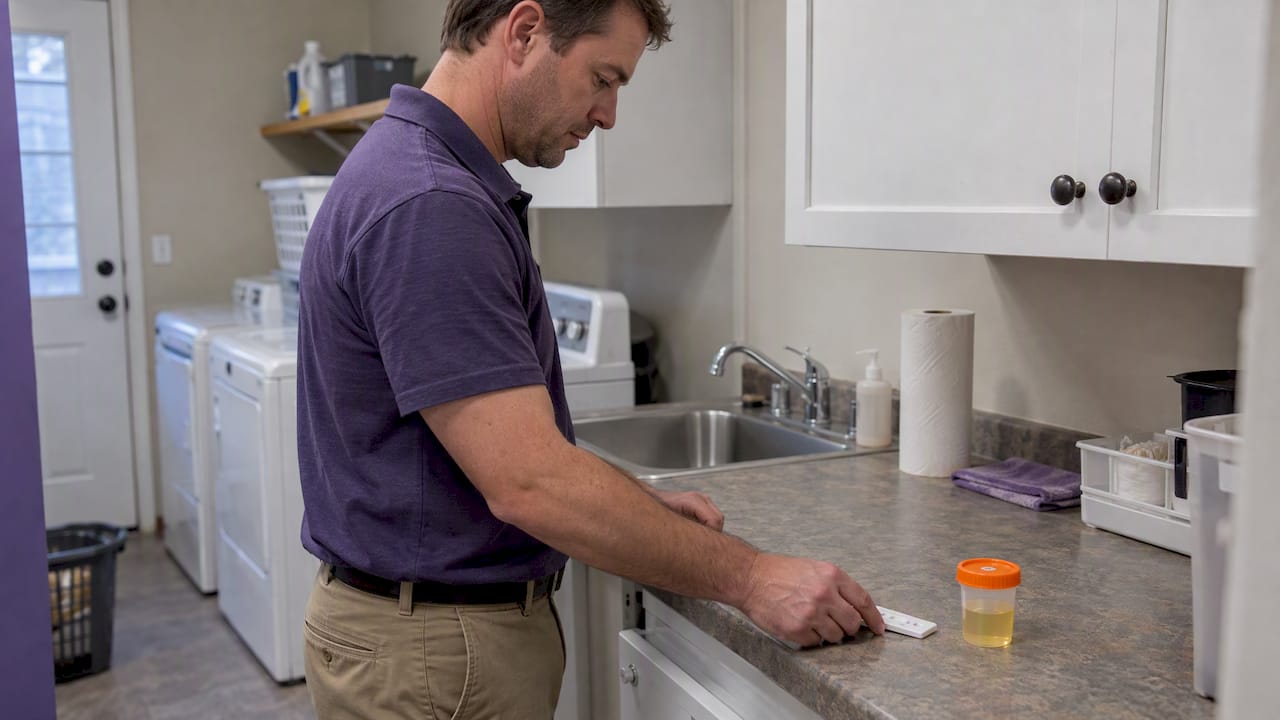
Oral fluid testing has gained ground because it is fast, easy to observe directly, and less invasive than a supervised urine collection. It detects recent use well but has a shorter window than urine, so it fits situations calling for same-day verification rather than a look back over several days.
Hair testing extends the detection window to a few months, which makes it useful for assessing a longer pattern rather than a single incident. Sweat patches offer continuous monitoring over days or weeks, a method that court supervision programs have used for ongoing accountability, though a patch cannot deliver an immediate onsite answer the way a urine or oral fluid screen can.
Alcohol calls for its own approach. Breath testing catches very recent drinking, while EtG and EtS urine tests can detect alcohol metabolites for a longer stretch after use, which makes them useful where abstinence from alcohol is a strict house requirement.
- Urine immunoassay: fast onsite screening, broad panel coverage, confirmation needed before action.
- Oral fluid: low intrusiveness, easy observation, shorter detection window.
- Hair: longest look back, not useful for same-day questions.
- Sweat patch: continuous wear, not an immediate result.
- Breath and EtG/EtS: alcohol specific, different windows for recent versus extended use.
| Test type | Typical detection window | Best suited for |
|---|---|---|
| Urine immunoassay | A few days for most substances | Routine and random screening |
| Oral fluid | Short detection window | Rapid, observed, low-intrusion checks |
| Hair | Long detection window | Pattern assessment over months |
| Sweat patch | Continuous while worn | Extended monitoring between checks |
| Breath (alcohol) | Short window | Immediate intoxication check |
| EtG/EtS (alcohol) | Several days detection | Verifying recent abstinence from alcohol |
Designing a sober living drug testing policy
A written policy is not a formality. NARR Standard 3.0 requires recovery residences to maintain an alcohol and illicit drug free environment and to have written protocols for both toxicology screening and medication handling, scaled to the residence’s level of support. Building that policy well protects residents and the house alike.
- Set frequency by residence level: a higher-support residence may test on move-in and at set intervals, while a more independent level relies more on random or for-cause testing.
- Build randomization into the schedule so testing cannot be predicted or selectively applied to certain residents.
- Choose a panel that reflects local substance trends, adding analytes like fentanyl where community data shows a real risk.
- Require written, signed consent at admission that explains what will be tested, how often, and what happens after a positive result.
- Document every prescribed medication at intake, including dosage and prescriber information, so a later positive can be checked against a legitimate prescription.
- Write a non-discriminatory policy for medication-assisted treatment so a resident on a prescribed medication is never penalized for it.
- Establish secure medication storage procedures and a log for anything controlled that residents keep on the property.
- Select a laboratory independent of any referral incentive, and document that the relationship carries no financial kickback.
Pro Tip: Put the full testing policy in writing and have every resident sign it at intake, including exactly which medications are exempt and why.
The lab selection step deserves particular attention. The LAPPA Model Recovery Residence Certification Act documents cases where some recovery residences steered residents to affiliated labs in exchange for kickbacks, a practice that drains resident resources without improving safety. Some states have gone further: Massachusetts recovery housing guidance prohibits lab self-referral arrangements with sober homes outright and ties penalties to violations. Any operator writing a policy should check whether their own state has adopted similar rules and should document, in writing, that the chosen laboratory has no financial relationship with house ownership or management.
Consent language matters as much as the schedule itself. Residents should know in writing what substances are being tested, how results get communicated, what due process looks like if a result is disputed, and how medication exemptions are verified. A policy that spells this out before anyone is tested prevents the kind of ambiguity that turns a single screening into a trust crisis.
Specimen collection, chain of custody, and specimen integrity
A test result only matters if the specimen behind it is unimpeachable. That starts with the collection method itself.
- Decide upfront whether a situation calls for an onsite rapid screen or a laboratory-based test; onsite screens are appropriate for routine or random checks, while any result that could lead to a consequence needs laboratory confirmation.
- Use a single chain-of-custody form for every specimen, recording who collected it, who handled it, and when each transfer happened.
- Check and record specimen temperature at collection to flag substituted or diluted samples.
- Require collector training so staff know how to spot adulteration attempts and document them correctly.
- Keep the chain-of-custody form and lab accession number on file before any administrative step is taken based on the result.
Privacy and dignity do not have to conflict with specimen integrity. A direct-observation collection is sometimes necessary to prevent tampering, but it should be explained in advance, documented in policy, and handled by staff trained to carry it out respectfully.
- Record every handoff of a specimen, including timestamps and storage conditions.
- Flag unusual temperature readings immediately rather than after the fact.
- Keep collection areas private while still following the house’s documented integrity procedures.
- Offer an alternate specimen type, such as oral fluid, for residents who cannot provide a urine sample under observation.
That last point reflects a real and common issue. Federal workplace drug testing guidelines address paruresis, the inability to urinate under observation, by authorizing alternate specimen collection when a donor makes a documented, good-faith attempt and cannot produce a sample. A house policy that builds in this accommodation from the start avoids turning a medical difficulty into an unwarranted accusation.
Handling positive results: confirmation, MRO review, and resident rights
An onsite screen is a starting point, not a verdict. The updated Mandatory Guidelines for Federal Workplace Drug Testing Programs lay out the analytes, cutoffs, and laboratory certification standards behind confirmatory testing using methods like GC-MS or LC-MS, along with the role of a Medical Review Officer in reviewing results before they become final.
- An initial immunoassay screen flags a presumptive positive, which can result from cross-reactivity or a legitimate prescription, and requires laboratory confirmation before action.
- Confirmatory testing at a certified laboratory verifies or clears that presumptive result with far greater specificity.
- A Medical Review Officer reviews any confirmed positive, checking it against documented prescriptions and medical explanations before the result is reported as verified.
- Only a verified positive, not a raw screen, should trigger any administrative or treatment-related step.
Pro Tip: Never take action on a presumptive screen alone. Wait for confirmatory results and MRO review, and document every step of that timeline.
Because confirmatory testing takes time, a house needs a clear interim plan that protects the household without presuming guilt before the result is verified. That might mean a temporary safety check-in or a conversation with a counselor, rather than an immediate consequence based on a screen that has not yet been confirmed. Once a result is verified, the resident should be told plainly what the process found, what documentation supports it, and what options exist, whether that means increased support, a referral to a higher level of care, or a defined appeal process. Transparency at every stage, backed by a documented chain of custody and a dated MRO review, is what makes a positive result defensible rather than disputed.
Legal, privacy, and standards every operator should know
Recovery housing sits at an intersection of several frameworks, and knowing which one applies where protects both the house and its residents.
NARR Standard 3.0 sets the baseline: a recovery residence must maintain a written policy for both toxicology screening and medication handling that is consistent with state law and matched to the residence’s level of support. It also warns explicitly against using testing as a revenue source, which should guide how a house selects and contracts with a laboratory.
NARR Standard 3.0 requires written toxicology and medication protocols at every certified recovery residence, a baseline that shapes how reputable programs structure testing policy (NARR Standard 3.0).
SAMHSA’s recovery housing guidance adds the clinical framing: urinalysis is recommended when suspected use makes the environment unsafe, not as a blanket requirement disconnected from actual concern, and recovery housing cannot bill insurance for testing since it operates as a nonclinical service.
Privacy questions come up often, and it helps to separate two distinct frameworks. Federal substance use confidentiality protections under 42 CFR Part 2 apply specifically to federally assisted substance use treatment programs, while HIPAA governs health information held by covered medical entities. A sober living house is typically neither, so operators should not assume either framework automatically covers their resident records, and should instead build their own confidentiality commitments into a clear written policy and consult a qualified attorney on how state law applies to their specific program.
- Check state-level rules on lab self-referral, since some states, like Massachusetts, prohibit kickback arrangements between labs and sober homes outright.
- Keep documented, written policies for toxicology screening and medication storage, per NARR Standard 3.0.
- Reference federal mandatory guidelines for analyte panels and MRO procedures when designing a confirmatory workflow.
- Verify that any laboratory relationship is free of referral incentives, documenting that independence in writing.
The LAPPA Model Recovery Residence Certification Act exists precisely because these conflicts have happened in real markets, where operators profited from steering residents to a specific lab. Adopting a documented, independent lab relationship and a written testing policy is the clearest way to avoid that pattern.
How we build testing protocols into sober living support
We treat drug testing as one part of a written, structured approach to sober living, not a standalone checkpoint. Our policies address medication storage and documentation with controlled substances logged and secured, and prescriptions documented at intake so a later screen can be checked against legitimate medical need. We built our confirmatory process around the principle that an onsite screen prompts a conversation and a referral path, never an automatic consequence before confirmation. Staff training covers collection procedures, chain-of-custody documentation, and how to talk with a resident about a result with respect. We view testing as a support tool inside a larger recovery plan that includes counseling, community, and personalized dual diagnosis care where it is needed.
Balancing accountability with recovery support
Testing only works when it serves the person it affects. We have seen that a policy treated as a punishment tool erodes the trust a house needs to function, while one explained clearly and applied consistently builds it. Staff training matters as much as the panel chosen, and residents deserve a voice in how house rules get communicated. Document the reasoning behind every policy choice, and explain it in plain language before anyone signs on.
Ty
SOZO sober living: standards-aligned support for men
We built our sober living program around principles like written policies, fair and consistent testing practices, and a structure that treats accountability as part of recovery rather than separate from it.
- Our sober living program pairs structured accountability with a supportive, faith-informed community.
- Residents transitioning from residential treatment can continue care through outpatient or dual diagnosis support as needed.
If you are weighing sober living options for yourself or someone you care about, reach out to our team to talk through what a placement at SOZO could look like.
This article is general information, not a substitute for advice from a qualified doctor. Consult a qualified healthcare professional about your own circumstances before acting on anything here.
FAQ
What kind of drug test do sober living homes use?
Most sober living homes rely on urine immunoassay testing for routine and random screening, since it is fast, affordable to administer onsite, and covers a broad panel of substances. Oral fluid, hair, sweat patches, and alcohol-specific tests like breath or EtG/EtS are used for more specific situations, such as verifying recent alcohol abstinence or assessing a longer pattern of use.
What happens if you fail a drug test in sober living?
An initial positive screen should trigger confirmatory laboratory testing and Medical Review Officer review before any action is taken, since screens can misfire on prescribed medications or cross-reactive substances. Once a result is verified, a well-run house responds with a conversation about treatment options and next steps rather than an automatic consequence.
How many days do you have to be sober to pass a drug test?
Detection windows vary by substance and test type: urine typically detects recent use within one to three days for most substances, while EtG alcohol testing can detect metabolites for a longer stretch after drinking. Hair testing looks back the furthest, up to about ninety days, so there is no single answer that applies across every substance and test method.
Do sober living homes test for kratom?
Kratom is not part of standard federal drug testing panels, so whether a house screens for it depends entirely on that house’s own written policy and chosen test panel. Residents should check their specific program’s documented substance list rather than assume kratom is included or excluded by default.