


Total rehab expense in Arkansas depends on the type of program a man enters, how long he stays, and who pays the bill, not a fixed statewide rate. Arkansas offers several payer pathways, including ARHOME and federal parity protections that commonly extend coverage to substance use disorder care. The most useful first step is practical: gather your insurance card, call member services, and if you lack coverage, contact Arkansas DHS or the SAMHSA locator today.
TL;DR:
- The total cost of rehab in Arkansas varies based on the treatment level, length of stay, and who pays, making individual benefits verification essential.
- Residential treatment and medical detox are the most expensive daily options due to continuous staffing and housing, while outpatient and sober living costs differ significantly.
- Verification of insurance benefits must include checking provider network status, prior authorization requirements, and whether medication costs are billed separately.
- Medicaid expansion (ARHOME) and private insurance can cover substance use disorder treatment, but confirmation of specific carriers and network participation is necessary.
- Early communication with facilities and insurers, including requesting itemized estimates and written approvals, can significantly reduce delays and unexpected expenses.
Table of Contents
- How Treatment Type and Length Shape Your Total Cost
- Insurance and Public Programs That Can Cover Care in Arkansas
- How to Verify Coverage and Estimate Your Out-of-Pocket Cost
- Ways to Reduce or Finance Treatment Expenses
- Availability and Regional Differences Across Arkansas
- Admissions, Prior Authorization, and Medical Necessity Timing
- SOZO Recovery Center: Programs and Payment Navigation in Arkansas
- Practical Guidance for Arkansas Families Weighing the Cost of Care
- How SOZO Helps With Benefits Checks and Admissions
- Sources
- FAQ
How Treatment Type and Length Shape Your Total Cost
The single biggest factor in what a family ends up owing is the level of care a man needs, not the facility’s reputation or location alone. Each level of care carries a different staffing model, a different length of stay, and a different billing pattern, and understanding these differences helps you interpret any facility’s quote with clear eyes.
Residential treatment provides around the clock clinical staffing, medical oversight, housing, and meals, along with the highest intensity of individual and group therapy. Because staff are present at all hours and the program covers lodging, this level of care generally carries the highest daily cost of any option. Medical detox adds another layer of expense on top of that: it requires licensed medical staff to monitor withdrawal, manage medication as needed, and respond quickly if a man’s condition changes, so the clinical observation itself is a meaningful part of what gets billed.
Outpatient and intensive outpatient programs work differently. Instead of daily housing, IOP bills for a set number of therapy hours per week, often billed per visit or bundled into a weekly or monthly rate. A man attending outpatient care for a few hours a few times a week will see a far different billing pattern than someone in residential care, since he is paying for scheduled clinical time rather than continuous housing and supervision.
Medication assisted treatment introduces an ongoing cost that outlasts the program itself. The medication component continues after a man leaves formal treatment, so it becomes a recurring line item rather than a one time charge, and it is worth asking any facility how medication costs are billed separately from therapy sessions.
Sober living sits outside clinical billing altogether. It is typically billed monthly by the housing provider rather than folded into insurance claims, since it functions as supportive housing rather than medical treatment. A man moving from residential care into sober living is usually looking at a separate, simpler monthly charge tied to rent and house structure rather than clinical services.
A few other variables push totals up or down regardless of program type:
- Staffing ratios: programs with more clinicians per client tend to bill higher rates.
- Room type: private rooms cost more than shared accommodations.
- Amenities: recreational or specialty amenities add to the daily rate.
- Program length: longer stays raise the total even when the daily rate stays flat.
Pro Tip: Ask every facility for a breakdown of what is included in the daily or weekly rate before comparing quotes. A lower daily number can hide a shorter list of included services.
Insurance and Public Programs That Can Cover Care in Arkansas
Arkansas residents have more coverage pathways available than many realize, but each one comes with its own administrative quirks worth understanding before you commit to a facility.
ARHOME is Arkansas’s approach to Medicaid expansion, and it differs from standard Medicaid administration in an important way: the state often contracts with private carriers to manage ARHOME benefits rather than administering claims directly. That means a facility saying it accepts “Medicaid” does not automatically mean it accepts your specific ARHOME carrier. According to Arkansas DHS, verifying both the carrier and the facility’s network status before admission is a necessary step, not an optional one. The ARHOME Quarterly Report also shows that cost sharing and carrier arrangements vary, so a benefits verification call often reveals gaps between what a plan document says and how a carrier actually processes substance use disorder claims.
Medicare covers inpatient and outpatient behavioral health services under defined rules, though the specifics depend on which part of Medicare applies to a given service. Veterans have additional pathways through the VA system that can run alongside or instead of Medicare, and it is worth asking a facility’s admissions team whether they coordinate with VA benefits directly.
Private insurance introduces its own set of questions. In-network facilities generally cost less out of pocket than out-of-network ones, and most plans require prior authorization before residential or intensive treatment begins. Deductibles and coinsurance for substance use disorder care may be combined with, or separate from, medical and surgical deductibles depending on the plan, which is exactly the kind of detail that only shows up when you ask directly.
That is where federal parity law becomes practically useful. Under the Mental Health Parity and Addiction Equity Act, plans that cover substance use treatment cannot apply stricter financial requirements or tighter treatment limits to that care than they apply to comparable medical or surgical benefits. MHPAEA, paired with Affordable Care Act protections, gives beneficiaries the right to request a plan’s rationale for denials or limits and to file appeals when parity appears to have been violated.
MHPAEA and ACA parity rules require insurers to apply comparable financial and treatment limits to substance use benefits as they do to medical benefits, which means a denial or unusually tight limit on rehab coverage is often appealable under federal law: CMS parity guidance.
A few practical habits protect you here:
- Ask every insurer representative for their name and a reference number.
- Request written or emailed confirmation of any benefits verification.
- Save every Explanation of Benefits document as claims are processed.
- Ask specifically whether your plan’s SUD deductible is combined with the medical deductible.
Our guide to insurance coverage for addiction treatment walks through these financial requirements in more depth, and a breakdown of Arkansas-specific carriers covers what Ambetter, BlueCross BlueShield, and QualChoice commonly cover for men seeking treatment in the state.
How to Verify Coverage and Estimate Your Out-of-Pocket Cost
Getting a reliable estimate takes a handful of deliberate steps rather than a single phone call, and doing them in order saves time later.
- Gather your documents. Have your insurance ID, plan name, and, if your coverage comes through work, your employer plan administrator’s contact information ready before you call.
- Call member services directly. Ask specifically about substance use disorder benefits, request the in-network facility list, ask about prior authorization rules, and confirm whether your SUD deductible is combined with your medical and surgical deductible.
- Ask the facility for a verification. A facility’s admissions team can typically run an insurance verification or preauthorization request and give you an itemized estimate of expected billable services before you commit to admission.
- Review every Explanation of Benefits closely. If a claim is adjusted or denied, ask the insurer in writing for the specific denial rationale so you can decide whether an appeal makes sense.
A few terms come up constantly in these conversations, and knowing them in advance keeps the process moving:
- Prior authorization is the insurer’s approval, required before treatment begins, confirming the plan will cover a specific level of care.
- Medical necessity is the clinical justification, often built on ASAM criteria, that shows a level of care matches a man’s assessed needs.
- In-network and out-of-network describe whether a facility has a contracted rate with your insurer, which directly affects your out-of-pocket share.
- Explanation of benefits is the statement your insurer sends after processing a claim, showing what was billed, what was covered, and what you owe.
Pro Tip: Request every benefits verification in writing, even a simple email confirmation. Verbal answers from a call center are hard to hold anyone to if the bill later looks different.
Ways to Reduce or Finance Treatment Expenses
Lacking full private coverage does not mean a man has no options, and several Arkansas specific and general pathways exist for reducing the financial burden of care.
- State-funded programs: Arkansas DHS coordinates state-funded treatment slots, and applying typically requires proof of income and residency along with a clinical assessment.
- Sliding scale fees: some providers adjust rates based on income, so it is worth asking a facility’s financial counselor directly whether this option exists and what documentation supports it.
- Employee Assistance Programs: many employers offer short-term assessment and referral services through an EAP, which can reduce immediate out-of-pocket barriers while a longer-term coverage plan comes together.
- Veterans benefits: veterans should ask admissions staff whether a facility coordinates directly with VA benefits.
- Community mental health centers: these centers often serve as a lower-cost entry point for assessment and referral.
- Nonprofit grants and scholarships: some organizations offer limited financial assistance specifically for addiction treatment.
Beyond identifying which of these applies to your situation, a few negotiation habits make a real difference. Ask any facility for a full itemized cost estimate before admission rather than a single bundled number, since itemized estimates make it easier to spot what insurance will and will not cover. Ask whether the facility offers payment plans that spread the remaining balance over several months rather than requiring payment in full at intake. And ask directly whether bundled pricing across multiple levels of care, such as detox followed by residential treatment, is available at a lower combined rate than booking each separately.
Availability and Regional Differences Across Arkansas
Where a man lives in Arkansas affects both how quickly he can start treatment and how far he may need to travel for a specific level of care. Facilities tend to cluster around the state’s larger population centers, while rural areas often have fewer specialty residential options nearby.
- Rural residents may need to travel to a regional hub for residential or specialized dual diagnosis care.
- Telehealth has expanded access to outpatient counseling and medication management for men who cannot easily reach a clinic in person.
- Traveling a bit farther for a specialized residential program is often a reasonable tradeoff when local options are limited.
- Wait times vary by facility and level of care, and admissions teams can often expedite intake when a medical need is documented.
The SAMHSA Arkansas Behavioral Health Barometer documents this regional variation in facility availability across the state, which is part of why expanding a search beyond your immediate county sometimes opens up faster admission or a better fit. For up to date facility listings and to check what a specific provider accepts, Findtreatment and the Arkansas DHS locator remain the most current starting points.
Admissions, Prior Authorization, and Medical Necessity Timing
Paperwork delays are one of the most avoidable reasons a man’s admission gets pushed back, and a little preparation goes a long way.
- Documentation for medical necessity. Facilities typically prepare an assessment aligned with ASAM criteria to show an insurer why a specific level of care is clinically appropriate, and this document is what insurers use to approve or deny prior authorization.
- Prior authorization timing. Insurers generally respond to a properly submitted request within a defined window, and if that window passes without a decision, admissions staff can often escalate the request or help file an appeal.
- What families should keep. Save copies of every assessment, every authorization request, and every insurer communication, since these documents are what support a faster resolution if a claim is delayed or denied.
Staying organized here is not just administrative tidiness. It is often the difference between starting care within days rather than weeks.
SOZO Recovery Center: Programs and Payment Navigation in Arkansas
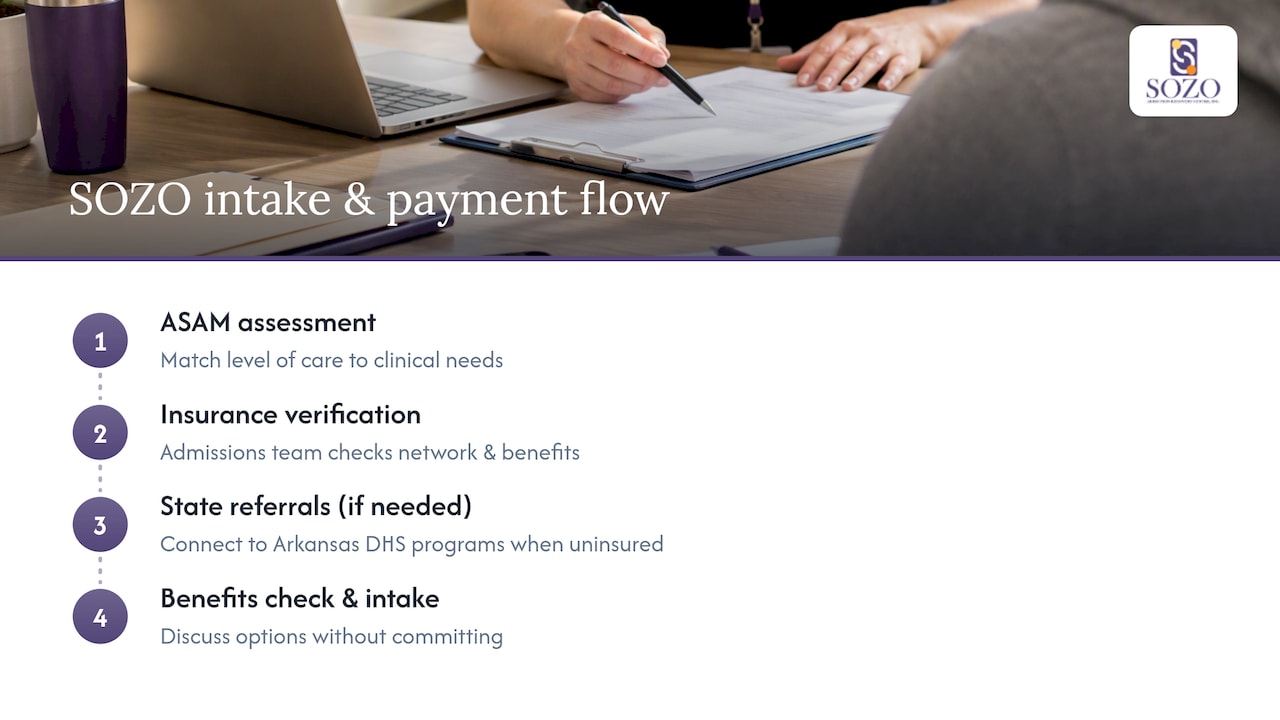
SOZO Recovery Center, based in Hot Springs, Arkansas, offers residential treatment, partial hospitalization, intensive outpatient, outpatient, sober living, medical detox placement, and dual diagnosis care for men. Each plan is built around ASAM informed assessment, meaning the level of care a man enters matches his documented clinical needs rather than a one-size approach.
An admissions team assists men and their families with insurance verification, helping confirm network status and benefits before committing to a program. For men without private coverage, assistance may be available to identify referrals to state-funded programs through Arkansas DHS. This combination of clinical assessment and financial navigation reflects SOZO’s broader approach: pairing personalized, faith-informed treatment with practical guidance through the parts of recovery that feel most confusing on paper.
Men or families ready to talk through options can start with a straightforward benefits check and intake conversation with SOZO’s admissions team, without committing to a program before understanding what it will actually involve.
Practical Guidance for Arkansas Families Weighing the Cost of Care
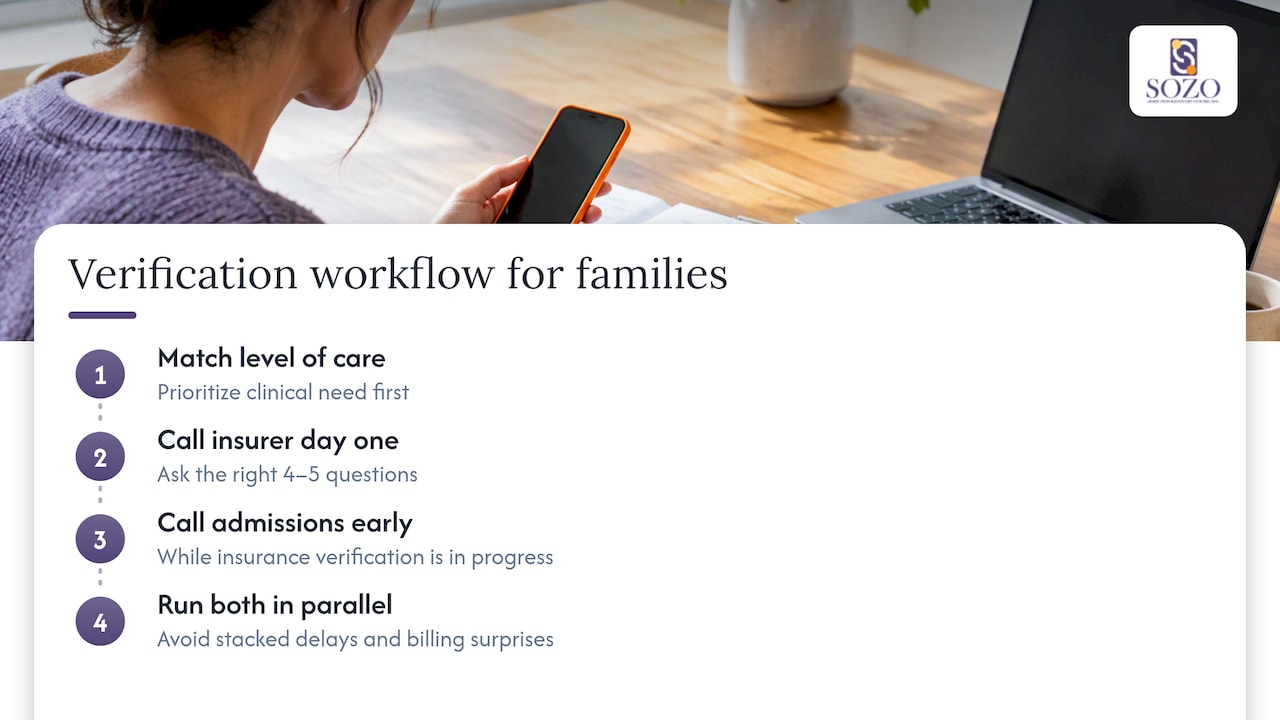
Families sorting through coverage details in the middle of a crisis often feel like they are choosing between speed and thoroughness. In practice, the two are not opposed. A man who calls his insurer and asks the right four or five questions on day one usually moves faster into appropriate care than one who skips verification and hits a billing surprise three weeks in.
What I have seen work best is simple: prioritize the level of care that matches the clinical need first, then work the payment details in parallel rather than waiting on one before starting the other. Families who call the facility’s admissions team early, while the insurance call is still in progress, tend to find that both processes move at once instead of stacking delays on top of each other.
Ty
How SOZO Helps With Benefits Checks and Admissions
Sorting through coverage while a family member needs care is hard enough without also guessing at what a facility offers. SOZO Recovery Center provides residential treatment, partial hospitalization, intensive outpatient, outpatient care, sober living, medical detox placement, and dual diagnosis treatment for men, all built around individualized, ASAM informed planning.
Rather than leaving families to sort through carrier details alone, SOZO’s admissions team runs benefits verification directly, checks in-network status, and helps identify referral options through Arkansas DHS when private coverage is not enough on its own.
- Call SOZO admissions to request a benefits check before committing to any program.
- Ask about ASAM based assessment to determine which level of care fits.
- Ask directly about referral support if state-funded programs are a better fit financially.
If you are ready to talk through what care could look like for a man in your life, start with the residential treatment program page to see what admissions involves and request a conversation with the team.
This article is general information, not a substitute for advice from a qualified doctor. Consult a qualified healthcare professional about your own circumstances before acting on anything here.
Sources
- Arkansas DHS, Office of Substance Abuse and Mental Health, SAMH treatment
- CMS, Mental Health Parity and Addiction Equity Act (MHPAEA)
- Findtreatment
FAQ
How much does rehab cost in Arkansas?
Cost depends on the type of program, its length, and who pays, rather than a single statewide price. The most reliable way to get a real number is a direct benefits verification call with your insurer or a conversation with a facility’s admissions team, since neither insurance details nor facility rates are standardized across the state.
How much does a typical rehab stay cost?
There is no fixed figure, because residential care, outpatient care, detox, and sober living each bill differently and vary by length of stay and staffing intensity. Ask any facility for an itemized estimate of expected billable services so you can compare programs on the same terms.
How much will rehab cost?
The honest answer is that it depends on your specific plan, the level of care you need, and the facility’s network status with your insurer. Request a written benefits verification and an itemized facility estimate before assuming any number, since both figures shift based on details unique to your situation.
Does Arkansas Medicaid pay for drug rehab?
Arkansas’s Medicaid expansion program, ARHOME, commonly extends to substance use disorder services, but the state often uses private carriers to administer those benefits, according to Arkansas DHS. Because of that, confirming your specific carrier and a facility’s network participation is a necessary step before assuming coverage applies.