


Faith and willpower both help people change, but they work differently: willpower supplies self-directed effort, while faith supplies identity, meaning, and social accountability. Willpower tends to work best for short bursts of resistance, while faith sustains people through long seasons of hardship when motivation alone runs dry. Research from the American Psychological Association and the Pew Research Center both point to this complementary pattern, and we see it daily in the men who come through our doors at SOZO Recovery Center.
TL;DR:
- Self control can weaken after heavy use in a day but improve with practice, so focus on one behavior instead of changing several at once.
- Research links religious engagement and prayer with lower substance use, with self control appearing to mediate the association rather than faith acting as a cure.
- Pair one spiritual habit with an existing routine, such as prayer after waking, and remove a specific trigger instead of relying on resistance alone.
- If the same setback persists for several weeks, or addiction overlaps with a mental health condition, seek structured clinical support rather than simply pushing harder.
Table of Contents
- 1. What willpower and faith actually mean
- 2. What the research says about willpower and belief
- 3. How theology and philosophy describe the will
- 4. How faith and behavioral tools work together
- 5. A simple daily plan to build both
- 6. How the concepts of faith and willpower developed over time
- 7. Clearing up common misunderstandings
- 8. How culture shapes the meaning of faith and willpower
- 9. When faith and willpower pull in different directions
- 10. Where faith and willpower meet in real recovery stories
- A faith-informed clinical perspective
- Finding faith-integrated care when self-direction isn’t enough
- FAQ
- Sources
1. What willpower and faith actually mean
Willpower is usually defined as the capacity for self-control: the ability to delay gratification, resist impulse, and keep working toward a goal even when it feels unpleasant. Psychologists have long treated it as a limited resource, one that can be worn down by overuse in a single day but strengthened over time through deliberate practice, according to Stanford Medicine’s overview of willpower research.
Faith works on a different mechanism. It is less about gritting your teeth and more about trust: trust in a larger story, a set of values, or a relationship with God that reorders what a person believes is possible and who they believe they are. Faith draws on identity and community, not just individual effort.
The two forces show up differently depending on the situation:
- Willpower shines in acute moments: turning down a drink at a party, finishing a workout, resisting a single temptation.
- Faith carries more weight across long stretches: enduring grief, rebuilding a marriage, staying sober for years rather than days.
- Willpower depends heavily on the individual’s internal reserves at that moment.
- Faith draws on something outside the self, including community accountability and a sense of purpose that doesn’t fluctuate hour to hour.
Neither force operates in isolation. A man resisting a craving still needs some belief that sobriety matters, and a man relying on faith still has to choose, moment by moment, to act on what he believes.
2. What the research says about willpower and belief
The clearest psychological research on willpower treats it as trainable but finite. The APA’s summary of the willpower literature describes self-control as a muscle that fatigues under heavy use within a single day but grows stronger with consistent practice over weeks and months, particularly when effort is focused on one goal rather than spread thin.
Religious engagement is associated with better self-regulation and lower substance use, with self-control often acting as the link between the two, according to peer-reviewed research published in PMC. That same body of research found that practices like daily prayer and general religiousness predicted lower alcohol and drug use, and self-control appeared to be the mechanism carrying that effect, not religion acting as some separate, direct cure.
Other findings complicate a simple story of faith always boosting motivation:
- Experimental work on priming people with thoughts of God found it could reduce active pursuit of personal goals, according to research published by the APA.
- The same studies found that reminders of God increased resistance to temptation, likely because people felt watched or accountable.
- Beliefs about willpower itself matter: people who see self-control as a limited resource tend to show depletion effects, while those who see it as more expandable often do not, per APA research.
Context and individual differences shape all of this. A person’s specific beliefs about God, their community, and their own capacity for change all bend the results in ways a single study can’t fully capture.
3. How theology and philosophy describe the will
Faith traditions have wrestled with the limits of human willpower for centuries, often concluding that effort alone is not enough. Augustine argued that the human will, left to itself, is bound by disordered desire, and that grace is necessary to reorient it toward the good. In his framework, willpower is real but insufficient without outside help.
Other traditions take different routes to a similar conclusion:
- Some theological views emphasize desire over sheer effort, arguing that what a person loves shapes what they choose more than raw discipline does.
- Pentecostal and charismatic traditions often describe a will empowered by the Spirit, treating moral change as cooperation between human effort and divine assistance rather than willpower acting alone.
- Compatibilist philosophy, surveyed in the Stanford Encyclopedia of Philosophy’s entry on free will, argues that free will and external influence (including divine influence) can coexist, rather than competing for credit.
These views shape what people expect from themselves. A man who believes willpower alone should be enough to overcome addiction often experiences repeated failure as proof of personal weakness. A man who understands his will as something that can be supported, trained, and strengthened by grace tends to carry less shame into the process.
4. How faith and behavioral tools work together
Faith does more than inspire. It can actually conserve willpower by giving a person a stable identity and a community that holds them accountable, which reduces the number of moment-to-moment decisions that rely purely on raw self-control. When sobriety is tied to who a person believes they are, not just a goal they’re grinding toward, fewer choices feel like constant battles.
That identity shift pairs well with practical behavioral tools:
- Habit cues that link a new behavior to an existing routine, such as prayer immediately after waking.
- Environment edits that remove obvious triggers rather than relying on resisting them in the moment.
- A single, clear goal rather than several competing ones, since the self-control research suggests focus preserves limited willpower.
For men whose struggles run deeper than self-guided effort can reach, structured faith-informed programs combine spiritual practice with clinical structure: residential treatment, partial hospitalization, intensive outpatient care, and dual diagnosis support for co-occurring mental health conditions. These levels of care exist because willpower and personal faith, while powerful, are sometimes not enough on their own to interrupt a pattern that has taken over someone’s life.
Pro Tip: Pair one spiritual practice, like a short daily prayer, with one environmental change, like removing a trigger from your home, rather than trying to overhaul everything at once.
5. A simple daily plan to build both
Building willpower and faith together works better as a daily practice than as a single act of resolve. A short, repeatable routine beats an ambitious plan that collapses after a few days.
- Pick one goal. Choose a single behavior to change rather than several at once.
- Create a bright line. Decide in advance what you will and won’t do, removing the need to decide in the heat of the moment.
- Stack a spiritual habit onto an existing routine. Pray or reflect right after a habit you already do daily, like brushing your teeth.
- Edit your environment. Remove or avoid obvious triggers instead of relying on resisting them face to face.
- Track progress weekly. Write down wins and setbacks so patterns become visible instead of hidden.
A simple version might look like five minutes of morning prayer, a short note of what you’re grateful for, and one firm boundary held that day, such as avoiding a specific place or person. When the same setback repeats for several weeks despite consistent effort, that is a signal to bring in outside support rather than pushing harder alone.
Pro Tip: *Measure consistency, not perfection.
6. How the concepts of faith and willpower developed over time
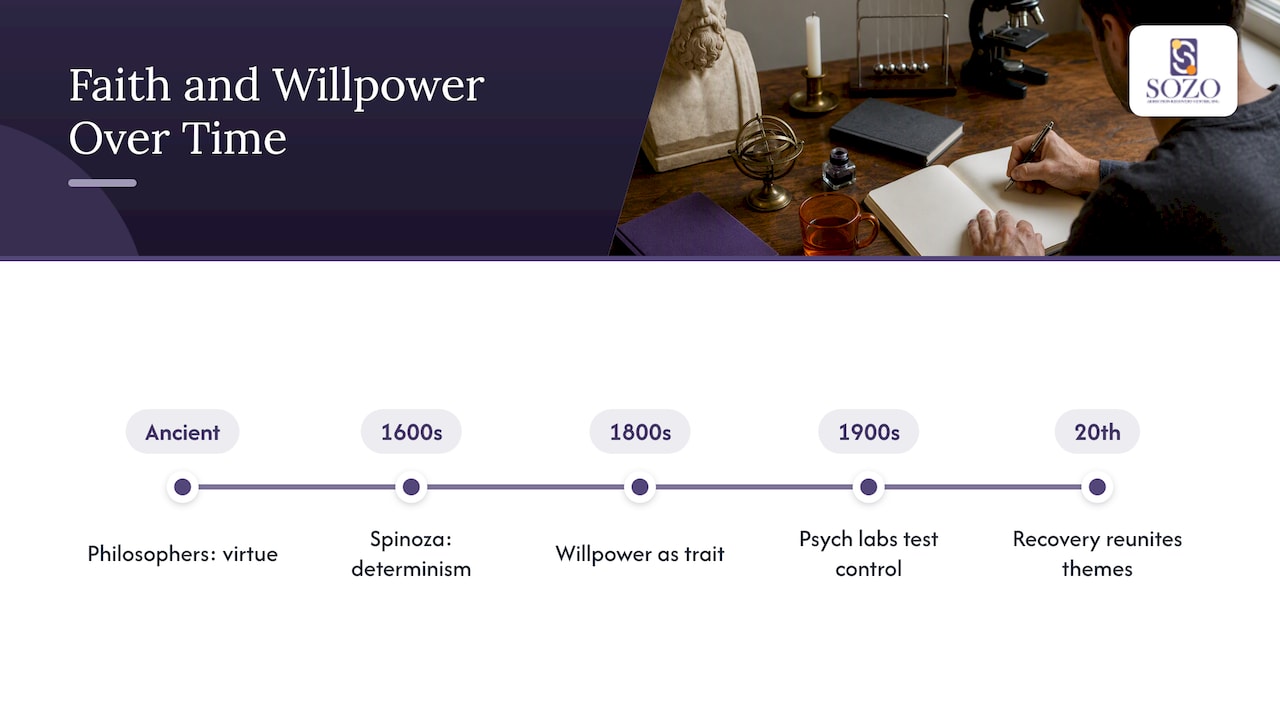
The idea of willpower as we use it today is relatively recent. Ancient philosophers wrote about self-mastery and virtue, but the specific language of “willpower” as a psychological trait emerged largely in the nineteenth century, as thinkers began separating moral character from purely religious explanations of behavior.
Faith, by contrast, carries a much older and more consistent thread across human history, tied to religious practice, communal ritual, and trust in forces beyond individual control. For most of recorded history, moral failure and triumph were explained primarily through religious or spiritual frameworks rather than internal psychological traits. The Stanford Encyclopedia of Philosophy’s survey of free will traces this long arc, from Augustine’s writings on grace and the will through Spinoza’s deterministic view of human action, up through modern debates between compatibilists and skeptics about how much control people truly exercise.
The two concepts began to intersect more directly as psychology emerged as its own discipline in the late nineteenth and twentieth centuries. Researchers started testing self-control in laboratories, while theologians continued refining older questions about grace and human agency. That split explains why faith and willpower are often discussed in separate conversations today, even though they were never fully separate ideas to begin with. Recovery work, including the 12-step model that began in the twentieth century, deliberately brought the two back together by treating addiction as something that required both personal responsibility and reliance on a higher power.
7. Clearing up common misunderstandings
A common misconception treats faith and willpower as competitors, as if relying on one means abandoning the other. In practice, they operate as complementary systems rather than rivals, and most people draw on both without realizing it.
Another misunderstanding assumes willpower is a fixed trait some people simply have and others lack. The research summarized by Stanford Medicine describes self-control as trainable, meaning a person who struggles with it today is not permanently stuck, provided they build it deliberately rather than waiting for motivation to strike.
A third misconception treats faith as a passive feeling rather than something that requires action. Faith traditions across history have generally paired belief with practice: prayer, service, confession, community involvement. Belief without any accompanying behavior tends to fade quickly, which is one reason faith communities build in regular rituals and accountability structures.
Finally, some assume that struggling with self-control reflects a lack of faith, or that strong faith should eliminate the need for discipline altogether. That framing sets an unrealistic bar. Even theological traditions that emphasize grace heavily, like Augustine’s writings, still expect human effort and cooperation, not passive waiting for change to happen automatically.
8. How culture shapes the meaning of faith and willpower
Culture shapes how people define, prioritize, and talk about both faith and willpower. In cultures that emphasize individual achievement, willpower often gets framed as a personal virtue, something a person either has or builds through sheer determination. In more collectivist cultures, self-control is more often described in terms of honoring family, community, or shared obligation rather than personal strength alone.
Faith shows similar variation. In the United States, Pew Research Center survey data shows that 70% of adults identify as spiritual, and roughly half identify as both spiritual and religious, suggesting that many people blend formal religious practice with a more personal, less institutional sense of spirituality. Other cultures draw a much sharper line between organized religion and private belief, or treat the two as inseparable in ways that don’t map neatly onto Western categories.
These cultural differences matter in recovery and personal growth work, because a program or approach built around one culture’s assumptions about willpower or faith may not translate directly to someone from a different background. A man raised in a tradition that emphasizes communal responsibility may respond better to group-based accountability than to individual goal-tracking, while someone from a highly individualistic background might need more explicit encouragement to lean on community rather than going it alone.
9. When faith and willpower pull in different directions
Faith and willpower don’t always point the same way. A person might feel a strong pull toward a behavior their faith tradition considers wrong, creating internal tension between what they believe and what they’re inclined to do in the moment. Resolving that tension often requires more than gritting through it.
Sometimes willpower is used in service of a goal that faith would question, such as pursuing success at the cost of family or integrity. Other times, faith commitments ask for more patience or surrender than a person’s instinct for control is comfortable with, particularly for people who are used to solving problems through sheer effort.
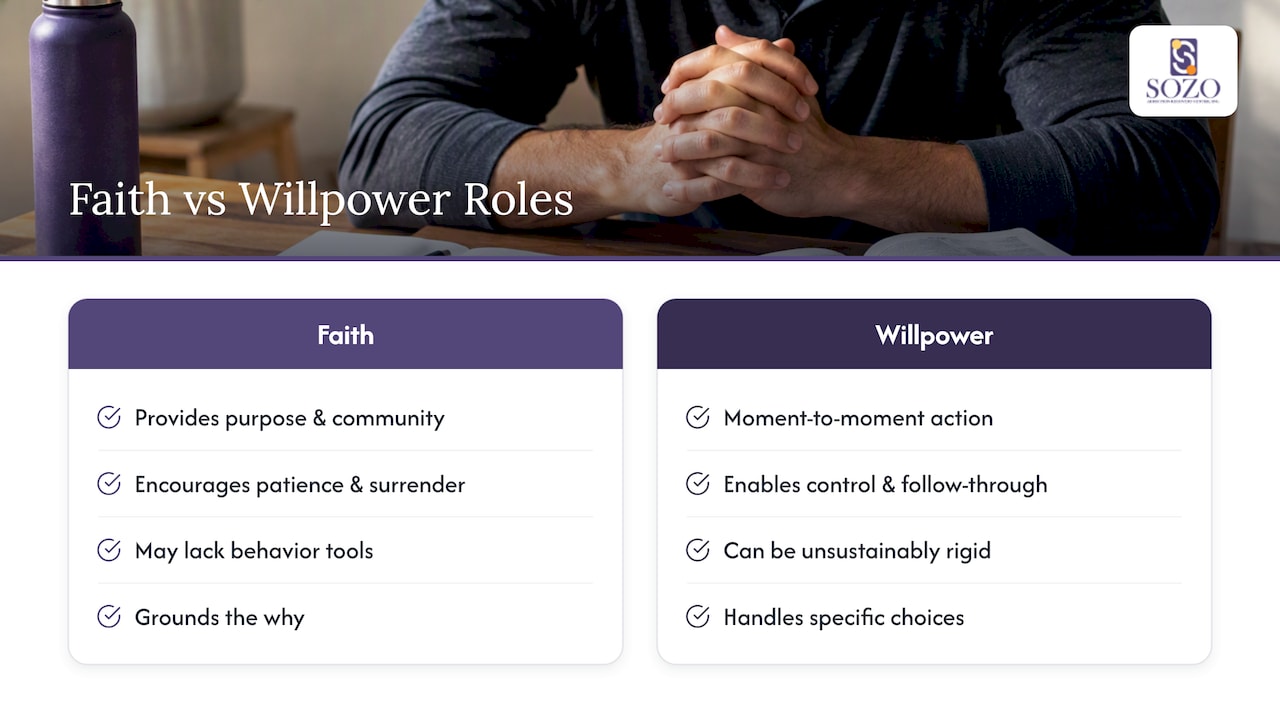
These conflicts show up clearly in recovery. A man might have the willpower to white-knuckle through a single difficult day, only to find that approach unsustainable over months or years without a deeper sense of purpose behind it. Conversely, a man with strong faith convictions but no practical behavioral tools may struggle to translate belief into the specific daily choices that sobriety requires.
Working through these tensions usually means neither abandoning willpower nor leaning on faith as a substitute for personal responsibility. It means letting each one do the job it’s suited for: faith providing the why and the community, willpower providing the specific, moment-to-moment follow-through.
10. Where faith and willpower meet in real recovery stories
The interplay between faith and willpower shows up clearly in addiction recovery, where both forces are tested repeatedly over long periods. A man who relies purely on willpower to stay sober often describes early recovery as a constant, exhausting fight against urges, one that becomes harder to sustain as other life stressors pile on.
Men who integrate faith alongside behavioral change often describe a shift in how the fight feels. Instead of white-knuckling through each craving alone, they describe drawing on a sense of purpose, a relationship with God, or accountability to a faith community that makes individual moments of temptation feel less like isolated battles and more like part of a larger, meaningful process.
The 12-step model itself reflects this interplay directly, built around acknowledging a power greater than oneself while also requiring concrete personal action: taking inventory, making amends, maintaining daily practices. Neither surrender nor effort alone defined the model’s design. In our own work at SOZO Recovery Center, we see this pattern consistently: men who pair structured clinical care with spiritual practice tend to describe their recovery as sustainable in a way that pure self-discipline alone rarely achieves over the long run.
A faith-informed clinical perspective
Research and theology tend to agree on one point: willpower and faith are both real forces, and neither works well in total isolation. The psychology shows self-control as trainable but limited, while faith traditions have long taught that grace and community carry people through seasons willpower alone cannot sustain.
What we encourage, both as a clinical team and as people who care about long-term recovery, is humility about this. Strength doesn’t mean never needing anyone’s help. The men who do well over years, not just weeks, tend to be the ones who build community, stay honest about setbacks, and know when to bring in professional support rather than carrying everything alone.
Ty
Finding faith-integrated care when self-direction isn’t enough
When repeated attempts at change haven’t held, or when addiction overlaps with anxiety, depression, trauma, or another mental health condition, self-guided willpower and personal faith practice often aren’t enough on their own. That’s the gap faith-integrated clinical care is built to close.
At SOZO Recovery Center, we offer residential treatment, partial hospitalization, intensive outpatient care, standard outpatient programs, sober living, medical detox placement, dual diagnosis treatment, and personalized care plans built on the ASAM Continuum model. Our approach combines biblical principles with the 12-step framework in a small, peaceful, retreat-like setting designed for men who need both spiritual renewal and clinical structure. For families considering faith communities building their own support infrastructure, resources like NYSUM’s trauma-informed ministry principles offer a useful complement grounded in evidence-based care. If repeated setbacks, a co-occurring mental health concern, or safety concerns are part of your story, reach out to our team for an evaluation and a personalized plan built around where you are right now.
FAQ
How to become stronger in faith?
Strengthening faith generally involves consistent practice, not just belief: regular prayer, participation in a faith community, and service to others all reinforce trust over time. Pairing spiritual habits with daily routines, such as prayer right after waking, helps faith grow through repetition rather than relying on occasional bursts of feeling.
What are three types of will of God?
Theological traditions use different frameworks to describe God’s will, and definitions vary across traditions. A common version distinguishes a sovereign will that governs all outcomes, a moral will reflected in commands and values, and an individual will concerning specific personal decisions, though the exact terminology differs by denomination.
Do we sleep after death or go to heaven?
This question touches on deep theological debates where Christian traditions themselves differ, and it falls outside what psychological or clinical research can answer. Different denominations and scholars hold varying views, and readers exploring this question are best served by discussing it with clergy or theologians from their own tradition.
What is the difference between faith and spirituality?
Faith typically refers to trust in a specific religious tradition, framework, or relationship with God, often tied to defined beliefs and communal practice. Spirituality is broader and more personal, describing a sense of connection to something greater without necessarily following a specific religious structure. Pew Research Center data shows many people blend both, with about half of U.S. adults identifying as both spiritual and religious.
Sources
- A conversation about the science of willpower, Stanford Medicine
- Religion and self-control related findings, PMC article
- Measuring spirituality among Americans, Pew Research Center