


When your son is out of control, the first priority is your safety and his. Set a firm, calm boundary right now, and hold it without negotiation. Acting out is almost always communication, not defiance for its own sake. Children and teens who rage, refuse, or shut down are usually struggling with something they cannot yet name. Understanding that shifts everything.
Start here:
- Stay calm. Yelling escalates aggression and teaches nothing except that big emotions win.
- Remove yourself briefly if you feel out of control. A parent who regulates first models the skill a son needs most.
- State one clear expectation. Not five. One.
- Do not negotiate during an outburst. Wait until he is calm, then talk.
- Write down your household expectations and the privileges tied to meeting them.
- Do not threaten consequences you will not follow through on. Empty threats teach that rules are optional.
- Seek professional evaluation if behavior involves violence, threats, or safety risks.
You are not failing. You are dealing with something that requires more than willpower from either of you.
Why is my son acting out? Understanding the root causes
Behavior is rarely random. When a teenage boy becomes defiant, aggressive, or completely unreachable, something is driving it, and the cause shapes the solution.
Two clinical conditions frequently underlie severe, persistent behavior problems. Oppositional Defiant Disorder (ODD) typically appears before age 12 and involves a persistent pattern of angry mood, argumentative behavior, and defiance toward authority figures. Conduct Disorder (CD) goes further, involving serious violations of rules and the rights of others, including aggression, property destruction, and truancy. The CDC classifies both as “externalizing disorders” because the distress is directed outward. Neither is a character flaw. Both respond to early, targeted treatment.
Beyond clinical diagnoses, many boys act out because of conditions that have never been identified. ADHD, anxiety, sensory processing issues, and undiagnosed learning disabilities all produce behavior that looks like defiance but is actually overwhelm. A boy who tears up his homework is not lazy. He may be drowning in material he cannot process and has no words for that frustration.
Peer pressure and social media add another layer. Adolescent brain development means the reward centers mature years before the prefrontal cortex, the part responsible for impulse control and long-term thinking. A teenage boy is neurologically wired to seek peer approval and take risks. That is not an excuse, but it is context that changes how you respond.
Parental modeling matters more than most parents realize. Boys who grow up watching adults manage conflict through yelling or avoidance learn those same patterns. The household emotional temperature sets the baseline.
Practical strategies to manage a defiant son at home
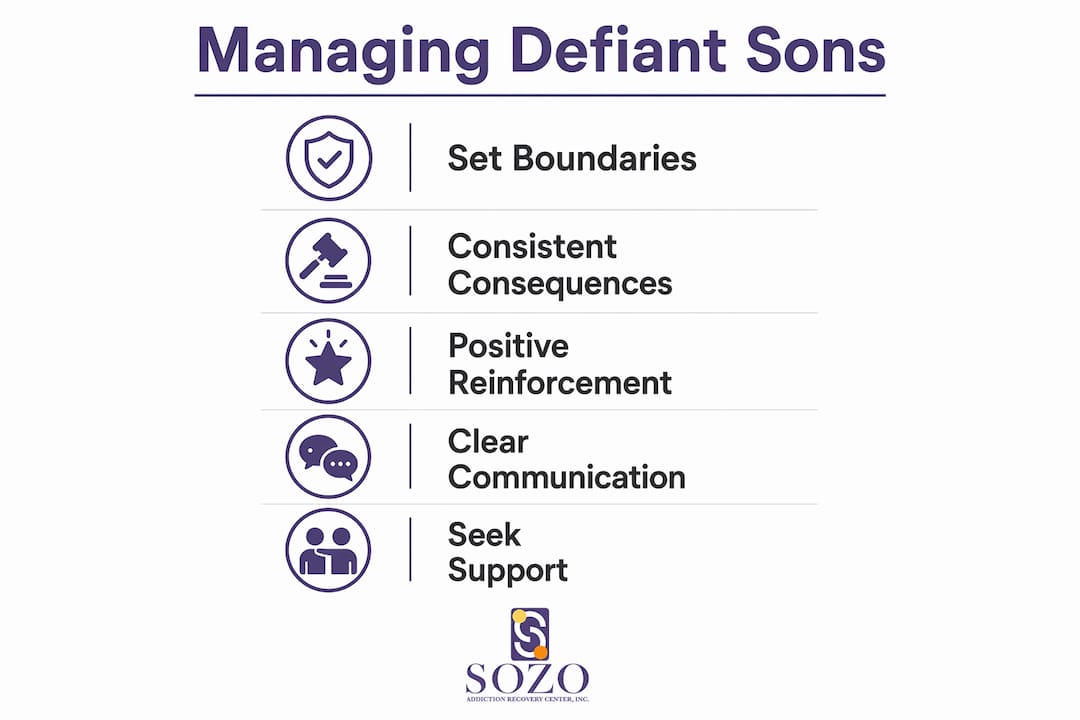
Consistency is the single most powerful tool a parent has. Kids respond better to firm boundaries that are consistently reinforced than to a rotating set of strategies that change every week.
A structured approach that works:
- Write down your expectations clearly, covering school behavior, chores, personal hygiene, and how family members treat each other.
- List the privileges your son currently has, including screen time, spending time with friends, and use of electronics.
- Hold a family meeting and present both lists. Make clear that privileges are earned by meeting expectations, not given automatically.
- When an expectation is violated, remove the relevant privilege immediately and calmly. No lectures. One brief statement.
- Allow privileges to be earned back in small increments, tied to specific positive behavior, not just the passage of time.
- Use a timeout for younger teens: one minute per year of age is a practical guideline, with the goal of helping him regulate, not shame him.
Communication style matters as much as the rules themselves. Brief, unemotional corrections work. Long lectures during an outburst do not. When you stay calm and speak in a steady voice, you are not just keeping the peace. You are teaching him what emotional regulation actually looks like in practice.
Pro Tip: Follow through on consequences the moment a rule is broken. Delayed discipline teaches a teenager that rules are negotiable. Immediate, quiet follow-through teaches that they are not.

Positive reinforcement is not soft parenting. Labeled praise, naming the specific behavior you noticed, builds the behavior you want to see more of. “You handled that frustration without yelling” is more effective than a generic “good job.”
When should you seek professional help for your son?
Some behavior is beyond what any parent can manage alone, and recognizing that point early protects everyone in the family.
Seek a professional evaluation when you see:
- Aggression that poses a physical safety risk to family members or others
- Persistent behavior that does not improve despite consistent parenting efforts
- Threats of self-harm or harm to others
- Significant decline in school performance or refusal to attend
- Signs of substance use alongside behavioral changes
- Behavior that seems driven by anxiety, mood swings, or emotional dysregulation beyond normal teen range
A comprehensive evaluation by a mental health professional can identify conditions like ADHD, anxiety, ODD, or Conduct Disorder that require targeted treatment. Cognitive Behavioral Therapy (CBT) and Parent Management Training (PMT) are two evidence-based approaches that Yale Medicine’s Child Study Center identifies as primary treatments for childhood anger and aggression. Schools can also conduct a Functional Behavior Assessment (FBA), a structured process that identifies what is triggering your son’s behavior in the classroom and what function that behavior serves.
Family therapy is often part of the picture too. When the parent-child relationship has become strained by months or years of conflict, rebuilding it requires more than new rules. It requires guided work on communication, trust, and the patterns both sides have learned.
How Sozorecoverycenter can help when addiction is part of the picture
Sometimes a son’s behavior has crossed into addiction, and the challenge is no longer just parenting. It is treatment.
Sozorecoverycenter is a men’s addiction treatment center in Hot Springs, Arkansas, offering a faith-based approach that integrates spiritual guidance with clinical dual diagnosis care. For parents whose sons are dealing with both substance use and underlying mental health conditions, that combination addresses the full picture rather than one piece of it.
Pro Tip: If your son’s behavior involves substance use alongside emotional or mental health struggles, a dual diagnosis program treats both conditions together. Treating only one rarely produces lasting change.
| Program Type | Format | Focus |
|---|---|---|
| Residential treatment | Inpatient, structured | Full immersion in recovery with clinical and spiritual support |
| Intensive outpatient | Partial schedule | Structured treatment while maintaining some daily routines |
| Outpatient program | Flexible schedule | Ongoing support for men in earlier or later recovery stages |
| Dual diagnosis care | All levels | Co-occurring addiction and mental health treatment |
| Sober living | Post-treatment housing | Accountability and community during the transition to independence |
Sozorecoverycenter accepts private pay and private insurance, including BlueCross BlueShield, Ambetter, and QualChoice. The center’s faith-based recovery programs draw on both biblical principles and the 12-step model, creating a structure that supports spiritual renewal alongside clinical progress. For a family that has tried everything else, that combination can be the turning point.
Key Takeaways
When a son’s behavior is out of control, the most effective response combines immediate, consistent boundaries with professional evaluation and, when addiction is involved, specialized dual diagnosis treatment.
| Point | Details |
|---|---|
| Behavior is communication | Acting out usually signals emotional distress or an unmet need, not pure defiance. |
| Consistency is the foundation | Privileges tied to clear expectations, with immediate follow-through, reduce conflict over time. |
| Early professional help matters | The CDC confirms early treatment for ODD and Conduct Disorder is most effective when tailored to the child. |
| Dual diagnosis changes outcomes | Treating addiction and mental health together, as Sozorecoverycenter does, addresses the full picture. |
| Parent regulation comes first | A calm, steady parent models the self-control a struggling son has not yet learned. |
FAQ
Where can I send my son who is out of control?
Options range from outpatient therapy and school-based behavioral programs to residential treatment, depending on severity. If substance use is involved, a men’s treatment center like Sozorecoverycenter offers residential, intensive outpatient, and dual diagnosis programs designed for exactly this situation.
What age are boys hardest to parent?
The early teen years tend to be the most challenging, as adolescent brain development prioritizes reward-seeking and peer approval before impulse control fully matures. Consistent structure and professional support during this time make a measurable difference.
What causes a child to be controlling or defiant?
Defiance often stems from undiagnosed conditions such as ADHD, anxiety, ODD, or learning disabilities, combined with difficulty regulating emotions. Trauma, inconsistent discipline, and family stress also contribute significantly.
Where can I send my disobedient child for structured help?
School-based behavioral assessments, outpatient therapy, and family counseling are strong first steps. For teens whose behavior involves substance use or serious mental health challenges, residential treatment programs provide the structure and clinical support that outpatient settings cannot always offer.