


What is a Celebrate Recovery step study?
A Celebrate Recovery step study is an intensive, Christ-centered 12-step program where a small group of people work through personal healing together in a confidential setting guided by biblical principles. It is not a drop-in meeting. It is a structured, closed group that moves through the full Celebrate Recovery curriculum from beginning to end, with every participant doing the work alongside one another.
The step study curriculum spans 25 lessons across four participant guides, covering the complete 12 steps and 8 recovery principles rooted in the Beatitudes from Matthew 5. Each week, members come prepared with written answers to that lesson’s questions and share their responses within the group.
Key features of a step study include:
- Confidential, closed group format with consistent membership
- Weekly one-hour meetings focused on personal workbook lessons
- Typical duration of several months depending on the group’s pace
- Healing focus on hurts, habits, and hang-ups through biblical truth
- Gender-specific groups to encourage honest, safe sharing
- Facilitators who have personally completed the step study themselves
You do not need to be a Christian to participate. Celebrate Recovery welcomes anyone willing to do the work honestly.
How long does a step study take, and what does it require?
The commitment is real, and that is exactly the point. Step studies typically run several months, meeting once per week for approximately one hour. Some groups take a full year, depending on lesson depth and group size.
Attendance is not optional. Because the group is closed and confidential, missing a session means catching up directly with the group leader before the next meeting. The group’s safety depends on everyone showing up and doing the work.
What participants are expected to bring:
- Written answers to that week’s lesson questions, completed before the meeting
- A commitment to confidentiality, never sharing what others say outside the group
- Willingness to attend every session for the full duration
- Honesty during sharing, even when it is uncomfortable
- Respect for the no cross-talk rule, meaning no advice-giving or interrupting
Pro Tip: Groups often close to new members after completing the first participant guide. If you are considering joining, reach out to a local facilitator as soon as possible rather than waiting.
One more thing worth knowing: groups close to new members once the first guide is finished, preserving the trust and intimacy the group has built. Timing matters.
What actually happens during a step study session?
A typical session follows a consistent, predictable format that creates safety through structure. Most groups open with the Serenity Prayer, though individual groups may adapt this. From there, members read the 8 principles or 12 steps aloud, rotating through the group.

The heart of each meeting is the sharing time. Members take turns reading their written answers to that week’s lesson questions, with each person given roughly 3 to 5 minutes. No one comments on another person’s answers. No one offers advice. The no cross-talk policy is one of the most important group guidelines because it keeps the space safe for honest disclosure.
Session elements that appear in most groups:
- Opening prayer and reading of group guidelines
- Recitation of the 8 principles or 12 steps by group members
- Individual sharing of written lesson answers
- Time-limited sharing, typically 3 to 5 minutes per person
- Prayer requests exchanged or written down
- Closing prayer
Everything shared in the room stays in the room. That confidentiality is not just a guideline; it is the foundation that makes honest sharing possible.
How does a step study differ from an open share meeting?
Open share meetings are the front door of Celebrate Recovery. Anyone can walk in, listen, and share. They are drop-in, welcoming, and designed for broad fellowship and immediate support. A step study is something different entirely.
Where open shares offer community, step studies offer transformation. The step study is the heart of the program, a long-term, structured commitment to working through every step with the same group of people over many months. The depth of healing that happens there is qualitatively different from what a weekly open share can provide.
Key distinctions:
- Open share: Drop-in, open to all, no homework, immediate support
- Step study: Closed group, long-term, homework required, deep curriculum work
- Open share: New faces welcome every week
- Step study: Membership closes after Guide 1 to protect group trust
- Open share: Broad fellowship across all recovery issues
- Step study: Focused, personal application of all 12 steps and 8 principles
Many participants attend open share meetings first, then join a step study when they are ready to go deeper. The two formats work together, not against each other.
Comparing local Celebrate Recovery step study providers in the US
Six established providers offer step study programs across the United States, each with a distinct profile.
| Provider | Location | Services | Step Study Duration | Cost | Specializations | Format | Rating |
|---|---|---|---|---|---|---|---|
| Celebrate Recovery Birmingham | Birmingham, AL | Christ-centered 12-step recovery | 6 to 12 months | General adult recovery | Confidential, community-based | 5★ (8 reviews) | |
| SOZO Addiction Recovery Center, Inc. | Hot Springs, AR | Residential, outpatient, IOP, PHP, sober living, dual diagnosis | 6 to 12 months | Private pay / insurance | Men’s faith-based addiction + mental health | Clinical + biblical, gender-specific | 5★ (7 reviews) |
| GBC Celebrate Recovery | Grace Bible Church | Step studies, worship, men’s/women’s groups, teen/kids, military family support | 6 to 12 months | Free | Military families, all ages | Large group + small discussion groups | 5★ (1 review) |
| Celebrate Recovery at New Life Church | Louisa, VA | CR meetings, care groups, open share, fellowship meals, youth/kids ministries | 6 to 12 months | Family-inclusive, youth | Church-based, childcare provided | 5★ (1 review) | |
| Celebrate Recovery (Canton, GA) | Canton, GA | Weekly CR meetings, step studies, large group teaching | Christ-centered recovery | Men’s and women’s step studies | |||
| Celebrate Recovery (Damascus, MD) | Damascus, MD | Weekly CR meetings, step studies, large group teaching | Christ-centered recovery | Men’s and women’s step studies |
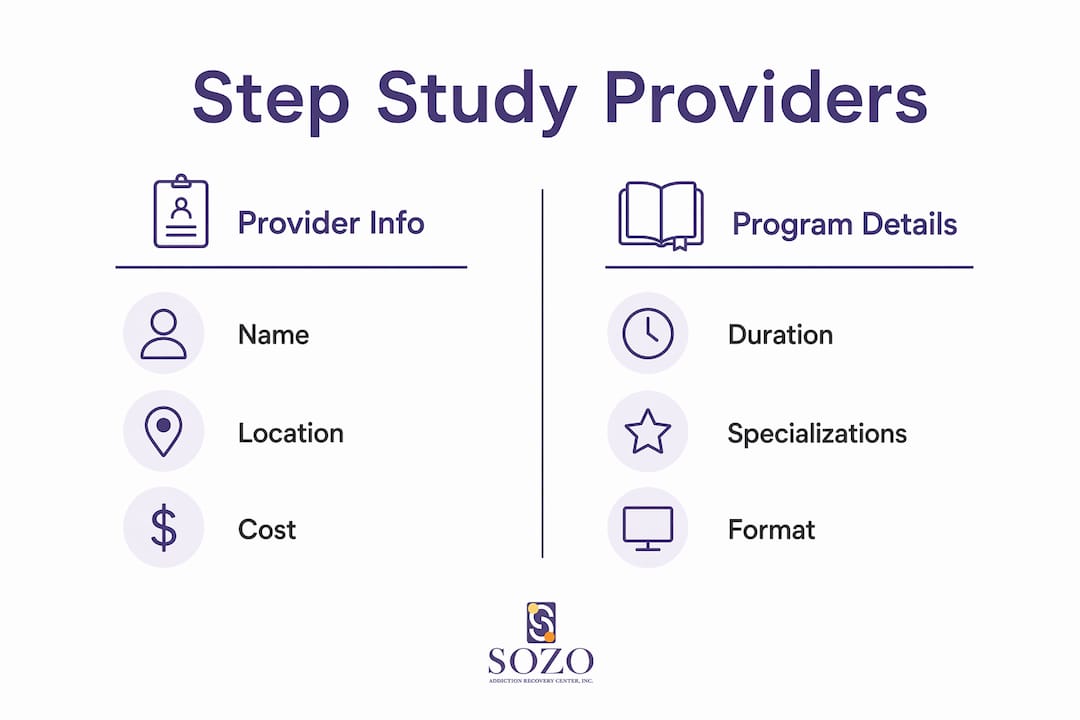
Celebrate Recovery Birmingham serves adults in the Birmingham, AL area with a confidential, community-rooted program focused on freedom from hurts, habits, and hang-ups. It is a solid starting point for anyone in the Birmingham metro seeking a local faith-based group.
SOZO Addiction Recovery Center, Inc. stands apart from the other providers on this list because it operates as a clinical treatment center, not a church ministry. For men dealing with addiction alongside a co-occurring mental health condition, Sozorecoverycenter integrates dual diagnosis care with biblical 12-step principles, personalized treatment plans, and a full continuum of care from residential through sober living. That combination of clinical structure and spiritual foundation is not available at a church-based step study group.
GBC Celebrate Recovery offers one of the most accessible programs on this list: free programming for all ages, a dedicated military family support track, and a format that combines large group worship with small discussion groups. The step study timeline aligns with the standard Celebrate Recovery model.
Celebrate Recovery at New Life Church prioritizes families. Childcare during meetings, youth and kids ministries running alongside adult sessions, and fellowship meals make this a practical option for parents who would otherwise struggle to attend consistently.
The Canton, GA and Damascus, MD locations follow the standard Celebrate Recovery format with men’s and women’s step studies. Specific duration and cost details are not publicly listed for these sites; contact the facilitators directly for current group availability.
How to find and join a step study group
Finding the right group takes a few deliberate steps, but the process is straightforward.
- Search the Celebrate Recovery website for local church-based meetings near you
- Attend open share meetings first to get familiar with the program and community
- Ask the group leader or facilitator directly about step study availability and start dates
- Confirm whether the current group is open to new members or whether a new group is forming
- Purchase the participant guides or ask the facilitator about availability
- Come to your first session with your lesson questions answered in writing
- Commit to the full duration before you begin, not partway through
The peer support structure in a step study group is one of its greatest strengths. The bonds formed through shared honesty over many months carry weight that a single meeting cannot replicate.
Faith, clinical care, and the 12 steps together
Celebrate Recovery’s 8 principles are drawn directly from the Beatitudes in Matthew 5, anchoring every step in Scripture rather than general spirituality. That biblical foundation is what distinguishes Celebrate Recovery from secular 12-step programs. Step 1 begins with admitting powerlessness. Step 12 closes with carrying the message to others, a full circle from receiving help to giving it.
Graduates of a step study receive a chip recognizing their completion and become eligible to lead or sponsor future groups, embodying the Step 12 service model. The steps were never the destination. They were the training.
For men whose recovery involves a co-occurring mental health condition, faith alone may not be sufficient. Programs that integrate clinical dual diagnosis care with biblical teaching address both dimensions at once, supporting spiritual renewal alongside evidence-based mental health treatment. The ASAM Continuum model, which guides personalized treatment planning at centers like Sozorecoverycenter, ensures that each man receives the level of care his situation actually requires rather than a one-size approach.
Sozorecoverycenter: when a step study needs clinical support behind it
For men who recognize that their hurts, habits, and hang-ups are also a clinical matter, a church-based step study group may be one piece of a larger picture.
Sozorecoverycenter, located in Hot Springs, Arkansas, offers a faith-based men’s treatment program that weaves biblical 12-step principles into a full clinical continuum: residential care, intensive outpatient, partial hospitalization, sober living, and dual diagnosis treatment. Insurance coverage through BlueCross BlueShield, Ambetter, and QualChoice is accepted. For a man carrying both addiction and a mental health condition, that combination of spiritual grounding and clinical structure is a different kind of support than a community step study can provide. Learn more about men’s-only addiction treatment and whether it fits where you are right now.
FAQ
What is a step study in Celebrate Recovery?
A Celebrate Recovery step study is a confidential, closed small group that works through all 25 lessons of the CR curriculum across four participant guides, covering the complete 12 steps and 8 biblical principles. Members meet weekly, complete written homework before each session, and share their answers within the group.
How many weeks does a Celebrate Recovery step study take?
Most step studies run 6 to 9 months, meeting once per week for approximately one hour, though some groups take up to a year depending on pace and group size.
Is Celebrate Recovery a 12-step program?
Yes. Celebrate Recovery is a Christ-centered 12-step program that parallels the traditional 12 steps but grounds each one in biblical principles and the Beatitudes from Matthew 5, making it explicitly faith-based rather than broadly spiritual.
Which is better, AA or Celebrate Recovery?
The two programs share the same 12-step structure, but Celebrate Recovery is explicitly Christ-centered and uses biblical principles as its framework, while AA uses a broader “higher power” concept. For men seeking a faith-based recovery community rooted in Scripture, Celebrate Recovery is the stronger fit; for those who prefer a secular or non-denominational approach, AA may suit better.
Key Takeaways
A Celebrate Recovery step study is a closed, Christ-centered 12-step group lasting 6 to 12 months, where consistent attendance and honest homework completion determine how much healing actually happens.
| Point | Details |
|---|---|
| Duration and commitment | Step studies run for 6 to 12 months with weekly one-hour meetings; groups close to new members after Guide 1. |
| Homework is required | Written answers to lesson questions must be completed before each session; unprepared attendance undermines the group. |
| Confidentiality is foundational | Everything shared in the group stays within the group; the no cross-talk rule protects every member’s safety. |
| Step 12 leads to service | Graduates receive a completion chip and become eligible to lead or sponsor future step study groups. |
| Sozorecoverycenter | For men needing clinical dual diagnosis care alongside faith-based 12-step work, Sozorecoverycenter offers a full treatment continuum in Hot Springs, AR. |
Recommended
- Celebrate Recovery 12 Steps: A Faith-Based Guide
- Celebrate Recovery 8 Principles: A Biblical Guide
- Transform Your Recovery: Embrace Healthy Habits for Wellness
- SOZO Recovery Center: Empowering Your Journey to Sobriety
When your step study group reaches the sixth step, the 6th step prayer gives you words for the readiness that step asks of you.