


Buspirone is not habit-forming or addictive. FDA-approved labeling states explicitly that human and animal studies found no evidence of abuse, diversion, tolerance, or physical or psychological dependence. The StatPearls clinical review confirms there is no associated risk of physical dependence or withdrawal with buspirone use. For anyone weighing the risks of long-term use of buspirone, three facts anchor the answer:
- Pharmacology: Buspirone works on serotonin receptors, not GABA receptors. GABA activity is what drives benzodiazepine dependence, and buspirone simply does not work that way.
- Clinical trial evidence: In double-blind studies, volunteers with recreational drug histories could not distinguish buspirone from a placebo, while they showed a clear preference for diazepam and methaqualone.
- Real-world monitoring guidance: The FDA still advises prescribers to evaluate substance-use history and monitor patients, because any CNS-active medication warrants clinical oversight, even one with low abuse potential.
“Unlike benzodiazepines and barbiturates, there is no associated risk of physical dependence or withdrawal with buspirone use due to the lack of effects on gamma-aminobutyric acid (GABA) receptors.” — StatPearls clinical review
This article is general health information, not medical advice. Always confirm medication decisions with your prescriber or a qualified clinician for your specific situation.
Table of Contents
- What authoritative sources say about buspirone and dependence risk
- How buspirone works in the brain and why that reduces addiction risk
- What you need to know about stopping buspirone safely
- How buspirone compares with benzodiazepines and SSRIs on addiction risk
- Rare situations where buspirone could still cause problems
- What to tell your prescriber if you’re worried about dependence
- Signs that you need specialist help, not just a medication adjustment
- Key Takeaways
- A treatment provider’s perspective on buspirone and dependence concerns
- Sozorecoverycenter offers dual-diagnosis care for men managing anxiety and addiction
- Useful sources
- FAQ
What authoritative sources say about buspirone and dependence risk
The evidence base here is unusually consistent. The FDA label, peer-reviewed clinical reviews, and international product summaries all reach the same conclusion, which is worth understanding in some detail.

FDA labeling. The DailyMed prescribing information reports that in two double-blind clinical investigations, none of the volunteer subjects could distinguish buspirone from placebo. By contrast, those same subjects showed a statistically significant preference for methaqualone and diazepam. The label concludes there is no evidence buspirone causes tolerance or either physical or psychological dependence.
StatPearls and clinical reviews. The StatPearls review reinforces that buspirone’s lack of GABAergic activity is the mechanistic reason it does not produce dependence. It is used primarily for generalized anxiety disorder (GAD), typically as a second-line agent when a patient does not respond to or cannot tolerate SSRIs.
Malcolm Lader’s landmark review. A peer-reviewed analysis published in the British Journal of Psychiatry examined whether buspirone could induce rebound anxiety, dependence, or abuse. The review concluded that short-term buspirone use is unlikely to produce any of those outcomes, adding historical depth to the more recent regulatory and clinical consensus.
“Historical reviews reinforce that short-term buspirone use is unlikely to induce rebound anxiety or long-term dependence, which supports the medication’s continued use when dependence risk is a major concern.” — British Journal of Psychiatry, Malcolm Lader
International alignment. UK product labeling (Summary of Product Characteristics) likewise describes buspirone as lacking sedative properties and carrying low abuse liability, which confirms the finding is not limited to the US regulatory context.
Pro Tip: When reading any clinical study on buspirone abuse potential, check whether volunteers were selected for recreational drug use history. Studies that use this design are more sensitive to abuse liability than general-population trials, and buspirone still showed no preference over placebo in those higher-sensitivity conditions.
How buspirone works in the brain and why that reduces addiction risk
Buspirone’s mechanism of action is the clearest explanation for why buspirone dependency concerns are largely unfounded. It acts primarily as a partial agonist at 5-HT1A serotonin receptors. That is a fundamentally different target than the one benzodiazepines act on.
Benzodiazepines bind to GABA-A receptors and enhance the inhibitory effect of gamma-aminobutyric acid throughout the brain. That rapid sedation produces an immediate calming effect, and it is precisely that fast, reinforcing “high” that creates the cycle of dependence. Buspirone does not touch GABA receptors at all. There is no sedative rush, no immediate euphoria, and therefore no pharmacological reward loop to get caught in.
Clinically, that difference shows up in how the medication is dosed and experienced:
- Starting dose: Typically 15 mg/day (7.5 mg twice daily), per prescribing information
- Maximum dose: Up to 60 mg/day; many clinical trials used 20–30 mg/day
- Onset of effect: Therapeutic benefit takes 2–4 weeks to appear, which is why patients sometimes assume it is not working
- No immediate sedation: The absence of a rapid calming effect is actually a feature from a dependence standpoint; it removes the reinforcement that drives misuse
- No cross-tolerance with benzodiazepines: Buspirone cannot substitute for a benzo or prevent benzo withdrawal
One practical consequence of the delayed onset is that patients sometimes escalate their dose prematurely, believing the medication has failed. That escalation can produce side effects, but it does not create physical dependence. The distinction matters: side effects from overuse are not the same thing as addiction.
What you need to know about stopping buspirone safely
Clinical studies do not show physical dependence or classical withdrawal when buspirone is discontinued. That said, stopping any anxiety medication abruptly, without a prescriber’s guidance, is never the right approach, and the reasons here are worth understanding carefully.

Rebound anxiety is possible. If anxiety symptoms return after stopping buspirone, that is most likely the underlying condition re-emerging, not a withdrawal syndrome. The distinction is clinically important: rebound anxiety does not mean the medication was habit-forming; it means the condition it was treating is still present.
The benzodiazepine switching problem. This is where the most serious clinical risk actually lives. Many patients start buspirone while tapering off a benzodiazepine. Because buspirone lacks cross-tolerance with benzodiazepines, it will not prevent or reduce benzodiazepine withdrawal symptoms. Those must be managed through a separate, carefully supervised benzo taper. Confusing the two is a genuine clinical hazard.
“The most practical risk is not buspirone addiction but mismanagement when switching from a habit-forming drug; buspirone does not mitigate withdrawal from benzodiazepines and must be part of a coordinated tapering plan.” — FDA labeling guidance
A framework to discuss with your prescriber. The following is an illustrative, non-prescriptive outline. Never adjust your medication without clinical supervision.
- Confirm the reason for stopping with your prescriber: symptom resolution, side effects, or switching to another therapy.
- Agree on a taper schedule rather than stopping abruptly, even though physical dependence is not expected.
- If you are also on a benzodiazepine, establish a separate taper plan for that medication with your prescriber or an addiction specialist.
- Monitor for returning anxiety symptoms for several weeks after stopping, and report them promptly.
- Document any new symptoms (sleep changes, irritability, physical discomfort) and bring that record to your follow-up appointment.
How buspirone compares with benzodiazepines and SSRIs on addiction risk
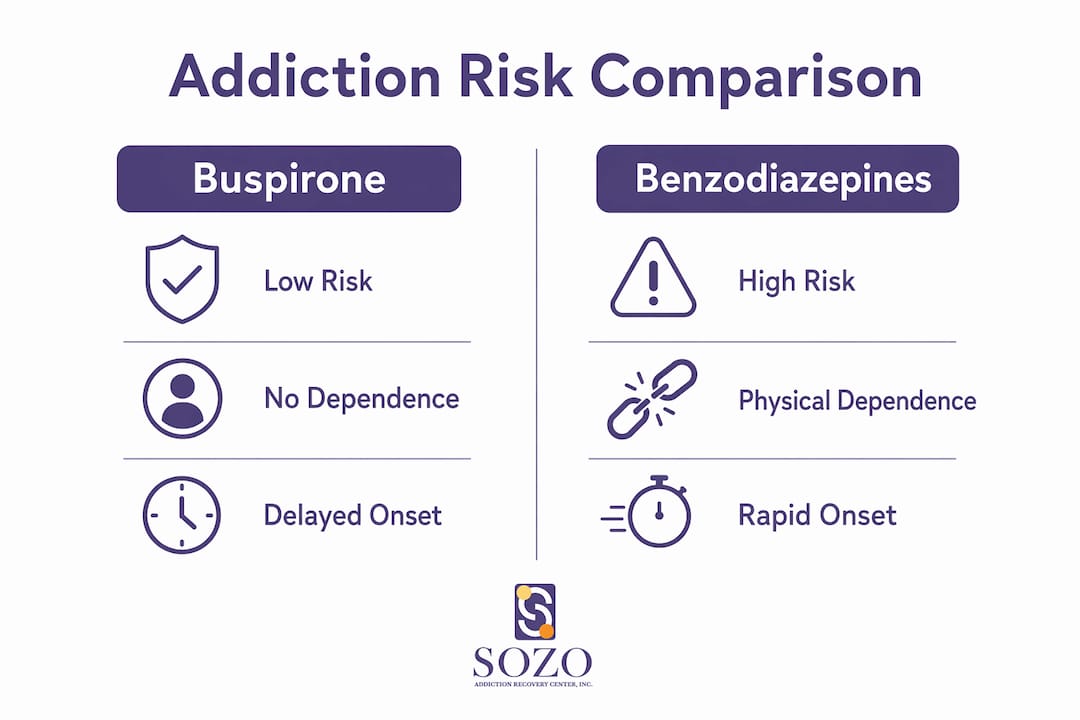
Understanding buspirone vs. anxiety meds means looking at the full picture across drug classes. The table below covers the dimensions that matter most for a patient weighing dependence risk.
| Dimension | Buspirone | Benzodiazepines (e.g., diazepam) | SSRIs (e.g., sertraline) |
|---|---|---|---|
| Abuse/addiction potential | Very low; no preference over placebo in drug-user studies | High; well-documented abuse and diversion risk | Very low; not associated with abuse |
| Withdrawal/dependence risk | No physical dependence; rebound anxiety possible | Physical dependence common; withdrawal can be severe | Discontinuation syndrome possible; not true dependence |
| Mechanism of action | 5-HT1A partial agonist; no GABAergic activity | GABA-A receptor positive allosteric modulator | Serotonin reuptake inhibition |
| Onset and clinical use | 2–4 weeks; long-term GAD management | Minutes to hours; acute anxiety, insomnia, seizure | 2–4 weeks; depression, GAD, panic, OCD |
| Side effects/interactions | Dizziness, nausea, headache; MAOI and CYP3A4 interactions | Sedation, cognitive impairment, respiratory depression | GI effects, sexual dysfunction, serotonin syndrome risk |
A few practical points the table does not fully capture:
- Buspirone is preferred for long-term GAD management, particularly when dependence risk is a concern or when a patient has a substance-use history.
- Benzodiazepines still have a legitimate role in acute, severe anxiety and in medically supervised benzodiazepine addiction recovery, but their dependence profile makes them a poor long-term choice for most patients.
- SSRIs are generally first-line for GAD; buspirone is typically added when SSRIs are not tolerated or when augmentation is needed.
- Combining buspirone with an SSRI is clinically common and generally well-tolerated, but always requires prescriber oversight.
Rare situations where buspirone could still cause problems
The low abuse potential of buspirone does not mean it is entirely without risk. A few specific scenarios deserve attention.
- Polypharmacy misuse: Some patients in congregate or institutional settings attempt to use buspirone alongside other CNS-active substances, hoping for an additive effect. The evidence suggests this is largely ineffective, but the attempt itself signals a pattern of problematic medication use that warrants clinical attention.
- Dose escalation for perceived benefit: Because the therapeutic effect is delayed, some patients increase their dose without guidance, believing more medication will work faster. This can produce side effects including dizziness, nausea, and agitation, without producing dependence.
- Diversion: Any prescription medication can be diverted. The FDA label advises prescribers to carefully evaluate patients with a substance-use history and monitor refill patterns.
- Severe substance-use disorder: A man in active addiction may seek any psychoactive medication as part of a broader pattern of substance-seeking behavior. Buspirone itself is unlikely to become the primary substance of misuse, but its prescription in this context requires careful coordination with addiction specialists.
- Drug interactions: Two interactions carry real clinical weight. Buspirone should never be combined with monoamine oxidase inhibitors (MAOIs) due to the risk of serotonin syndrome. Strong CYP3A4 inhibitors (such as certain antifungals and some HIV medications) can significantly raise buspirone blood levels, intensifying side effects. CYP3A4 inducers (such as rifampin) can reduce its effectiveness.
Mitigation is straightforward: document a complete medication and substance-use history before prescribing, set clear expectations about onset and dosing, and monitor refill patterns over time.
What to tell your prescriber if you’re worried about dependence
If buspirone side effects or dependency concerns are on your mind, the most useful thing you can do before your next appointment is prepare a clear, honest account of your situation. Clinicians can only work with what they know.
Tell your prescriber:
- Every medication you currently take, including supplements and over-the-counter products
- Your full substance-use history, including past or current alcohol, cannabis, or prescription drug use
- Whether you have previously used benzodiazepines and how that went
- The specific symptoms prompting your concern (anxiety returning, unusual side effects, urge to take more than prescribed)
- Your preferences about tapering, switching medications, or exploring non-pharmacologic supports like mindfulness-based approaches
Ask your prescriber:
- How long before I should expect to feel a difference?
- What is the plan if this medication stops working or causes problems?
- If I need to stop, how will we do that safely?
- Are there non-medication options we should consider alongside this?
Pro Tip: Bring a written timeline of every medication and substance you have used in the past two years, including start and stop dates and any side effects. A single page of organized notes can cut the intake conversation in half and helps your prescriber make a more accurate assessment.
Signs that you need specialist help, not just a medication adjustment
Most people taking buspirone for anxiety will never need more than routine prescriber follow-up. But some situations call for a higher level of care, and recognizing those signs early can make a real difference.
Seek specialist evaluation or addiction treatment if you notice:
- Loss of control over how you use any medication, including taking more than prescribed or obtaining it outside of your prescription
- Continued dose escalation despite experiencing harm or side effects
- A co-occurring substance-use disorder that is not being treated alongside your anxiety
- Severe withdrawal symptoms from benzodiazepines, alcohol, or other CNS depressants (these require medically supervised detox, not outpatient tapering)
- Significant decline in work, relationships, or daily functioning connected to medication or substance use
- Patterns that signal emerging addiction, even if buspirone itself is not the primary concern
Treatment pathways for these situations include medication-assisted stabilization, inpatient detox for benzodiazepine or alcohol dependence, and dual-diagnosis programs that treat anxiety and substance-use disorder together. Understanding post-acute withdrawal syndrome is also worth exploring if you or someone you care about has been through a difficult withdrawal from alcohol or benzodiazepines, since those symptoms can persist and complicate anxiety treatment.
The right next step depends on the full clinical picture. A conversation with your prescriber is the starting point; a referral to an addiction specialist or a structured treatment program may follow.
Key Takeaways
Buspirone is not habit-forming: its serotonin-based mechanism, placebo-indistinguishable drug-preference studies, and FDA labeling all confirm it carries no meaningful abuse or dependence risk.
| Point | Details |
|---|---|
| Not habit-forming | FDA labeling and StatPearls confirm no physical dependence, tolerance, or withdrawal with buspirone. |
| Mechanism explains the difference | Buspirone acts on 5-HT1A serotonin receptors, not GABA receptors, so it does not produce the sedative reinforcement that drives benzodiazepine dependence. |
| Delayed onset is a common pitfall | Therapeutic effect takes 2–4 weeks; premature dose escalation causes side effects, not dependence. |
| Benzo taper must be separate | Buspirone lacks cross-tolerance with benzodiazepines and will not prevent benzo withdrawal; those require an independent taper plan. |
| Sozorecoverycenter for complex cases | When anxiety co-occurs with substance-use disorder, Sozorecoverycenter’s dual-diagnosis program in Hot Springs, Arkansas offers integrated clinical and faith-based care. |
A treatment provider’s perspective on buspirone and dependence concerns
The question “is buspirone habit-forming” comes up often, and it usually carries something heavier underneath it. A man asking that question is often not just curious about pharmacology. He may be someone who has watched a family member lose years to benzodiazepine dependence, or he may be in early recovery himself, trying to understand whether the medication his doctor just prescribed is going to become another problem he has to fight.
That concern deserves a direct, honest answer, and the evidence gives us one. Buspirone is genuinely different from the medications that create dependence. It does not produce a high, it does not create tolerance in the clinical sense, and stopping it does not trigger the kind of physical withdrawal that makes benzodiazepine discontinuation so dangerous. That is not marketing language; it is what the FDA label, peer-reviewed reviews, and decades of clinical use consistently show.
What clinicians actually watch for is not buspirone addiction. The real clinical risk is the transition period, specifically when a man is switching from a benzodiazepine to buspirone and the benzo taper is not managed carefully. Buspirone will not carry him across that gap. It needs a separate, supervised plan. That is where things go wrong when they go wrong.
The other thing worth saying plainly: a man with a serious substance-use history who is also managing anxiety needs more than a prescription adjustment. He needs a treatment environment where both conditions are addressed together, with clinical rigor and the kind of sustained support that outpatient prescribing alone cannot provide. Dual-diagnosis care exists precisely for that situation, and it works best when it starts early.
Sozorecoverycenter offers dual-diagnosis care for men managing anxiety and addiction
For men who are navigating both anxiety and a history of substance use, a prescription change is rarely the whole answer. Sozorecoverycenter, located in Hot Springs, Arkansas, offers a dual-diagnosis treatment program for men that addresses both conditions at the same time, within a structured, faith-integrated clinical environment.
The program is built on the ASAM Continuum model and includes residential, intensive outpatient, and partial hospitalization levels of care, so the right level of support can be matched to where a man actually is. Insurance options include BlueCross BlueShield, Ambetter, and QualChoice, and the admissions team can walk through coverage and financial considerations directly. For men who want recovery grounded in both clinical care and faith, the center’s approach integrates biblical principles with the 12-step model in a way that few programs do.
If you or someone you care about is dealing with anxiety alongside substance dependence, the right starting point is an honest conversation with an admissions counselor. Start that conversation at SOZO’s admissions page to learn what a personalized assessment looks like and what to expect from the intake process.
Useful sources
The following primary sources were used throughout this article. Readers and clinicians are encouraged to consult them directly to verify claims and access full prescribing information.
- Buspirone Hydrochloride Tablets, USP — DailyMed (FDA labeling)
- Buspirone — StatPearls, NCBI Bookshelf
- Buspirone: Package insert / prescribing information — Drugs.com
- Can buspirone induce rebound, dependence, or abuse? — British Journal of Psychiatry (Malcolm Lader)
- BuSpar (buspirone hydrochloride) — DailyMed alternate label
FAQ
Is buspirone addictive?
No. FDA labeling and clinical reviews confirm buspirone has no meaningful abuse or addiction potential; in controlled studies, subjects with recreational drug histories could not distinguish it from a placebo.
Is it hard to stop taking buspirone?
Stopping buspirone does not cause physical withdrawal, but anxiety symptoms may return because the underlying condition is still present. Always consult your prescriber before making any change to your dosing schedule.
Is buspirone considered a high-risk medication?
Buspirone carries a low abuse liability compared to benzodiazepines, but the FDA advises prescribers to evaluate substance-use history and monitor patients, since any CNS-active medication warrants clinical oversight.
What is a significant drawback of buspirone?
The most clinically significant drawback is its delayed onset: therapeutic effects take 2–4 weeks to appear, which can lead to premature dose escalation or the mistaken belief that the medication is not working.
Can buspirone be used to manage benzodiazepine withdrawal?
No. Buspirone lacks cross-tolerance with benzodiazepines and will not prevent or reduce benzodiazepine withdrawal symptoms; a separate, supervised benzo taper is required.