


Art therapy for men in addiction recovery works. When integrated with clinical care, spiritual support, and dual-diagnosis treatment, creative therapy for addiction produces measurable improvements in impulse control, emotional regulation, and social connectedness. A one-hour art session in a residential setting produced immediate changes in delay discounting, a cognitive marker tied directly to impulsive decision-making in substance use disorders. The American Art Therapy Association (AATA) and the American Society of Addiction Medicine (ASAM) both recognize creative modalities as legitimate complements to evidence-based addiction care. Programs like Sozorecoverycenter in Hot Springs, Arkansas, show what this looks like in practice: faith-centered, clinically grounded, and built around the whole man.
Before calling an admissions line, ask two questions: Does a credentialed art therapist (ATR or ATR-BC) facilitate sessions? And is creative therapy coordinated with your dual-diagnosis treatment plan?
- Art therapy is most effective when embedded in a comprehensive plan that includes medical oversight and psychiatric care.
- AATA membership or alignment signals that a program follows professional ethical and clinical standards.
- ASAM-informed individualized plans ensure creative therapy serves your specific level of care, not a one-size-fits-all schedule.
Table of Contents
- How does art therapy help with addiction recovery?
- What does the research actually show?
- What does an art therapy session look like?
- How does art therapy fit inside faith-based, dual-diagnosis programs?
- How Sozorecoverycenter integrates creative therapy in men’s recovery
- How to choose a program that uses art therapy
- Practical next steps: finding care and what to expect
- Key Takeaways
- Why combining faith, clinical care, and creative therapy makes sense
- Sozorecoverycenter is ready when you are
- Useful sources and further reading
- FAQ
How does art therapy help with addiction recovery?
The benefits of art therapy in recovery are not about making something beautiful. They are about giving the mind a safe channel when words run out.
Nonverbal processing. Addiction often lives in places that talk therapy cannot easily reach: shame, early trauma, patterns of denial. Drawing, painting, or working with clay lets a man externalize those experiences without having to name them first. A PLOS One review confirmed that art therapy addresses the psychological dimensions of addiction that verbal approaches alone tend to miss, particularly for people with co-occurring disorders.
Cognitive and impulse-control benefits. Delay discounting, the tendency to choose immediate reward over long-term gain, is a core driver of relapse. Art-making engages attention networks in ways that strengthen this capacity over time, according to Frontiers in Psychiatry research on art therapy’s activation of key neural networks.
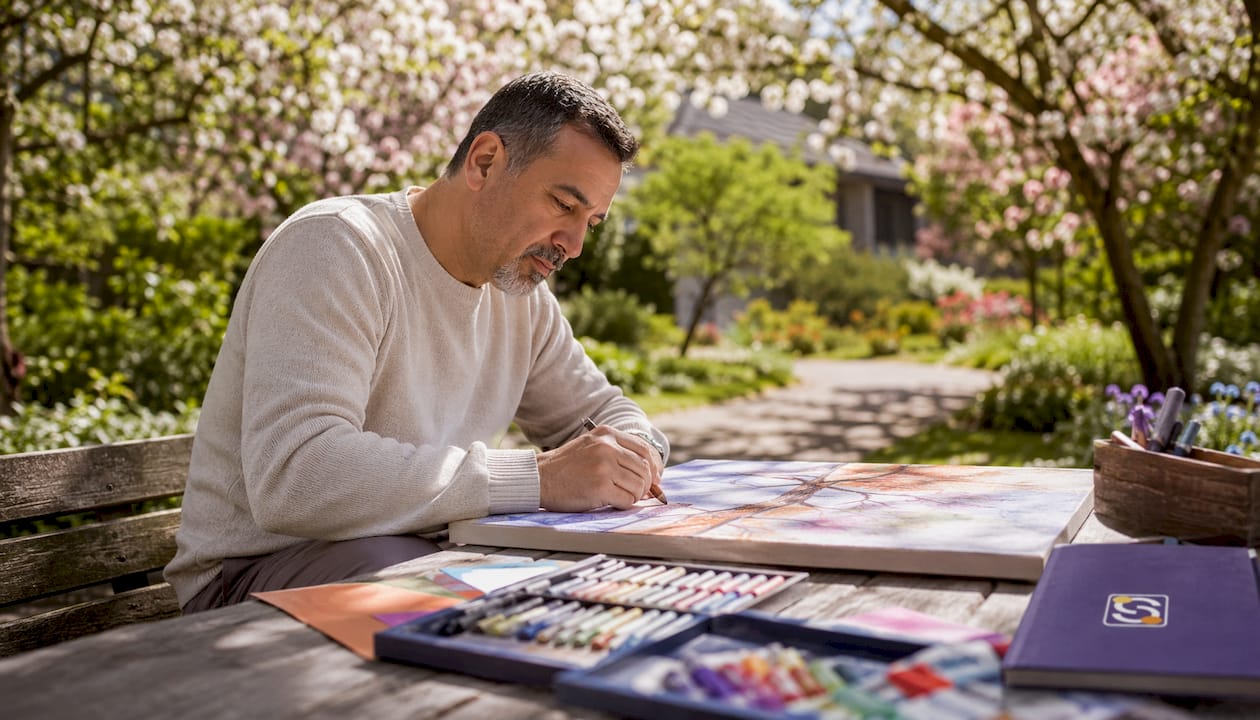
Emotional regulation. The tactile, rhythmic nature of working with materials, whether oil pastels, clay, or collage, grounds the nervous system. Participants in recovery programs consistently report feeling calmer and more present after sessions.
Social connectedness. A recent qualitative study in addiction treatment found that informal creative arts groups improved social connectedness and peer accountability, two factors strongly linked to sustained sobriety.
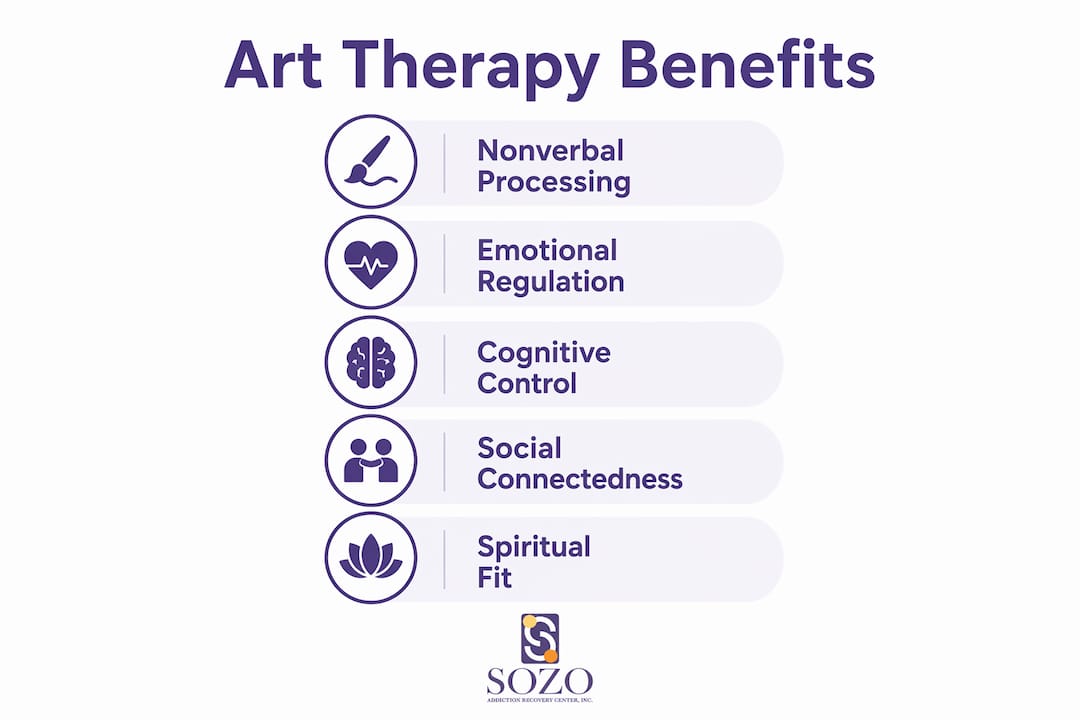
Spiritual fit for men of faith. Christian frameworks already value craftsmanship, stewardship, and the work of one’s hands. Framing art practice within those concepts reduces the stigma some men feel about “therapy.” Pottery, woodworking, and drawing can be introduced as skill-building, which lowers the barrier to entry.
Pro Tip: For men who resist the word “therapy,” introduce the first session as working with your hands. The therapeutic process begins the moment they pick up the materials.
What does the research actually show?
The evidence base for art therapy in addiction treatment is growing, though it remains early-stage in terms of large randomized controlled trials.
The University of Kansas study found that a single one-hour creative art session produced immediate changes in delay discounting among residents in a substance use treatment program. That is a short intervention with a measurable cognitive effect, which matters when treatment windows are narrow.
“Art therapy’s potential for revealing and treating the wide-ranging comorbidities found in people who develop addictions may help SUD treatment to become more effective and economical.” — Frontiers in Psychiatry, 2024
The PLOS One review found that art therapy as a complementary service accelerates healing when paired with detoxification, 12-step support, and medical supervision. A 2026 qualitative study documented improved social connectedness and identity rebuilding among participants in informal creative arts groups. Community-based programs like the Brush It Off exhibition show that art practice helps participants sustain recovery identity beyond the clinical setting.
Limitations to understand: Most studies use small samples, and methods vary widely across programs. Larger randomized trials with standardized outcome measures are still needed. What the current evidence supports is art therapy as a meaningful complement to clinical care, not a standalone treatment.
What does an art therapy session look like?
Sessions in addiction treatment fall into two distinct categories, and the difference matters clinically.
Individual clinical art therapy is led by a credentialed art therapist (ATR or ATR-BC) with specific treatment goals, documentation, and coordination with the broader care team. This format creates a confidential space for trauma disclosure and deeper psychological work.
Creative wellness groups are peer-supported, often facilitated by recovery support specialists. They build community and sustain engagement but are not a substitute for clinical art therapy in dual-diagnosis cases.
Common activities include:
- Drawing and painting (free-form or structured prompts)
- Collage and vision boards, including faith-friendly “life map” exercises
- Pottery and clay work, which research links to trauma processing and self-compassion through acceptance of imperfection
- Mandalas and structured coloring for grounding
- Photography and woodworking for skill-building and responsibility
Evidence supports one-hour sessions as the effective unit length. Weekly or biweekly frequency is standard in residential programs. Group sizes typically stay small enough for the facilitator to observe each participant’s process, not just the product.
Pro Tip: Offer graduated engagement: start with structured tasks like mandalas or coloring, then move toward open studio time as comfort grows. Men who feel in control of the task stay in the room.
How does art therapy fit inside faith-based, dual-diagnosis programs?
Clinical coordination is what separates a well-integrated program from one that simply offers art as a recreational activity. Under ASAM-informed individualized plans, creative therapy is assigned based on a man’s level of care, his co-occurring diagnoses, and his treatment goals. It is documented, supervised, and adjusted as he progresses.
Faith-based adaptations add another layer without compromising clinical standards. Scripture-based reflection prompts, chaplain collaboration on session themes, and the use of Christian metaphors (stewardship, restoration, the potter and the clay) can make creative work feel spiritually coherent rather than clinically foreign. The clinical boundary remains clear: the art therapist holds the therapeutic relationship; the chaplain or spiritual director holds the spiritual one.
For men with co-occurring disorders, trauma-sensitive facilitation is non-negotiable. This means:
- Screening for trauma history before introducing open-ended expressive work
- Coordinating with prescribing clinicians on medication management
- Having clear protocols for distress that emerges during sessions
- Ensuring dual-diagnosis care is integrated, not siloed
Art therapy also supports 12-step work directly. Collaging and visual exercises help reduce denial and allow men to externalize feelings they are not yet ready to speak aloud, which maps naturally onto Step 4 inventory work.
Pro Tip: Offer both secular and faith-tailored prompts and let each man choose his pathway. Forcing religious content alienates; offering it as an option invites.
How Sozorecoverycenter integrates creative therapy in men’s recovery
Sozorecoverycenter in Hot Springs, Arkansas, offers men’s-only residential, outpatient, intensive outpatient, partial hospitalization, and sober living programs. Treatment plans are built on ASAM Continuum criteria, meaning each man’s level of care, including any creative therapeutic components, is matched to his clinical and spiritual needs.
The program integrates Christian principles with the 12-step model, and spiritual and therapeutic healing are treated as complementary, not competing. Creative therapeutic supports are part of the broader activity and therapy schedule, alongside individual counseling, group therapy, and faith-based programming.
Key program details:
- Men’s-only environment with gender-specific clinical and spiritual programming
- ASAM-informed individualized treatment plans with dual-diagnosis coordination
- Insurance accepted: BlueCross BlueShield, Ambetter, QualChoice; private pay available
- Admissions include an initial assessment to determine level of care and program fit
- Diverse treatment components that pair creative activities with medical and psychiatric oversight
How to choose a program that uses art therapy
Not every program that lists “art therapy” on its website delivers clinical art therapy. Here is how to evaluate quickly.
Questions to ask intake staff:
- Who facilitates art therapy sessions — a credentialed ATR or ATR-BC, or a peer support specialist?
- How is art therapy coordinated with psychiatric care and medication management?
- What is the session frequency and typical group size?
- How do you document outcomes from creative therapy?
- How is spirituality integrated, and can clients choose their level of faith engagement?
Must-haves:
- Credentialed facilitator (ATR or ATR-BC) for clinical populations
- AATA alignment or membership
- Documented trauma-sensitive protocols
- Integration with dual-diagnosis and medical care
Nice-to-haves:
- Faith-tailored prompt options alongside secular ones
- Both individual and group formats available
- Community exhibition or public creative project opportunities
Red flags: Art labeled as “activity” when billed as therapy. No dual-diagnosis coordination. Pressure to accept religious content without choice. No trauma safeguards in place.
Practical next steps: finding care and what to expect
How to find integrated care:
- Contact Sozorecoverycenter admissions directly for an initial assessment
- Ask your primary care physician for a referral to a program with credentialed art therapists
- Check the AATA provider directory for licensed art therapists in your area
- Request a referral from a psychiatrist who specializes in substance use disorders
Cost and insurance: Private insurance, including BlueCross BlueShield, Ambetter, and QualChoice, covers many levels of care at Sozorecoverycenter. Private pay is also available. Contact admissions for a benefits verification before your first appointment.
Timeline: Most men notice a shift in engagement and emotional regulation within the first few sessions. Measurable changes in impulse control, as the University of Kansas research suggests, can begin with a single session. Sustained identity rebuilding and social connectedness develop over weeks of consistent participation.
What to bring to your first session: Comfortable clothes you can move in, an open mind about the materials provided, and one or two personal items that help you feel grounded, whether a verse, a photograph, or a small object with meaning.
Key Takeaways
Art therapy for men in addiction recovery is most effective when it is clinically integrated, credentialed, and coordinated with dual-diagnosis and spiritual care inside a structured treatment program.
| Point | Details |
|---|---|
| Evidence supports one-hour sessions | A single one-hour creative session produced measurable changes in delay discounting in residential treatment. |
| Clinical credentials matter | Look for ATR or ATR-BC facilitators and AATA alignment; peer-led groups supplement but do not replace clinical art therapy. |
| Dual-diagnosis coordination is required | Art therapy must be coordinated with psychiatric care and medication management for men with co-occurring disorders. |
| Faith integration is possible and effective | Christian metaphors, scripture-based prompts, and chaplain collaboration can deepen creative therapy without compromising clinical boundaries. |
| Sozorecoverycenter offers integrated care | Men’s-only residential and outpatient programs in Hot Springs, Arkansas, combine ASAM-informed plans, faith integration, and creative therapeutic supports. |
Why combining faith, clinical care, and creative therapy makes sense
The conventional view of addiction treatment still tends to separate the clinical from the spiritual, as if a man can be treated in parts. What programs like Sozorecoverycenter understand, and what the research increasingly supports, is that recovery requires the whole person to show up.
Creative therapy is not a soft add-on. For men who have spent years suppressing trauma through substances, working with their hands offers something that a therapy chair sometimes cannot: a way to externalize what they carry without having to find the words first. The clay does not judge. The canvas does not require a coherent narrative. That freedom is clinically significant.
The faith dimension matters too, but not in the way skeptics assume. Integrating spiritual practices into clinical care does not mean replacing evidence-based treatment with prayer. It means giving a man a framework for meaning that outlasts the treatment episode. When creative work is framed within Christian principles, stewardship, craftsmanship, restoration, it connects to something a man already values. That connection sustains engagement when motivation runs thin.
My honest advice to any man considering this path: try one session before you decide it is not for you. The men who resist it most are often the ones who need it most.
Sozorecoverycenter is ready when you are
Men who are serious about lasting recovery need more than detox and willpower. They need a program that addresses the clinical, the spiritual, and the psychological dimensions of addiction at the same time. Sozorecoverycenter offers exactly that: men’s-only residential and outpatient care in Hot Springs, Arkansas, built on ASAM-informed individualized plans, Christian principles, and dual-diagnosis treatment that includes creative therapeutic supports.
All assessments are confidential, and the admissions team will verify your insurance benefits before you commit to anything. BlueCross BlueShield, Ambetter, and QualChoice are accepted, and private pay options are available. If you are ready to take the first step, start your admissions process today and speak with someone who understands both the clinical and the faith dimensions of what you are facing.
Useful sources and further reading
Core studies cited:
- University of Kansas: one-hour art session and delay discounting — Residential treatment study showing immediate cognitive effects from a single creative session.
- PLOS One: art therapy as a complementary clinical service — Review confirming art therapy accelerates healing when paired with detox, 12-step support, and medical supervision.
- Frontiers in Psychiatry: brain networks and addiction recovery — Analysis of how art therapy activates neural networks relevant to trauma and reward processing.
- Qualitative study: informal creative arts groups in treatment — 2026 study of eight adults documenting improved social connectedness and peer accountability.
- Pottery and recovery in Wooster — Program-level report on clay work, trauma processing, and self-compassion.
Authoritative organizations:
- American Art Therapy Association (AATA): provider directory, credentialing standards (ATR, ATR-BC), and ethical guidelines.
- American Society of Addiction Medicine (ASAM): ASAM Continuum criteria for individualized treatment planning.
Sozorecoverycenter resources:
- Admissions and initial assessment
- Dual-diagnosis treatment for men
- Faith-based rehab in Arkansas
FAQ
Does art therapy actually help people in addiction recovery?
Yes. Research shows creative therapy for addiction improves impulse control, reduces anxiety, and builds social connectedness when integrated with clinical care. A single one-hour session has produced measurable changes in delay discounting in residential treatment settings.
Do you need artistic skill to benefit from art therapy?
No artistic skill is required. The therapeutic benefit comes from the process of making, not the quality of the product. Structured activities like mandalas or collage work well for men who have never engaged with art before.
How is art therapy different from a regular art class?
Clinical art therapy is facilitated by a credentialed art therapist (ATR or ATR-BC) with documented treatment goals and coordination with the broader care team. A recreational art class has no clinical intent or therapeutic oversight.
Does Sozorecoverycenter offer creative therapy as part of its program?
Sozorecoverycenter integrates creative therapeutic supports into its men’s-only residential and outpatient programs in Hot Springs, Arkansas, alongside ASAM-informed dual-diagnosis care and Christian principles.
Will insurance cover art therapy in an addiction treatment program?
Coverage depends on the program and your plan. Sozorecoverycenter accepts BlueCross BlueShield, Ambetter, and QualChoice, and the admissions team can verify your benefits before you begin.