


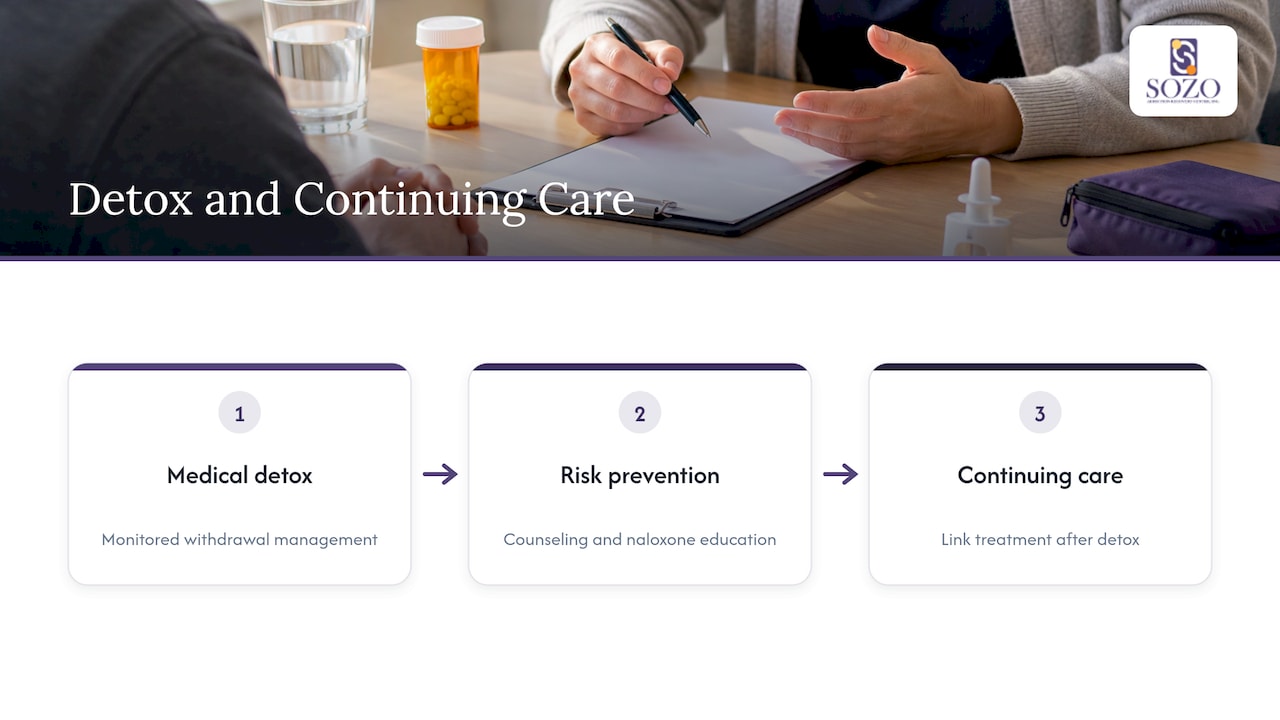
The safest move after detox is a direct one: a confirmed place in the next level of treatment, with a date, a ride and a named person following up, before withdrawal management ends. Detox stabilizes the body. It does not treat the patterns, the mental health symptoms or the relationships that drove a man’s substance use, and the days right after discharge are when a plan matters most.
This guide walks a man and his family through that handoff: what detox does and does not do, how clinicians decide between residential, partial hospitalization, intensive outpatient and outpatient care, how to avoid a gap, and what to line up for the months after.
TL;DR
- Detox is the first step, not the whole treatment. NIDA states that detoxification alone is not sufficient and that treatment should go on to address drug-use patterns and related medical, mental and social problems.
- The handoff works best when it is arranged before discharge: a confirmed admission or appointment, transportation, and one person responsible for follow-up.
- The right level of care is matched to the man’s clinical needs through a structured assessment such as the ASAM Criteria, not to a fixed number of days.
- Opioid and alcohol detox carry extra risks after discharge, so medication treatment and overdose prevention belong in the discharge plan where a clinician says they are appropriate.
- Sober living, peer support and faith community can carry a man through the months after formal treatment steps down.
Table of Contents
- What detox does, and what it leaves undone
- How the right next step is chosen
- Closing the gap between discharge and admission
- What a structured outpatient schedule can look like
- Dual diagnosis and faith in the treatment plan
- Perspective
- Housing and support after formal treatment
- How long treatment should last
- When return to use happens
- Starting the conversation with SOZO
- FAQ
- Sources
What detox does, and what it leaves undone
Detox, or withdrawal management, is the medically supervised process of getting through the physical side of stopping alcohol or drugs. For some substances that part is dangerous without medical oversight, which is why it is done in a monitored setting. Our medical detox placement service exists for that reason: we help a man find the right medical setting for withdrawal and plan the step that follows.
What detox cannot do is change why a man drank or used. NIDA’s research-based guidance says treatment must be personalized and address not only substance use but also co-occurring medical, psychological, social and vocational needs. A man leaving detox is usually clearer in the head and exhausted in the body. He may also be raw emotionally, facing a job, a marriage or legal matters that did not pause while he was away.
There is a physical reason the gap is risky too. For opioids, SAMHSA’s guidance treats detoxification as a transition point rather than an endpoint, because tolerance drops during withdrawal management and a return to use at the old dose can be fatal. The same guidance says withdrawal management should include relapse-prevention counseling and overdose-prevention education with naloxone. ASAM guidance likewise notes that withdrawal management without ongoing treatment increases overdose risk.
The evidence for linking the two steps is concrete. NIDA summarizes research in which hospitalized patients with opioid dependence who received buprenorphine and were linked to continuing treatment stayed on medication treatment longer and reported more opioid misuse-free days than patients who received detoxification alone without linkage.
How the right next step is chosen
Not every man leaving detox needs the same thing. One may need a residential setting away from the people and places tied to his use. Another has a stable home, a job and a supportive wife, and does well with a structured outpatient schedule.
Best-practice guidelines suggest using ASAM placement criteria to assess six dimensions and decide the level of treatment a person needs. ASAM’s own guidance recommends a structured approach and matching clinical needs, housing and access to technology with available residential, outpatient or telehealth services. Academic training material on the fourth edition describes the principle as care matched to severity and need, not to arbitrary time limits or fixed lengths of stay.
This is the same model behind our own treatment plans. We use ASAM criteria to build personalized plans, and you can read more in our guide to understanding ASAM levels of care.
The levels, in plain terms
| Level | What it looks like | Often fits a man who… |
|---|---|---|
| Residential | Lives at the facility, with daily structure, therapy and peer community | Needs distance from triggers, has an unstable home, or has strong cravings or untreated mental health symptoms |
| Partial hospitalization | Full days of treatment, home or sober living at night | Needs close daily support but can sleep somewhere safe |
| Intensive outpatient | Several sessions a week, built around work or family | Is stable, but needs more than weekly counseling |
| Outpatient | A few hours a week of counseling and groups | Has a strong support system, or is stepping down from a higher level |
The hours are a useful way to tell the levels apart. Teaching material built on the ASAM Criteria describes standard outpatient as under nine hours a week for adults, and partial hospitalization as twenty hours or more of clinically intensive programming each week. Intensive outpatient sits between the two. Individual programs set their own schedules, so ask any program for its weekly hours.
A man does not have to move up this ladder in order. Many step down: residential first, then partial hospitalization, then intensive outpatient, then outpatient, often with sober living alongside. Our guide to IOP versus outpatient explains how the two differ in practice.
Closing the gap between discharge and admission
The danger point is the gap: detox ends on a Thursday, the next program has a bed on Monday, and the weekend is spent at home. A study of the detox to treatment handoff identified discharge planning and referrals, patient education, rapport building, care coordination and convenient access as the things that help people make the transition. Here is how that looks in practice.
- Start the conversation on day one of detox. Tell the detox team that you intend to go on to treatment, and ask them to coordinate with the next program. Do not wait for discharge day.
- Get a confirmed date. A promise to call next week is not a plan. Ask for an admission date and time, and a phone number for the person who will meet you.
- Ask about same-day transfer. Many men go straight from a detox setting to a residential program the same day. If you want that, say so early so the beds, paperwork and transport line up.
- Settle the logistics. Insurance verification, packing list, medications, transportation and who is dropping you off. We can work through verification with you for private insurance plans, including BlueCross BlueShield, Ambetter and QualChoice.
- Name a follow-up person. Pick one person, a case manager, a counselor or a family member, who is responsible for checking that the handoff happens.
If a same-day admission is not available
Sometimes the right bed is not open on the day of discharge. SAMHSA’s opioid treatment guidance describes a practical bridge: a confirmed outpatient or intensive outpatient appointment, enough prescribed medication to last until that appointment when clinically appropriate, naloxone where relevant, transportation, and a named person responsible for follow-up and reminders.
The transition study also found that case management can help with practical needs such as childcare and housing, and that reminder calls after discharge can help people stay engaged. A small 2023 U.S. proof-of-concept study of a peer recovery coach after inpatient alcohol-withdrawal treatment is encouraging on the same theme. Among participants who engaged with the coach, 83% linked to ongoing treatment, compared with none of those who did not engage. The study was small, only ten participants, so it points to a direction and proves nothing alone. Still, it fits what we see: a man does better when a real person is expecting him.
Alcohol, opioids and medication
Medications can be part of the next step. For opioid use disorder, the guidelines above say aftercare planning should include a strategy to move to medication treatment when clinically indicated. For alcohol, a prescriber may discuss options such as naltrexone alongside counseling, and a clinical overview of psychosocial therapy with naltrexone shows how therapy and medication can work together. Whether any medication is right for a given man is a decision for his physician or psychiatrist, based on his history and his other medications.
What a structured outpatient schedule can look like
Many men worry that a higher level of care means losing a job or leaving a family. A structured outpatient program is built for the man who needs real treatment and still has daily responsibilities. In general, intensive outpatient means several scheduled sessions a week of group and individual work, with evenings and mornings at home, while standard outpatient is lighter, a few hours a week. The weekly hours above give you a way to compare programs, and any program should be able to tell you its schedule, session length and how it handles work conflicts.
At SOZO, intensive outpatient and outpatient care are offered for men, and a man can step down into them from residential or partial hospitalization. If you want the details first, our IOP key facts page covers what a typical program includes.
A few practical points help the schedule hold:
- Tell your employer only what you are comfortable sharing, and ask the program about documentation if you need time away.
- Plan transportation for the first two weeks before they begin.
- Keep the evenings protected. Sessions work better when the hours between them are not spent with old drinking or using routines.
- Tell the care team early if the schedule is slipping. Adjusting the plan is better than quietly dropping out.
Dual diagnosis and faith in the treatment plan
Many men leave detox with depression, anxiety, trauma symptoms or sleep problems that were hidden by substances or made worse by withdrawal. When these are left untreated, they push a man back toward the thing that numbed them. That is why we treat substance use and mental health together through our dual diagnosis and personalized care approach, rather than asking a man to deal with one before the other.
For many of the men we serve, faith is part of the answer, not an extra. Our program combines Christian principles with the 12-step model, so a man can bring his beliefs into treatment as part of the work. The plan is still built clinically, using ASAM criteria, and it fits the individual. NIDA’s guidance on personalized care supports the idea that a plan should address the whole person, and for these men that includes the spiritual side of their lives.
Perspective
We have watched the same pattern many times: a man finishes detox feeling better, decides he can handle the rest himself, and is back where he started within weeks. That is not weakness of character. It is what happens when a body has been cleared but nothing in his daily life has changed.
This is why we think the transition deserves as much attention as the treatment itself. Our men’s program is designed around continuity: medical detox placement when it is needed, then the level of care his assessment calls for, whether that is residential, partial hospitalization, intensive outpatient or outpatient, with sober living available alongside.
We also believe the setting matters. A small, peaceful, retreat-like community in Hot Springs gives a man room to set down a weight he has carried alone, and the 12 steps and biblical principles give him a framework for the long work ahead. The steps were never the destination. They are the training.
If you are in detox now, or a loved one is, our team can talk through what the next step could look like before discharge day.
Ty
Housing and support after formal treatment
Where a man sleeps after treatment shapes his first year. SAMHSA’s best practices for recovery housing describe sober living as a drug- and alcohol-free environment that supports stable long-term recovery, and cite research associating residency in these homes with improved abstinence and lower incarceration rates.
For a man whose home is full of triggers, or who has no stable place to go, sober living can be the bridge between structured treatment and independent life. Our page on what sober living for men looks like at SOZO describes the day-to-day, and our comparison of sober living and residential treatment helps a man see which one he needs now. Drug testing expectations are covered in our sober living drug testing policies.
Beyond housing, build a weekly rhythm of supports:
- Regular counseling or group sessions at the step-down level.
- 12-step meetings and a sponsor.
- A church or faith community, and service work. Volunteering gives a man somewhere to be useful, which matters more than it sounds.
- Family involvement, with clear agreements about boundaries and communication.
NIDA’s director has noted that peer support and community-based organizations often substitute for or add to formal treatment, which is a reason to build several kinds of support rather than rely on one.
How long treatment should last
Men often ask how many days they need. The honest answer is that it depends on the assessment, but the research gives a floor. NIDA’s research-based guide says most people need at least three months in treatment to significantly reduce or stop drug use, and that the best outcomes occur with longer durations.
That does not mean three months in a residential bed. It means the full course of care, stepping down as stability grows, and continuing at lower intensity afterward. Because ASAM-based care follows need rather than a calendar, a man’s plan can be revisited as he changes.
When return to use happens
Some men use again after treatment. NIDA describes relapse as part of addiction’s chronic course that may call for resumed, modified or new treatment, and says medications, behavioral therapies and peer support can help people stay in treatment. In another publication, NIDA says relapse should be seen as a signal that the treatment plan needs adjustment, much as with other chronic illnesses such as diabetes, and not as the patient’s or the treatment’s failure.
If it happens, call your counselor or program the same day. For opioids, tolerance may have dropped, so keep naloxone available and make sure those around you know where it is. Shame keeps men silent, and silence is the real danger.
Starting the conversation with SOZO
If a man you love is in detox, or you are, we can help you plan the next step. SOZO Recovery Center is a faith-based men’s treatment center in Hot Springs, Arkansas, offering residential, partial hospitalization, intensive outpatient, outpatient, sober living and dual diagnosis care, with medical detox placement referrals and personalized plans based on ASAM criteria. Read about residential care in Hot Springs, or visit our home page to reach our admissions team.
What a program costs depends on the level of care, the length of stay, whether sober living is included and what a private insurance plan covers. Our team can walk through those pieces with you when you call.
FAQ
What happens right after detox?
The goal is a direct move into the next level of treatment, ideally on the day detox ends. The detox team and the receiving program should coordinate the handoff, including medications, transportation and a named follow-up person. If a bed is not available that day, a confirmed outpatient or intensive outpatient appointment can bridge the gap.
Do I need residential rehab after detox, or is outpatient enough?
That is decided by a clinical assessment, not by preference alone. Clinicians commonly use the ASAM Criteria to weigh six dimensions, including withdrawal risk, mental health, readiness to change and the home environment. A man with a stable home and strong support may do well in intensive outpatient, while one facing high relapse risk often needs residential care first.
Can I keep working during treatment?
Often yes, at the outpatient and intensive outpatient levels, which are built around work and family schedules. Residential and partial hospitalization take more of the day. Ask any program for its weekly hours and how it handles work conflicts before you commit.
Why do people return to use after rehab?
Addiction is a chronic condition, and its course can include relapse, especially when the handoff between levels is weak, mental health conditions go untreated or the home environment has not changed. NIDA says relapse is a signal to adjust the plan, so the right response is to reconnect with treatment quickly.
What if I am not sure I can afford the next step?
Call and ask. Our admissions team can explain how private insurance verification works for plans such as BlueCross BlueShield, Ambetter and QualChoice, and what drives the total for the level of care you need.
Sources
- NIDA: Treatment and Recovery
- NIDA: Principles of Drug Addiction, a Research-Based Guide
- ASAM: Caring for Patients During the COVID-19 Pandemic
- NIDA: Medication Treatment for Opioid Use Disorder in the Inpatient Setting
- University of Utah: Finding the Best Treatment
- Understanding the 4th Edition ASAM Criteria
- ASAM Dimensions and Levels of Care
- Transitioning from Detoxification to Substance Use Disorder Treatment
- Digitally Assisted Peer Recovery Coach Study
- SAMHSA: Best Practices for Recovery Housing
- NIDA: Supporting Needed Research on Recovery
- NIDA: Seeking Drug Abuse Treatment, Know What to Ask
- Psychosocial Therapy plus Naltrexone for Alcohol Addiction