


A relapse means a man has returned to substance use after a period of sobriety, and it is not the same as a single lapse or slip. The first three actions matter more than the setback itself: confirm his physical safety given lowered tolerance, contact his sponsor, pastor, or treatment team immediately, and schedule a clinical reassessment within days, not weeks. Relapse is not evidence of spiritual failure. It is a signal that both his faith walk and his clinical plan need attention right now.
TL;DR:
- Most relapses occur within the first 30 days after discharge, emphasizing the need for immediate support and safety measures during this period.
- Contact support within an hour of relapse and schedule a clinical reassessment within 24 to 48 hours to prevent escalation and reduce overdose risk.
- Faith-based coping strategies like prayer, scripture reading, and community connection help manage cravings alongside clinical treatment, especially during high-risk times.
- Relapse is a common, non-linear part of recovery, with rapid response and support being more critical than avoiding setbacks entirely.
- Re-admission to treatment is a clinical process, not a moral failure, and should focus on understanding triggers and adjusting the recovery plan without shame.
Table of Contents
- What Relapse After Rehab Christian Guidance Actually Means
- Is Relapse Normal After Rehab? What the Evidence Shows
- Common Triggers and the Riskiest Times After Leaving Rehab
- Immediate Steps After a Slip or Relapse (First 72 Hours)
- Faith-Based Coping Strategies That Work Alongside Clinical Care
- When to Seek Clinical Help After a Relapse
- Returning to Christian Rehab Without Shame
- A Christian Perspective on Getting Back Up
- How Sozorecoverycenter Supports Men After a Relapse
- Sources
- FAQ
What Relapse After Rehab Christian Guidance Actually Means
Clinicians draw a line between a lapse (a brief, isolated return to use, often followed by immediate correction) and a relapse (a sustained return to the addictive pattern with rebuilding tolerance and behavior). That distinction shapes everything that comes next, especially around safety.
Christian communities sometimes treat any return to use as proof of weak faith or hidden rebellion. That framing does real harm. The American Society of Addiction Medicine defines addiction as a chronic, treatable brain disease, and clinical standards built on that model expect setbacks as part of a longer arc, not as the end of the story.
A faith-aware, clinically accurate view holds both truths together:
- Relapse often involves real physiological changes, including reduced tolerance that raises overdose risk.
- It rarely stems from a single failure of willpower or prayer.
- Spiritual care and clinical care answer different questions, and a man in recovery needs both.
- Naming the return to use honestly, without shame language, is the fastest way back to stability.
Is Relapse Normal After Rehab? What the Evidence Shows
Relapse is common enough that the Cleveland Clinic describes recovery as a non-linear process where a return to use is a possible event, not a rare failure. What matters clinically is speed of response: contacting support and getting stabilized quickly changes outcomes far more than the relapse itself.
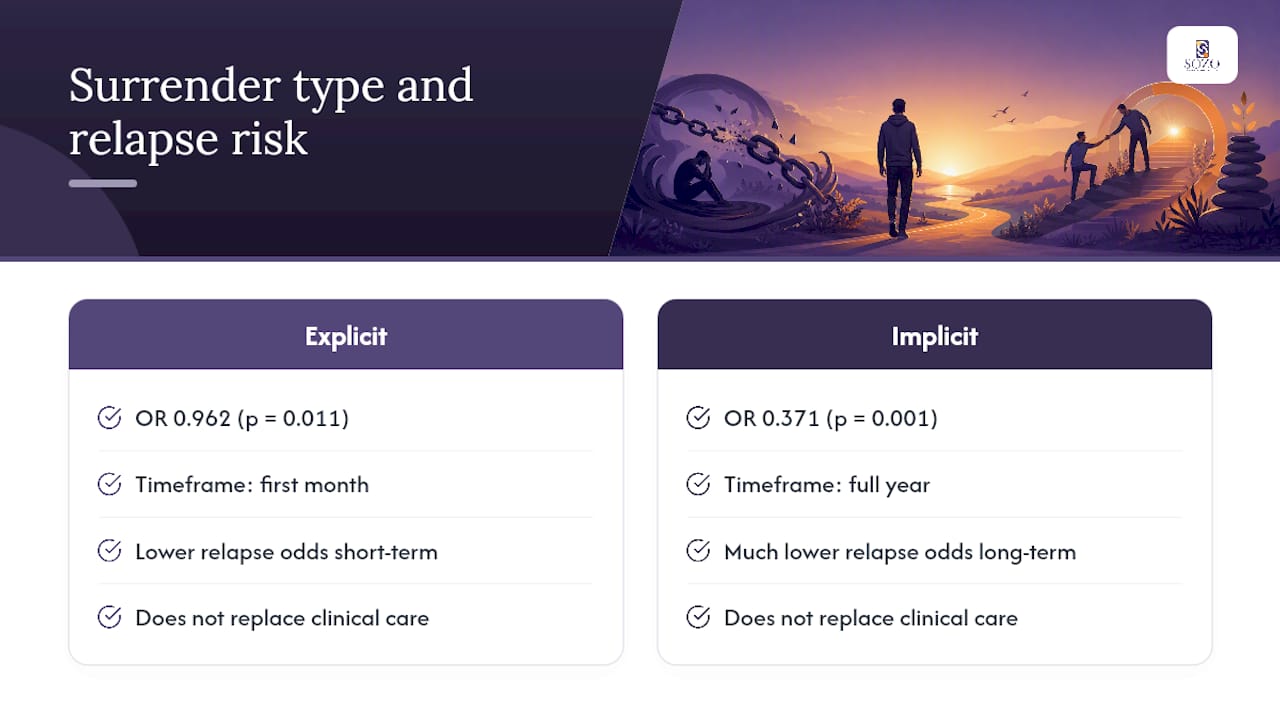
A longitudinal study of 177 men in Christian inpatient treatment found that surrender to God predicts relapse risk in two different ways. Explicit surrender (a conscious, verbalized decision) predicted lower relapse odds in the first month (OR = 0.962, p = 0.011), while implicit surrender (a deeper, internalized posture) predicted much lower relapse odds across the full year (OR = 0.371, p = 0.001). Short-term faith declarations help immediately. Long-term spiritual formation protects further out. Neither replaces medical and clinical care.
Common Triggers and the Riskiest Times After Leaving Rehab
Risk is not constant. It clusters around specific windows and specific states of mind, and knowing both lets a man plan instead of just hope.
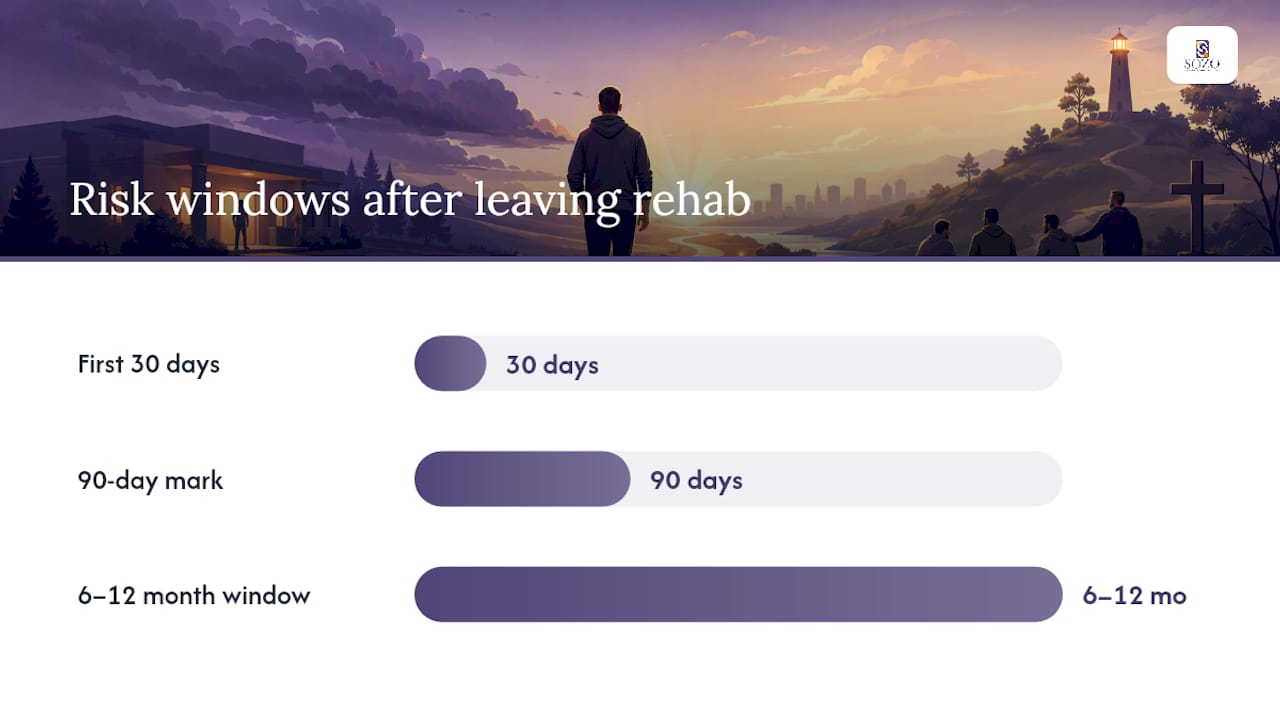
The first 30 days after discharge carry the highest risk, when new routines are fragile and old cues are everywhere. The 90-day mark is a second danger zone, often coinciding with reduced meeting attendance and a false sense of “I’ve got this.” The 6 to 12 month window brings a quieter risk: complacency, isolation from recovery community, and drifting from both church and clinical follow-up.
Watch for these common triggers:
- HALT states: hungry, angry, lonely, tired, often in combination rather than alone
- Celebrations, holidays, or family gatherings where alcohol or old company is present
- Relationship conflict, especially with a spouse or parent
- Sudden change in housing, job, or income
Pro Tip: Track your HALT state daily for two weeks after leaving treatment. Most men discover their riskiest hour of the day is the same one every time, usually late evening when the house goes quiet.
Immediate Steps After a Slip or Relapse (First 72 Hours)
The first three days set the trajectory. Move fast, and move in this order:
- Assess physical safety first. Tolerance drops fast after even a short break from use, and resumed use at old levels can trigger an overdose. If there’s any doubt about what was used or how much, seek emergency care or medical detox before anything else.
- Contact someone within the hour, not the day. A short honest message works: “I used. I’m safe right now but I need help today.” Send it to a sponsor, pastor, or the treatment team, whichever answers fastest.
- Remove yourself from the environment where the use happened, if it’s safe to do so.
- Schedule a clinical reassessment within 24 to 48 hours to evaluate whether the level of care needs to change.
While arranging that reassessment:
- Increase meeting or small group contact to daily, even if only by phone
- Avoid isolating decisions, big or small, for at least a week
- Tell one trusted person the whole truth, not an edited version
Faith-Based Coping Strategies That Work Alongside Clinical Care
Prayer and clinical relapse prevention are not competing systems. They work on different timescales and different parts of a man’s response to craving, and the strongest recovery plans use both.
Brief contemplative practices, prayer pauses of one to five minutes, slow scripture reading, or breath-based meditation, function as a genuine interruption to the craving cycle. Research on spiritual practices and physiological reactivity shows these routines lower physical stress responses, giving a man a real pause between the urge and the decision.
Community structures matter just as much as personal devotion:
- Church-based phone trees that connect a man to a real voice within minutes of a craving text
- Faith-adapted 12-step meetings that use Christian language for the steps without dropping clinical accountability
- Recovery-focused small groups, including Celebrate Recovery, built around confession and mutual support rather than performance
Forgiveness work deserves specific mention. Structured forgiveness practice reduces depression, anxiety, and the kind of rumination that often precedes a relapse in men carrying co-occurring mental health struggles.
Pro Tip: Pair a HALT check with one fixed spiritual action, a specific verse, a two-minute call, ten slow breaths. Decide the pairing in advance, when you’re calm, not in the moment you’re craving.
When to Seek Clinical Help After a Relapse
Some situations call for immediate escalation, not a wait-and-see approach. Move toward clinical care right away if any of the following apply:
- Withdrawal symptoms are present or expected based on what was used
- Use has continued for more than a day or two
- There are thoughts of self-harm or a sense of hopelessness
- A co-occurring mental health condition, depression, anxiety, trauma, has worsened
The ASAM Continuum model offers a framework for matching the level of care to actual risk rather than guesswork:
- Medical detox when withdrawal risk is present
- Residential treatment for men needing a full reset away from triggers
- Partial hospitalization (PHP) for structured daily care without full residency
- Intensive outpatient (IOP) for men balancing work or family with treatment
- Outpatient care for ongoing maintenance once stability returns
Medication-assisted treatment can be layered into any of these levels, and a well-run faith-based program pairs it with pastoral counseling rather than treating the two as opposites.
Returning to Christian Rehab Without Shame
Re-admission usually starts with a straightforward reassessment: what changed, what triggered the relapse, and what needs to shift in the treatment plan. It is a clinical conversation, not a confession booth.
Talking to family or a pastor goes easier with short, honest, action-focused language rather than a long apology. A few examples that work:
- To a spouse: “I relapsed. I’ve already called my counselor and I’m going back in.”
- To a pastor: “I need prayer and I need you to know I’m getting clinical help too.”
- To a parent: “This is a setback, not the end. Here’s my plan.”
Boundaries protect the relationship on both sides. Accountability sounds like check-in calls and shared expectations; enabling sounds like covering for missed responsibilities. A family that learns the difference protects the man’s return to treatment and its own well-being at the same time.
A Christian Perspective on Getting Back Up
Most relapse guidance treats faith as a nice addition to the real work, the clinical work. That gets the order backward for a lot of men. The surrender-to-God research cited earlier suggests something sharper: an internalized surrender predicts a year’s worth of protection, while a spoken decision protects the next month. Neither one is decoration on top of treatment. Both are mechanisms, measurable ones, that clinical programs would be foolish to ignore.
The harder truth is that most churches are not built to hold this well. A congregation that treats relapse as scandal will drive a man back into hiding faster than any craving will. A faith-integrated program that pairs CBT with an honest theology of failure and grace gives him somewhere to actually stand.
— Ty
How Sozorecoverycenter Supports Men After a Relapse
A center like Sozorecoverycenter can provide clinical structure and support from a faith community in moments of relapse. Such programs often cover a full range of care a return to use might require:
- Residential Treatment for men needing a full, structured reset
- Partial Hospitalization and Intensive Outpatient for stepped-down structure that fits real schedules
- Outpatient care for ongoing maintenance
- Medical Detox Placement when withdrawal risk needs medical supervision first
- Dual Diagnosis care for men whose relapse is tangled with depression, anxiety, or trauma
- Sober Living for a stable, accountable place to rebuild routine
Every plan is informed by the ASAM Continuum model, which means the level of care matches actual clinical need rather than a one-size approach, while biblical principles and the 12-step model run alongside the therapy, not apart from it. If a relapse has you or someone you love wondering what comes next, reach out about residential treatment or ask about medical detox placement to get a clinical starting point today.
This article is general information, not a substitute for advice from a qualified doctor. Consult a qualified healthcare professional about your own circumstances before acting on anything here.
Sources
- Surrender to God measures and relapse outcomes — PubMed entry
- Relapse (return to substance use) — Cleveland Clinic
- I relapsed: A compassionate guide to getting back on track — National Rehab Hotline
- Spiritual practices and physiological reactivity — PMC review
FAQ
What does the Bible say about addiction, recovery, and relapse?
Scripture doesn’t use the word “relapse,” but it speaks directly to human weakness, repeated failure, and the possibility of restoration through grace. Passages on Paul’s struggle with his own nature (Romans chapter) and the call to confess and be healed (James chapter) support a theology where a setback prompts confession and renewed effort, not condemnation.
Is it normal to relapse after rehab?
Yes. Clinicians treat relapse as a possible part of the chronic, non-linear recovery process rather than a rare failure, and what matters most is how quickly a person reconnects with support afterward.
What can I do instead of relapsing?
Use a HALT check paired with an immediate action: call your sponsor or pastor, pray for even sixty seconds, or leave the environment triggering the urge. These brief interruptions give the craving time to pass while you reach real support.
What is the riskiest time for relapse after leaving rehab?
The first 30 days after discharge carry the highest risk, with a second danger zone around 90 days when meeting attendance often drops. A quieter risk window follows at 6 to 12 months, usually tied to isolation from both church and clinical follow-up rather than any single crisis.