


A sponsor is a fellow member of a 12-step fellowship who walks you through that fellowship’s steps and principles. A mentor is a broader guide who offers perspective, encouragement and practical help, and who can support a man on any recovery path. Many men benefit from both. Neither one replaces clinical care.
The two words get used as if they were interchangeable, and in the workplace they often have their own meaning. In recovery, the difference is more specific, and knowing it helps a man ask the right person for the right kind of help.
TL;DR
- A sponsor is a volunteer peer inside a 12-step fellowship who guides you through the steps. A mentor is a wider support role that is not tied to one program.
- An accountability partner is a teammate in recovery who checks in with you. A sober companion is a paid, practical, day-to-day helper.
- None of these roles is therapy, and none replaces medical or mental health treatment.
- Research reviewed by the Recovery Research Institute links having a sponsor to better short-term outcomes, though cause and effect are not fully established.
- If you are unsure where to begin, a clinical assessment can tell you which supports fit your situation.
Table of Contents
- The Short Answer: Sponsor and Mentor Are Different Jobs
- What a Sponsor Actually Does
- What a Mentor Does
- Trained Peer Support Is a Third Category
- Sponsor vs Accountability Partner
- Sober Companion vs Sponsor
- Which One Fits Where You Are
- Where These Roles Stop and Clinical Care Starts
- Our Perspective
- How SOZO Fits With the People Around You
- FAQ
- Sources
The Short Answer: Sponsor and Mentor Are Different Jobs
The simplest way to separate them is by structure. A sponsor works inside a fellowship. A mentor works inside a relationship.
A.A. World Services describes sponsorship as an alcoholic who has made some progress in the program sharing that experience, on a continuous and individual basis, with another alcoholic who is trying to get or stay sober. The sponsor encourages meeting attendance, introduces the newcomer to other members and goes over the meaning of the Twelve Steps.
A mentor has no such script. One recovery resource describes a mentor as a broader support role focused on perspective, encouragement, practical goals, routines and accountability. A mentor can support a person using any recovery pathway, including faith-based, clinical or a mix of both.
Here is the comparison in one view.
| Sponsor | Mentor | |
|---|---|---|
| Where the role lives | Inside a specific 12-step fellowship | Outside any one program |
| Main focus | Working the steps and principles | Perspective, routines, goals, encouragement |
| Who fills it | A volunteer member with experience in that program | A person with relevant experience, sometimes an older man in recovery, a pastor or a respected peer |
| Structure | Defined by the fellowship’s tradition | Set by the two people involved |
| Clinical? | No | No |
What a Sponsor Actually Does
A sponsor is not a boss, a counselor or a rescuer. The A.A. pamphlet says sponsor and sponsored meet as equals, and that a sponsor does not impose personal views or take the newcomer’s inventory unless asked.
In practice, a sponsor typically does these things:
- Meets or calls the newer member on a regular basis.
- Explains how the steps work and helps the member begin them.
- Shares what has worked in his own recovery, without insisting it will work the same way for someone else.
- Introduces him to other members and encourages him to keep attending meetings.
- Brings denial or procrastination into the open, kindly and directly.
The Celebrate Recovery lesson on sponsors adds detail. It says a sponsor coaches you through the Principles and Steps, offers suggestions and ideally has at least one year of continuous sobriety and has worked through the Steps. It also says a sponsor should be the same gender as the person he sponsors. Men’s recovery groups often follow the same principle for good reason: it keeps the focus on honest work rather than distraction.
If you want to see how the steps fit with a faith-based approach, our guide to Celebrate Recovery’s 12 steps walks through them, and our page on 12-step recovery for men explains how we practice them.
What the research says about sponsors
The Recovery Research Institute reviewed a study on this question. In it, having a sponsor at treatment completion was associated with 33% greater odds of no illicit-drug use or problems, and 50% greater odds of no stimulant use, at one month, after adjusting for baseline substance use.
The same review notes that the precise mechanism and causal effect are not fully established. So the honest reading is this: sponsorship is associated with better early outcomes, and it is a reasonable part of a recovery plan. It is not a promise.
What a Mentor Does
A mentor helps a man see further down the road than he can see today. Where a sponsor asks, “Where are you in the steps?”, a mentor might ask, “What does your week look like, and what is getting in the way of the life you want?”
Mentors often help with:
- Rebuilding daily routines, such as sleep, work, meals and meetings
- Setting practical goals, like returning to school, finding steady work or repairing family relationships
- Offering perspective from having walked through hard seasons
- Encouragement on the days motivation runs low
A mentor may come from a church, a men’s group, a recovery community or a treatment program’s alumni network. Because the role is flexible, it suits a man who is not part of a 12-step fellowship, or one who wants a second voice alongside a sponsor.
Our article on how support systems strengthen sobriety covers how a mix of relationships, rather than one single person, tends to hold a man steady.
Trained Peer Support Is a Third Category
There is a role that sits between informal sponsorship and clinical care. The Mountain Plains ATTC distinguishes sponsors, who are volunteer fellowship members without required professional training, from peer recovery support specialists, who are trained, often certified, and governed by formal boundaries and supervision.
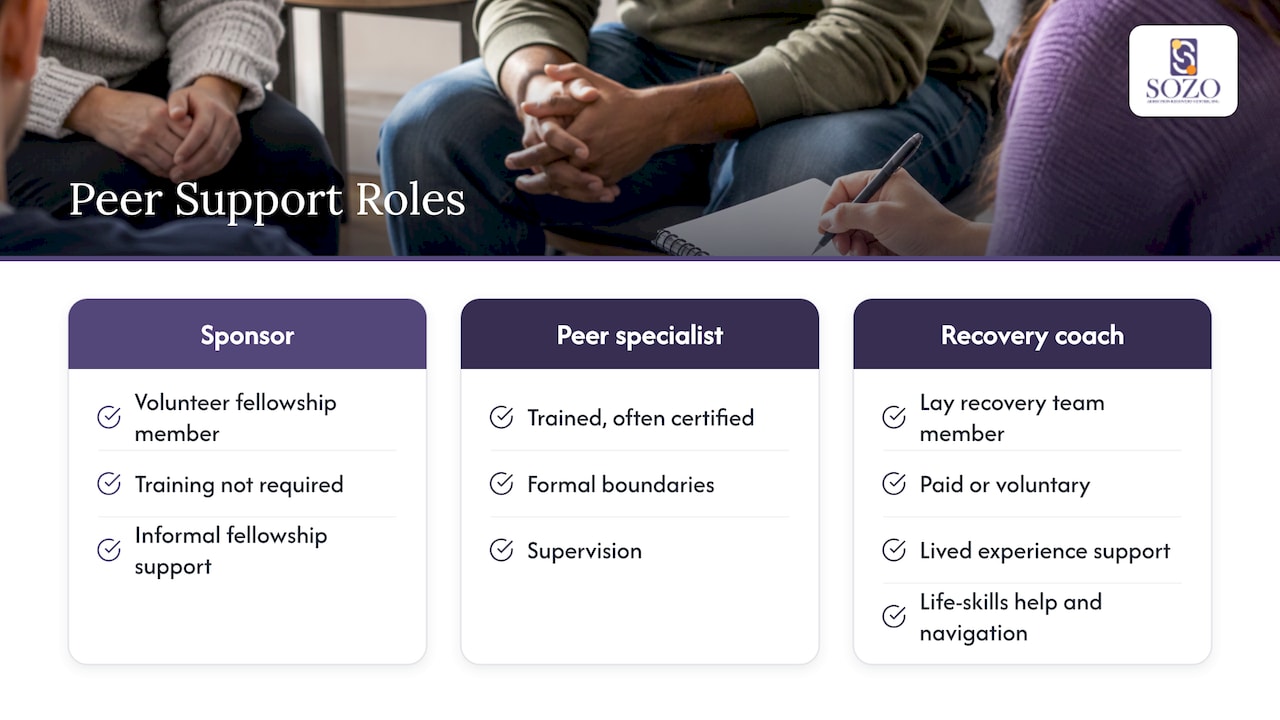
The Agency for Healthcare Research and Quality describes recovery coaches and peer support workers as lay members of the recovery team who may be paid or voluntary and who use lived experience to offer hope, emotional support, life-skills help and navigation to community services.
This matters if you are comparing informal sponsorship with supervised peer support. Programs that follow a man after treatment often offer the structured version, and alumni support after treatment is one example of how organized follow-up can sit alongside the informal relationships a man builds on his own.
Sponsor vs Accountability Partner
The two are close cousins, and men often ask which one they need.
An accountability partner is a peer in recovery who walks alongside you. The Celebrate Recovery glossary describes an accountability partner as a teammate who walks the road to recovery together with you, encouraging one another along the way, and says the partner should also be the same gender.
The Celebrate Recovery lesson draws the line clearly. A sponsor coaches you through the steps and has been through them. An accountability partner encourages you daily, helps motivate you, and may or may not be at the same place in recovery. The lesson also recommends that at least three people be on your accountability team, so no single person carries all of it.
| Sponsor | Accountability partner | |
|---|---|---|
| Relationship | Guide with more experience | Teammate, often at a similar stage |
| Direction | Mostly one way, from experienced to newer | Mutual |
| Focus | Steps and principles | Daily encouragement and honesty |
| Experience | Ideally a year or more of sobriety, steps worked | Any stage of recovery |
| Number | Usually one | Several is recommended |
A practical way to use both: ask a sponsor to guide the step work, and ask two or three men at your own stage to be the people you text when the day gets hard.
Sober Companion vs Sponsor
This is the clearest contrast of all, because a sober companion is typically a paid, practical role, and a sponsor is a volunteer one.
Descriptions of sober companion work include helping with routines and meals, getting a client to therapy or recovery meetings, supporting medication compliance, managing exposure to high-risk situations and being present for difficult conversations.
A sponsor does not do any of that on a daily basis. A sponsor shares experience and guides step work, usually through scheduled contact and calls when needed.
One point deserves care. According to Psychology Today, sober companion services are unregulated in the U.S., with no minimum sobriety or training requirement for companions. If you or your family are considering one, ask about background, references and how the companion coordinates with your treatment team. A sober companion is also not a replacement for a licensed therapist, and the work is meant to translate clinical goals into daily behavior.
Which One Fits Where You Are
Use the situation, not the label, to decide.
- You are new to a 12-step fellowship and want to work the steps. A sponsor is the natural fit.
- You are not part of a fellowship, or you want practical life guidance. A mentor fits well.
- You need daily encouragement and someone at your own stage. Ask for one or more accountability partners.
- You are in a high-risk transition and need hands-on daily help. A sober companion or a structured treatment program may fit better.
- You are leaving treatment. Combine them. A sponsor, a mentor and a small team of peers each cover something the others do not.
Our aftercare plan for men lays out how these relationships fit alongside clinical follow-up, and our piece on volunteering in recovery shows how service often leads to the kind of relationships that become mentorship.
How to choose a sponsor or mentor well
A few simple checks help:
- Look for someone whose recovery you respect, not just someone who is available.
- Choose someone of the same gender, which both Celebrate Recovery and A.A. materials recommend.
- Ask how long they have been in recovery and whether they have worked the steps. Celebrate Recovery suggests at least a year of continuous sobriety for a sponsor.
- Pay attention to how they listen. A good guide shares experience and does not push personal views.
- Start with a conversation. It is fine to ask a few men before you settle.
Where These Roles Stop and Clinical Care Starts
Sponsors, mentors, accountability partners and companions are people with experience. They are not clinicians. The A.A. pamphlet says a sponsor does not offer professional services such as those provided by counselors or the medical and social work communities.
That boundary matters most when mental health is part of the picture. The National Institute on Alcohol Abuse and Alcoholism states that alcohol use disorder frequently co-occurs with mental health disorders, and that the severity of both conditions determines the right level of care. Less severe cases may be managed in primary care, while more severe cases may need addiction or mental health specialists.
SAMHSA’s advisory on protracted withdrawal adds that persistent symptoms can include impaired impulse control, negative emotional states, sleep disturbance and cravings, and that symptoms suggesting a co-occurring disorder call for thorough mental health assessment and concurrent care.
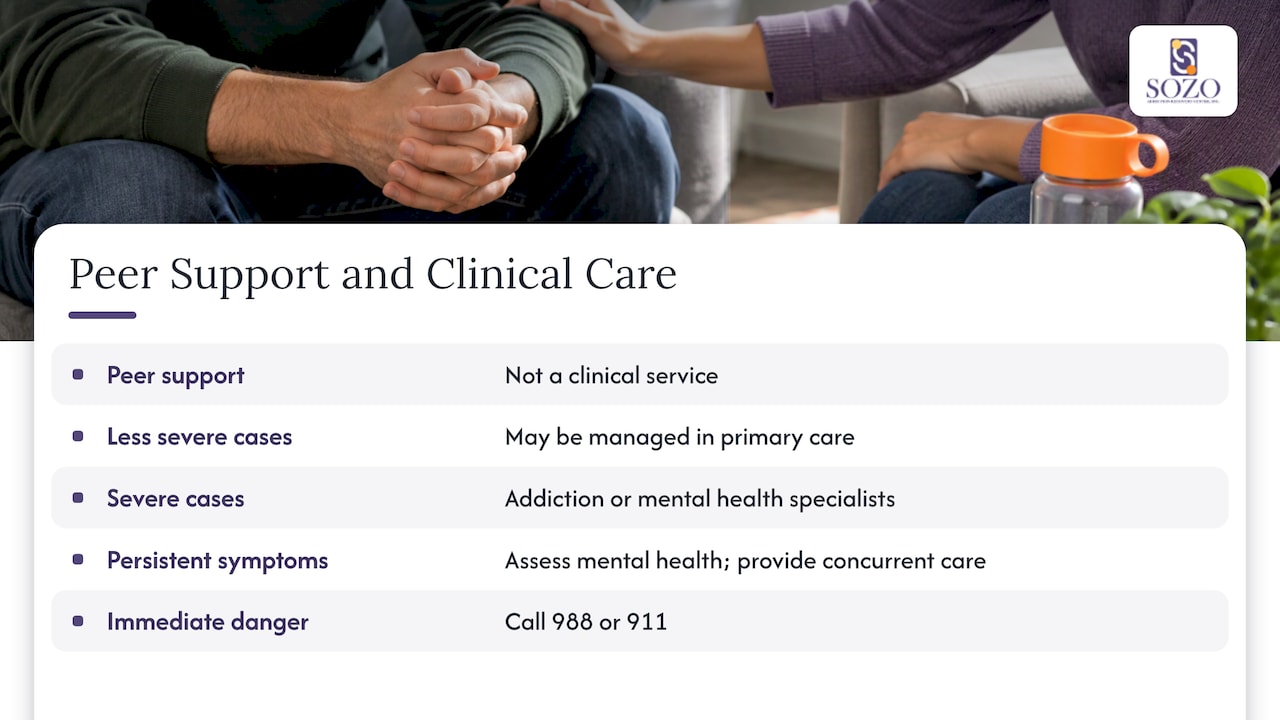
In plain terms: if you are struggling with depression, anxiety, trauma symptoms, withdrawal or thoughts of harming yourself, talk to a licensed clinician or your doctor, and bring your sponsor or mentor in as support alongside that care. If you are in immediate danger, call 988 or 911.
Our Perspective
We have watched men do their best work when they stop asking which single person will carry their recovery and start building a team. At SOZO, a man’s clinical care, his faith and his peer relationships each have a place, and they work best together.
A sponsor teaches a man how to work the steps as someone who has done it. A mentor widens his view. Accountability partners keep him honest on ordinary days. Clinicians treat what a peer cannot, including co-occurring mental health concerns. Our personalized plans are built on ASAM criteria so that the level of care matches the man, and our program joins biblical principles with the 12-step model in a small, peaceful, retreat-like setting for men.
The steps were never the destination. They were the training. The people around a man are what help him keep training once he walks out the door, and we encourage every man in our care to build those relationships while he is still with us.
Ty
How SOZO Fits With the People Around You
If you are looking for more than a sponsor or mentor can give, we offer faith-based care for men in Hot Springs, Arkansas. Our programs include residential treatment, partial hospitalization, intensive outpatient and outpatient care, sober living, medical detox placement referrals and dual diagnosis care, each shaped by a personalized plan.
Men in our programs are encouraged to connect with sponsors, mentors and peers as part of their recovery, so those relationships are already in place when treatment steps down. To talk through which level of care fits, reach out through our website.
FAQ
Is a sponsor the same as a mentor?
No. A sponsor belongs to a specific 12-step fellowship and guides a member through that program’s steps. A mentor is a wider support role that offers perspective, encouragement and practical help on any recovery path. One person can sometimes do both, but the roles are different.
Can I have a sponsor and a mentor at the same time?
Yes, and many men do. A sponsor guides the step work, while a mentor helps with routines, goals and the bigger picture of life. Adding accountability partners at your own stage gives you daily encouragement as well.
What is the difference between a sponsor and an accountability partner?
A sponsor is an experienced guide who coaches you through the steps. An accountability partner is a teammate in recovery who encourages you and keeps you honest, and may be at a different stage. Celebrate Recovery suggests having at least three people on your accountability team.
Is a sober companion better than a sponsor?
They do different jobs. A sober companion is a paid, hands-on helper who supports daily routines, while a sponsor is a volunteer who shares experience and guides step work. Which fits depends on how much daily structure you need, and neither replaces treatment or therapy.
Do sponsors and mentors replace treatment?
No. They are peers with lived experience, not clinicians, and they do not diagnose or treat. If you have withdrawal symptoms, a mental health condition or a history of relapse, speak with a doctor or licensed clinician and keep your sponsor or mentor as a supportive part of your wider plan.
Sources
- P-15 Questions & Answers on Sponsorship, A.A. World Services
- How to Find a Sponsor or Mentor in Recovery
- Lesson 7: Sponsor, Celebrate Recovery
- Glossary of Terms, Celebrate Recovery
- Mounting Evidence of the Benefits of 12-step Sponsors, Recovery Research Institute
- Understanding the Distinction: Peer Recovery Support, Mountain Plains ATTC
- Community Resources and Recovery Supports, AHRQ
- Post-Treatment Alumni Program
- What is a sober companion?
- Do I Need a Sober Companion? Psychology Today
- Mental Health Issues: Alcohol Use Disorder and Common Co-occurring Conditions, NIAAA
- Protracted Withdrawal, SAMHSA