


Bipolar disorder and substance use disorder commonly co-occur and feed each other in a two-way cycle. Lifetime co-occurrence estimates reach at least 40 percent in many clinical samples, with alcohol and cannabis the most frequent substances involved. If you recognize this pattern in yourself or someone you love, the next step is an integrated dual-diagnosis evaluation, and if there is any thought of suicide or active substance use putting someone at immediate risk, that evaluation needs to happen today.
TL;DR:
- Up to 60 percent of individuals with bipolar disorder will experience a substance use disorder during their lifetime, with alcohol and cannabis being most common.
- Substance use often occurs during specific mood episodes: stimulants during mania, alcohol during depression, and cannabis can either destabilize sleep or serve as self-medication.
- Active substance use worsens bipolar treatment outcomes by increasing hospitalization, impairing medication adherence, and raising the risk of suicide attempts.
- Effective dual diagnosis care should be integrated within a single team that manages both conditions simultaneously, with thorough assessment and coordinated medication management.
- Keeping a detailed mood and substance use log over several weeks improves diagnosis accuracy, while staged treatment focusing on safety and stabilization offers the best chance for recovery.
Table of Contents
- Bipolar and Addiction: How Common Is Co-Occurrence?
- Why Bipolar Disorder and Substance Use Reinforce Each Other
- What Untreated Dual Diagnosis Does to Health and Safety
- How Do Doctors Tell Bipolar Episodes Apart From Substance-Induced Mood Symptoms?
- Integrated Care vs. Treating Bipolar Disorder and Addiction Separately
- Choosing Medications When Bipolar Disorder and Addiction Overlap
- Therapy Options That Work for Bipolar Disorder and Substance Use Together
- How to Evaluate a Dual-Diagnosis Treatment Program
- How Sozorecoverycenter Approaches Bipolar Disorder and Addiction
- Living With Bipolar Disorder and Addiction: A Realistic View
- Starting Treatment for Bipolar Disorder and Addiction at SOZO
- Trusted Resources for Understanding Bipolar Disorder and Addiction
- Sources
- FAQ
Bipolar and Addiction: How Common Is Co-Occurrence?
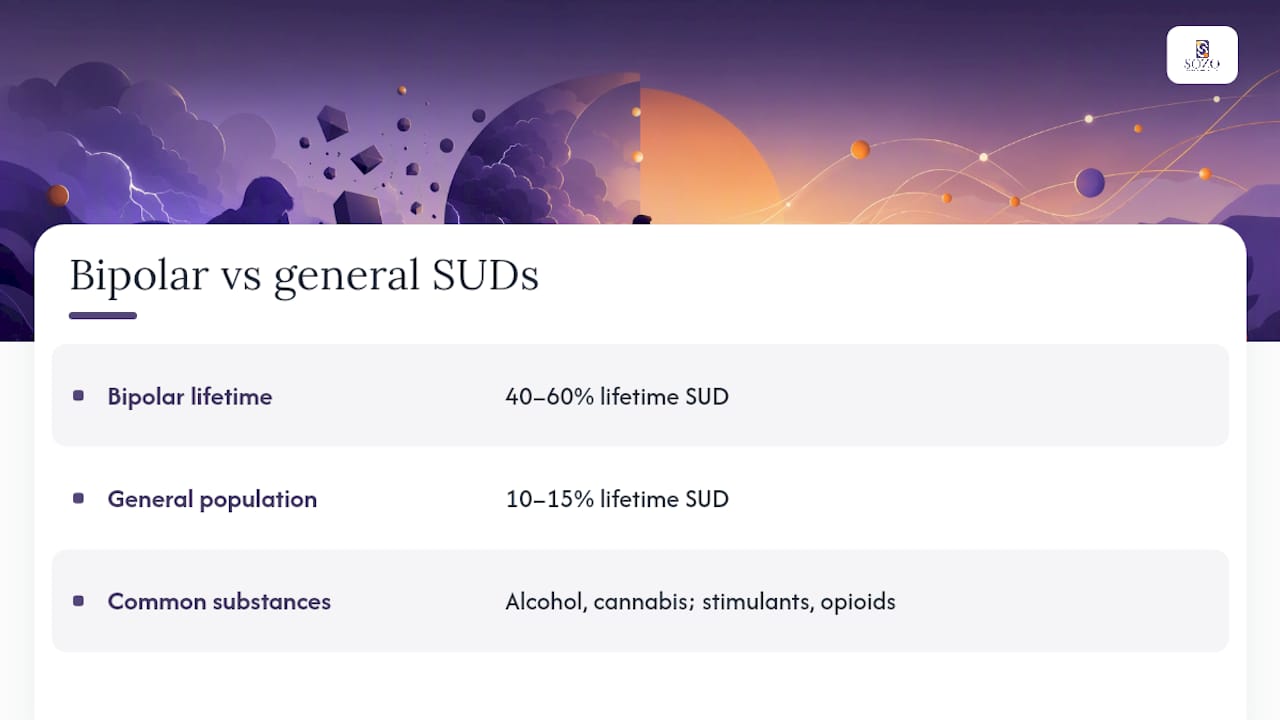
The numbers are not subtle. Research reviewing the intersection of bipolar disorder and substance abuse consistently finds that somewhere between 40 and 60 percent of people with bipolar disorder will meet criteria for a substance use disorder at some point in their life. That is not a fringe statistic. It means that in any given clinical setting treating bipolar disorder, a substantial share of the men and women in that waiting room are also wrestling with alcohol, cannabis, or other substances.
Alcohol and cannabis top the list, but stimulants and opioids show up often enough that they cannot be treated as afterthoughts. Alcohol tends to appeal during depressive and mixed episodes because of its sedating effect. Stimulants like cocaine or methamphetamine often surface during manic or hypomanic periods, when a person already feels wired and is chasing more intensity rather than less. Cannabis occupies a strange middle ground. Some people use it to blunt anxiety or come down from mania; others find it destabilizes sleep and tips them toward a manic episode.
Bipolar and Addiction, by the Numbers: Clinical reviews place lifetime substance use disorder rates in bipolar populations at 40 to 60 percent, compared to roughly 10 to 15 percent in the general population across most large surveys. That gap alone tells you this is not a coincidence of two separate epidemics colliding. It is a specific vulnerability tied to how bipolar disorder alters mood, sleep, and impulse control.
Subtype matters too. People with Bipolar I, which involves full manic episodes, tend to show higher rates of stimulant and alcohol misuse tied to the disinhibition of mania. Bipolar II, characterized by hypomania and more prolonged depressive episodes, is linked more often to alcohol use tied to depressive self-medication. Setting matters as well. Inpatient psychiatric samples report higher substance use disorder rates than outpatient samples, largely because the more severe, harder-to-manage cases are the ones landing in hospital beds in the first place.
Age of onset adds another layer. Bipolar disorder that emerges in adolescence or early adulthood correlates with earlier and heavier substance involvement, possibly because the developing brain is more vulnerable to both conditions taking root simultaneously. A teenager cycling through unpredictable mood states while also experimenting with alcohol or cannabis is dealing with two conditions that reinforce each other before either one is fully diagnosed.
None of this is meant to alarm you into hopelessness. It is meant to replace vague worry with a clear picture, because a clear picture is what makes it possible to ask the right questions when you or a family member finally sits down with a treatment provider.
Why Bipolar Disorder and Substance Use Reinforce Each Other
The relationship between bipolar disorder and substance use runs in both directions, and understanding that bidirectional pattern changes how you think about treatment. Some people use substances to self-medicate mood symptoms. Others develop mood symptoms that look bipolar but are actually driven by the substance itself. Many people experience some combination of both, which is exactly why disentangling the two conditions takes real clinical skill.
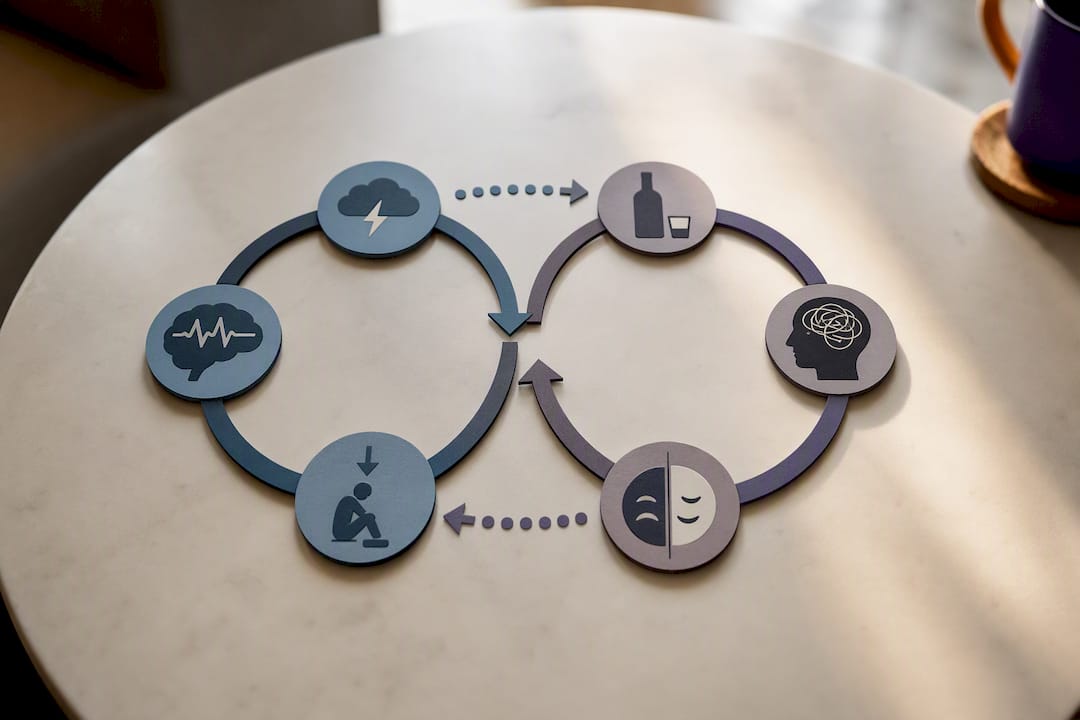
The self-medication pattern is intuitive enough. Depressive episodes bring exhaustion, hopelessness, and a mind that will not quiet down at 3 a.m., so alcohol or a sedative starts to look like relief. Manic or hypomanic episodes bring restlessness and grandiosity that stimulants seem to match rather than fight. The problem is that this relief is always temporary and usually makes the underlying mood cycle worse once the substance wears off.
The other direction gets less attention but matters just as much. Sustained heavy substance use can produce mood symptoms that mimic bipolar disorder. Stimulant use can trigger manic-like states. Chronic alcohol use during withdrawal periods can produce depressive symptoms severe enough to look identical to a major depressive episode. This overlap is a major reason dual diagnosis is so often missed or misdiagnosed in the first place.
Underneath both patterns sits a shared biological vulnerability. Reviews of the biopsychosocial mechanisms connecting these conditions point to reward-circuit sensitization and shared genetic risk factors as core contributors. The brain’s dopamine reward pathway, already dysregulated in bipolar disorder, appears more reactive to the reinforcing effects of drugs and alcohol. Someone with bipolar disorder is not choosing addiction out of weak character. Their reward circuitry is wired to respond more intensely to substances that spike dopamine, which is a biological fact, not a moral one.
Behavior plays its part too, and three factors stand out. Impulsivity during mania drives decisions that a stable mood state would never make, including substance use that escalates quickly once started. Sleep disruption, a hallmark of bipolar disorder in both directions of mood swing, is also a well-documented trigger for both mood episodes and cravings. Environmental stress, whether financial pressure, relationship conflict, or trauma history, tends to hit people with bipolar disorder harder and pushes many toward substances as a coping mechanism that inevitably backfires.
Genetic studies add one more thread. Family and twin studies suggest that some of the same inherited vulnerabilities that raise risk for bipolar disorder also raise risk for substance use disorder, independent of any self-medication behavior. That means two people can be born with elevated risk for both conditions long before either one manifests, and the eventual collision of the two is not a personal failure. It is a predictable outcome of shared genetic and neurobiological wiring meeting the wrong set of stressors.
What Untreated Dual Diagnosis Does to Health and Safety
The clinical consequences of untreated co-occurring bipolar disorder and addiction are not abstract. They show up in hospital admission rates, in how well medication works, and in whether a person survives the illness at all. Reviews addressing co-occurring disorders consistently find higher hospitalization rates, more emergency service use, and poorer functional recovery among people managing both conditions compared to those managing bipolar disorder alone.
Rapid cycling and mixed episodes, two of the more difficult presentations of bipolar disorder to treat, show up more frequently when substance use is active. Mixed episodes, where depressive and manic symptoms occur simultaneously, are already associated with higher suicide risk on their own. Layer active substance use on top, and both the frequency of mood episodes and the danger of each one climbs. Treatment resistance follows a similar pattern. Medications that would otherwise stabilize mood often perform less reliably when alcohol or drugs are interfering with sleep, absorption, or adherence.
Adherence itself takes a direct hit. Someone in the grip of active addiction is less likely to take mood stabilizers consistently, less likely to keep therapy appointments, and more likely to discontinue treatment altogether during a substance-driven crisis. This creates a loop: missed medication destabilizes mood, destabilized mood increases substance cravings, and increased substance use further disrupts medication adherence.
Suicide risk deserves direct, unflinching attention here. Bipolar disorder already carries one of the highest suicide risk profiles among psychiatric conditions, and co-occurring substance use disorder increases suicide attempt rates further, likely because substances lower inhibition around self-harm during already dangerous mood states. This is not a detail to skim past. If you or someone you love has bipolar disorder and is actively using alcohol or drugs, a documented safety plan is not optional. That plan should include a list of warning signs, an emergency contact who can act fast, removal or restriction of means during high-risk periods, and the direct number for the 988 Suicide and Crisis Lifeline.
None of this means the outlook is fixed. It means the stakes of getting a fast, accurate diagnosis and coordinated treatment are genuinely high, and that urgency should shape how quickly you move toward evaluation rather than how much you worry once you have already started the process.
How Do Doctors Tell Bipolar Episodes Apart From Substance-Induced Mood Symptoms?
Timing is often the single most useful clue a clinician has. A mood episode that appeared well before any substance use started, or that persists for weeks after a person has stopped using entirely, points toward primary bipolar disorder. A mood episode that only shows up during heavy use, or that resolves within days to a few weeks of sobriety, points more toward substance-induced mood symptoms. The trouble is that most real cases do not fall neatly into either category, which is exactly why careful, patient assessment matters more than a quick checklist.
Reviews of assessment challenges in dual diagnosis point to the value of tracking symptoms over time rather than relying on a single conversation. A mood and substance use log kept for two to four weeks gives both the patient and the clinician something concrete to look at: which days involved drinking or drug use, what the mood was like that day, how sleep behaved, and whether cravings tracked with mood state or ran independently of it. Keeping this kind of log is a low-cost, practical step that meaningfully improves diagnostic clarity, particularly in early assessments where a single intake interview would otherwise have to guess.
A few tools and practices tend to show up in serious dual-diagnosis assessments:
- Structured screening instruments that assess both mood symptoms and substance use severity in the same intake process, rather than screening for one and asking about the other informally.
- Collateral history from family members, close friends, or previous treatment providers, since a person in an active mood episode is not always the most reliable narrator of their own symptom timeline.
- A detailed substance use history covering not just current use but patterns going back years, since a first manic episode that occurred years before any substance use began is diagnostically significant.
- Review of prior hospitalization records and medication trials, which often reveal patterns the current provider would otherwise have to rediscover from scratch.
- Physical health screening to rule out medical causes of mood symptoms, since thyroid dysfunction and other conditions can mimic bipolar presentations.
Pro Tip: If you are heading into an intake appointment, bring your mood and substance log along with a written timeline of when symptoms first appeared relative to when substance use started. That single page can save weeks of diagnostic back and forth.
None of this happens in a single visit. A clinician who takes dual diagnosis seriously will often ask you to return for a follow-up assessment once some sobriety has been established, specifically because certain mood symptoms only reveal their true nature once the substance is out of the picture.
Integrated Care vs. Treating Bipolar Disorder and Addiction Separately
For decades, the standard approach split bipolar disorder and addiction treatment into two separate systems that rarely talked to each other. A person might see a psychiatrist for mood stabilization and, separately, attend a substance use program with no coordination between the two. That model is called sequential or parallel care, and the evidence increasingly shows it falls short for dual diagnosis.
Sequential care treats one condition, typically stabilizing the substance use disorder first, before addressing the mood disorder afterward. Parallel care treats both at the same time but through separate providers or programs that operate independently, with the patient left to coordinate the message between them. Integrated care treats both conditions simultaneously, through the same team or a tightly coordinated one, using a single treatment plan that accounts for how the two conditions interact.
The evidence favors integration, particularly for substance use outcomes. A qualitative review of treatment strategies for comorbid bipolar disorder and substance use disorder found that Integrated Group Therapy (IGT) produced consistent benefits for substance outcomes that separate, uncoordinated treatment tracks did not reliably achieve. The logic makes sense once you see it: a therapist who understands that a client’s cravings spike right before a hypomanic episode can address both in the same session, rather than sending the client to two different providers who never compare notes.
That said, integration is not a magic switch that erases every mood symptom and craving at once. Some of the clearest treatment research suggests staging matters. A well-regarded approach starts with safety and substance stabilization as the immediate priority, often through IGT-style group work and relapse prevention, and then layers in bipolar-specific psychosocial treatment once the acute substance crisis has settled. Mood stability and sobriety often need to be pursued as a sequence within an integrated framework, not as two totally separate battles.
- Integrated programs assign a single coordinated team or tightly linked providers rather than referring patients between disconnected clinics.
- Integrated programs adjust bipolar medication management with active knowledge of substance use patterns, rather than prescribing in isolation.
- Integrated programs treat relapse in either domain, a mood episode or a substance use lapse, as clinically relevant to both conditions rather than as a separate event.
Pro Tip: When you call a treatment center, ask directly: “Does one team manage both my mood and substance use, or will I be referred elsewhere for one of them?” The answer tells you in ten seconds whether you are looking at integrated care or the older, siloed model.
Here is the honest caveat, and it matters for setting expectations. Many real-world treatment systems, including well-intentioned ones, still require a period of medical or psychiatric stabilization before they can offer full integrated services, particularly in acute crisis situations. That is not a failure of the integrated care model. It reflects the practical reality that a person in active mania or severe withdrawal often needs immediate stabilization before any psychosocial treatment plan, integrated or otherwise, can take hold.
Choosing Medications When Bipolar Disorder and Addiction Overlap
Medication management gets more complicated the moment substance use enters the picture, and any provider worth trusting will treat that complexity seriously rather than glossing over it. Mood stabilizers and antipsychotics remain the backbone of bipolar treatment, but active substance use can blunt their effectiveness, interfere with blood levels, and make it harder to tell whether a medication is failing or simply being undermined by alcohol or drugs in the system.
Lithium and other mood stabilizers require reasonably consistent kidney function and hydration, both of which heavy alcohol use can compromise. Antipsychotic medications used for bipolar mood stabilization can interact with substances in ways that increase sedation or reduce the medication’s own effectiveness. This is one of the strongest arguments for integrated prescribing: a psychiatrist who does not know a patient is drinking heavily may misread a poor treatment response as medication failure rather than substance interference, and adjust the prescription in the wrong direction entirely.
On the addiction side, medications like naltrexone for alcohol use disorder have real evidence behind them and can be used alongside bipolar treatment, but they require careful coordination. A prescriber managing both conditions needs to weigh how each medication affects the other, watch for interactions, and adjust the overall plan as sobriety and mood both shift over the course of treatment.
The clearest safety principle in this space is straightforward: avoid starting potentially addictive sedatives, particularly benzodiazepines, without direct consultation from an addiction specialist. Benzodiazepines are sometimes used short-term for acute anxiety or agitation in bipolar disorder, but for someone with an active or historical substance use disorder, they carry real dependence risk and can complicate an already difficult diagnostic picture. Careful tapering and close coordination between a prescriber and an addiction specialist are essential when benzodiazepines are already part of someone’s history, since sedative-hypnotics both mask mood symptoms and carry a meaningful risk of dependence on their own.
Therapy Options That Work for Bipolar Disorder and Substance Use Together
Medication addresses the biology, but the day-to-day work of staying stable and sober happens largely in therapy, and not every therapy model is built for dual diagnosis. Some approaches target mood regulation, some target substance use, and the strongest programs braid both together rather than treating them as separate curricula.
Cognitive Behavioral Therapy, adapted for dual diagnosis, works on the thought patterns that drive both mood episodes and substance cravings. It teaches a person to catch the early cognitive distortions that precede a manic spiral or a depressive crash, while also addressing the automatic thoughts that trigger reaching for a drink or a drug. Dialectical Behavior Therapy, originally built for emotion regulation, has been adapted with real success for dual diagnosis populations because it directly targets the distress tolerance and impulse control skills that both bipolar disorder and addiction chip away at.
- CBT adaptations focus on identifying and interrupting the thought patterns that precede both mood episodes and substance cravings.
- DBT adaptations build distress tolerance and emotion regulation skills, directly addressing the impulsivity that fuels both mania and relapse.
- Integrated Group Therapy (IGT) has the strongest evidence base specifically for substance use outcomes in comorbid samples, per the qualitative review of treatment strategies for bipolar disorder and substance use comorbidity.
- Interpersonal and Social Rhythm Therapy (IPSRT) stabilizes sleep and daily routines, which matters enormously given how much sleep disruption drives both mood episodes and cravings.
- Family therapy and 12-step facilitation serve as adjuncts that extend support beyond the clinical hour and into daily life.
The limitations matter as much as the strengths. IGT’s evidence is strongest for substance outcomes specifically, which means mood symptoms often still need dedicated bipolar-focused treatment layered in alongside it rather than assumed to improve automatically. CBT and DBT adaptations require real skill from the therapist delivering them; a generic CBT protocol not adapted for bipolar disorder can miss the mood-specific triggers that a substance-only program would never catch. No single therapy model covers everything, which is precisely the argument for coordinated, integrated programs rather than a single silver-bullet technique.
How to Evaluate a Dual-Diagnosis Treatment Program
Finding the right level of care starts with understanding the options. Residential treatment provides 24-hour structure and is typically appropriate for someone in an acute mood episode, active withdrawal risk, or a pattern of relapse that outpatient support has not been able to interrupt. Partial hospitalization and intensive outpatient programs offer several hours of structured treatment most days of the week while allowing the person to return home at night. Standard outpatient care and sober living arrangements support the longer stretch of recovery once acute stabilization has occurred.
Once you know roughly what level of care fits, ask direct questions before committing to any program:
- Is treatment genuinely integrated, meaning one team manages both bipolar disorder and substance use, or will you be referred elsewhere for one of the two?
- Do clinical staff have specific dual-diagnosis training, not just general addiction or general psychiatric credentials?
- How is medication coordinated between the psychiatric provider and the addiction treatment team, and who has final say if there is a disagreement?
- What safety protocols exist for suicide risk, withdrawal complications, or a mood crisis that emerges during treatment?
- What does the transition plan look like after this level of care, including sober living, aftercare, and continued psychiatric follow-up?
Because real-world systems remain fragmented more often than anyone would like, patients and families should walk into an intake conversation prepared to ask these questions directly rather than assuming integration is automatic. Insurance verification and admissions logistics vary by provider, so it helps to have insurance information, a list of current medications, and a brief written history ready before the first call. A practical resource on coping skills for substance use recovery can also help you prepare for what early recovery actually demands day to day.
Pro Tip: Call two or three programs before deciding, and ask each one the same five questions above. The differences in how confidently they answer will tell you more than any brochure.
How Sozorecoverycenter Approaches Bipolar Disorder and Addiction
Treatment centers sometimes build individualized treatment plans using the ASAM Continuum model, a framework designed to match the level and type of care to what each person actually needs rather than applying a one-size-fits-all program. For men carrying both a bipolar diagnosis and a substance use disorder, that means dual-diagnosis care that treats mood symptoms and addiction as connected, not separate, problems.
Some programs integrate biblical principles and the 12-step model alongside clinical dual-diagnosis treatment, providing a path that addresses both psychiatric stabilization and spiritual renewal. Services for co-occurring bipolar disorder and addiction sometimes include structured dual-diagnosis programming, medication coordination for individuals with a history of sedative or benzodiazepine use, and sober living support that extends stability past initial treatment.
Living With Bipolar Disorder and Addiction: A Realistic View
Bipolar disorder and addiction do not resolve on a fixed timeline, and pretending otherwise sets people up for discouragement. What the evidence does support is that integrated care measurably improves outcomes compared to treating the two conditions apart. That is worth holding onto on the harder days.
Stigma remains one of the biggest obstacles, often keeping men in particular from asking for help until a crisis forces the issue. If you are the one asking questions on someone else’s behalf, know that pushing for genuinely integrated care, and escalating immediately if safety becomes a concern, is not overstepping. It is often the difference between stalled progress and real, sustained recovery.
Ty
Starting Treatment for Bipolar Disorder and Addiction at SOZO
Some treatment centers offer a single, faith-integrated team that treats bipolar disorder and addiction together instead of shuffling clients between disconnected providers. For a man who has already tried the fragmented, separately-managed version of treatment and watched it fail, that coordination is the practical difference between another relapse cycle and lasting stability.
The dual-diagnosis program for men combines ASAM-informed clinical planning with biblical principles and the 12-step model, built specifically around the reality that mood stability and sobriety have to be pursued together, not in sequence. Sedative and benzodiazepine history can complicate bipolar medication management, so coordination of this aspect is important in clinical settings. Some programs focus exclusively on men, while care for women or other populations typically begins with a general practitioner or community mental health referral.
If you are ready to talk through what integrated care would look like for your situation, SOZO’s admissions team can walk you through insurance verification, program logistics, and what to expect at intake, starting with a single phone call.
Trusted Resources for Understanding Bipolar Disorder and Addiction
- NCBI Bookshelf, Chapter 4 on Co-Occurring Disorders covers clinical treatment strategies and expected outcomes for dual diagnosis in depth.
- PMC review on bipolar disorder and substance abuse offers a comprehensive look at dual-diagnosis treatment approaches and prevalence data.
- Mayo Clinic’s expert answer on bipolar disorder and alcohol use provides accessible, patient-facing guidance on the connection between the two conditions.
- PMC review of biopsychosocial mechanisms explains the genetic and neurobiological pathways linking bipolar disorder and substance use disorder.
This article is general information, not a substitute for advice from a qualified doctor. Consult a qualified healthcare professional about your own circumstances before acting on anything here.
Sources
- Comprehensive Review on Association of Bipolar Disorder and Substance Abuse: Dual Diagnosis and Treatment Approaches
- Substance use comorbidity in bipolar disorder: A qualitative review of treatment strategies and outcomes
- Substance Use Disorder Treatment for People With Co-Occurring Disorders: NCBI Bookshelf (Chapter 4)
- Co-Occurring Bipolar and Substance Use Disorders: A Review of Impacts, Biopsychosocial Mechanisms, Assessment, and Treatment
- Mayo Clinic: Is there a connection between bipolar disorder and alcohol use disorder?
FAQ
Are people with bipolar disorder more prone to addiction?
Yes. Lifetime substance use disorder rates in people with bipolar disorder reach 40 to 60 percent in many clinical samples, well above general population rates, largely due to shared genetic vulnerability and reward-circuit sensitization.
What is the average life expectancy for people with bipolar disorder?
Bipolar disorder is associated with a shortened life expectancy compared to the general population, driven largely by elevated suicide risk and higher rates of co-occurring conditions like substance use disorder and cardiovascular disease. Integrated treatment that addresses both mood symptoms and substance use directly improves these outcomes.
What mental illness is most associated with addiction?
Bipolar disorder carries one of the highest rates of co-occurring substance use disorder among major psychiatric conditions, with alcohol and cannabis the most commonly involved substances, though other mood and anxiety disorders also show elevated addiction risk.
How does a bipolar husband treat his wife?
Behavior varies widely and depends heavily on whether the bipolar disorder is stabilized and whether substance use is active, since untreated mood episodes and co-occurring addiction both tend to strain relationships through unpredictability and impaired judgment. Family therapy and coordinated dual-diagnosis treatment often improve relationship functioning as mood and substance use both stabilize.
Should I seek separate treatment for bipolar disorder and addiction, or one integrated program?
Evidence favors integrated treatment, since Integrated Group Therapy has shown consistent benefits for substance use outcomes that separate, uncoordinated care often fails to achieve. Ask any program directly whether one team manages both conditions before enrolling.