


Supporting a man with addiction means helping him move toward treatment and recovery. Enabling means shielding him from the consequences of substance use, which lets the problem continue. The two can look almost the same from the outside, because both come from love. The difference is in the result: does your action ask him to carry more responsibility for his recovery, or does it carry that responsibility for him?
This guide gives you plain definitions, real examples, a simple test you can apply on a hard day, and words you can use in the conversation. It is written for wives, parents, siblings, and friends who are tired, worried, and unsure whether they are helping.
TL;DR
- Support encourages treatment and honest responsibility. Enabling protects a person from consequences and keeps the pattern going.
- A useful test: does this action help him keep using, or does it help him get help?
- Specific enabling examples include covering missed work, lending money, paying bills left unpaid because of substance use, and making excuses.
- Speak when he is sober, name specific concerns, say you love him, and state what you will do if use continues. Then follow through.
- You cannot help well if you are depleted. Your own care and support are part of the plan.
Table of Contents
- What the two words really mean
- What enabling looks like in real life
- What supportive behavior looks like
- Gray areas: the same action, two different results
- A simple test for a hard moment
- How to have the conversation
- Boundaries that protect love instead of ending it
- Taking care of yourself is part of the answer
- When mental health is part of the picture
- Our perspective
- How SOZO can help when he is ready
- FAQ
- Sources
What the two words really mean
In everyday speech, “enabling” sounds like an accusation and “supporting” sounds like praise. In recovery work they are simply two directions a loving action can take.
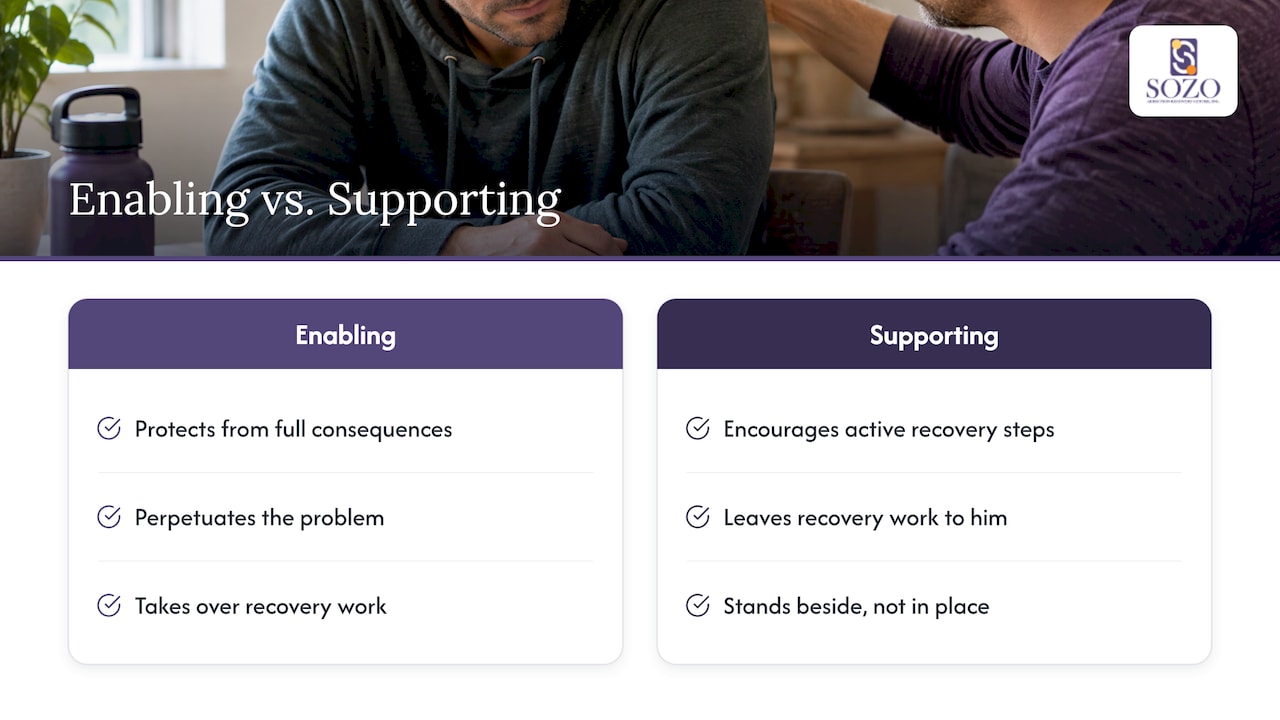
Psych Central describes the core distinction this way: enabling protects a person from the full consequences of their actions and perpetuates the problem, while supporting encourages active steps toward recovery. It also frames support as avoiding the urge to solve every problem and not treating his recovery as your responsibility.
That last point matters. A man in recovery is the one doing the work. Family can stand beside him, but cannot walk the road for him. When a family member takes over, even with the best motives, he is no longer practicing the humility, honesty, and accountability that lasting sobriety grows from.
It also helps to remember that enabling is not a character flaw. Most people who enable are acting out of fear: fear of a job lost, a marriage ended, a phone call in the night. Seeing the pattern is the first step toward changing it, and nothing about it needs shame. When a whole home centers on his drinking, read our guide to codependency and addiction.
What enabling looks like in real life
Enabling rarely announces itself. It tends to arrive one reasonable-seeming favor at a time. The following behaviors appear across guidance from health agencies and mental health publishers.
- Covering for him. The U.S. Department of Veterans Affairs lists trying to control, excuse, or cover up a loved one’s alcohol or drug use, such as covering missed work or missed activities with children, as enabling-type behavior.
- Money. Psychology Today points to lending money that may buy drugs, paying bills left unpaid because of drug use, accepting abusive behavior, lying, and covering up as ways families make continued use easier.
- Housing without expectations. WebMD lists giving money, paying expenses, and providing rent-free housing without meaningful contribution, along with bailing someone out, making excuses, and denying the problem.
- Neglecting your own life. The same WebMD list includes putting your own health, work, and relationships aside in order to manage his.
- Endless arguing. Psychology Today also notes that scolding, nagging, and arguing can become enabling, because they shift attention onto the family member and away from the real consequences of use.
That last item surprises many families. You can enable by being too soft or by being too loud. In both cases the conversation stops being about his choices and starts being about your reaction.
What supportive behavior looks like
Support is not the absence of help. It is help aimed at recovery. The VA suggests spending time with your loved one when he is sober, helping find treatment options, attending recovery meetings, and staying involved and patient. Reinforcing healthy behavior helps rebuild relationships that substance use has strained.
Psych Central adds that supportive people listen, offer encouragement, and act as a resource rather than a rescuer. MedlinePlus recommends offering to go with him to an appointment with a provider or addiction counselor.
There is a practical middle ground too. A professional article from AIHCP explains that families can help with transportation, healthcare access, appointments, prescribed medication, and a return to treatment without taking over clinical care or promising a particular outcome. Driving a man to an intake appointment is support. Making his recovery decisions for him is not.
Support sounds like these sentences:
- “I love you, and I will drive you to the appointment.”
- “I am not going to cover for you with your boss, but I will sit with you while you call a counselor.”
- “I noticed you were clear-headed today. I enjoyed our time.”
Gray areas: the same action, two different results
Most families do not struggle with obvious cases. They struggle with actions that could go either way. The table below shows how context changes the answer. These are illustrations drawn from the principles above, not rules for every household.
| Situation | Likely enabling | Likely supporting |
|---|---|---|
| He asks for money | Handing over cash that could buy drugs or alcohol | Offering to pay a treatment intake fee directly, or to buy a meal with him |
| He misses work | Calling his employer with an excuse | Letting him speak to his employer, and offering to help him find treatment |
| He needs a place to stay | Open-ended housing with no expectations | A clear agreement tied to treatment, such as a structured program |
| He is angry or ashamed | Arguing, then giving in | Waiting until he is sober, then using calm “I” statements |
| A relapse happens | Hiding it or pretending it did not happen | Encouraging a return to treatment and staying connected |
| You feel exhausted | Pushing through and absorbing every problem | Getting your own counseling or a family support group |
Notice that support does not require cold treatment. In nearly every row, the supportive option keeps warmth and connection while moving responsibility back to him.
A simple test for a hard moment
When you are standing in the kitchen with a decision to make, you do not need a long framework. Use two questions.
- Does this help him keep using, or help him get help? This is WebMD’s practical test: whether the action enables the person to continue using or enables them to get help and support.
- Does it add to his recovery responsibility, or remove it? Psych Central’s outcome-based distinction makes this easy to apply: support increases his ownership, and enabling shields him from it.
If the honest answer is that you would be removing a consequence he would otherwise feel, pause. If the honest answer is that you are opening a door to treatment, proceed.
A third question is worth asking quietly: am I doing this because it helps him, or because I cannot bear the discomfort of saying no? Both are human. Only one is support.
How to have the conversation
Changing from enabling to supporting usually requires one honest conversation, and then consistency. The VA recommends this approach, and MedlinePlus agrees on most of its elements.
- Choose a time when he is sober. Talking while he is under the influence rarely goes anywhere. MedlinePlus specifically advises against arguing with someone while they are drinking.
- Be specific. Describe concrete concerns about his health, work, safety, or the effect on the family. MedlinePlus suggests using facts and “I” statements, such as “I was worried when you did not come home,” rather than “You always…”
- Say you love him and want to help. Name the relationship before the problem.
- Encourage treatment. Offer to help look into options or to attend an appointment.
- Avoid the counterproductive tools. MedlinePlus lists labels, preaching, guilt, bribery, threats, and pleading as approaches to avoid.
- State what you will do if use continues. The VA advises telling him what action you will take, and being prepared to follow through.
That final step is where good intentions often collapse. A boundary you announce and then do not keep teaches everyone that the boundary is negotiable. Choose only consequences you can actually carry out, such as “I will no longer pay his phone bill” or “I will not be at home when he comes in intoxicated.”
If you want more help planning the talk, our guide on how to help a loved one with addiction walks through concrete steps for families, and our article on how to get someone to go to rehab covers the conversation about treatment itself.
Boundaries that protect love instead of ending it
Many families hear the word “boundary” and picture an ultimatum. A healthier picture is a fence around what is yours to carry. Your money, your home, your time, your peace, and your own health belong to you. His recovery belongs to him.
MedlinePlus puts it plainly. Families are advised not to lie, make excuses, take over his responsibilities, drink with him, or feel guilty, because his drinking is not your fault and not something you can control. Psychology Today describes a similar posture as detaching with love: staying connected and caring while no longer absorbing the consequences of choices that are not yours.
For families who draw strength from their faith, boundaries and compassion belong together. Our article on setting Christian boundaries around addiction looks at how Scripture speaks to both mercy and responsibility. If the man in question is your husband, this guide for wives addresses the conversation and the limits at home. Grown sons and daughters can read our post on helping an alcoholic father accept treatment.
Practical help that is not enabling
Setting boundaries does not mean withdrawing practical help. The goal is to point your help toward treatment and stability. Examples include researching programs, sitting with him during the first phone call, arranging a ride, or keeping him company at a meeting. These are the same actions the VA, MedlinePlus, and AIHCP describe as constructive.
The early weeks matter in particular, because routines are fragile. A clear overview of the first 90 days of recovery can help you understand where practical assistance fits and where respecting his choices and his relationship with his treatment team matters most.
Taking care of yourself is part of the answer
Families sometimes believe that attention to their own health is selfish while a loved one is suffering. The guidance says the opposite. MedlinePlus states that alcohol overuse takes a toll on everyone around it, and that you cannot help your loved one if you do not take care of yourself and seek support. Psychology Today lists self-care and realistic hope among its core recommendations, and encourages families to treat addiction as a disease rather than a moral failing.
In practice, that can mean:
- Meeting with a counselor of your own.
- Joining a family support group.
- Keeping routines for sleep, meals, and prayer or quiet time.
- Telling one or two trusted people what is happening, so you are not carrying it alone.
If you feel guilt, name it for what it is. A man’s use is not caused by your failure to love him well enough, and you cannot control it. What you can do is respond with clarity and kindness.
When mental health is part of the picture
Many men in recovery are also living with depression, anxiety, trauma, or other mental health conditions alongside substance use. The pressure to “fix” things can be even stronger in these cases, and so can the pull to enable.
A few principles from the research on supporting someone with both challenges carry over: listen more than you advise, validate feelings without agreeing that things are hopeless, use “I” statements, ask what kind of help he wants, and preserve his autonomy. Families can also lower barriers to care by looking up providers, making the first call, handling insurance questions, or giving rides, while remaining family rather than becoming a case manager.
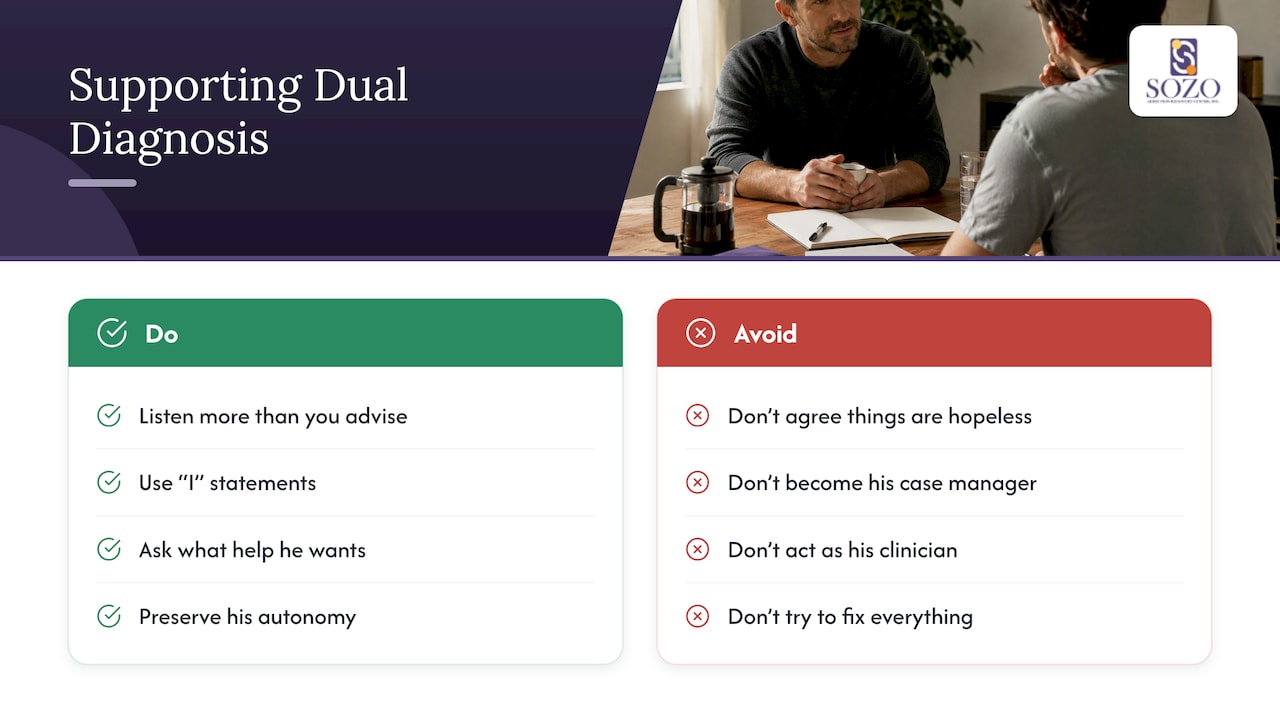
That last phrase is worth remembering. You are his brother, father, wife, or friend. You are not his clinician, and you do not have to be. Integrated care, in which one team treats substance use and mental health together, exists so that the whole weight does not fall on the household. Our dual diagnosis and personalized care page explains how we approach that.
Our perspective
We have sat across the table from many families who arrived worn down by years of trying to help. Almost all of them were not careless. They were loving people who had been covering, paying, and explaining for so long that it felt like the only way to keep the family together.
What we see again and again is that a man begins to change when two things are true at once: he is fully loved, and he is no longer protected from the truth. Love without honesty can become a soft cushion over the problem. Honesty without love can become a wall. Recovery tends to grow in the space where both are present.
That is why our program is built around the whole man. We combine Christian principles and the 12-step model with dual diagnosis care, and we shape each plan around the ASAM Continuum so that the level of care fits where he is today. Faith gives him humility and a reason to hope. Clinical care gives him the tools to understand what has been driving his use. Community gives him people who walk beside him without carrying him.
Families have a role in this, and it is a meaningful one. It is not to manage his recovery. It is to stand in the doorway with open arms and a steady voice, and to say: “I believe you can do this, and I will be here when you do the work.”
Ty
How SOZO can help when he is ready
Once a man is willing to take a step, the question becomes what kind of care fits. At SOZO Recovery Center in Hot Springs, Arkansas, we offer faith-based treatment for men, including residential treatment, partial hospitalization, intensive outpatient, outpatient, sober living, and referrals for medical detox placement. Each plan is personalized, informed by the ASAM Continuum, and designed to treat addiction and co-occurring mental health needs together.
Families are part of the conversation from the start. If you are trying to understand what is available, our family support for men in rehab page explains how loved ones stay connected in healthy ways, and you can reach out through our main site to talk with our admissions team about what level of care may fit. We will talk about funding options, including private pay and private insurance, when you call.
FAQ
Are support and enabling the same thing?
No. Support encourages a person to take active steps in recovery, while enabling protects him from the full consequences of his choices and lets the pattern continue. Both often come from love, which is why they are easy to confuse. The difference shows up in the outcome: more ownership for him, or less.
How can I be supportive but not enabling?
Talk with him when he is sober, name specific concerns, and say that you love him and want to help. Encourage treatment, offer to help him find it, and say what you will do if use continues. Then follow through. Keep your help pointed at recovery, such as rides to appointments, rather than at removing consequences.
Am I being supportive or enabling?
Ask whether your action helps him keep using or helps him get help. If it hides, excuses, pays for, or smooths over the results of substance use, it is likely enabling. If it connects him to treatment, honest conversation, or healthy time together, it is likely support.
Does setting a boundary mean I do not love him?
No. A boundary protects what is yours to carry while keeping the door to the relationship open. Health agencies encourage families to avoid guilt, to avoid controlling his use, and to care for themselves, because a depleted family cannot help anyone. Many men later say the clear, calm limits were what finally got their attention.
Who should I talk to about my own situation?
Your own counselor, your doctor, or a family support group is a good place to start. If you are unsure about the right level of treatment for him, an addiction treatment provider can assess his needs and explain options. Our team is glad to talk with families at any stage.
Sources
- Helping vs. Enabling: What’s the Difference? (Psych Central)
- Alcohol and Drug Use Disorders and Relationships (U.S. Department of Veterans Affairs)
- Helping or enabling a loved one with substance use (Psychology Today)
- Signs You’re Enabling a Loved One’s Addiction (WebMD)
- Helping a loved one with a drinking problem (MedlinePlus)
- When family involvement helps and when it complicates addiction care (AIHCP)
- The first 90 days of addiction recovery (Supporting Wellness)