


If you are looking for rehab in Arkansas without insurance, the fastest path is to call the Arkansas Department of Human Services helpline or your nearest Community Mental Health Center and ask for an intake assessment. That assessment is the gateway to state-funded treatment slots, referrals, and other funding routes covered below.
TL;DR:
- State-funded treatment slots are available for uninsured residents through DHS and community mental health centers, but waitlists can be lengthy and require persistence.
- Medicaid and ARHOME plans differ in coverage, with ARHOME offering broader access to residential care, but eligibility and approvals must be confirmed in writing before admission.
- County opioid settlement funds and faith-based programs sometimes provide additional free or low-cost treatment options outside the DHS pathway.
- The initial assessment determines the appropriate level of care and funding source; always request written confirmation of what is authorized and covered.
- Reaching out with no insurance involves multiple pathways, and verifying funding details in writing reduces the risk of promises falling through during treatment placement.
Table of Contents
- State-funded options through Arkansas DHS and community mental health centers
- Step-by-step access checklist: what to do from first call to placement
- Medicaid, ARHOME, and coverage limits that affect residential care
- Other low-cost routes: grants, settlement funds, and faith-based placements
- What to expect at intake and why the assessment matters
- How SOZO Recovery Center fits into Arkansas pathways for men without insurance
- A word of encouragement before you make the call
- If a faith-based Arkansas option fits, SOZO is ready to talk
- Sources
- FAQ
State-funded options through Arkansas DHS and community mental health centers
The Arkansas Department of Human Services, through its Office of Substance Abuse and Mental Health, funds treatment providers across eight catchment areas statewide. This structure exists so that a man in Hot Springs and a man in Jonesboro both have a designated public provider network to call, regardless of what county they live in. According to DHS OSAMH, uninsured and underinsured residents can access these providers, with a particular focus on opioid use disorder and broader substance use disorder care.
Community mental health centers within each catchment area typically offer:
- Outpatient counseling and medication services for substance use and co-occurring mental health conditions.
- Crisis intervention and same-day assessment for people in acute need.
- Some state-funded residential and intensive treatment slots, subject to availability.
DHS guidance is direct on the first step: once you identify a provider, you schedule an appointment to meet with a therapist and talk through your needs, and that conversation determines which services fit you. To start that process, call the Arkansas DHS helpline at 1-844-763-0198 or email treatment@dhs.arkansas.gov. Expect standard weekday business hours, and expect to be asked basic questions about your location and your substance use history before you are matched to a catchment area provider.
Step-by-step access checklist: what to do from first call to placement
Getting from a phone call to an actual bed or outpatient slot takes some persistence. Following a clear sequence keeps you from losing weeks to confusion or repeated intake paperwork.
- Call the DHS helpline or your local community mental health center and ask directly for an assessment and a catchment area referral.
- Bring identification, proof of Arkansas residency, a brief summary of your substance use history, and current contact information to that first appointment.
- Ask admissions specifically whether state-funded slots, sliding-scale fees, or scholarship beds exist, and how their waitlist works.
- Request written confirmation of any funding commitment before you count on it.
- Write down who you spoke with, when, and what your next appointment is, then escalate to a supervisor or a DHS case manager if a waitlist stretches on without movement.
A written confirmation matters more than it might seem. Verbal promises about funding tend to evaporate when a different staff member handles your file later, and a signed or emailed confirmation gives you something to reference if a placement falls through.
Medicaid, ARHOME, and coverage limits that affect residential care
Arkansas runs two different Medicaid pathways that matter here. Traditional fee-for-service Medicaid covers a defined set of behavioral health services, but historically had real limits on adult residential addiction treatment. ARHOME, Arkansas’s Section 1115 Medicaid demonstration, uses qualified health plans to cover adults up to 138% of the federal poverty level, and this structure can open access to a broader continuum of care, including some residential placements, compared with fee-for-service Medicaid alone.
A federal rule known as the IMD exclusion has historically limited how Medicaid can pay for adult residential care in larger inpatient behavioral health facilities, which is part of why ARHOME’s plan-based structure matters for men trying to access residential treatment.
Before you assume a facility takes Medicaid or ARHOME, ask:
- Which payer, specifically, will cover this placement: traditional Medicaid, an ARHOME plan, or a state-funded slot.
- Whether the exact level of care you need, such as residential or partial hospitalization, is one that payer covers.
- For written authorization confirming the funding before you show up expecting a bed.
The OSAMH FAQ outlines services available to Medicaid clients, including partial hospitalization, therapeutic communities, supportive housing, and peer aftercare support, which gives you concrete language to use when asking a provider what your plan actually covers.
Other low-cost routes: grants, settlement funds, and faith-based placements
State funding is not the only door. Arkansas has distributed opioid settlement money to counties for treatment beds, recovery housing, and local recovery organizations, and some of that funding has created placement opportunities outside the standard DHS pipeline. Calling your county health department or a local recovery organization can surface options that never show up in a general online search.
Faith-based and nonprofit residential programs are another route worth pursuing directly:
- Ask admissions whether the program accepts residents regardless of ability to pay, or whether it holds charity or scholarship slots.
- Ask whether any beds are funded through opioid settlement partnerships or philanthropic donors rather than insurance billing.
- Ask whether the facility will hold a bed for you while a state or Medicaid authorization is still being processed.
Pro Tip: Ask every admissions coordinator the same direct question: “If I have no insurance and no cash, what happens next?” The answer reveals whether a program has a real no-cost pathway or is simply not equipped to help you.
What to expect at intake and why the assessment matters
Your intake assessment typically includes a medical screening and a clinical evaluation using an ASAM-style level of care determination, which looks at your substance use history, physical health, and any co-occurring mental health symptoms.
- This assessment decides whether you are placed in detox, residential, partial hospitalization, or outpatient care.
- The level of care assigned often determines which funding source applies, since state slots and ARHOME plans do not cover every level equally.
- Before you leave intake, ask for written confirmation of what was approved and by which funding source, and ask how to appeal or follow up if a request is initially denied.
How SOZO Recovery Center fits into Arkansas pathways for men without insurance
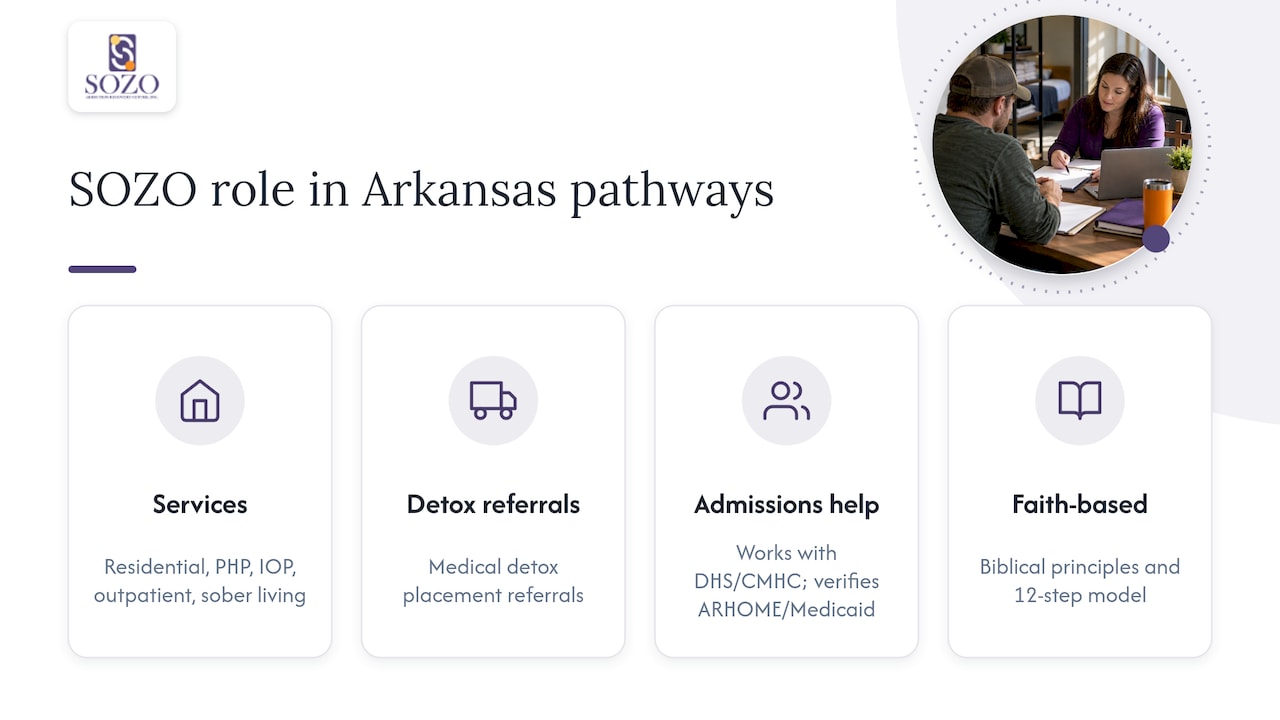
SOZO Recovery Center, located in Hot Springs, is a faith-based men’s treatment center offering residential treatment, partial hospitalization, intensive outpatient, outpatient care, sober living, medical detox placement referrals, and dual diagnosis care. Admissions staff can work alongside a DHS or CMHC referral, help verify ARHOME or Medicaid benefits for the specific level of care you need, and discuss scholarship or donation-assisted placement when it applies. For men who want treatment built around biblical principles and the 12-step model rather than a purely clinical setting, SOZO offers that combination directly through its personalized care programs.
A word of encouragement before you make the call
Reaching out when you have no insurance and no clear plan takes real courage, and multiple pathways exist even when the first call does not pan out. Get every funding decision in writing, no matter who is making the promise.
Ty
If a faith-based Arkansas option fits, SOZO is ready to talk
Once you have explored DHS, Medicaid, ARHOME, and local grant options, a faith-based residential setting is worth a direct conversation if you want recovery grounded in biblical principles alongside clinical dual diagnosis care.
SOZO Recovery Center’s admissions team can walk through your situation, verify what ARHOME or Medicaid will cover for your level of care, and explain how residential treatment works in a small, retreat-like setting in Hot Springs. Reach out to start that conversation and find out what a personalized plan looks like for you.
Sources
This article is general information, not a substitute for advice from a qualified doctor. Consult a qualified healthcare professional about your own circumstances before acting on anything here.
FAQ
Can you go to rehab if you have no insurance?
Yes. Arkansas residents without insurance can access state-funded treatment through DHS-designated providers, community mental health centers, ARHOME plans, sliding-scale programs, and faith-based or nonprofit placements. An intake assessment is usually the first step toward any of these routes.
What drives the total cost of rehab in Arkansas?
Cost depends on the level of care needed, such as detox, residential, or outpatient, and on which funding source applies, whether that is a state-funded slot, ARHOME coverage, or private pay. Asking admissions to confirm the payer and level of care in writing before starting treatment helps you understand what, if anything, you will owe.
How do I find funding for drug rehab?
Start with the Arkansas DHS helpline for state-funded slots and referrals, then ask about ARHOME or Medicaid coverage for your specific level of care. County opioid settlement funds and faith-based or nonprofit scholarship placements are additional routes worth calling about directly.
Do you have to pay to go to rehab?
Not always. Programs funded through DHS, ARHOME, Medicaid, or opioid settlement partnerships can cover part or all of treatment for eligible Arkansas residents, and some faith-based programs offer charity-funded placements. Always confirm the funding arrangement in writing before assuming a program is free or paid.