


When a craving hits, name it, rate its intensity, and ride it out for 5 to 15 minutes using a plan you already prepared. Cravings behave like a wave. They build, peak, and fall, whether or not a man acts on them. The techniques that hold up under real research, cognitive reappraisal, urge surfing, grounding, and in some cases medication, work because they help a man outlast the peak instead of fighting it.
TL;DR:
- Cravings follow a wave pattern, peaking within minutes and weakening with repeated non-use, making outlasting the peak an effective strategy.
- Recognizing specific external and internal triggers through logging helps tailor avoidance and coping plans to individual patterns.
- Evidence supports techniques like cognitive reappraisal, urge surfing, grounding, and medication as effective ways to manage cravings.
- Building and rehearsing an urge toolkit with contacts, distraction methods, and personal reasons before cravings occur increases the chances of successful management.
- Persistent cravings beyond one hour, linked to withdrawal or mental health issues, require professional intervention and potentially structured clinical care.
Table of Contents
- What Coping With Cravings Actually Means (And Why the Wave Passes)
- How to Recognize Your Cravings Triggers
- Which Craving Management Techniques Actually Have Evidence Behind Them?
- How to Build an Urge Toolkit for the Moments That Matter
- When Do Cravings Signal the Need for Clinical Help?
- How SOZO Recovery Center Supports Long-Term Craving Management
- A Personal Note on Practicing These Skills
- Ready for Structured Support Beyond a Single Craving?
- Sources
- FAQ
What Coping With Cravings Actually Means (And Why the Wave Passes)
A craving is not one sensation. It’s three things layered on top of each other: a thought (“I need this right now”), a feeling (anxiety, restlessness, longing), and a physical response (a racing pulse, tight chest, dry mouth). Each part feeds the others, which is why cravings can feel bigger than they are.
They also follow a pattern. The brain learns to associate certain cues, a bar, a phone call, a bad day at work, with relief, so exposure to that cue fires a craving almost automatically. That’s conditioning, not weakness. Clinical materials from the VA describe cravings as common, predictable, and time-limited: they weaken with repeated non-use rather than growing stronger forever.
The useful image here is a wave. It rises, crests, and breaks, usually within minutes, not hours.
- Cravings typically peak early and decline on their own if a man doesn’t act on them.
- Physical intensity fades faster than the mental replay of the craving.
- Riding out one wave measurably weakens the next one over time.
How to Recognize Your Cravings Triggers
Cravings rarely appear at random. They attach to specific people, places, emotions, or times of day, and once a man can name his own pattern, he can plan around it instead of getting ambushed by it.
- Separate external triggers from internal ones. External triggers are outside events: a specific bar, a former using buddy, payday, a particular playlist. Internal triggers are states: loneliness, boredom, anger, even excitement or celebration.
- Log every craving for one to two weeks. Note the time, the intensity on a 1 to 10 scale, what triggered it, and how he responded. Four columns are enough. Complexity kills follow-through.
- Look for repeats. Most men find their cravings cluster around two or three specific situations, not a dozen. That’s the actual target.
This kind of tracking mirrors the recognize, avoid, and cope framework built into NIAAA’s clinical worksheets. Recognizing a pattern lets a man avoid what’s avoidable and prepare a specific response for what isn’t.
Which Craving Management Techniques Actually Have Evidence Behind Them?
Not every coping technique carries the same weight of research, and it matters which ones a man leans on when the stakes are sobriety.
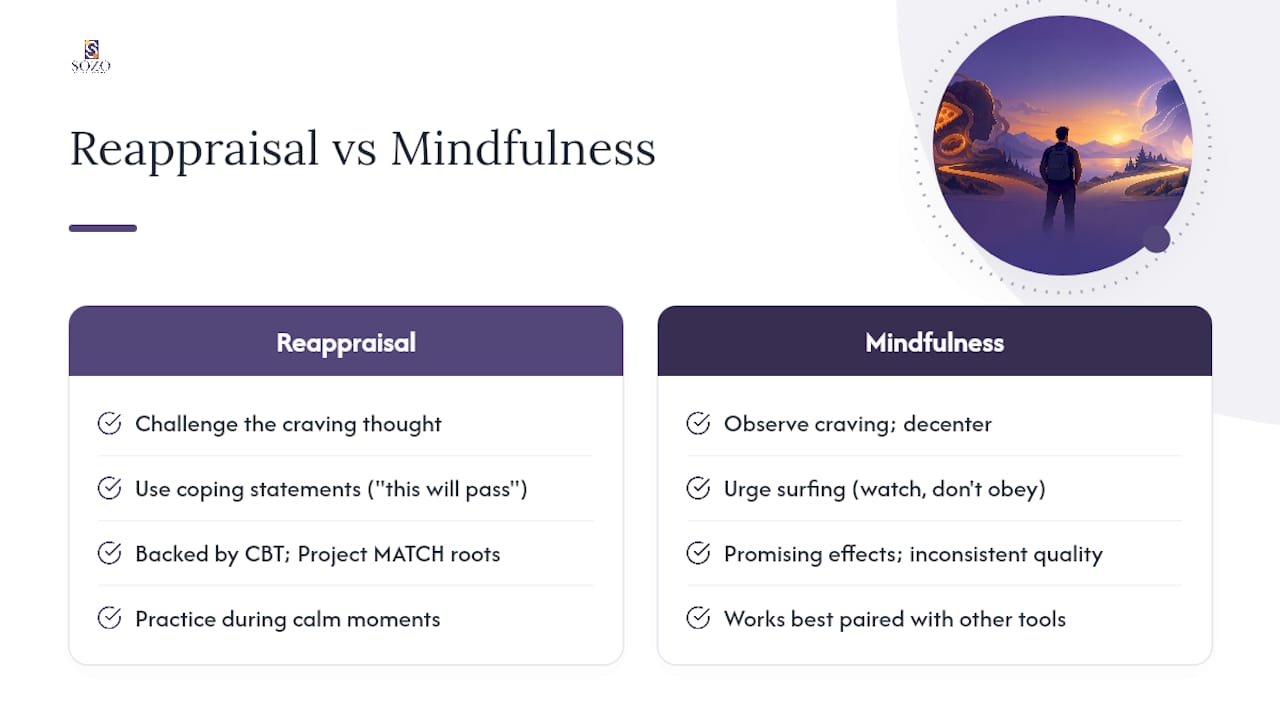
Cognitive reappraisal, a core piece of cognitive behavioral therapy, teaches a man to challenge the thought driving the craving instead of accepting it as fact. Coping statements (“this will pass in ten minutes, and I’ve done this before”) interrupt the automatic thought loop. This approach traces back to structured CBT skills training in Project MATCH, which remains a foundation for craving-focused therapy.
Mindfulness and urge surfing ask a man to observe the craving instead of obeying it, a process researchers call decentering: seeing an urge as a passing mental event rather than a command. A systematic review and meta-analysis found mindfulness-based interventions show promising effects on craving, but results are inconsistent and evidence quality ranges from low to mixed. That doesn’t make it useless. It means mindfulness works best paired with other tools, not relied on alone.
Distraction and grounding buy time. A short walk, a cold glass of water, calling someone from a support list, or the 5-4-3-2-1 senses exercise all pull attention away from the craving during its peak minutes.
Medication-assisted treatment (MAT) deserves a place in this list, especially for alcohol, opioid, or nicotine use disorders. FDA-approved medications can reduce craving intensity directly, and a prescriber can evaluate whether MAT fits a man’s specific situation.
A randomized trial of Regulation-of-Craving Training found that daily smokers who practiced mindfulness- or reappraisal-based skills in the presence of real cues showed large reductions in cue-induced craving compared to controls. Practice with real triggers, not just imagined ones, appears to matter.
Pro Tip: Don’t wait for a craving to test a new coping skill for the first time. Practice reappraisal or grounding during a calm moment so it’s already familiar when the pressure is on.
How to Build an Urge Toolkit for the Moments That Matter
An urge toolkit is a short, physical or written list a man keeps ready before a craving ever starts, not something he tries to improvise mid-crisis.
- Assemble the toolkit now. Include two or three phone numbers (sponsor, accountability partner, sober friend), a short list of distraction options, a written grounding script, and a “reasons to stay sober” card with two or three specific, personal reasons.
- Name it. When a craving hits, say to himself, “this is a craving, not an emergency.”
- Rate it. Score the intensity 1 to 10. Most cravings that reach an 8 will drop to a 3 or 4 within ten minutes if nothing feeds them.
- Run one short strategy. Grounding, a walk, a call, or a coping statement, held for 5 to 15 minutes.
- Escalate if it doesn’t fade. Call a support contact or a clinician if intensity stays high past 20 minutes or comes with thoughts of self-harm.
Pro Tip: Rehearse this exact sequence when you’re calm, maybe once a day for a week. A prepared response used under pressure works far better than one invented on the spot, because decision-making narrows during the peak of a craving.
When Do Cravings Signal the Need for Clinical Help?
Most cravings respond to the strategies above. Some don’t, and recognizing the difference protects a man from white-knuckling something that needs real clinical support.
- Cravings that don’t fade after 30 to 60 minutes despite active coping efforts.
- Repeated near-misses or actual relapse despite consistent use of coping tools.
- Cravings tied to withdrawal symptoms, tremors, seizures, or severe physical distress.
- Cravings that intensify alongside depression, anxiety, or suicidal thoughts.
That last point matters more than it might seem. SAMHSA’s guidance on integrated care makes clear that cravings often worsen when a co-occurring mental health condition goes untreated. Treating the addiction alone, without addressing the anxiety or depression fueling it, leaves the craving cycle intact. Integrated care treats both at once. For some substances, a prescriber can also discuss FDA-approved medications as part of that plan, alongside therapy rather than instead of it.
How SOZO Recovery Center Supports Long-Term Craving Management
Cravings don’t stay contained to a single moment. They surface across withdrawal, early sobriety, and years into recovery, which is why structured programs exist at different levels of intensity.
- Residential Treatment provides round-the-clock structure for men whose cravings are frequent or severe enough to need daily clinical support.
- Partial Hospitalization offers full-day treatment while a man returns to his own bed at night.
- Intensive Outpatient and Outpatient programs fit men managing cravings while holding down work or family responsibilities.
- Medical Detox Placement addresses cravings tied to acute withdrawal, under medical oversight.
- Dual Diagnosis care treats co-occurring mental health conditions alongside addiction, consistent with the integrated-care approach SAMHSA recommends.
SOZO builds each plan around the ASAM Continuum model, then layers in the 12-step framework alongside biblical principles, giving a man both a clinical structure and a spiritual one to lean on when a craving tests his resolve.
A Personal Note on Practicing These Skills
Willpower fails under pressure. That’s not a character flaw, it’s how decision-making works when a craving peaks. The men who hold onto sobriety tend to be the ones who rehearsed their response before they ever needed it, not the ones who trusted themselves to improvise. Build the toolkit today, while you’re calm. Read the worksheets once, then practice the sequence like it’s a fire drill.
Ty
Ready for Structured Support Beyond a Single Craving?
Coping skills carry a man through a lot, but some cravings are tied to withdrawal, co-occurring mental health conditions, or a pattern that keeps repeating despite real effort. That’s where structured, clinical care changes the outcome. Some treatment programs offer faith-based men’s addiction recovery that pairs ASAM-informed planning with the 12-step model and spiritual principles, often in a small, retreat-like setting rather than an institutional one.
If cravings are tied to active withdrawal, medical detox placement provides safe, supervised support before any other work begins. If a man needs daily structure and dual diagnosis care, Residential Treatment offers round-the-clock support built around his specific triggers and history. Call SOZO or request an assessment to find out which level of care fits, and take the step from managing cravings alone to managing them with a full team behind you.
This article is general information, not a substitute for advice from a qualified doctor. Consult a qualified healthcare professional about your own circumstances before acting on anything here.
Sources
- How to Stop Alcohol Cravings | Rethinking Drinking | NIAAA
- Mindfulness interventions for craving reduction in substance use disorders and behavioral addictions: systematic review and meta-analysis
- SAMHSA guidance on integrated care for co-occurring disorders
FAQ
How Long Do Cravings Usually Last?
Most cravings peak within minutes and fade significantly within a short period if a man doesn’t act on them, following a wave-shaped pattern rather than building indefinitely. Intensity, not duration, is usually what feels overwhelming.
What Is Urge Surfing?
Urge surfing is a mindfulness technique where a man observes a craving as a temporary sensation, like a wave, rather than a command he has to obey. It relies on decentering, and while research shows promise, results vary enough that it works best combined with other coping strategies.
What Should Go in an Urge Toolkit?
An urge toolkit should include emergency contacts, a short list of distraction activities, a written grounding script, and a personal reasons-to-stay-sober card. Build and rehearse it while calm, since decision-making narrows during an actual craving.
When Should Someone Get Professional Help for Cravings?
Seek clinical support when cravings persist past an hour despite active coping, when they’re tied to withdrawal symptoms, or when they intensify alongside depression, anxiety, or suicidal thoughts. Programs like SOZO’s Residential Treatment and Dual Diagnosis care address these situations directly.
Does SOZO Recovery Center Treat Co-Occurring Mental Health Conditions?
Yes. SOZO’s Dual Diagnosis programming treats mental health conditions alongside addiction using personalized, ASAM-informed plans, consistent with SAMHSA’s recommendation for integrated care. Details are available on the personalized care page.