


Biblical counseling centers Scripture, prayer, and discipleship toward Christlike character; licensed clinical therapy centers diagnosis, evidence-based treatment, and symptom relief. Choose biblical counseling for spiritual growth, sin struggles, or marriage and life guidance rooted in faith. Choose licensed therapy, or better yet an integrated approach that blends both, when you’re facing clinical depression, addiction, trauma, or any condition that needs medical oversight.
TL;DR:
- Biblical counseling views Scripture as the final authority and aims at heart transformation, making it effective for spiritual, relational, and moral struggles.
- Licensed therapy relies on diagnostic frameworks like DSM-5 and focuses on symptom relief, daily functioning, and medical interventions for serious conditions.
- Both approaches share techniques like active listening and accountability, and religion-adapted cognitive behavioral therapy bridges faith and evidence-based treatment.
- Severe mental health crises, active substance overdose risks, or ongoing symptoms require immediate licensed clinical care and medical oversight rather than biblical counseling alone.
- Credential verification and clear communication about treatment scope, including integration with medical providers, are essential when selecting care aligned with spiritual and clinical needs.
Table of Contents
- Biblical Counseling vs Therapy: What Actually Separates Them
- Where Biblical Counseling and Therapy Actually Overlap
- Does Research Actually Support Faith-Based Approaches?
- When Clinical Therapy Should Come First
- How Do You Choose the Right Counselor or Therapist?
- Where to Find Faith-Aligned Care You Can Trust
- How Did We Get Two Separate Traditions?
- Where Does Each Type of Care Actually Happen?
- How Does Cultural Background Shape the Right Choice?
- What Should You Expect for Privacy and Confidentiality?
- How Do You Know If Either Approach Is Working?
- Publisher Perspective: How SOZO Frames Faith-Integrated Clinical Care
- Sources
- FAQ
Biblical Counseling vs Therapy: What Actually Separates Them
The difference between counseling and therapy in the biblical context comes down to one question: what has final authority over the conversation? Biblical counseling treats Scripture as the primary lens for understanding a person’s struggles. A biblical counselor asks what the Bible says about anger, fear, or lust, and works with a man toward repentance and renewed thinking rooted in his faith. Clinical therapy, by contrast, works from diagnostic frameworks like the DSM-5 and treatment protocols validated through research.
That distinction shapes everything downstream, including how each approach defines a “good outcome.”
- Authority and worldview. Biblical counseling leans on Scripture as the final word on human nature and change. Clinical therapy leans on clinical evidence, assessment tools, and diagnostic criteria developed through research and licensing boards.
- Goals. A biblical counselor is aiming at heart change, repentance, and Christlikeness. A licensed therapist is usually targeting symptom reduction, improved daily functioning, and, where relevant, a documented response to treatment or medication.
- What counts as success. In a biblical counseling relationship, progress looks like growth in humility, restored relationships, and spiritual maturity. In clinical therapy, progress is often tracked with standardized measures such as symptom scales, behavioral changes, or a psychiatrist’s notes on medication response.
Neither framework is wrong. They’re simply built to answer different questions. A man wrestling with pride, resentment toward his father, or a crisis of faith may find exactly what he needs in a biblical counseling relationship. A man showing signs of major depressive disorder, panic attacks that keep him from working, or a substance use disorder needs clinical tools that biblical counseling alone was never designed to provide.
Where Biblical Counseling and Therapy Actually Overlap
The two models aren’t as far apart in practice as their theological starting points suggest. Both rely on listening, relational trust, and structured conversation to help someone change patterns of thought and behavior. A good biblical counselor practices active listening and asks probing questions in ways that would look familiar to any trained therapist.
- Shared techniques. Reflective listening, homework between sessions, and structured accountability show up in both settings.
- Religion-adapted CBT (R-CBT). Licensed clinicians increasingly build religion-adapted cognitive behavioral therapy around a client’s own faith tradition, using Scripture and prayer as tools inside a standard CBT framework rather than setting faith aside.
- Hybrid staffing models. Some treatment centers pair a licensed clinician who will pray with a client if asked with a chaplain or pastoral counselor on staff, creating a referral loop between clinical and spiritual care.
- Clinician training in spiritual competence. Therapists are increasingly trained to assess and respectfully integrate a client’s religious identity into treatment rather than ignore it as irrelevant.
This overlap is exactly why religiously integrated therapy has become one of the fastest-growing niches in Christian counseling methods. It doesn’t force a man to choose between his faith and his clinical needs.
Does Research Actually Support Faith-Based Approaches?
Yes, with real caveats attached. A systematic review and meta-analysis of randomized controlled trials found that religious and spiritual interventions reduced anxiety symptoms, and in some analyses depressive symptoms, compared to control conditions. That’s a meaningful signal that faith-integrated approaches aren’t just emotionally comforting. They can produce measurable clinical benefit for people who hold religious belief as central to their identity.
Religion-adapted CBT explicitly uses a client’s own faith tradition as the foundation for cognitive restructuring, and trial evidence suggests it can perform on par with standard secular CBT for clients who identify as religious.
That finding, drawn from research on religion-integrated CBT, matters because it validates a middle path many Christian men are looking for: therapy that doesn’t ask them to check their faith at the door. Still, the same body of research flags heterogeneity across studies, meaning results vary depending on the population, the protocol, and how faith was actually incorporated. Is biblical counseling effective on its own for every condition? The honest answer is that it depends heavily on what’s being treated.
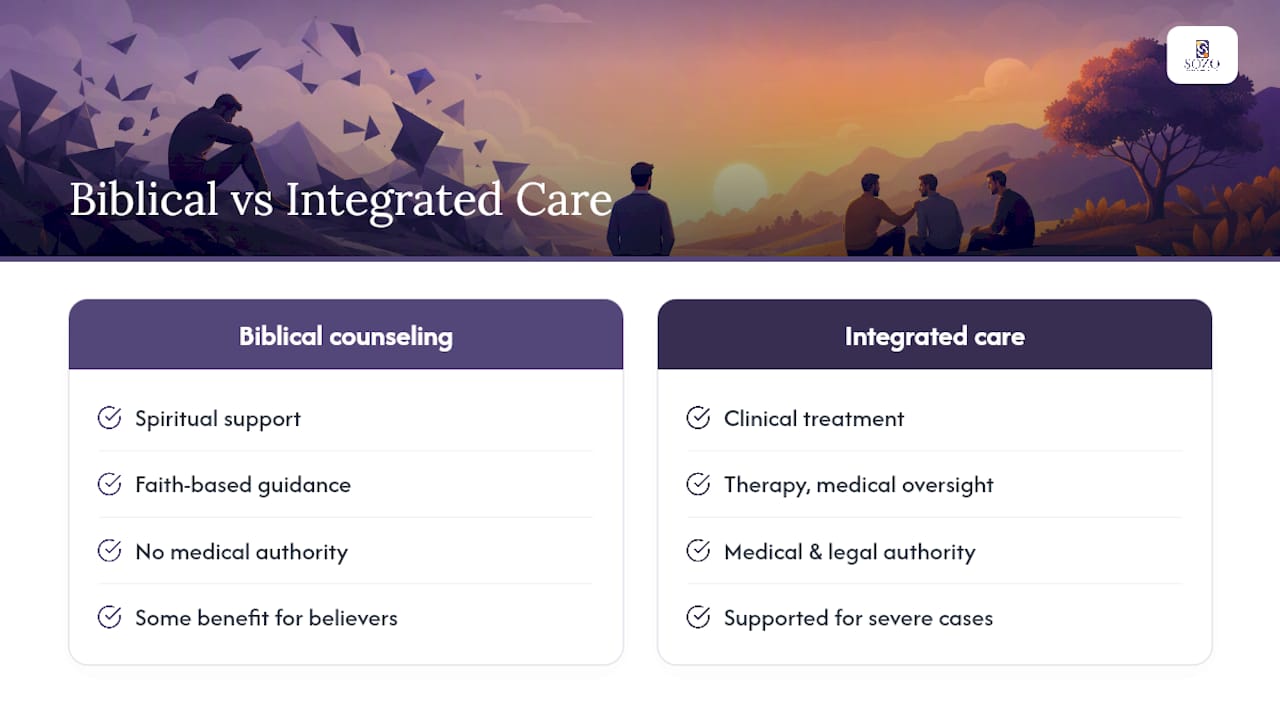
Here’s where the line has to be drawn firmly. SAMHSA’s clinical guidance is direct on this point: for severe substance use and co-occurring mental health disorders, integrated clinical care involving therapy, medical oversight, and medication where indicated is the standard of care. Spiritual support is complementary to that care. It was never designed to replace medical detox, medication-assisted treatment, or psychiatric management. A biblical-only counselor, however well-intentioned, typically lacks the clinical training and legal authority to manage a psychiatric emergency or a medical withdrawal.
When Clinical Therapy Should Come First
Some situations call for licensed care without delay, and recognizing them quickly can be the difference between a hard season and a genuine crisis.
- Suicidal ideation, psychosis, or severe self-harm. These require immediate evaluation by a licensed clinician or emergency services, not a counseling appointment scheduled for next week.
- Mania or an inability to function. If a man can’t hold down basic responsibilities, sleep, or think clearly, the issue has moved past what conversation alone can resolve.
- Active substance use with overdose risk. Situations involving medical detox, withdrawal risk, or a need for medication-assisted treatment (MAT) require an integrated clinical team, not solo pastoral support.
- Longstanding or worsening symptoms. Depression or anxiety that hasn’t budged after months of prayer and counseling is a signal, not a failure of faith.
- Legal or safety issues. Situations involving domestic violence, child safety, or court-ordered treatment need documentation and licensed oversight that biblical counseling settings usually don’t provide.
Pro Tip: If you’re unsure whether a struggle has crossed into clinical territory, ask whether it’s affecting sleep, work, or physical safety for more than two weeks straight. That’s usually the threshold where a licensed evaluation is worth scheduling.
How Do You Choose the Right Counselor or Therapist?
Start by verifying credentials before you verify chemistry. A licensed professional counselor, licensed clinical social worker, or psychologist has completed state licensure requirements and ongoing continuing education. A biblical counselor may hold a certification through a training body like the Association of Certified Biblical Counselors, which is valuable but is not the same as a state clinical license and doesn’t carry the same legal scope of practice.
- Ask directly how faith gets integrated: is it through Scripture reading, prayer during sessions, or referral to a pastor when spiritual questions arise?
- Ask about the provider’s policy on proselytizing versus client-led faith conversations.
- Confirm whether the provider treats co-occurring disorders or only refers out when clinical complexity appears.
- Ask whether the provider coordinates with a prescribing physician or psychiatrist when medication is part of the picture.
- Ask what the provider’s emergency plan looks like if a crisis happens between sessions.
On your first call, ask these questions directly:
- “What’s your license or certification, and what does it allow you to treat?”
- “How do you handle a client who needs medication or medical detox?”
- “What does a typical session actually look like?”
- “Do you have a referral relationship with a clinical team if my needs go beyond what you offer?”
A vague answer to any of those four is a red flag worth taking seriously.
Where to Find Faith-Aligned Care You Can Trust
Finding faith-based therapy options that are both clinically sound and spiritually grounded takes a bit more digging than a basic search, but the paths are well established.
- State licensure lookup. Every state licensing board maintains a searchable database confirming whether a therapist’s license is active and in good standing.
- The Association of Certified Biblical Counselors (ACBC). This organization trains and certifies biblical counselors and maintains a directory searchable by region.
- Christian counseling networks. Directories built specifically around Christian therapy approaches let you filter by denomination, specialty, and whether the provider holds a clinical license.
- Telehealth platforms. Several national telehealth directories now let you filter specifically for religion-adapted therapists, useful if local options are limited.
- Integrated treatment programs. For addiction or dual-diagnosis needs, look for programs that combine faith-based recovery with licensed clinical staff rather than choosing a purely pastoral or purely secular option.
The safest bet, especially for men facing addiction alongside mental health struggles, is a program built to handle both realities at once rather than forcing a choice between a church basement and a clinical office.
How Did We Get Two Separate Traditions?
Biblical counseling traces its modern form to the nouthetic counseling movement launched by Jay Adams in the 1970s, which pushed back against what Adams saw as an overreliance on secular psychology inside the church. That movement grew into the broader biblical counseling field, formalized through training bodies and seminary programs that still shape how pastors and lay counselors are trained today.
Secular therapy has a longer and more layered history, stretching from Freud’s psychoanalytic theory through behaviorism, humanistic psychology, and the rise of cognitive behavioral therapy in the 1960s and 1970s. Licensure requirements, state boards, and formal graduate training standards developed over the 20th century to professionalize the field and protect patients.
The two traditions developed largely in parallel and, for decades, in tension. Christian counseling methods that blend both worlds are a relatively recent development, gaining real traction only as research on religion-adapted CBT matured enough to give clinicians a validated way to build faith into evidence-based protocols instead of treating the two as competitors.
Where Does Each Type of Care Actually Happen?
Biblical counseling most often happens inside a church building, a pastor’s office, or a dedicated counseling ministry attached to a congregation. Sessions are frequently free or offered on a donation basis, and the counselor is usually known to the client through church community, which shapes the relationship differently than a clinical intake ever could.
Licensed clinical therapy happens in a wider range of settings: private practice offices, hospital outpatient departments, community mental health centers, and increasingly, telehealth platforms accessed from home. Insurance coverage, session length, and documentation requirements are far more standardized across these settings because of licensing and reimbursement rules.
Faith-integrated clinical care sits in its own category, usually found in dedicated treatment centers or private practices where licensed clinicians build spiritual formation directly into a structured clinical program. Men dealing with addiction alongside a faith commitment often find this setting the most workable, since it doesn’t ask them to leave either part of their identity at the door.

How Does Cultural Background Shape the Right Choice?
A man’s cultural and denominational background often predicts which model he’ll trust before he ever sits down for a first session. Men from traditions that emphasize pastoral authority and church community, common in many evangelical and Pentecostal congregations, frequently feel more comfortable starting with a biblical counselor who shares their theological language. Men from backgrounds with more skepticism toward clergy involvement in personal struggles, or from traditions less centered on a single congregation, often gravitate toward licensed clinical care first.
Cultural attitudes toward mental illness itself play a role too. In some communities, seeking a therapist still carries stigma that seeking a pastor doesn’t, which can delay men from getting clinical help even when they need it. In others, biblical counseling gets dismissed as unqualified or overly simplistic, which can push men away from an approach that might have genuinely helped with a spiritual or relational struggle. Effective care usually means finding a provider, clinical or pastoral, who understands the client’s cultural framework well enough not to fight it unnecessarily.
What Should You Expect for Privacy and Confidentiality?
Licensed therapists operate under strict legal confidentiality standards, most notably HIPAA, with clearly defined exceptions for imminent harm to self or others, abuse reporting, and court orders. Clients know, in writing, exactly what stays private and what doesn’t.
Biblical counseling confidentiality expectations vary far more by setting. A counselor operating inside a formal counseling ministry may follow written confidentiality policies similar to clinical standards. A pastor offering informal counsel may not, and information shared in a small church community can sometimes travel further than a client expects, whether through prayer requests, accountability structures, or simple overlap in social circles. It’s worth asking directly, before the first real conversation, exactly who else might learn what’s shared.
How Do You Know If Either Approach Is Working?
Biblical counseling typically measures progress through changes that are harder to quantify on a chart: growth in humility, repentance from a specific sin pattern, restored trust in a marriage, or a renewed sense of purpose rooted in faith. These outcomes matter deeply to the men experiencing them, even though they resist the kind of standardized measurement clinical research demands.
Clinical therapy leans on structured outcome measures: standardized symptom scales for depression and anxiety, documented changes in behavior, and, where medication is involved, a prescriber’s assessment of response over time. This is part of why clinical research can produce the kind of evidence cited in reviews of religious and spiritual interventions and why clinical settings can track outcomes across large groups of patients in ways a church counseling ministry generally can’t.
The most honest answer for many men is that both kinds of progress matter, and neither one alone tells the whole story of recovery or healing.
Publisher Perspective: How SOZO Frames Faith-Integrated Clinical Care
A faith-based recovery center can exist in the space between a church counseling office and a clinical treatment facility, blending spiritual and clinical approaches. Our model layers biblical principles and 12-step recovery elements on top of dual-diagnosis care informed by the ASAM Continuum, because we’ve seen that men rarely need to choose between spiritual renewal and clinical rigor when both are handled by people trained to hold them together.
Biblical counseling alone can carry a man a long way through a season of doubt or a relational conflict. But when addiction and co-occurring mental health struggles are in the picture, that’s the moment for an integrated program with licensed clinical staff, medical oversight, and a faith foundation that doesn’t get set aside. If that describes where you or someone you love stands right now, our team can walk you through what personalized dual-diagnosis care at SOZO actually looks like, starting with a conversation about your specific situation.
Ty
This article is general information, not a substitute for advice from a qualified doctor. Consult a qualified healthcare professional about your own circumstances before acting on anything here.
Sources
- SAMHSA evidence-based practices kit (integrated care and safety guidance)
- Religion-adapted cognitive behavioral therapy: a review and description of techniques
- Duke research on religion-integrated CBT (RCBT) trial summary
FAQ
What Does the Bible Say About Getting Therapy?
Scripture doesn’t prohibit clinical therapy, and many pastors point to passages on wise counsel, such as Proverbs’ repeated emphasis on seeking counsel, as support for pursuing qualified help of any kind. Most Christian leaders view licensed therapy as a legitimate tool God can use alongside prayer and Scripture, not a replacement for faith.
What Are the Key Elements of Biblical Counseling?
Biblical counseling typically centers on Scripture as the primary authority, prayer, identifying sin or thought patterns needing repentance, accountability within a faith community, and a goal of Christlike character change. Definitions of a specific numbered framework vary by training organization, so the exact list depends on which ministry or model a counselor was trained under.
Is Therapy or Biblical Counseling Better?
Neither is universally better. Biblical counseling tends to fit spiritual, relational, or life-guidance struggles, while licensed clinical therapy fits diagnosable conditions, severe symptoms, or situations needing medication and medical oversight, with religion-adapted therapy offering a middle path for many Christian clients.
What Are the Common Criticisms of Biblical Counseling?
Critics point out that many biblical counselors lack clinical training to recognize or manage serious mental illness, medical emergencies, or medication needs. Confidentiality standards can also be inconsistent compared to licensed practice, and some critics argue certain biblical counseling models can minimize legitimate clinical conditions as purely spiritual failures.
Is Biblical Counseling Effective for Serious Mental Health Conditions?
Biblical counseling can be effective for spiritual and relational struggles, but it isn’t designed to manage severe conditions like psychosis, mania, or active addiction requiring medical detox. For those situations, SAMHSA’s guidance points toward integrated clinical care as the standard, with faith support running alongside it rather than replacing it.