


Christian support groups for addiction offer free, faith-centered peer support through networks like Celebrate Recovery, the Dunamis Initiative, and Recovery-Through Christ. These groups provide fellowship, prayer, and 12-step structure, but they are not licensed treatment. If withdrawal risk, mental illness, or dual diagnosis is part of the picture, pair a group with clinical care through a rehab center or licensed counselor.
TL;DR:
- Christian support groups are peer-led and focus on community and prayer, not licensed medical treatment or medication management.
- Groups like Celebrate Recovery and Recovery-Through Christ offer faith-based 12-step programs, but cannot address withdrawal symptoms or mental health crises.
- Signaling the need for clinical care includes severe withdrawal, suicidal thoughts, psychosis, or ongoing psychiatric medication requirements.
- Families should support loved ones by offering encouragement, transportation, and education, while maintaining boundaries and avoiding enabling relapse.
- Combining faith-based community support with professional clinical treatment improves recovery outcomes, especially for co-occurring mental health and substance use disorders.
Table of Contents
- What Christian Support Groups Are and Who They Serve
- Major Christian Recovery Models and Networks to Look For
- How to Find, Evaluate, and Safely Join a Group
- When a Peer Support Group Is Not Enough
- How Families Can Support Someone in a Christian Recovery Group
- A Clinical View From SOZO on Faith Groups and Treatment
- Faith-Based Treatment Options When You Need More Than a Support Group
- Sources
- FAQ
What Christian Support Groups Are and Who They Serve
A Christian support group is lay-led, Scripture-rooted peer support, usually built around a 12-step framework adapted to explicitly Christian language and practice. Volunteers who have walked through their own recovery lead most meetings, not therapists or physicians. That distinction shapes everything about what these groups can offer.
Men and women turn to these groups for a wide range of struggles, not just drinking or drug use:
- Substance use and chemical dependency
- Codependency and relationship patterns
- Pornography and sexual compulsions
- Compulsive behaviors like gambling or overeating
- Grief, anxiety, and unresolved trauma
What they don’t offer matters just as much as what they do. Church-based recovery groups are typically free, lay-led peer-support gatherings rather than licensed clinical treatment programs, and most say so plainly on their websites. There’s no medical detox happening in a church fellowship hall, and no one running these meetings is prescribing medication or diagnosing a psychiatric disorder. That’s by design. Peer groups exist to surround people with community, accountability, and prayer, not to replace a treatment plan a physician or licensed counselor would write.
Major Christian Recovery Models and Networks to Look For
A handful of established networks account for most of the faith-based recovery ministries operating in American churches today. Knowing the differences helps you pick one that matches your theology, your schedule, and how much structure you want.
- Celebrate Recovery. The largest and most recognized name in the space. Celebrate Recovery reports more than 35,000 churches worldwide and an estimated 7 million-plus participants, with most locations now offering hybrid meetings that combine in-person gatherings with Zoom access.
- Recovery-Through Christ. A curriculum-driven model built for congregations that want depth over speed. Recovery-Through Christ provides a Christ-centered 12-step curriculum with leader training, including intensive nine-month studies and a preparatory “Step Zero” phase before participants begin formal step work.
- The Dunamis Initiative. Distinct for its clinical grounding. The Dunamis Initiative combines Christian 12-step resources with clinical insight from addiction medicine practitioners, which makes it a useful bridge for people who want faith language alongside a program shaped by someone with medical training.
- New Life and other church-run groups. Many congregations run their own recovery ministries using starter kits and leader guides supplied by larger networks, letting a church launch a group even without an existing local chapter nearby.
How to Find, Evaluate, and Safely Join a Group
Finding a group takes less effort than most people expect, but a few checks up front save you a wasted first visit.
- Search the organization’s own finder tool. Look up “Celebrate Recovery group finder” or check a network’s “Find a Group” page directly rather than relying on a general search engine, since directories go stale fast.
- Confirm the format before you go. Ask whether the meeting is open-share, step-work focused, or both, and whether it offers gender-specific or family-inclusive sessions.
- Check for hybrid access. Many church-based recovery groups now run hybrid meetings pairing in-person worship and testimony with online breakout rooms, so a group two towns over may still be reachable from your living room.
- Ask about confidentiality and referral practices. A well-run lay group will tell you upfront how it handles disclosures and who it refers out for medical or mental health concerns.
- Plan your first visit. Bring a support person if you can, expect a large-group worship or testimony time followed by smaller breakout groups, and don’t hesitate to ask about childcare or accessibility before you commit.
Pro Tip: Call or email the group leader before your first visit. A two-minute conversation about what to expect removes most of the anxiety that keeps people from walking through the door at all.
When a Peer Support Group Is Not Enough
Peer support and licensed clinical care solve different problems, and confusing the two can be dangerous. A support group gives you community, accountability, and shared faith. It does not give you medication management, a psychiatric evaluation, or supervised detox. Most Christian support groups are peer-led lay ministries that explicitly advise they are not a substitute for licensed medical or mental health professionals, particularly when a dual diagnosis is involved.
Certain signs mean it’s time to look past the group and toward clinical evaluation:
- Physical withdrawal symptoms, including tremors, seizures, or severe nausea
- Suicidal thoughts or a specific plan to harm oneself
- Symptoms of psychosis, severe mania, or a mood disorder spiraling out of control
- A need for ongoing psychiatric medication management
The Dunamis Initiative combines Christian 12-step resources with clinical insight from addiction medicine practitioners, and that model points to a broader truth: the strongest recovery outcomes often come from coordinating a group leader’s community support with a clinician’s medical oversight, not choosing one over the other. If you’re in a group and recognize these signs in yourself or someone you love, ask the leader directly for a referral. Most are used to the question and know when to point someone toward residential treatment rather than another week of meetings alone. Good coordination usually means sharing your recovery goals with both the group leader and your clinician, keeping medications consistent, and letting a pastor stay looped into the care plan rather than sidelined from it.
How Families Can Support Someone in a Christian Recovery Group
Families often want to help but aren’t sure whether showing up looks like support or interference. The clearest signal of helpful encouragement is low pressure and high consistency: offering a ride to the meeting, sitting in the parking lot if that’s what’s needed, and using language that doesn’t shame or moralize.
- Offer to attend an open meeting together if the group welcomes guests
- Provide transportation without turning it into a lecture
- Learn the difference between supporting recovery and covering for relapse
- Attend a family education night or panel if the church offers one
Some ministries build family support directly into their programming. Many churches and ministries offer family education, retreats, and panels that bring in therapists or community mental health representatives to help relatives understand addiction as a disease rather than a moral failure. Boundaries still matter here. Loving someone through recovery doesn’t mean absorbing the consequences of their choices, and if a loved one shows the red flags described above, family encouragement should shift from “come to group with me” to “let’s get you evaluated” without delay.
A Clinical View From SOZO on Faith Groups and Treatment
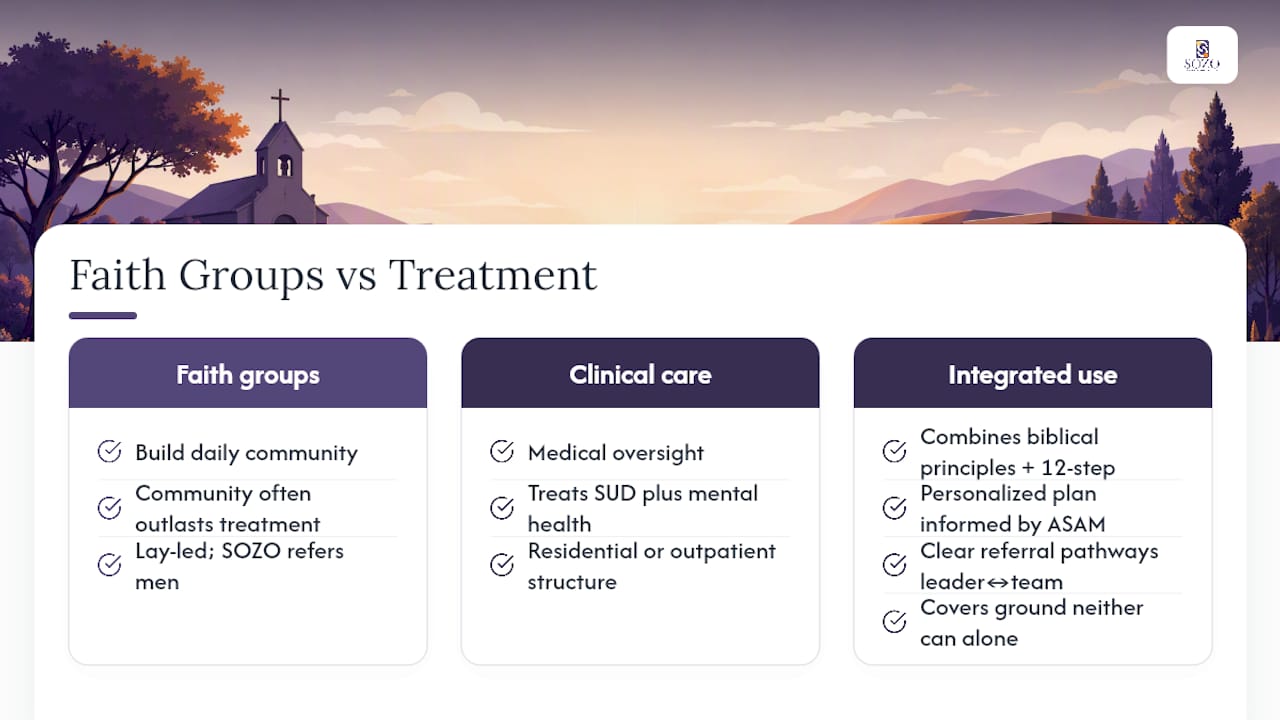
Lay-led recovery ministries do something clinical programs can’t replicate on their own: they build daily community around faith, and that community often outlasts any treatment episode. SOZO Recovery Center respects that work and refers men into it regularly.
Where a man needs more than fellowship, our program integrates biblical principles with the 12-step model inside a personalized plan informed by the ASAM Continuum. When someone is carrying both a substance use disorder and a diagnosed mental health condition, residential or outpatient care with medical oversight isn’t a step away from faith. It’s often the structure that makes lasting faith-based recovery possible. Church ministries and clinical treatment aren’t competitors. Used together, with clear referral pathways between a group leader and a treatment team, they cover ground neither can cover alone.
— Ty
Faith-Based Treatment Options When You Need More Than a Support Group
Support groups meet at a scheduled hour once or twice a week. Some men need care that’s structured every day, especially when addiction and a mental health diagnosis are tangled together. A faith-based men’s addiction treatment center can combine biblical principles with 12-step recovery in personalized plans built on ASAM criteria.
SOZO’s residential treatment program gives men a retreat-like setting away from daily triggers, while dual diagnosis and personalized care address co-occurring mental health conditions alongside substance use rather than treating them as separate problems. For men who need structure but not around-the-clock residential care, intensive outpatient and sober living options provide a step down that still holds accountability in place. If you’re a man wrestling with addiction and a mental health diagnosis together, or a family member trying to find the next right step for a loved one, learn what to expect at SOZO and reach out to start the intake conversation.
Sources
- Celebrate Recovery
- Mental Health Grace Alliance — Find a Group
- The Dunamis Initiative — Christian 12 Step recovery
- Recovery-Through Christ
FAQ
Are Christian support groups a replacement for rehab?
No. Christian support groups provide peer fellowship and accountability, but they are lay-led and not licensed clinical treatment, so medical detox and psychiatric care require a separate treatment provider.
How do I find a Celebrate Recovery meeting near me?
Use Celebrate Recovery’s official group finder tool on its website, where the organization lists locations across more than 35,000 churches worldwide, and many offer hybrid online access if no in-person group is close by.
What’s the difference between Celebrate Recovery and Recovery-Through Christ?
Celebrate Recovery runs a widely available, open-format weekly meeting model, while Recovery-Through Christ uses a longer, curriculum-driven study track with dedicated leader training for congregations.
Can a support group leader refer me to clinical treatment?
Yes, most trained group leaders know when to refer someone to a clinician or residential program, especially when a member shows signs of withdrawal risk or a co-occurring mental health condition.
Does SOZO Recovery Center work alongside church support groups?
Yes, SOZO’s faith-based program integrates biblical principles with clinical, ASAM-informed care for men with dual diagnosis needs, and welcomes coordination with a man’s home church or recovery ministry during and after treatment.