


An ASAM assessment is a standardized, multidimensional clinical interview used to match a person’s needs to the right intensity of addiction care. It examines six areas of a person’s health and circumstances, not just their substance use history, to produce a level-of-care recommendation and a foundation for the treatment plan that follows. It’s the difference between guessing at the right program and knowing.
TL;DR:
- The assessment evaluates six key areas to determine the appropriate level of care, adjusting for physical health, mental health, motivation, and social support.
- A Level 3.7 care involves daily medical oversight for those with significant withdrawal risk or medical complications but does not require full intensive inpatient support.
- Clinicians use risk ratings from the assessment to recommend services like detox, outpatient therapy, or residential treatment, depending on severity.
- Preparation, such as listing medications and treatment history, can speed up the assessment process and improve accuracy.
- A strengths-based approach considers individual motivation and support systems, increasing engagement and long-term recovery success.
Table of Contents
- Understanding ASAM Criteria: Why This Framework Matters
- What Are the Six ASAM Dimensions?
- What Types of ASAM Assessments Exist?
- How Does the ASAM Assessment Process Actually Work?
- How Do ASAM Results Determine Your Level of Care?
- What Should You Bring to Your First Assessment?
- How Clinicians Turn ASAM Findings Into a Real Plan
- Why a Strengths-Based Assessment Changes the Recovery Conversation
- Start With an Assessment That Sees the Whole Man
- Primary Sources and Further Reading
- Sources
- FAQ
Understanding ASAM Criteria: Why This Framework Matters
The ASAM Criteria is the most widely used framework in the country for deciding what level of addiction treatment a person needs, whether they’re entering care for the first time, continuing in a program, or transferring between levels. It replaced the old habit of matching people to whatever bed happened to be open. Instead, it asks a clinician to look at the whole person.
That multidimensional approach matters because two men with the same drug of choice can need completely different levels of care. One might need medical detox and daily supervision. Another might do well in an outpatient program while living at home. The assessment is what tells the difference.
The Fourth Edition, released as the current standard, modernized the language clinicians use and sharpened the focus on the person behind the diagnosis. Three things changed with it:
- A stronger emphasis on shared decision-making between clinician and patient
- Updated terminology that reflects current understanding of co-occurring mental health conditions
- Explicit attention to social determinants of health, like housing and transportation, as factors that shape a workable plan
What Are the Six ASAM Dimensions?
Every ASAM assessment walks through the same six content areas, called dimensions. They were designed to catch problems a simple intake question (“How much do you drink?”) would miss entirely.
- Acute intoxication and withdrawal potential. This looks at what’s happening in a person’s body right now, whether they’re at risk of dangerous withdrawal symptoms and need medical detox before anything else can happen.
- Biomedical conditions and complications. Pregnancy, diabetes, heart disease, chronic pain. Physical health issues that could complicate treatment or require coordinated medical care.
- Emotional, behavioral, and cognitive conditions. This is where co-occurring depression, anxiety, trauma, or other mental health conditions get identified alongside the substance use.
- Readiness to change. The Fourth Edition leans harder into this one, gauging a person’s motivation and where they stand in accepting that change is needed.
- Relapse or continued use potential. What triggers a return to use, and what kind of support structure a person has to manage those risks.
- Recovery environment. Housing stability, family support, work obligations, and other social determinants of health that will either support or sabotage a treatment plan.
According to the ASAM Criteria Intake Assessment Guide, these six dimensions are what every accredited program in the country is expected to evaluate before recommending a level of care.
What Types of ASAM Assessments Exist?
Not every ASAM assessment looks the same, and understanding the difference helps you know what to expect on any given day of treatment.
- Level of Care Assessment. A shorter, faster interview used at intake or even over the phone through a call center. It gathers just enough information across the six dimensions to make a placement decision quickly.
- Treatment Planning (Biopsychosocial) Assessment. A deeper, full inventory conducted after admission. This is where the actual treatment plan gets built, and it often uncovers needs the quick intake interview missed, according to ASAM’s own assessment guides.
- Reassessment. Ongoing check-ins that determine whether someone should step up to a more intensive level, step down to a less intensive one, or transition out of treatment altogether.
Clinicians rely on different tools to run these interviews consistently, including the paper-based ASAM Criteria Assessment Interview Guide developed with UCLA, and various electronic intake systems built for the same purpose.
How Does the ASAM Assessment Process Actually Work?
Walking into an assessment blind is one of the biggest sources of first-day anxiety in rehab. Here’s the actual sequence.
- Consent and initial screening. Before anything clinical happens, a staff member explains the process and gets your written consent to be evaluated and treated.
- The clinician interview. A counselor or clinician walks through each of the six dimensions, asking direct questions: “When did you last use?” “Have you ever had withdrawal seizures?” “Do you have stable housing to return to?”
- Applying risk ratings. Your answers get scored against Dimensional Admission Criteria, decision rules that translate what you said into a numeric risk rating for each dimension.
- Documentation and recommendation. The clinician documents the ratings and translates them into a specific level-of-care recommendation, which becomes the starting point for your treatment plan.
A nurse often handles the medical screening in Dimensions 1 and 2, while a counselor or licensed clinician typically leads the rest. Expect the full interview to run for a duration that varies depending on how complex your history is.
Pro Tip: Bring a written list of medications, past treatment episodes, and emergency contacts to your assessment. Trying to recall all of that from memory under stress is exactly when important details get left out.
How Do ASAM Results Determine Your Level of Care?
Once the six dimensions are rated, those scores feed into Dimensional Admission Criteria, decision rules that point toward a specific level on the continuum of care. Higher-risk ratings in dimensions like withdrawal potential or biomedical complications push someone toward more intensive, medically supervised settings. Lower-risk ratings across the board might point toward outpatient care.
- Level 1: Outpatient services, typically a few hours a week.
- Level 2: Intensive outpatient or partial hospitalization, several hours a day, several days a week.
- Level 3: Residential or inpatient treatment, with round-the-clock structure and support.
- Level 4: Medically managed intensive inpatient care, for the highest-acuity medical or psychiatric needs.
Level 3.7 specifically refers to medically monitored intensive inpatient treatment. It fits someone whose withdrawal risk or biomedical complications are serious enough to need daily physician oversight and 24-hour nursing, but who doesn’t need the full intensive care of a Level 4 setting. Think of it as the level for people who need more than counseling. They need medical eyes on them every day.
None of this is purely mechanical. The Fourth Edition formalizes shared decision-making, meaning your own preferences, practical barriers, and comfort level get weighed alongside the numbers before a final placement is made. SOZO’s guide to navigating levels of care walks through this continuum in more depth.
What Should You Bring to Your First Assessment?
Walking into your first day of rehab with a little preparation makes the whole process faster and more accurate.
- A list of current medications and dosages
- Names and dates of any prior treatment episodes
- Emergency contact information
- Insurance card or payment information
Answer every question honestly, even the uncomfortable ones. A clinician can’t rate your withdrawal risk accurately if you underreport how much you’ve been using, and an inaccurate rating can mean landing in a level of care that’s not safe for you.
Pro Tip: Ask your clinician directly: “What dimension pushed you toward this recommendation, and what would change it?” That one question tells you more about your plan than almost anything else you could ask.
Your answers are protected by standard confidentiality rules, and you’ll be asked to sign consent forms before any information is shared with family or outside providers.
How Clinicians Turn ASAM Findings Into a Real Plan
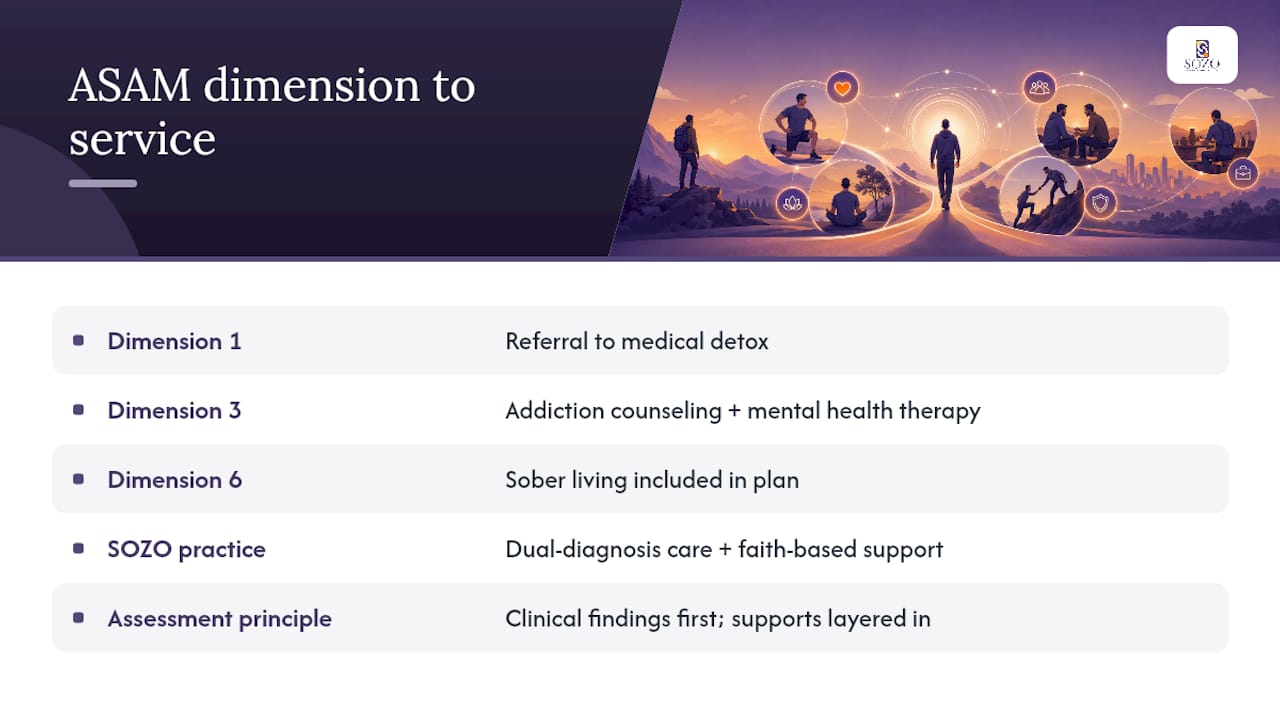
Dimensional ratings only matter if someone translates them into services. A high rating in Dimension 1 might trigger a referral to medical detox before anything else happens. A high rating in Dimension 3 might mean pairing addiction counseling with dedicated mental health therapy from day one. A weak recovery environment in Dimension 6 might mean sober living becomes part of the plan rather than an afterthought, a point echoed in Carexroads’ work on supported living environments.
At SOZO Recovery Center, that same dimensional data shapes dual-diagnosis care and faith-based support side by side.
A man’s mental health history and his spiritual life aren’t separate columns on an intake form. They’re both part of Dimension 3 and Dimension 6, and a plan that ignores either one is incomplete.
That’s how SOZO builds individualized treatment assessments: clinical findings first, then biblical principles and community support layered in as part of the actual recovery environment, not as an extra.
Why a Strengths-Based Assessment Changes the Recovery Conversation
The ASAM model’s shift toward strengths and shared decision-making isn’t a minor procedural update. It changes the conversation from “here’s what’s wrong with you” to “here’s what we’re working with.” That reframing matters more than most clinical literature gives it credit for, because a man who feels heard in his first assessment is far more likely to stay engaged through the harder weeks that follow.
Faith and community add another layer to that engagement. A dimensional rating can tell you a man needs stable housing and daily structure. It can’t tell you what gives him a reason to stay sober once he has both.
— Ty
Start With an Assessment That Sees the Whole Man
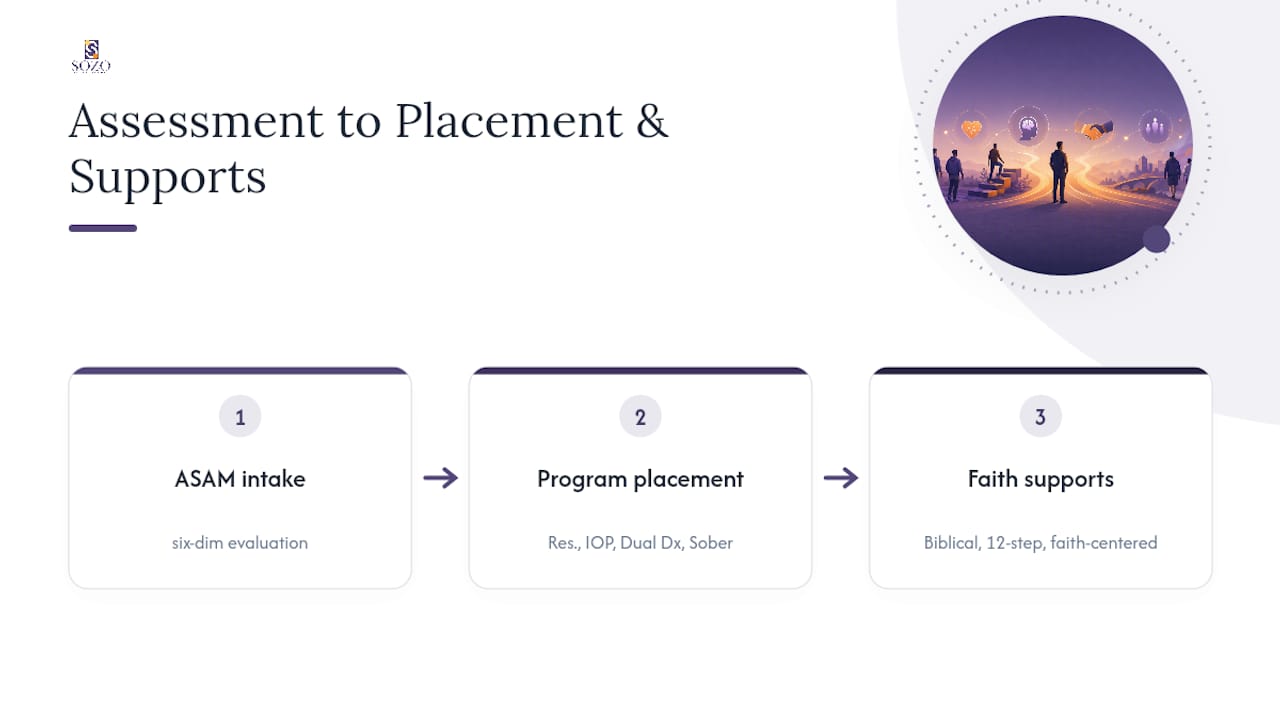
SOZO Recovery Center conducts full ASAM-based multidimensional assessments during intake, not a quick checklist, but a real evaluation across all six dimensions before any program gets recommended. Those findings shape everything that follows.
Depending on what your assessment shows, that could mean residential treatment, intensive outpatient support, dual diagnosis care for co-occurring mental health conditions, or sober living as a bridge back to independence. Programs like SOZO’s outpatient track exist precisely because not every man coming out of assessment needs the same intensity of care.
What sets SOZO apart isn’t just the clinical process. It’s what gets built on top of it: biblical principles, 12-step community, and a faith-centered environment layered onto an ASAM-informed plan. If you or someone you love is ready for an honest evaluation and a path forward, start the admissions process at SOZO today.
Primary Sources and Further Reading
For deeper detail, review ASAM’s official assessment guides, the UCLA ISAP interview guide, and Findtreatment for locating accredited providers near you.
This article is general information, not a substitute for advice from a qualified doctor. Consult a qualified healthcare professional about your own circumstances before acting on anything here.
Sources
- About The ASAM Criteria
- ASAM Criteria for Patients with Addiction and Co-occurring Conditions (SAMHSA)
FAQ
How Do You Complete an ASAM Assessment?
A clinician or nurse walks you through a structured interview covering all six ASAM dimensions, then scores your responses using Dimensional Admission Criteria to reach a level-of-care recommendation.
What Are the Six Criteria of ASAM?
The six dimensions are acute intoxication/withdrawal potential, biomedical conditions, emotional/behavioral/cognitive conditions, readiness to change, relapse potential, and recovery environment, as outlined in ASAM’s intake assessment guide.
What Is the Purpose of an ASAM Assessment?
Its purpose is to standardize how clinicians match a person’s needs to the correct intensity of addiction treatment and to build the foundation for an individualized treatment plan, per SAMHSA’s evidence-based resource listing.
What Is the ASAM Criteria for Level 3.7 Care?
Level 3.7 is medically monitored intensive inpatient treatment, for people whose withdrawal risk or medical complications require daily physician oversight and 24-hour nursing, but who don’t need full intensive care. Programs like SOZO use this level for men who need more than counseling alone can provide.