


What are the top 30-day rehab centers near me?
The strongest 30 day rehab centers near me offer accredited, structured care that moves a man from detox through therapy and into a discharge plan within a single month. The centers below span inpatient, outpatient, and residential programs across the United States, each verified for accreditation and program depth.

| Center | Location | Program Types | Specializations | Accreditations | Best For | Rating |
|---|---|---|---|---|---|---|
| Oxford Treatment Center | Mississippi | Detox, Residential, IOP, MAT | Veterans, LGBTQ+, Christian recovery | Joint Commission | Broad clinical and specialized care | 4.5★ (845) |
| Avenues Recovery Center at Metairie | Louisiana | Detox, Residential, Family support | Holistic, Christian-based, Dual diagnosis | Joint Commission | Faith-supported holistic recovery | 4.9★ (685) |
| Banyan Delaware | Delaware | Inpatient, Outpatient, Telehealth IOP | Dual diagnosis, Masters-level therapy | Joint Commission, NAATP | Telehealth-enhanced outpatient care | 4.6★ (402) |
| Recovery Centers of America | Nationwide | Inpatient, Outpatient, Detox, Virtual | Evidence-based, Family guidance | CARF, Joint Commission | Multi-level care across states | 4.5★ (245) |
| Denver Recovery Center | Colorado | PHP, IOP, Aftercare | Dual diagnosis, Family involvement | Joint Commission | Licensed outpatient and aftercare | 4.7★ (185) |
| Southeastern Recovery Center | North Carolina | IOP, Virtual IOP, Individual/Group therapy | Trauma-informed, Holistic | Trauma-focused long-term sobriety | 5★ (122) | |
| Oregon Trail Recovery LLC | Oregon | Detox, IOP, Transitional rehab | Gender-specific, Employment assistance | Golden Seal | Long-term outpatient with life skills | 4.6★ (108) |
| [Luxe Recovery | Luxury Rehab & Detox](http://luxerecovery.com/) | Los Angeles, CA | Detox, Residential, Outpatient, Sober living | Luxury, Holistic therapies | NAATP, LegitScript, BBB | Customized luxury addiction treatment |
| American Addiction Centers | Nationwide | Outpatient, Mental health | Evidence-based, Personalized | Joint Commission, SAMHSA | Accessible outpatient across states | 3.9★ (68) |
| Bay Area Recovery Center: Houston Clear Lake | Houston, TX | Addiction treatment services | Local recovery support | Houston-area accessible care | 4.9★ (54) | |
| Ultimate Recovery Center | Montebello, CA | Inpatient, Outpatient, Aftercare | Family involvement, Clinical therapies | Multi-level care in Southern California | 4.9★ (39) | |
| SOZO Addiction Recovery Center, Inc. | Arkansas | Residential, IOP, PHP, Sober living | Faith-based, Dual diagnosis, Men’s only | ASAM-informed | Men seeking faith-integrated dual diagnosis care | 5★ (7) |
Key distinctions worth noting before you call any of these centers:
- Oxford Treatment Center covers the widest range of specialized populations, including veterans and first responders.
- Avenues Recovery Center at Metairie combines 24/7 admissions with private townhome-style residential living.
- Banyan Delaware stands out for its Masters-level clinical staff and telehealth intensive outpatient option.
- Recovery Centers of America earned Newsweek’s Best Addiction Treatment Center recognition in 2025.
- Luxe Recovery offers a genuinely customized luxury experience with LegitScript certification.
- SOZO Addiction Recovery Center, Inc. is the strongest choice for men who want faith and clinical care woven together from day one.
How to choose the right 30-day rehab program
Accreditation is the first filter. Centers holding Joint Commission, CARF, or NAATP credentials have passed independent clinical audits. A center without any accreditation is a center you cannot verify.
Beyond credentials, match the program type to the severity of the addiction. Inpatient care removes a man from his environment entirely, which is often necessary when home life is a trigger or when withdrawal requires medical supervision. Outpatient programs, including intensive outpatient and partial hospitalization, work best when a person has stable housing and a lower-risk withdrawal profile.
Ask specifically about dual diagnosis capacity. Many men entering treatment carry an unaddressed mental health condition alongside the addiction, and a program that treats only the substance use without addressing the underlying condition tends to see higher relapse rates. Aftercare planning matters just as much as the 30 days themselves; ask what happens on day 31.
- Verify accreditation status before scheduling a tour.
- Confirm the center accepts your insurance and offers benefits verification.
- Ask whether the program includes family counseling, not just individual therapy.
- Check that aftercare or sober living referrals are part of the discharge plan.
- Confirm staff credentials, specifically whether licensed clinicians lead therapy groups.
Pro Tip: Visiting a center before admission, even briefly, helps you read the environment and gauge staff warmth. ASAM criteria emphasize that patient engagement with the treatment setting is a real predictor of outcomes.
What does a 30-day rehab program actually look like?
A 30-day program typically runs 28 to 30 days and moves through three overlapping phases: stabilization, active treatment, and discharge planning. The first phase is often medical detox, which focuses entirely on physical stabilization before any psychological work begins.
Medical detox for alcohol or opioids usually requires a separate clinical stay to manage withdrawal safely. Once stabilized, a man moves into the core therapeutic work: individual counseling, group therapy, relapse prevention education, and family sessions where appropriate. Programs like those at Avenues Recovery Center at Metairie layer in holistic therapies such as yoga, art, and meditation alongside clinical care.
Common therapy types across accredited centers include:
- Cognitive behavioral therapy and dialectical behavior therapy
- 12-step facilitation and peer support groups
- Dual diagnosis treatment for co-occurring mental health conditions
- Medication-assisted treatment where clinically indicated
- Family counseling and psychoeducation
- Holistic modalities: yoga, mindfulness, art, and music therapy
Costs and insurance coverage for 30-day rehab programs
Cost varies widely based on location, amenities, and program intensity. Luxury residential programs in cities like Los Angeles cost substantially more than community-based outpatient programs in rural areas. Treatment costs depend on the level of care, the length of stay, and what the facility includes in its daily rate.
Most accredited centers accept major private insurance plans. Recovery Centers of America, American Addiction Centers, and Oxford Treatment Center all work with insurance providers and offer benefits verification before admission. Sliding-scale fees and financial assistance exist at some centers for those without coverage.
Key fact: Free benefits verification is available at most accredited centers. Call before assuming cost is a barrier.
Medicaid and Medicare coverage for substance use treatment has expanded under the Mental Health Parity and Addiction Equity Act, though covered services vary by state and plan. The federal treatment locator at findtreatment.gov can help identify publicly funded options near you.
How to find and contact local 30-day rehab centers near you
The fastest verified starting points are the SAMHSA treatment locator and Medicare’s care comparison tool, both of which filter by location, program type, and insurance.
- Search SAMHSA’s findtreatment.gov for state-licensed programs near your zip code.
- Call your insurance provider’s behavioral health line for an in-network referral list.
- Ask your primary care physician for a clinical referral, which can speed insurance approval.
- Use Google Maps to find centers with verified addresses and read recent reviews as one data point.
- When you call a center, ask directly: What is your accreditation? Do you accept my insurance? What does a typical day look like? What is the discharge plan?
Site visits, when possible, remain the clearest way to assess fit. Staff tone, facility cleanliness, and how questions are answered in person tell you more than any website.
Faith-based 30-day rehab options at SOZO Recovery Center
For men whose recovery needs to be grounded in something larger than clinical protocol, SOZO Addiction Recovery Center, Inc. in Hot Springs, Arkansas offers a distinct path. The program integrates biblical principles with the 12-step model and uses ASAM criteria to build individualized treatment plans, so the spiritual and clinical dimensions reinforce each other rather than compete.
SOZO’s program covers the full continuum of care:
- Residential treatment with structured daily programming
- Intensive outpatient and partial hospitalization programs
- Sober living with community accountability
- Dual diagnosis care addressing both addiction and mental health
- Referrals for medical detox placement when needed
The men’s-only environment matters clinically. Gender-specific treatment removes certain social dynamics that can distract from the therapeutic work, and the shared faith context builds a peer community that extends well beyond discharge. Learn more about faith-based recovery programs and how they compare to traditional models.
Pro Tip: If a man has tried secular programs without lasting success, a faith-integrated approach can address the spiritual dimension of recovery that clinical care alone sometimes misses.
What is the full timeline of a 30-day rehab stay?
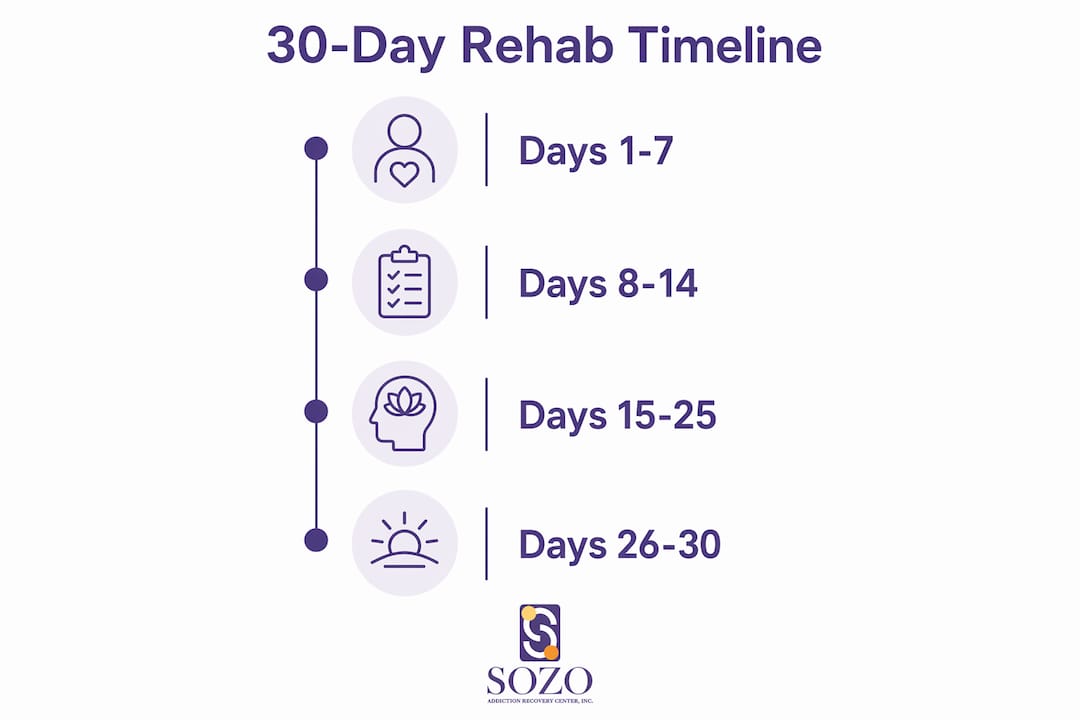
The timeline below reflects a typical inpatient 30-day program, though exact sequencing varies by center and individual need.
Days 1 to 7: Intake assessment, medical detox or stabilization, orientation to program rules and schedule. This is the most physically demanding phase.
Days 8 to 14: Active therapy begins. Individual counseling sessions, group therapy, psychoeducation on addiction and relapse triggers. Family contact is often reintroduced here.
Days 15 to 25: Deeper therapeutic work, including trauma processing, dual diagnosis treatment, and 12-step or alternative peer support integration. Vocational and life skills planning may begin.
Days 26 to 30: Discharge planning, aftercare referrals, sober living placement if needed, and a continuing care plan. A strong discharge plan is what separates a 30-day program that holds from one that doesn’t.
Admission typically requires a phone intake, insurance verification, and a clinical pre-assessment. Discharge is a planned clinical event, not simply the end of a billing cycle.
Red flags to watch for when evaluating a rehab center
Not every facility that calls itself a rehab center meets clinical or ethical standards. These warning signs warrant serious caution:
- No verifiable accreditation from Joint Commission, CARF, or a state licensing body
- Pressure to commit before you have spoken with a clinician
- Vague or evasive answers about what a typical day includes
- No licensed clinical staff listed on the website or available to speak with
- Promises of guaranteed recovery or unusually high success rates without evidence
- No clear discharge or aftercare planning process
Patient brokering, where a center pays for referrals rather than earning them clinically, is illegal in most states and a sign that the program prioritizes revenue over care.
Questions to ask when evaluating a 30-day rehab center
Before committing to any program, a man deserves clear, direct answers to these questions:
- What accreditations does the center hold, and can you verify them?
- Does the program include dual diagnosis treatment for co-occurring mental health conditions?
- What is the staff-to-client ratio during therapy sessions?
- How is family involvement structured, and is it optional or required?
- What does the discharge plan include, and who coordinates aftercare?
- Does the program address spiritual or faith-based needs, and how?
- What happens if a client needs more than 30 days?
The last question matters more than most people realize. NIDA research consistently shows that longer treatment durations correlate with better long-term outcomes, particularly for complex cases with co-occurring disorders. A good center will have an honest answer about when 30 days is enough and when it isn’t.
Key Takeaways
Accreditation, dual diagnosis capacity, and a real discharge plan are the three factors that separate effective 30-day programs from ones that simply fill beds.
| Point | Details |
|---|---|
| Accreditation first | Only consider centers with Joint Commission, CARF, NAATP, or state licensure verification. |
| Match program to severity | Inpatient suits high-risk withdrawal and unstable home environments; outpatient fits lower-severity cases with stable support. |
| Detox is separate | Medical detox precedes the 30-day therapeutic program and focuses solely on physical stabilization. |
| Cost varies widely | Insurance, location, and amenities all affect price; free benefits verification is available at most accredited centers. |
| Sozorecoverycenter’s fit | SOZO Addiction Recovery Center, Inc. is the strongest choice for men seeking faith-integrated dual diagnosis care in a men’s-only residential setting. |
What most people get wrong about choosing a 30-day program
The conventional wisdom says find the highest-rated center near you and call. That framing misses the more important question: rated highly by whom, for what kind of person?
A luxury residential program in Los Angeles may be exactly right for one man and completely wrong for another who needs the accountability of a faith community and a peer group who share his values. Treatment philosophy is not a soft preference. It shapes whether a man actually engages with the work or just endures it.
The 30-day duration itself deserves honest scrutiny. It is a starting point, not a finish line. For men with long-term addiction and co-occurring mental health conditions, 30 days often stabilizes the crisis without resolving the underlying pattern. The centers that are transparent about this, and that build a real continuing care plan from day one, are the ones worth trusting. A program that treats discharge as the goal has already missed the point.
Men’s faith-based care at Sozorecoverycenter
For men who want recovery grounded in both clinical rigor and spiritual purpose, Sozorecoverycenter offers something the larger national networks don’t: a men’s-only environment where biblical principles and the 12-step model work alongside ASAM-informed dual diagnosis treatment. There’s no one-size approach here. Each man’s plan is built around his specific addiction history, mental health needs, and spiritual background.
Sozorecoverycenter serves men across Arkansas and the surrounding region through residential, intensive outpatient, partial hospitalization, and sober living programs. If you or someone you care about is ready to take the first step, the dual diagnosis treatment for men at SOZO addresses both addiction and mental health from the start, not as an afterthought. Reach out to learn whether the program is the right fit.
FAQ
Is 30 days enough for rehab?
For many people, 30 days provides a strong foundation, but clinical evidence shows that longer stays correlate with better long-term outcomes, particularly when co-occurring mental health conditions are present. A 30-day program works best when paired with a structured aftercare plan.
How much does 3 months of rehab cost?
Cost depends heavily on program type, location, and amenities, and varies widely across the country. Insurance, sliding-scale fees, and financial assistance can reduce out-of-pocket expenses significantly; free benefits verification is available at most accredited centers.
What’s the longest you can stay in rehab?
There is no official maximum. Treatment duration is individualized based on addiction severity, mental health status, and personal progress, with ASAM criteria used to update the plan as a person moves through care.
Is rehab in the US free?
Fully free rehab is available through state-funded programs and some nonprofit centers, particularly for those who qualify based on income. The SAMHSA locator at findtreatment.gov lists publicly funded options by location.