


Chemical-free housing means deliberately designing and maintaining a living space to minimize exposure to harmful synthetic chemicals, not eliminating every chemical that exists. The goal is reduction, not perfection. Most conventional homes contain VOCs, phthalates, and flame retardants in their flooring, furniture, paint, and adhesives, and the health consequences of chronic low-level exposure accumulate quietly over years.
The case for acting is grounded in a sobering reality: of the more than 86,000 chemicals commonly used in building products, only about one percent have been tested for human safety. That gap means most homeowners are making material choices without complete safety information. The good news is that informed swaps, prioritized by room and exposure level, can meaningfully lower your chemical load without requiring a full renovation.
Key benefits of non-toxic homes include:
- Improved indoor air quality and reduced respiratory irritation
- Lower allergy and asthma triggers from dust-borne chemicals
- Reduced endocrine disruption from phthalates and PFAS
- Better sleep quality when bedroom materials are addressed first
- Long-term protection against chronic disease linked to formaldehyde and VOC exposure
What harmful chemicals are hiding in your home?
The most problematic chemicals in conventional housing fall into a few well-documented families, each with specific sources that are easy to overlook.

| Chemical | Common Sources | Primary Health Risk |
|---|---|---|
| VOCs | Paint, adhesives, engineered wood, vinyl flooring | Respiratory irritation, headaches, organ damage |
| Formaldehyde | Particleboard, MDF furniture, textiles | Known carcinogen; linked to neurological disease |
| Phthalates | Vinyl flooring, fragranced products, plastics | Endocrine disruption |
| PFAS | Non-stick cookware, stain-resistant carpet, upholstery | Persistent bioaccumulation; hormonal effects |
| Flame retardants | Foam sofas, mattresses, upholstered furniture | Accumulate in household dust; developmental concerns |
| Synthetic fragrances | Cleaning products, air fresheners, detergents | Undisclosed phthalates; respiratory sensitizers |
Vinyl plank flooring deserves particular attention. Made from PVC with phthalate plasticizers, it releases endocrine-disrupting compounds throughout its entire lifespan, accumulating steadily in household dust. Despite being the most popular flooring category in the U.S., it ranks among the worst choices from a health standpoint.
Formaldehyde is another chemical that rarely announces itself. It off-gasses from urea-formaldehyde resins in particleboard and MDF furniture, sometimes for years after installation, and has been linked in studies to cancers and neurodegenerative diseases including Alzheimer’s and ALS. Polyurethane foam insulation carries its own risk: the isocyanates used in spray foam are potent respiratory sensitizers that can off-gas for months or years when the mix ratio is imperfect.
Around 20% of building materials are classified as Confidential Business Information, meaning their chemical identities are never publicly disclosed. That makes independent verification of material safety genuinely difficult for most homeowners.
How to create a safer, low-tox home room by room
Start with the bedroom. You spend significant time there, breathing the same air for extended periods, which makes it the highest-priority space. Experts recommend focusing first on large surfaces: flooring, wall finishes, and the mattress.
Practical material swaps worth prioritizing:
- Flooring: Solid hardwood with a natural finish (tung oil or hardwax oil), cork with click-lock installation, or stone and ceramic tile. All off-gas minimally compared to vinyl or synthetic carpet.
- Paint: Low-VOC or zero-VOC formulations, such as AFM Safecoat, which is specifically designed for chemically sensitive environments.
- Wall finishes: Lime plaster or clay plaster. Clay plaster is hygroscopic, helping maintain indoor humidity in the 40 to 60% range, and produces no emissions.
- Mattresses and upholstery: Organic cotton certified to GOTS standards, or natural latex. Avoid polyurethane foam treated with organophosphate flame retardants.
- Adhesives: Mechanical fastening (screws, clips, click-lock systems) wherever possible. When adhesive is necessary, AFM Safecoat zero-VOC formulations or natural rubber adhesives are the lowest-emission options.
- Cleaning products: Fragrance-free, plant-based formulas. Conventional sprays and fabric softeners often contain glycol ethers and quaternary ammonium compounds.
Ventilation is the single most cost-effective intervention for indoor air quality. Opening windows daily dilutes VOC concentrations that build up from off-gassing materials. In spaces where ventilation is limited, an air purifier with both HEPA and activated carbon filters addresses particles and some gases.
Pro Tip: You do not need to replace everything at once. Follow the exposure hierarchy: air quality first, then items in direct skin contact (bedding, mattresses), then food-contact surfaces. Incremental swaps spread over months protect your budget while steadily lowering your chemical load.
Building biology experts also caution about electromagnetic field exposure from smart meters and wireless networks. For those pursuing a truly thorough approach to chemical-free construction, wired internet connections and breathable wall assemblies are worth considering alongside material choices.
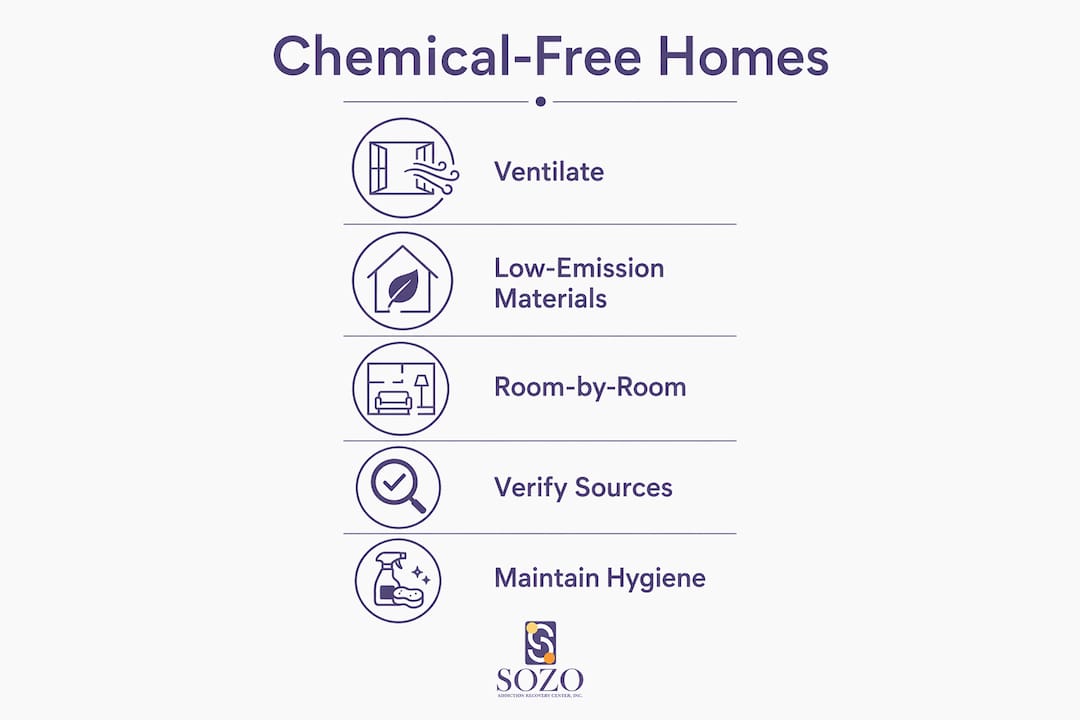
Common misconceptions that can derail your efforts
The phrase “chemical-free” is technically impossible. Every material, natural or synthetic, is made of chemicals. What the term actually signals is a commitment to reducing toxic exposures, and that distinction matters when evaluating products and certifications.
Common pitfalls homeowners encounter:
- Trusting green building labels uncritically. LEED certification focuses on energy efficiency and carbon footprint, not indoor air quality or chemical emissions. A LEED-certified building can still contain high-VOC adhesives and formaldehyde-laden particleboard.
- Overlooking adhesives and finishes. These are hidden inside wall assemblies and under flooring, yet many conventional construction adhesives rank among the highest-emitting materials in a building.
- Accepting “non-toxic” marketing claims at face value. Without product-level certifications for VOC content and specific chemical families, the label means very little. Look for Greenguard Gold, OEKO-TEX, or FSC certification depending on the material category.
- Underestimating cost and scope. Non-toxic materials generally cost more upfront. Sheep wool insulation, for example, runs two to three times the price of standard fiberglass batts. Prioritizing by exposure level, rather than renovating everything simultaneously, keeps the project manageable.
Physical inspection and sensory testing remain important when selecting a home. Marketing claims may not reflect actual material use, and chemical tolerances vary considerably from person to person.
Trusted U.S. resources for finding or building a low-tox home
Several organizations and listing platforms support homeowners and renters navigating eco-friendly housing options in the United States.
- Environmentally Safer Homes maintains listings of MCS-safe, fragrance-free, and mold-free homes and rentals across the U.S., including tiny homes and custom builds in various locations. Listings include material age and local environmental notes.
- Healthy Building Network (hbelc.org) publishes category-by-category guides to non-toxic building materials, with specific product recommendations and certification guidance.
- Building biology practitioners trained through the International Institute for Building Biology and Ecology apply the SBM-2008 standard, which addresses both chemical and electromagnetic exposures in residential environments.
- pH Living offers third-party certified homes built to the Healthy Home Standard for Conventional Construction, with VOC barriers and low-emission interior material specifications.
When evaluating any listing or resource, verify the age of key materials, ask about pesticide use in the surrounding area, and request documentation for any certification claims. A site visit with sensory evaluation is worth more than any marketing description.
What long-term research says about chemical exposure in homes
The evidence connecting chronic indoor chemical exposure to serious health outcomes has grown considerably over the past two decades. Formaldehyde, classified as a Group 1 carcinogen by the International Agency for Research on Cancer, has been linked in multiple studies to leukemia and nasopharyngeal cancer, as well as neurodegenerative conditions. PFAS compounds, which accumulate in the body and resist breakdown, have been associated in longitudinal studies with thyroid disruption, immune suppression, and certain cancers.
Flame retardants, particularly the polybrominated diphenyl ethers that were phased out internationally due to bioaccumulation, were replaced with organophosphate alternatives whose long-term safety profile remains under active study. The pattern across chemical families is consistent: early reassurances, followed by accumulating evidence of harm, followed by regulatory action that lags years behind the science.
Reducing exposure now, before regulatory consensus catches up, is the practical takeaway from this research trajectory. Homes built or renovated with low-emission materials and building biology principles offer a measurable buffer against that uncertainty.
Healing environments at Sozorecoverycenter
Recovery from addiction asks a man to rebuild his life from the ground up, and the physical environment where that rebuilding happens carries real weight. Sozorecoverycenter, located in Hot Springs, Arkansas, offers CARF-accredited faith-based men’s addiction treatment that integrates dual diagnosis care with personalized treatment plans built on ASAM criteria. The center’s approach recognizes that a clean, supportive living environment, one that reduces unnecessary stressors including chemical exposures, supports the kind of clarity and renewal that lasting recovery requires.

For men navigating addiction alongside mental health challenges, Sozorecoverycenter provides residential, outpatient, and sober living programs grounded in both clinical care and biblical principles. If you or someone you care about is ready to take that step, learning more about men’s dual diagnosis treatment at SOZO is a place to start.
Key Takeaways
Chemical-free housing reduces chronic health risks by prioritizing low-emission materials, improving ventilation, and addressing the bedroom and high-contact surfaces first.
| Point | Details |
|---|---|
| Start with the bedroom | You spend a third of your life there; address flooring, wall finishes, and mattresses before other rooms. |
| Vinyl flooring is a primary concern | Phthalate plasticizers migrate from vinyl throughout its lifespan, accumulating in household dust as endocrine disruptors. |
| Green labels don’t guarantee safety | LEED focuses on energy efficiency, not indoor air quality; verify product-level certifications like Greenguard Gold or OEKO-TEX. |
| Ventilation is the most cost-effective fix | Daily window ventilation dilutes VOC concentrations; add a HEPA and activated carbon air purifier where ventilation is limited. |
| Sozorecoverycenter | Offers CARF-accredited, faith-based men’s treatment in a supportive environment that complements the principles of healthy, intentional living. |
FAQ
What does chemical-free housing actually mean?
Chemical-free housing refers to living spaces intentionally designed to minimize exposure to harmful synthetic chemicals like VOCs, phthalates, PFAS, and flame retardants. It means reduction of toxic exposures, not the elimination of all chemicals, which is physically impossible.
Which room should I address first in a non-toxic home?
Start with the bedroom. Experts recommend prioritizing large surfaces like flooring, wall finishes, and the mattress, since you spend roughly eight hours there each night in close contact with whatever materials are present.
Does LEED certification mean a home is low in toxic chemicals?
No. LEED primarily addresses energy efficiency and carbon footprint, not indoor chemical emissions or air quality. A LEED-certified home can still contain high-VOC adhesives or formaldehyde-based particleboard.
Where can I find chemical-free or MCS-safe housing in the U.S.?
Environmentally Safer Homes maintains listings of fragrance-free and MCS-safe properties across the U.S., including tiny homes and rentals in locations like Joshua Tree, CA, Santa Fe, NM, and Sarasota, FL.
How do I verify that a home is truly low in toxic materials?
Request documentation for any certification claims, ask about the age of key materials, and conduct a physical site visit. Chemical tolerances vary, and sensory evaluation during a visit often reveals what marketing descriptions do not.