


Young adult failure to launch is defined as a pattern of psychological stuckness where a capable young adult wants independence but cannot move forward due to internal barriers like anxiety, depression, or executive function deficits. It is not a clinical diagnosis, but a descriptive term for a real and painful experience. Nearly 50% of young adults in the U.S. live at home, yet living at home alone does not define this condition. What matters is whether a young adult is psychologically stuck, not simply where they sleep. Understanding this distinction is the first step toward real change.
What key psychological factors drive young adult failure to launch?
Anxiety is the most common driver behind delayed adulthood challenges, not laziness or lack of ambition. When the structure of high school ends, unmanaged avoidance patterns surface quickly. A young adult who relied on external schedules suddenly faces open-ended days, and anxiety fills that space with paralysis rather than action.
Separation-individuation is the developmental process through which a young adult builds a distinct identity while staying connected to family. When this process stalls, the result is linked to anxiety, depression, and reduced self-reliance. A young adult who never fully individuated often struggles to make decisions, tolerate uncertainty, or trust their own judgment.

Executive function deficits compound the problem significantly. These deficits affect planning, task initiation, time management, and emotional regulation. A young adult with weak executive function does not avoid tasks because they do not care. They avoid tasks because the mental load of starting feels genuinely overwhelming.
Undiagnosed conditions like ADHD or learning differences often sit beneath the surface. Warning signs appear years before young adulthood, including chronic avoidance and overreliance on parents. Without a proper evaluation, these conditions go untreated, and the young adult carries labels like “unmotivated” that make things worse.
The dependency gap is another hidden trap. When parents consistently remove natural consequences, they protect their child from discomfort but also from growth. Parental accommodation sustains stuckness by reducing resilience-building opportunities, creating a cycle that requires deliberate effort to interrupt.
Key psychological contributors include:
- Anxiety and depression driving avoidance and withdrawal from responsibilities
- Executive function deficits making task initiation and planning feel impossible
- Incomplete separation-individuation leaving identity formation unfinished
- Undiagnosed ADHD or learning differences creating invisible barriers
- The dependency gap where accommodation replaces natural consequence
Pro Tip: If a young adult consistently avoids starting tasks rather than completing them, executive function coaching, not motivational pressure, is the right response.
What are the warning signs of failure to launch syndrome?
Failure to launch syndrome shows up in patterns, not single moments. Recognizing these patterns early prevents longer-term stuckness and makes intervention far more effective.
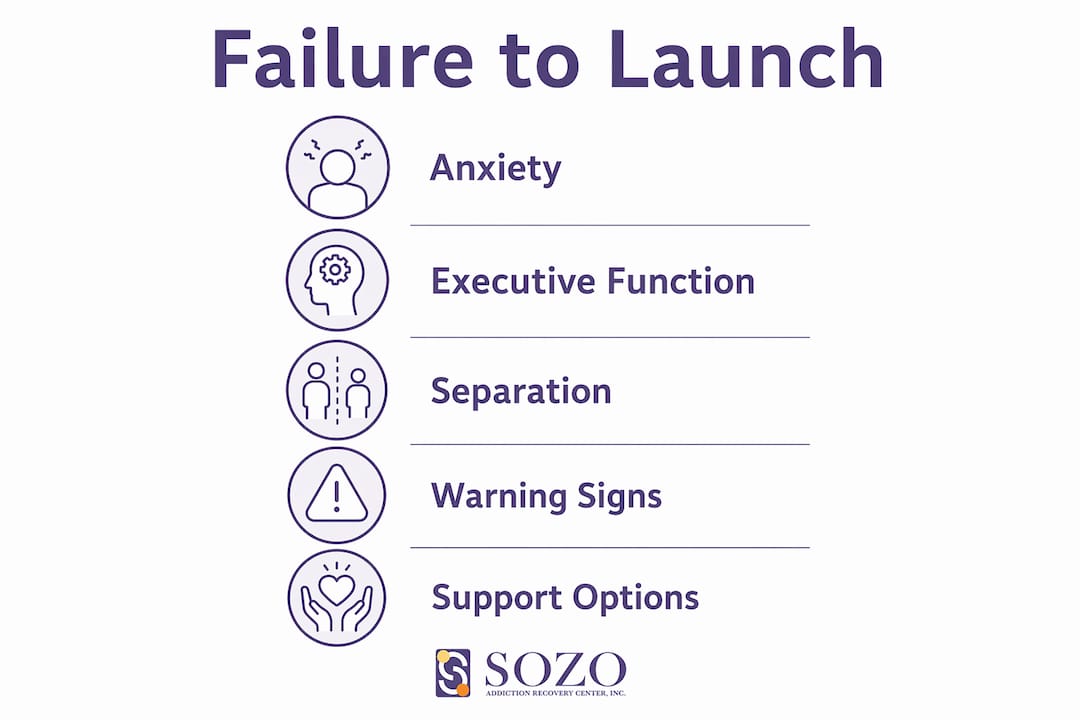
The most visible signs involve avoidance of employment and education. A young adult may cycle through brief job attempts, withdraw from college after one semester, or spend months in a holding pattern with no clear plan. Excessive screen time often fills the void, not as a cause, but as a symptom of unstructured days and unaddressed anxiety.
Emotional signs are harder to spot because they hide behind indifference. Shame and low confidence often present as “I don’t care” or “it doesn’t matter.” A young adult who shrugs off every suggestion may actually feel deeply embarrassed about where they are. Tough love approaches increase avoidance and shame, which is why pressure without support tends to deepen the problem rather than solve it.
Disrupted sleep and the absence of daily routine are reliable early indicators. When a young adult sleeps until 2 PM, stays up until 4 AM, and has no consistent anchor to the day, their capacity for self-regulation drops further. Routine is not a luxury for this population. It is a clinical tool.
Common warning signs to watch for:
- Avoiding or repeatedly abandoning employment or education
- Excessive screen use as the primary daily activity
- Irregular sleep patterns with no consistent daily structure
- Emotional flatness or irritability masking shame and low confidence
- Resistance to planning or discussing the future
The critical distinction is between temporary setbacks and entrenched patterns. A young adult who moves home after a layoff and actively pursues next steps is not experiencing failure to launch. A young adult who moves home and stops pursuing anything for six months or more, while economic challenges like high housing costs and competitive labor markets add real pressure, may need structured support.
How can young adults and families build effective transition plans?
Co-created plans outperform unilateral demands every time. Negotiated expectations improve outcomes compared to silent agreements or top-down ultimatums. The young adult needs to feel agency in the plan, not just compliance with someone else’s timeline.
A practical starting point is a 90-day plan built around small, specific goals. Vague goals like “get a job” produce anxiety. Specific goals like “apply to three positions this week” produce movement. The plan should be written, reviewed together, and adjusted without shame when things shift.
Here is a step-by-step approach to building a transition plan together:
- Start with a conversation, not a lecture. Ask the young adult what they want their life to look like in one year. Listen without correcting.
- Identify two or three concrete 90-day goals. Keep them small enough to feel achievable and specific enough to measure.
- Break each goal into micro-steps. Breaking tasks into micro-steps directly addresses executive function deficits by reducing the cognitive load of starting.
- Set clear, warm boundaries. Define what the family will and will not continue to provide, and frame it as belief in the young adult’s capacity, not punishment.
- Schedule weekly check-ins. Keep them brief and focused on progress, not problems. Celebrate small wins explicitly.
- Revisit and adjust at 30 days. Plans that cannot flex will be abandoned. Build in a review point from the start.
Communication style matters as much as the plan itself. Parents who engage in back-and-forth conversations rather than lectures build belief and reduce shame. A young adult who feels trusted is more likely to take risks. A young adult who feels judged retreats further.
Pro Tip: Replace “Why haven’t you done this yet?” with “What’s the hardest part of getting started?” That single shift opens a real conversation instead of closing one.
Parental warmth combined with clear expectations is the most effective combination. Warmth without structure enables avoidance. Structure without warmth produces shame. Both together create the conditions for genuine progress.
What professional support is available for young adults who are stuck?
Professional support addresses what family conversations cannot reach. Therapy, executive function coaching, and structured programs each serve a different function, and many young adults need more than one.
Therapy for anxiety, depression, and trauma is the clinical foundation. Cognitive behavioral therapy targets avoidance patterns directly. A therapist who understands the developmental context of delayed adulthood challenges can help a young adult separate their identity from their current situation, which is often the first real breakthrough.
Executive function coaching focuses on the practical skills that therapy does not always address. A coach works on planning, task initiation, time management, and follow-through in real time. Executive function coaching targets skill gaps that have built up over years, and progress is measurable within weeks. Programs specializing in executive functioning support offer structured frameworks that complement clinical therapy effectively.
Structured support programs provide external scaffolding independent of family dynamics. These programs create accountability, routine, and community outside the home. For young adults whose home environment has become part of the problem, an external structure can reset the entire dynamic.
Medical evaluation is necessary when ADHD or another condition is suspected. Anxiety and ADHD frequently co-occur, and treating one without addressing the other limits progress. A psychiatrist or neuropsychologist can clarify the picture and open treatment options that coaching and therapy alone cannot provide.
Key professional support options include:
- Cognitive behavioral therapy targeting avoidance, anxiety, and depression
- Executive function coaching building planning and task initiation skills
- Structured transition programs offering external accountability and routine
- Psychiatric or neuropsychological evaluation for ADHD and co-occurring conditions
- Mindfulness-based approaches reducing anxiety and building present-moment awareness
When substance use enters the picture alongside anxiety or depression, dual diagnosis treatment addresses both conditions together. Treating only one while ignoring the other produces incomplete results. Young men in particular often use substances to manage undiagnosed anxiety, which means the substance use is a symptom, not the root cause.
Key Takeaways
Young adult failure to launch is driven by psychological barriers like anxiety and executive function deficits, not character flaws, and resolving it requires co-created plans, appropriate professional support, and family communication that builds belief rather than shame.
| Point | Details |
|---|---|
| It is not laziness | Anxiety and executive function deficits, not character flaws, drive stuckness in young adults. |
| Living at home is not the issue | Psychological stuckness defines failure to launch, not the living situation itself. |
| Co-created plans work best | Negotiated 90-day goals with micro-steps outperform unilateral demands or silent agreements. |
| Professional support is often necessary | Therapy, executive function coaching, and medical evaluation address what family support cannot reach. |
| Accommodation deepens the problem | Parental warmth with clear boundaries builds resilience; accommodation without structure sustains avoidance. |
What I’ve learned about shame, patience, and real progress
Working alongside men who are rebuilding their lives from the ground up, I have seen one pattern repeat itself more than any other. Shame does not motivate. It paralyzes. A young man who hears “you should have figured this out by now” does not suddenly find clarity. He retreats further into the one place that feels safe, even if that place is a bedroom with the blinds closed.
The most useful reframe I have encountered is this: separate the living situation from the trajectory. A young adult who lives at home but is actively working on their mental health, building skills, and moving toward specific goals is not failing. A young adult who lives independently but is using substances to manage unaddressed anxiety and avoiding every responsibility is not succeeding. Location is not the measure. Direction is.
Families often ask me how long they should wait before pushing harder. My honest answer is that pushing harder rarely works. What works is getting curious. Asking what the hardest part is. Sitting with the discomfort of not having a quick fix. The therapeutic benefits of addressing anxiety and depression early are well documented, and the cost of waiting compounds over time.
Adulthood itself has changed. Economic realities like high housing costs and a competitive labor market make traditional milestones harder to reach. That context does not excuse avoidance, but it does require a more nuanced response than “just get a job.” The young adults I respect most are the ones who acknowledge both the real barriers and their own role in staying stuck. That combination of honesty and humility is where real movement begins.
Ty
When stuckness goes deeper than a transition plan can reach
Some young men carry more than delayed adulthood challenges. Anxiety, depression, and substance use often arrive together, each one feeding the others in ways that a 90-day plan alone cannot address.
Sozorecoverycenter, located in Hot Springs, Arkansas, offers faith-based dual diagnosis care for men who are dealing with both mental health and addiction challenges at the same time. The program combines clinical treatment informed by the ASAM Continuum model with biblical principles and the 12-step recovery model, creating a structured environment where men can address the root causes of their stuckness. If you or someone you care about is showing signs of addiction alongside mental health struggles, Sozorecoverycenter provides the kind of specialized, compassionate support that makes lasting change possible.
FAQ
What is failure to launch syndrome exactly?
Failure to launch is a descriptive term, not a clinical diagnosis, for a pattern where a young adult struggles to move into independence due to psychological barriers like anxiety, depression, or executive function deficits. It is defined by psychological stuckness, not by living at home.
Why do young adults struggle to become independent?
Anxiety, depression, and ADHD are the most common drivers, often combined with executive function deficits that make planning and task initiation genuinely difficult. Systemic factors like high housing costs add real pressure but do not fully explain the pattern on their own.
Does living at home mean a young adult has failed to launch?
No. Nearly 50% of young adults in the U.S. live at home, and many do so for practical reasons while actively building independence. The defining factor is psychological stuckness and avoidance, not the living arrangement itself.
How can parents help without making things worse?
Parents help most by setting warm, clear boundaries and engaging in back-and-forth conversations rather than lectures. Parental accommodation without structure sustains avoidance, while belief in the young adult’s capacity combined with defined expectations creates conditions for real progress.
When should a young adult seek professional help?
Professional support is appropriate when avoidance patterns persist beyond a few months, when anxiety or depression is interfering with daily functioning, or when substance use is present alongside other challenges. Early intervention produces better outcomes than waiting for the situation to resolve on its own.
Recommended
- Barriers to Enrolling in Residential Addiction Treatment
- Step 6 AA and Willingness: Were Entirely Ready to Have God Remove All These Defects of Character
- Step 1 AA and the Spiritual Principle of Honesty
- Long-Term Addiction Recovery: Why 90 Days Matters | SOZO Recovery Center
Related reading: Structured Living Program for Young Adults in Arkansas: A Sober House Where the Staff Answer at 2 a.m..