


Faith can genuinely strengthen mental health, and it does so through three specific channels: community that counters isolation, meaning that resists hopelessness, and regulated practices like prayer or worship that steady the nervous system. None of that replaces treatment for depression, anxiety, or addiction that has become severe. The safest path uses both, faith as a source of resilience and clinical care as the mechanism that treats the underlying condition.
TL;DR:
- Faith practices like community involvement, purpose, and structured routines can support mental health but are not substitutes for clinical treatment of severe conditions.
- Negative religious coping, such as blaming suffering on divine punishment or rejecting medication, can worsen mental health outcomes and should be recognized and addressed.
- Proper integration involves clinicians conducting spiritual histories and collaborating with faith leaders without proselytizing or replacing psychiatric care.
- Most research shows modest and inconsistent benefits of religiosity for mental health, emphasizing faith as a complementary rather than standalone solution.
- Signs such as suicidal thoughts, inability to care for oneself, or severe withdrawal require immediate clinical intervention, regardless of faith-based support.
Table of Contents
- How Faith and Spiritual Practices Support Mental Health
- When Faith Becomes a Risk: Negative Religious Coping
- How Clinicians and Faith Leaders Can Work Together
- How to Balance Faith Practices With Therapy and Medication
- What Does the Research Actually Show?
- When to Seek Professional Help Right Away
- Common Misconceptions About Mental Health in Religious Communities
- How Different Faith Traditions Shape Mental Health Perspectives
- Navigating Conflicts Between Religious Beliefs and Psychiatric Advice
- An Honest Perspective From SOZO Recovery Center
- Faith-Integrated Treatment at SOZO Recovery Center
- Sources
- FAQ
How Faith and Spiritual Practices Support Mental Health
Faith rarely works as a single lever. It supports mental health through a cluster of ordinary, repeatable habits that happen to be built into most religious traditions.
A congregation is, functionally, a built-in support network. Men who show up weekly to the same pews, the same small groups, and the same volunteer shifts are rehearsing connection in a way that isolation-prone people often stop doing on their own. That structure matters more than the theology behind it, though the theology usually reinforces the behavior.
Meaning-making is the second lever. A person who believes their suffering has purpose, or that they are accountable to something larger than their own impulses, tends to resist the hopelessness that fuels both depression and relapse. That is not a clinical cure. It is a cognitive scaffold that makes the harder clinical work more bearable.
Faith also supplies structured practices that regulate mood day to day:
- Prayer and structured meditation, which slow reactive thinking and create a consistent daily anchor
- Worship attendance and small-group involvement, which build predictable social contact
- Service and volunteer work, which redirect attention outward during recovery
- Faith-based sober communities and 12-step groups with a spiritual framework, which pair accountability with belief
Purposeful daily habits, whether rooted in faith and daily work or a recovery routine, tend to reinforce the same psychological muscle: showing up consistently, even on hard days.
When Faith Becomes a Risk: Negative Religious Coping
Not every religious framework helps. Researchers distinguish positive religious coping (a collaborative, hopeful relationship with God) from negative religious coping, which includes believing suffering is divine punishment, feeling abandoned by God, or spiritual bypassing, using prayer to avoid dealing with a real problem instead of facing it. Negative coping is associated with worse mental health outcomes, not better ones.
Watch for these patterns in a faith community:
- Messages that frame depression or addiction as purely a sin or a faith failure
- Pressure to stop psychiatric medication because “real faith” should be enough
- Shame used as a motivational tool instead of accountability paired with support
- Isolation from clinical care disguised as spiritual discipline
Pro Tip: If a spiritual leader discourages medication or therapy outright, ask for their reasoning in writing and bring it to your treating clinician before you change anything. A good pastor will welcome that conversation, not resist it.
Setting a boundary here is not a lack of faith. It is discernment.
How Clinicians and Faith Leaders Can Work Together
Ethical integration starts with a simple clinical tool: the spiritual history. FICA, a brief four-part assessment, asks about Faith, its Importance to the patient, their Community, and how they want it Addressed in care. Clinical reviews support including religion and spirituality in psychiatric care precisely because patients who are asked these questions feel more understood, not less clinically served.
From there, integration usually looks like this:
- A clinician takes a spiritual history early in treatment, without pushing any belief system
- A chaplain or faith-aware therapist coordinates with the treatment team on shared goals
- A pastor or spiritual mentor reinforces recovery work outside clinical hours, rather than substituting for it
- For co-occurring addiction and mental illness, dual diagnosis specialists lead the clinical plan while faith communities provide relational support
The ethical line is proselytizing. Good integration respects whatever the patient already believes, or doesn’t, and never conditions care on adopting a specific faith.
How to Balance Faith Practices With Therapy and Medication
You do not have to choose between your pastor and your psychiatrist. The two roles answer different questions, and most men in recovery need both.
Start by telling your therapist or doctor directly: “My faith matters to me, and I want it included in my treatment plan.” That single sentence gives them permission to ask about it and factor it into your care instead of guessing.
From there:
- Keep a daily anchor practice, prayer, scripture reading, or quiet reflection, at the same time each day so it becomes a habit, not an afterthought
- Stay in community: a small group, a recovery meeting, or a Bible study counts as treatment support, not a substitute for it
- Ask family or your pastor to check in on whether you’re actually attending therapy or taking prescribed medication, not just how you’re feeling spiritually
- Build a simple written plan: one clinical goal, one spiritual practice, one person checking on both
Prayer and structured meditation work best as a daily complement to treatment, not a replacement for a missed appointment.
What Does the Research Actually Show?
The honest answer is: real benefit, real limits, and a lot of uncertainty in between.
Observational studies lean positive. A substantial body of research finds protective associations between religiosity and lower depression, but most of it is cross-sectional and cannot prove causation, meaning it captures a snapshot, not a cause-and-effect timeline.
Longitudinal and trial data tell a more cautious story. A longitudinal analysis of religiosity and later depression found weak, inconsistent evidence that religiosity causally prevents depression or anxiety over time, with small effect sizes that varied by gender. Separately, randomized trials of manual-guided spiritual direction added to inpatient addiction treatment found no improvement in substance use outcomes, and one trial actually showed less improvement in depression and anxiety among participants who received it.
What that means practically:
- Faith is a legitimate protective factor for many people, not a guaranteed one
- Specific spiritual interventions are not interchangeable; timing, format, and fit all matter
- Guidelines still support integrating spirituality into addiction treatment as a complementary resource within multidisciplinary care, not a stand-alone therapy
- Uncertainty in the research is a reason for combined care, not a reason to dismiss faith’s role
When to Seek Professional Help Right Away
Faith-based support has limits, and knowing where those limits sit can save a life. These signs mean it’s time for clinical intervention, not more prayer alone:
- Suicidal thoughts, a plan, or statements about not wanting to be alive
- Inability to perform basic self-care, eating, hygiene, getting out of bed for days
- Severe substance withdrawal symptoms, including seizures, hallucinations, or extreme shaking
- A sudden break from reality, paranoia, or hearing voices
In any of these situations, call 988 (the Suicide and Crisis Lifeline) or go to an emergency room immediately. Tell your pastor or spiritual mentor plainly what you need: “I need you to sit with my family while I get medical help,” not a longer conversation about faith first. Faith communities support someone in crisis best by driving them to care, staying present afterward, and following the clinical team’s lead.
Common Misconceptions About Mental Health in Religious Communities
The most damaging misconception is that mental illness signals a lack of faith or insufficient prayer. Depression, anxiety, and addiction are medical conditions with biological, psychological, and social components. Treating them as purely spiritual failures delays care and adds shame on top of suffering that’s already hard to carry.

A second common belief: that taking psychiatric medication means you don’t trust God enough. This framing conflates spiritual trust with a medical decision. Insulin doesn’t undermine a diabetic’s faith, and antidepressants don’t undermine anyone else’s.
A third misconception treats therapy as inherently secular or even hostile to belief, when in practice many therapists actively welcome a client’s faith as a clinical asset. Faith-aware therapy exists precisely because clinicians recognize that dismissing a patient’s belief system tends to backfire.
Finally, some communities quietly treat addiction as a moral failing rather than a chronic, relapsing condition that responds to structured treatment. That framing often keeps men from admitting a problem until it’s severe, because confession feels like it should be enough on its own. Faith-based rehab models that pair biblical principles with clinical structure exist specifically to correct this: accountability and grace both matter, but neither one replaces treatment.
Correcting these beliefs inside a congregation usually takes ongoing conversation, not a single sermon. Pastors who partner with clinicians and speak openly about their own or others’ treatment experiences do more to reduce stigma than any isolated announcement.
How Different Faith Traditions Shape Mental Health Perspectives
Christian traditions vary widely on this question. Many evangelical and mainline Protestant communities have moved toward openly supporting therapy and medication alongside prayer, while some more insular congregations still treat outside clinical help with suspicion. Catholic teaching has long supported the compatibility of psychology and faith, with pastoral counseling often working alongside licensed therapists rather than instead of them.
Jewish tradition, particularly in its emphasis on pikuach nefesh (the preservation of life as a supreme value), generally treats seeking medical and psychiatric care as a religious obligation, not a compromise of faith. Islamic teaching similarly frames seeking treatment as consistent with trust in God, with many scholars emphasizing that Allah created both the illness and its cure.
Buddhist and mindfulness-rooted traditions bring a different contribution: meditation practices that have been adapted, sometimes controversially, into clinical tools like mindfulness-based stress reduction. The spiritual framework and the clinical technique are not identical, but the overlap has made meditation one of the more research-friendly intersections of faith and mental health.
The practical lesson for readers is not to rank traditions, it’s to recognize that your own tradition’s stance on medicine and psychiatry shapes what kind of resistance or support you’re likely to encounter, and to seek out clergy or communities within your tradition who already bridge that gap well.
Navigating Conflicts Between Religious Beliefs and Psychiatric Advice
Conflicts show up most often around three issues: medication, the causes of mental illness, and whether therapy itself is trustworthy. When your pastor’s advice and your psychiatrist’s advice point in different directions, the resolution usually isn’t picking a side. It’s getting both parties talking, ideally with your consent, to the same page.
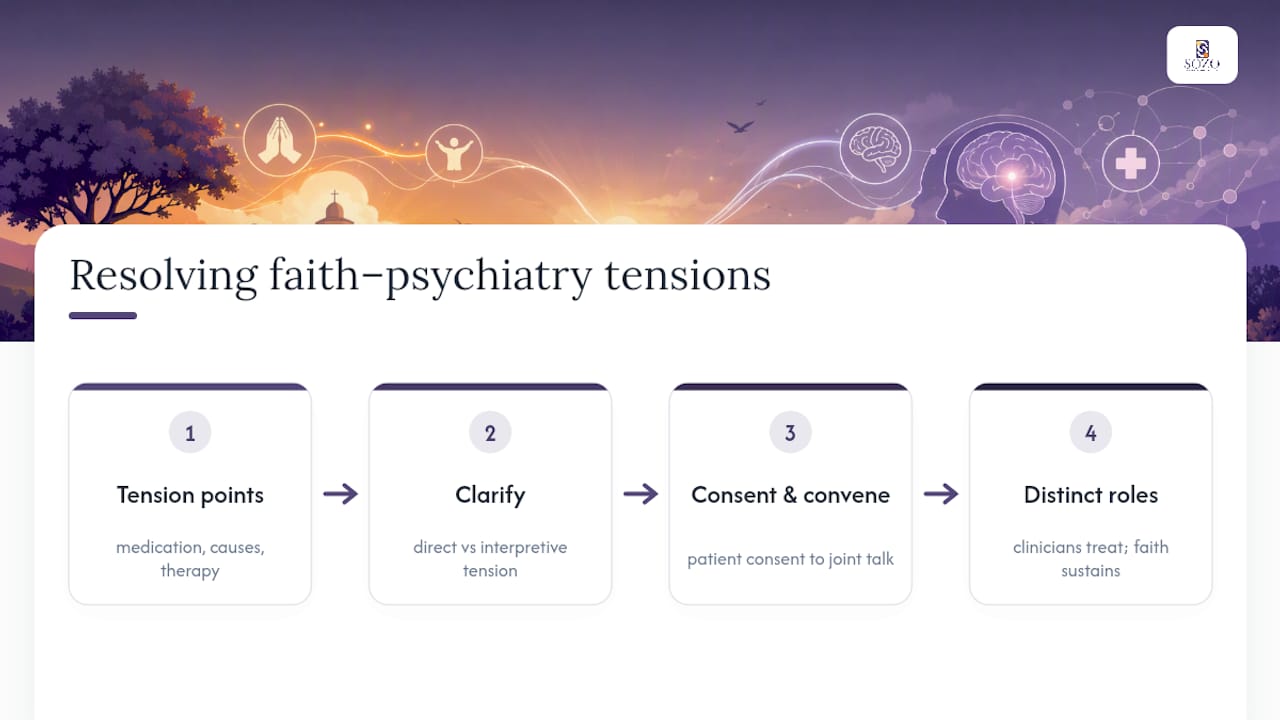
Start by clarifying what’s actually in tension. If a spiritual leader says “pray harder instead of taking medication,” that’s a direct conflict with medical advice and warrants a second opinion, possibly from clergy trained in pastoral counseling who understand clinical treatment. If the tension is more about interpretation, whether your depression has a spiritual root, a biological one, or both, that’s not necessarily a conflict at all. Most clinicians who work with people of faith are comfortable holding both explanations at once.
Bring your psychiatrist or therapist into the conversation explicitly: ask them to talk with your pastor, with your permission, about your treatment plan. This isn’t unusual, and most licensed clinicians will do it when a patient requests it. If a faith leader refuses to work alongside your clinical team at all, that refusal is itself useful information about how much weight to give their advice on a medical question.
The bottom line: your psychiatric team treats the illness. Your faith community sustains you through it. Neither one should be asked to do the other’s job.
An Honest Perspective From SOZO Recovery Center
Faith-integrated treatment works best when it stops pretending to be a substitute for clinical rigor. In practice, that means a man walks into treatment holding both his relapse history and his relationship with God, and neither one gets minimized to make room for the other.
What tends to hold up over time isn’t the moment of spiritual breakthrough, it’s the daily discipline that follows it: showing up to group, taking medication as prescribed, staying honest with a sponsor and a counselor at the same time. Faith gives men a reason to keep going. Clinical structure gives them a way to actually get there.
Ty
Faith-Integrated Treatment at SOZO Recovery Center
SOZO Recovery Center exists for men who don’t want to leave their faith at the door of treatment, and don’t want their faith treated as a replacement for clinical care either. Programs are built on the ASAM Continuum for personalized, criteria-based treatment planning, combined with biblical principles and the 12-step model, so a man working through addiction and a co-occurring mental health condition gets both a spiritual foundation and a clinical plan built for his specific case.
This approach fits men whose substance use disorder is tangled up with depression, anxiety, or trauma, and who want their recovery grounded in scripture without giving up evidence-based dual diagnosis care. Residential, outpatient, intensive outpatient, partial hospitalization, and sober living options mean the level of care matches where a man actually is, not a one-size-fits-all program.
If this integration sounds like what you or someone you love needs, the next step is a conversation. Reach out through SOZO’s admissions team in Hot Springs, Arkansas to talk through fit, insurance, and next steps before committing to anything.
Sources
- The case for inclusion of religion and spirituality into psychiatric care: PMC
- Longitudinal analysis of religiosity and later depression/anxiety: PLOS ONE
FAQ
What do you view as the connections between faith and mental health?
Faith supports mental health mainly through community, meaning, and regulated daily practices like prayer, while research shows these benefits are real but modest and inconsistent across studies. It works best as a complement to clinical treatment, not a replacement for it, particularly for moderate to severe depression, anxiety, or addiction.
How can we balance faith and mental health?
Tell your therapist or doctor that your faith matters and ask them to include it in your treatment plan, then keep both your clinical appointments and your spiritual practices on a consistent schedule. Programs like SOZO Recovery Center build this balance directly into treatment by pairing biblical principles with clinical, dual diagnosis-informed care.
Can prayer or meditation replace therapy or medication?
No. Prayer and meditation can regulate mood and reduce daily stress, but they haven’t been shown in trials to replace treatment for clinical depression, anxiety disorders, or addiction.
What is negative religious coping, and why does it matter?
Negative religious coping includes believing illness is divine punishment or that seeking help shows weak faith, and it’s linked to worse mental health outcomes than positive, hope-based religious coping. Recognizing it early lets you set boundaries with unhelpful messages without abandoning your faith.
What is a spiritual history, and why do clinicians use it?
A spiritual history, often gathered using the FICA tool, asks about a patient’s Faith, its Importance, their Community, and how they want it Addressed in care. Clinicians use it to respect a patient’s beliefs and coordinate care that fits their values, not to introduce religion into treatment.