


Biblical addiction recovery combines scripture, prayer, and pastoral guidance with clinical treatment such as counseling, medical care, and relapse prevention to support whole-person healing. It treats addiction as a condition that affects the body, mind, and spirit together. We practice this integrated model at SOZO Recovery Center, where scripture-based support works alongside evidence-based clinical care rather than replacing it.
TL;DR:
- Spiritual practices like prayer and scripture engagement are associated with reduced substance misuse when practiced regularly alongside clinical treatment.
- A responsible faith-based program must include medical detox, medication management, and psychiatric care when indicated, without replacing them.
- Effective programs incorporate thorough assessments, individualized care plans, biblical counseling, clinical therapies, and structured aftercare to maintain long-term recovery.
- Families and congregations play a vital role by providing ongoing community support, education, and involvement that reinforce recovery after formal treatment.
- Dual-diagnosis treatment, combining clinical mental health care and spiritual support, addresses co-occurring conditions and promotes sustained sobriety.
Table of Contents
- What faith-based or biblical addiction recovery looks like in practice
- What research and government guidance say about faith and recovery
- Core components of a biblical faith-based recovery program
- How to choose a faith-based recovery program that fits
- Scripture-based practices to support recovery this week
- The role of clergy, congregations, and mutual-help groups
- How long treatment takes and why continuity matters
- Common misconceptions about biblical addiction recovery
- Integrating biblical recovery with mental health treatment and medications
- Tailoring biblical recovery for different kinds of addiction
- Supporting families and loved ones through the recovery process
- Long-term relapse prevention within a faith-based framework
- A pastoral and clinical perspective on what lasts
- Take the next step with SOZO Recovery Center
- FAQ
- Sources
What faith-based or biblical addiction recovery looks like in practice
Addiction rarely touches just one part of a man’s life, reflecting the need for holistic mental health care that addresses body, mind, and spirit altogether. It reshapes brain chemistry, strains relationships, and often leaves a man feeling cut off from God and from the people who love him. A biblically grounded recovery approach treats all of that as connected, not as separate problems to solve one at a time.
In practice, this means scripture study, prayer, and pastoral mentoring sit alongside licensed clinical therapies rather than standing in for them. A man might spend part of his week in individual counseling working through the roots of his substance use, and another part in group devotionals or accountability circles grounded in biblical teaching. Neither piece does the other’s job. The spiritual work addresses meaning, identity, and moral injury. The clinical work addresses the physiological and behavioral patterns that keep a man stuck.
This distinction matters most when safety is on the line. Faith-based support is not a substitute for medical detox, medication-assisted treatment, or psychiatric care when those are clinically indicated. A responsible program recognizes where scripture and pastoral care add depth and where licensed medical oversight is simply necessary.
- Addiction affects the body, brain, relationships, and spirit, so recovery plans should address all four.
- Scripture and spiritual practices complement clinical therapies rather than replacing them.
- Medical detox, medication-assisted treatment, and psychiatric care remain essential when clinically indicated, regardless of a program’s spiritual emphasis.
What research and government guidance say about faith and recovery
The role of spirituality in recovery is not just a matter of belief. It has been studied, and the findings support a measured, specific claim: spiritual practice is associated with better outcomes, not a cure on its own.
People who engaged in spiritual practices were less likely to misuse alcohol or drugs, and weekly service attendees showed a notable reduction in likelihood of substance misuse, according to a Harvard Health summary of a JAMA Psychiatry analysis covering long-term studies and a large adult population. That is a meaningful association, not a guarantee, and it reflects regular practice over time rather than a single decision or prayer.
Clinical and public health bodies back this up from different angles:
- The ISAM position statement recommends that clinicians assess a patient’s spiritual history and treat spiritual resources as part of recovery capital, the accumulated strengths that help sustain long-term recovery.
- SAMHSA’s faith-based community engagement guidance endorses partnerships with faith organizations, noting that churches and faith groups provide grassroots support, including meals, transportation, and ongoing social connection, that complements professional treatment.
- NIDA’s guidance on treatment describes addiction as a treatable chronic disease best addressed through models that combine behavioral therapies and medications when indicated, with mutual-help participation often recommended as continuing support.
Taken together, this evidence points in one direction: spiritual components strengthen recovery when they work alongside clinical care, not instead of it.
Core components of a biblical faith-based recovery program
A quality faith-based program is built, not improvised. The components fit together with intention, and a man evaluating his options should expect to see each of these pieces named clearly.
- Clinical assessment and individualized planning. A thorough intake should follow an ASAM-informed framework, matching the level of care to the person rather than placing everyone in the same track.
- Scripture-based counseling and pastoral mentoring. Group devotionals, one-on-one mentoring, and scripture study give men a framework for meaning and identity alongside clinical work.
- Behavioral therapies integrated with spiritual practice. Motivational interviewing and cognitive behavioral techniques for relapse prevention sit comfortably beside pastoral counseling because, as SAMHSA’s TIP 35 guidance notes, motivational approaches emphasize empathy, partnership, and a person’s own autonomy, values that pastoral care shares.
- Safe referral pathways. A program should have clear protocols for medical detox placement and medication-assisted treatment when those are clinically necessary, not a stance that avoids them.
- Structured aftercare. Sober living arrangements, church partnerships, and peer support groups extend the work beyond a formal treatment window.
Our own approach reflects this structure directly: we build spiritual and therapeutic healing into a single individualized plan rather than running two separate tracks.
Pro Tip: Ask any program directly how scripture-based counseling and licensed clinical therapy are scheduled together, not just offered separately.
How to choose a faith-based recovery program that fits
Choosing a program means asking direct questions and watching for how honestly they get answered. A program confident in its model will welcome scrutiny.
- Verify licensing, clinical staffing credentials, and whether dual-diagnosis care is available for co-occurring mental health conditions.
- Ask how the program handles medical safety: detox protocols, psychiatric referral, and medication management when needed.
- Ask about length of care, what aftercare looks like, and how family members are involved in the process.
- Clarify what spiritual practices are actually offered week to week, not just referenced in marketing materials.
- Watch for red flags: refusal to coordinate with medical or psychiatric providers, secrecy about methods, or no real plan for continuity after discharge.
Cost in faith-based treatment is driven mainly by the level of care (residential versus outpatient), length of stay, and whether dual-diagnosis services are included. Most programs work with private insurance or private pay, and a direct conversation with admissions staff is the clearest way to understand what applies to your situation.
| What to verify | Why it matters |
|---|---|
| Clinical licensing and staff credentials | Confirms the program meets professional treatment standards |
| Dual-diagnosis capability | Ensures co-occurring mental health conditions are treated, not ignored |
| ASAM-informed individualized planning | Matches level of care to the person instead of a fixed track |
| Family involvement process | Supports the relationships that sustain recovery after discharge |
| Aftercare and continuity planning | Reduces relapse risk after the formal program ends |
For a closer look at how clinical and spiritual priorities are weighed together, see our page on why faith and clinical care belong together.
Scripture-based practices to support recovery this week
Small, repeated actions build the habits that sustain recovery. These practices work best as a daily rhythm alongside therapy and mutual-help meetings, not as a replacement for either.
- Day 1 to 2: Read Psalm 23 each morning and write one sentence naming a fear you are handing over.
- Day 3 to 4: Read Philippians 4:6 to 7 before a scheduled meeting or counseling session, and pray specifically for the conversation ahead.
- Day 5: Attend a mutual-help meeting or accountability check-in and journal one honest observation about the day.
- Day 6: Read James 5:16 and reach out to one trusted person for an honest conversation about a struggle.
- Day 7: Reflect in writing on the week, naming one place faith and one place clinical support each carried you forward.
Pro Tip: Pair every scripture reading with one concrete action, a phone call, a meeting, a journal entry, so reflection turns into practice.
Our list of scriptures for addiction recovery offers more verses and prompts to extend this pattern into daily life.
The role of clergy, congregations, and mutual-help groups
Churches and clergy offer something clinical settings cannot replicate: ongoing community that outlasts a treatment calendar. SAMHSA’s core competencies for clergy call for pastoral leaders to recognize the signs of substance use disorders and refer promptly to medical or clinical resources rather than attempt to manage them alone.
Congregations support recovery concretely by hosting mutual-help meetings, organizing transportation, providing meals, and offering ongoing fellowship. Groups like Alcoholics Anonymous and Narcotics Anonymous function as peer-based, spiritually oriented fellowships, and clinical programs commonly encourage participation in them as a long-term, community-level support alongside formal treatment.
- Clergy trained in addiction signs can identify a crisis early and refer appropriately.
- Congregations can host meetings, arrange transportation, and provide meals for men in early recovery.
- Mutual-help groups like AA and NA offer ongoing peer and spiritual support beyond formal treatment.
How long treatment takes and why continuity matters
There is no single length of treatment that fits every man, because addiction severity, co-occurring mental health conditions, and life circumstances all vary. What matters more than hitting a specific number of days is moving through a continuum: a higher level of structured care followed by progressively less intensive support as stability builds.
A man might begin in residential treatment, where daily structure and clinical oversight are highest, then step down to partial hospitalization or intensive outpatient as he regains footing, and finally transition into outpatient care or sober living. Each step down is not an ending but a handoff, carrying forward the relationships, routines, and spiritual practices built in the earlier phase.
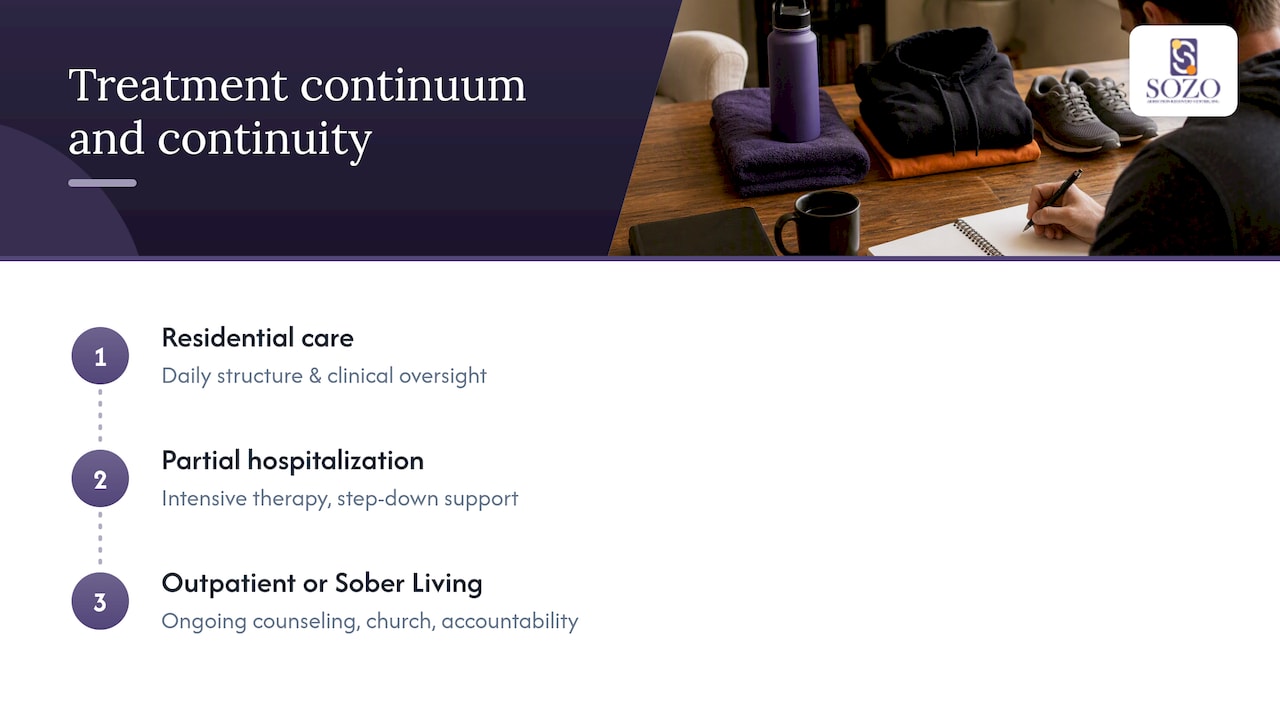
This is where continuity of care becomes the deciding factor in whether early progress holds. A man who leaves residential treatment without a plan for ongoing counseling, church connection, and accountability is far more exposed to relapse than one who steps into sober living with those supports already in place. NIDA’s description of addiction as a treatable chronic disease underscores why: chronic conditions require ongoing management, not a single intervention and an assumption that the work is finished.
Faith-based continuity looks like a scripture-based support group that continues meeting after discharge, a pastor who stays in contact, and a sober living environment that reinforces the habits built in treatment. The spiritual relationships formed during treatment often become the backbone of this continuity, which is part of why congregational involvement matters as much after a program ends as during it.
Common misconceptions about biblical addiction recovery
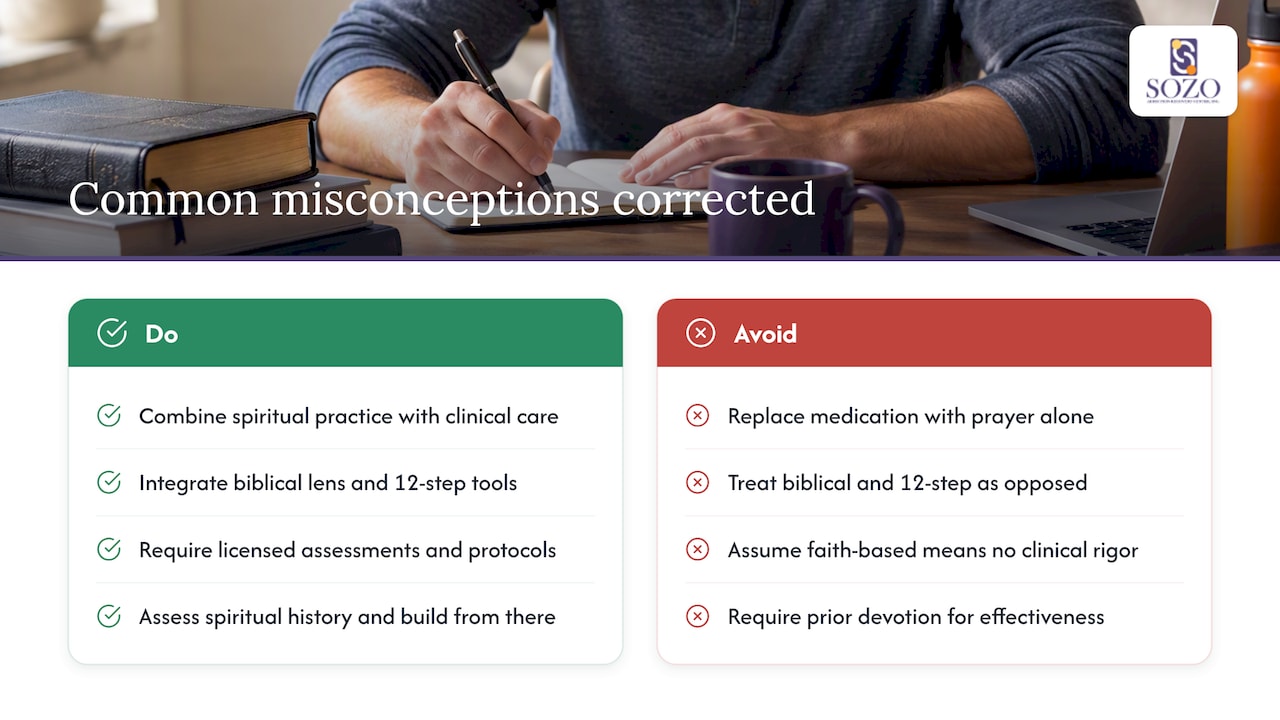
One persistent misconception is that faith-based recovery means replacing medicine with prayer alone. That is not what a responsible program does. The evidence consistently supports spiritual practice as a complement to clinical care, not a substitute for detox, medication, or psychiatric treatment when those are needed.
Another misconception treats biblical recovery and the 12-step model as opposing systems. In practice, many programs integrate the two directly, reframing concepts like surrender to a Higher Power through a biblical lens rather than discarding either framework. Research on religiosity and recovery from alcohol use disorder, reviewed by the National Institute on Alcohol Abuse and Alcoholism, suggests that reframing surrender in spiritual terms can reduce shame and strengthen social connectedness, which supports recovery rather than undermining it.
A third criticism holds that faith-based programs lack clinical rigor. This concern is fair when aimed at programs that genuinely skip licensed care, but it is not a necessary feature of biblical recovery itself. A program built on ASAM-informed assessment, licensed counseling staff, and documented clinical protocols can hold both scripture and clinical science without compromising either.
Finally, some assume biblical recovery only works for men who were already devout before treatment. Spiritual history assessment, as the ISAM position statement recommends, meets a man wherever his faith stands and builds from there rather than requiring a fixed starting point.
Integrating biblical recovery with mental health treatment and medications
Co-occurring mental health conditions, depression, anxiety, trauma, and others, are common alongside substance use disorders, and a biblical recovery approach does not ask a man to choose between spiritual care and psychiatric treatment. The two work together.
Dual-diagnosis care means a licensed clinician evaluates and treats mental health conditions directly, often through therapy and medication when indicated, while pastoral counseling and scripture-based support address the spiritual and relational dimensions of the same struggles. Neither track should operate in isolation. A man managing depression alongside substance use benefits from a counselor who understands both conditions and a pastoral mentor who respects the clinical plan rather than questioning it.
Medication-assisted treatment deserves the same clarity. When medications are clinically appropriate, whether for withdrawal management or for ongoing psychiatric stability, faith-based support should reinforce adherence, not cast doubt on it. The ISAM position statement’s recommendation to assess spiritual history alongside clinical evaluation reflects this balance: spirituality is one input among several that inform a complete, individualized plan.
Our approach to dual diagnosis and personalized care reflects this integration directly, building psychiatric and medical evaluation into the same plan as spiritual assessment and scripture-based support.
Tailoring biblical recovery for different kinds of addiction
Substance use disorders and behavioral addictions share underlying patterns, compulsive engagement, reward-driven cycles, and often deep shame, but they do not respond identically to the same interventions. A faith-based recovery plan should reflect that difference.
For substance use disorders, medical considerations like withdrawal management and medication-assisted treatment often take priority early on, with scripture-based counseling and pastoral mentoring building alongside stabilization. For behavioral addictions, such as compulsive gambling or pornography use, the clinical emphasis shifts more toward behavioral therapy and relapse prevention planning, while scripture and accountability structures address the shame and isolation that often drive these patterns.
What stays constant across both is the recovery capital framework the ISAM position statement describes: spiritual resources, community connection, and a sense of purpose function as protective factors regardless of which addiction a man is working through. The specific clinical tools shift. The underlying integration of spiritual and clinical support does not.
Supporting families and loved ones through the recovery process
Addiction does not affect one person in isolation, and families often carry their own exhaustion, confusion, and grief by the time a man enters treatment. A faith-based recovery program should actively include family members rather than treating them as bystanders.
Practical family involvement might include family counseling sessions, educational sessions explaining the ASAM-informed treatment process, and clear guidance on how to support recovery without enabling old patterns. Clergy and congregations play a role here too. As research on clergy involvement in mental health and addiction support notes, pastoral leaders are often among the first people a family turns to in crisis, which means they should be equipped to assess safety risks and refer families to appropriate medical or psychiatric resources rather than attempt to manage acute needs alone.
Spiritually, families benefit from the same scripture-based support offered to the man in treatment: prayer, community, and honest conversation about the toll addiction has taken. Recovery that includes family involvement from the outset tends to carry further, because the relationships a man returns to after treatment are the same ones that will either reinforce his progress or strain it.
Long-term relapse prevention within a faith-based framework
Relapse prevention in a biblical framework works on two tracks that reinforce each other over years, not weeks. The clinical track includes recognizing triggers, building coping skills, and often continuing some form of counseling or mutual-help participation well past formal discharge. The spiritual track includes sustained scripture engagement, ongoing accountability relationships, and consistent involvement in a faith community.
Neither track alone holds up as well as both together. A man who maintains clinical relapse prevention skills but loses his spiritual community often loses the sense of purpose that made sobriety feel worth protecting. A man who leans entirely on faith without maintaining clinical coping strategies can find himself unprepared for triggers that scripture alone does not address in the moment.
Sober living environments and church-based accountability groups both serve this long-term function, offering structure and relationship simultaneously. A sober living arrangement that reinforces recovery habits alongside continued congregational involvement gives a man two reinforcing systems rather than one.
Reviews cited by NIAAA on religiosity and alcohol recovery note that spiritual practices like prayer and mindfulness can be integrated directly with behavioral relapse-prevention strategies, suggesting the two are not competing approaches but complementary ones that, together, build a more durable foundation than either provides alone.
A pastoral and clinical perspective on what lasts
What holds a man in recovery long after treatment ends is rarely a single breakthrough moment. It is the slow accumulation of honest relationships, steady clinical support, and a faith that gets tested and holds anyway. We have watched men rebuild that kind of foundation through an integrated, ASAM-informed approach that treats scripture and clinical care as partners, not alternatives.
Ty
Take the next step with SOZO Recovery Center
We believe that a man does not have to choose between scripture and clinical science to find lasting recovery. Our programs use individualized planning alongside biblical counseling, 12-step integration, and pastoral mentoring, all within a small, peaceful setting designed for men.
If you are ready to talk through what a personalized plan could look like, our residential treatment program is a direct place to start, and our outpatient treatment option offers flexibility for men balancing work or family. Reach out to our admissions team to talk through what fits your situation.
FAQ
How to get rid of addiction biblically?
Biblical approaches address addiction through prayer, scripture study, pastoral counseling, and accountability within a faith community, used alongside clinical treatment such as counseling and medical care when needed. Research summarized by Harvard Health associates regular spiritual practice with lower likelihood of substance misuse, though spiritual practice works best as a complement to, not a replacement for, licensed treatment.
What is faith-based addiction recovery?
Faith-based addiction recovery integrates religious or spiritual practices, such as scripture study, prayer, and pastoral mentoring, with clinical treatment methods like counseling, medication when indicated, and relapse prevention planning. SAMHSA’s faith-based community guidance describes this as a partnership where congregations provide grassroots support that complements professional treatment rather than substituting for it.
How can I break the cycle of addiction?
Breaking a cycle of addiction typically requires a combination of professional clinical treatment, ongoing accountability, and, for many men, a spiritual or community framework that provides purpose and connection. The ISAM position statement notes that spiritual resources function as recovery capital, strengthening the other supports such as therapy and mutual-help groups that drive lasting change.
What does the Bible say about recovering drug addicts?
Scripture does not address substance use disorder in clinical terms, but biblical recovery programs draw on passages about surrender, renewal, and community support, such as Psalm 23 and James 5:16, to frame the emotional and spiritual dimensions of recovery. These themes are typically used alongside, not instead of, licensed clinical treatment for substance use disorders.
What programs does SOZO Recovery Center offer?
Programs commonly include residential treatment, partial hospitalization, intensive outpatient, outpatient care, sober living, medical detox placement, and dual-diagnosis treatment, typically built around individualized planning. Programs often integrate biblical principles and the 12-step model with licensed clinical care for men.
Sources
- Spirituality may protect against substance misuse, Harvard Health
- Faith and Community Engagement, SAMHSA
- How can prescription drug addiction be treated?, NIDA
- TIP 35: Enhancing motivation for change in substance use disorder treatment, SAMHSA