


Talk with your husband only when he is sober and calm, name specific things you have seen rather than labels, and offer concrete next steps like an evaluation or a doctor visit. If you see vomiting with unresponsiveness, seizures, suicidal talk, or violence, call 911 immediately. At the same time, reach out to a support group or your own doctor so you have help too.
TL;DR:
- Clearly identify specific behaviors and observable signs, such as unresponsiveness or seizures, before engaging in emergency action or conversations.
- Establish consistent boundaries, like keeping finances separate and refusing to allow drinking in shared spaces, to foster stability and natural consequences.
- Talk to your husband only when he is sober and calm, avoiding blame and focus on achievable steps like medical evaluation or therapy.
- Seek immediate help through hotlines or emergency services if he shows signs of hallucinations, hallucinations, or suicidal ideation, and prepare a safety plan in advance.
- Prioritize your own well-being by connecting with peer support groups and getting support before attempting to influence his treatment or behavior.
Table of Contents
- How his drinking affects you and your marriage
- How to talk with your husband about his drinking
- Setting boundaries and protecting yourself
- Warning signs that need emergency action
- Treatment and family approaches that actually help
- Where to find help right now
- A faith-based perspective on family support
- What the research gets right, and what it leaves out
- A next step if your husband is ready for treatment
- FAQ
- Sources
How his drinking affects you and your marriage
Living alongside a husband’s drinking wears on a person in ways that are easy to underestimate until they stack up. Sleep gets interrupted by worry or late nights. Trust frays a little more with every broken promise. Many spouses describe a kind of exhaustion that has nothing to do with physical tiredness and everything to do with always being on alert.
Family functioning matters more than most people realize. How a household communicates and copes shapes how recovery unfolds, which is why shifting from trying to fix the problem yourself toward becoming an informed, steady presence tends to work better than control ever does.
Common impacts worth naming for yourself:
- Chronic stress and a sense of walking on eggshells
- Disrupted sleep and constant low-grade worry
- Emotional exhaustion from managing someone else’s crisis
- Gradual erosion of trust that colors every interaction
How to talk with your husband about his drinking
Timing determines whether this conversation helps or backfires. According to the NIAAA Alcohol Treatment Navigator, the moment to talk is when he is sober, safe, and not in the middle of a crisis. Trying to extract a confession while he is drinking rarely works and often makes things worse.
- Choose a calm, sober moment when neither of you is rushed or upset.
- Rehearse what you want to say and stick to specific, observable behavior rather than character judgments.
- Use “I” statements: “I felt scared last night” lands differently than “You’re an alcoholic.”
- Keep your request narrow and achievable, like asking him to talk to a doctor, not demanding he quit forever on the spot.
- Offer real choices: an evaluation, a family meeting, a visit to his physician, so he has a path rather than a wall.
Avoid ultimatums that box both of you into an all-or-nothing corner. The goal of this first talk is not a resolution. It is an opening.
Pro Tip: Write your opening line down beforehand so nerves do not pull you toward blame in the moment.
Setting boundaries and protecting yourself
Boundaries are not punishments. They are the structure that lets you stay steady while he faces the consequences of his own choices. The NIAAA’s review of family roles in recovery treats boundary setting as a skill: decide ahead of time what you will and will not do, write it down, and plan your response before emotions take over.
Examples worth considering:
- Keep finances separate so his spending does not become your financial crisis.
- Decline to drink with him or allow drinking in shared living spaces.
- Refuse to cover for him at work or bail him out of legal trouble he caused while drinking.
- State clearly what happens if a boundary is crossed, then follow through every time.
Consistency matters more than severity. A boundary you enforce calmly and every single time teaches him something that shouting never will, and it lets natural consequences do the work instead of a confrontation that escalates.
Warning signs that need emergency action
Some situations cannot wait for a calm conversation. The Veterans Affairs guidance on alcohol use lists vomiting combined with unresponsiveness, seizures, hallucinations, and suicidal or violent statements as signs that require emergency help immediately, not a wait and see approach.
- Vomiting while unresponsive or unable to be woken
- Seizures or tremors that look uncontrolled
- Hallucinations or sudden confusion
- Any mention of suicide or violent intent toward himself or others
One of the medical risks spouses most often miss: according to VA guidance, stopping heavy, prolonged drinking abruptly without medical supervision can be dangerous, which is why a medical detox placement is sometimes necessary before anything else happens. If there is any history of domestic violence or you feel unsafe, the National Domestic Violence Hotline and similar intimate partner violence resources exist specifically for that situation. Build a short safety plan now, before you need it.
Treatment and family approaches that actually help
Treatment is not one size for every man. Options range from a primary care referral and outpatient counseling to intensive outpatient programs, residential care, and medication when a doctor recommends it. What tends to move the needle for families specifically is approaches built around them, not just around him.
SAMHSA’s guidance on family therapy points to methods like CRAFT, ARISE, and structured family therapy as ways to improve communication and increase the odds that he seeks help on his own. CRAFT in particular is built for the spouse: it teaches concrete skills for reducing enabling and encouraging treatment entry without confrontation.
When you talk to any program, ask these questions:
- Does the program offer medically supervised withdrawal protocols for his specific drinking history?
- Is there structured family education or coordinated family participation during treatment?
- What evidence-based therapies does the clinical team use?
Where to find help right now
You do not have to figure this out alone or from scratch. The SAMHSA National Helpline is a confidential, free, 24/7 line that connects families with local treatment options, and the NIAAA’s treatment guidance walks through counseling, medication, and group-based care as realistic paths forward.
- Call SAMHSA’s helpline or use FindTreatment.gov to locate programs near you.
- Look into Al-Anon or SMART Recovery Family and Friends for your own peer support.
- Ask any program directly about family services and whether detox placement is available.
- If travel or scheduling is a barrier, ask about remote options or faith-friendly programs before ruling anything out.
Preparing a short list of questions before you call makes the conversation faster and less overwhelming on a hard day.
A faith-based perspective on family support
SOZO Recovery Center combines clinical, ASAM-informed care with a faith-integrated approach for men, and families are part of that process from the start. Intake typically begins with an evaluation and a conversation about family education options. A referral call is a reasonable first step, not a commitment.
What the research gets right, and what it leaves out
Most guidance on this topic focuses heavily on the conversation itself, as if the right words at the right moment will unlock change. That emphasis is not wrong, but it overstates what any single talk can do. Timing and tone matter, yet the deeper lesson in the family research is that your actions over weeks and months, not one good conversation, shape whether he seeks help.
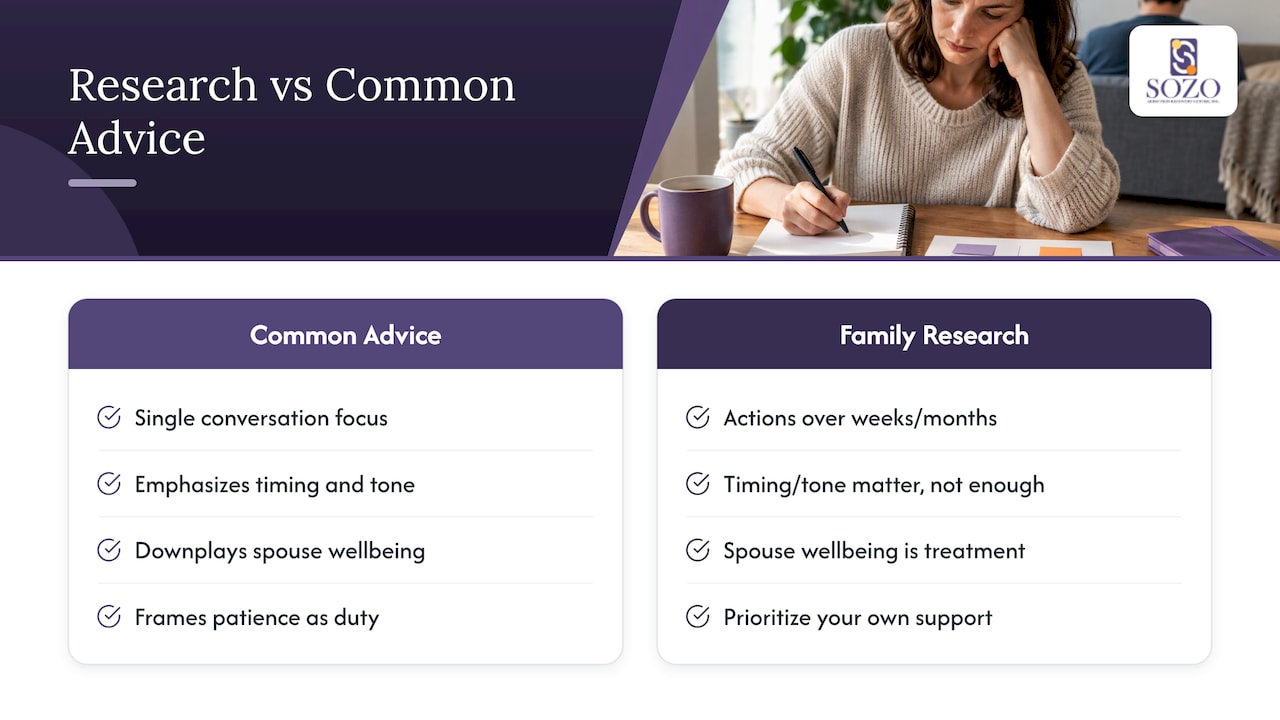
The part conventional advice underplays is your own wellbeing. Spouses are often told to be patient, supportive, and endlessly understanding, with little said about the cost of carrying that alone. Family functioning improves outcomes, which means your stability is not a side issue. It is part of the treatment.
If there is one thing to prioritize first, it is getting support for yourself before you expect to change anything about him. A spouse who is grounded, informed, and connected to her own support system is in a far stronger position to hold boundaries and recognize warning signs than one who is running on worry alone.
Ty
A next step if your husband is ready for treatment
If your husband is open to evaluation or treatment, some recovery centers offer structured paths that pair clinical care with faith-based support in small, residential settings built specifically for men. Families may be included in the process, with education and guidance potentially available during and after intake.
You can learn more about the Residential Treatment program or review Intensive Outpatient options if he needs flexibility to keep working. The simplest next step is a call to admissions for an assessment, which carries no obligation and starts the conversation on his terms.
This article is general information, not a substitute for advice from a qualified doctor. Consult a qualified healthcare professional about your own circumstances before acting on anything here.
FAQ
How can I cope with my alcoholic husband?
Focus on what you can control: your own safety, your support network, and clear boundaries you actually enforce. Groups like Al-Anon and approaches such as CRAFT give spouses practical skills for reducing stress and encouraging change without taking on the drinking itself as your job.
How can I best support an alcoholic family member?
The most effective support combines calm, factual conversations timed for sobriety with consistent boundaries and encouragement toward treatment. SAMHSA’s guidance on family therapy notes that family involvement in care, not just the individual’s willpower, tends to improve engagement in treatment.
What resources are available for wives of alcoholics?
The SAMHSA National Helpline offers free, confidential referrals around the clock, and the NIAAA’s Alcohol Treatment Navigator provides tools built specifically for family members starting this process. Al-Anon meetings and SMART Recovery Family and Friends groups offer ongoing peer support as well.
What are some examples of boundaries I can set with my alcoholic spouse?
Common boundaries include keeping finances separate, not allowing drinking in shared living spaces, and declining to cover for him with work or legal consequences caused by his drinking. Writing the boundary down ahead of time and deciding your response in advance makes it easier to follow through calmly when the moment comes.