


Expect roughly 20 or more hours a week for partial hospitalization (PHP), 9 to 20 hours a week for intensive outpatient (IOP), and under 9 hours a week for standard outpatient care. Daily time blocks run from full-day PHP sessions to 2 to 4 hour IOP blocks and 1 to 2 hour outpatient visits. Every outpatient rehab schedule gets built around a man’s clinical needs first, then adjusted for work, school, and family life.
TL;DR:
- PHP typically requires 20 or more hours of treatment weekly, often in 5 to 6 hour daily blocks, ideal for early recovery or stepping down from residential care.
- IOP usually involves 9 to 20 hours each week, with sessions lasting 2 to 4 hours across three to five days, balancing active treatment with daily life demands.
- Standard outpatient schedules involve fewer than 9 hours weekly, generally consisting of one to three sessions of one or two hours and are suitable for maintenance or aftercare.
- Treatment plans are highly individualized, with adjustments for co-occurring mental health conditions, medication monitoring, and personal needs, making weekly schedules flexible.
- Programs often combine group therapy, skills training, psychoeducation, and individual or medication management sessions, with options like evening or telehealth slots to accommodate work and family commitments.
Table of Contents
- How Does Outpatient Rehab Work: PHP, IOP, and Standard Outpatient
- Sample Daily Schedules for Each Level of Care
- What Actually Happens During Each Treatment Block
- Fitting Outpatient Treatment Around Work, School, and Family
- How Long Treatment Lasts and What Comes Next
- SOZO’s Outpatient Schedule: How ASAM Planning Shapes a Real Week
- Choosing a Schedule That Fits Both Your Recovery and Your Life
- Get Started With SOZO’s Outpatient and IOP Programs
- Sources
- FAQ
How Does Outpatient Rehab Work: PHP, IOP, and Standard Outpatient
Three levels of care make up most outpatient treatment, and each one asks for a different slice of a man’s week. Partial hospitalization sits at the top of outpatient intensity. It typically runs 20 or more hours per week, often delivered in 5 to 6 hour days, and functions almost like day treatment without an overnight stay. Intensive outpatient scales that back to roughly 9 to 20 hours weekly, usually split into 2 to 4 hour sessions across three to five days. Standard outpatient asks for the least time: fewer than 9 hours a week, often just one to three sessions lasting an hour or two apiece.
| Level | Typical hours/week | Typical session length | Common use case |
|---|---|---|---|
| PHP | 20+ | 5 to 6+ hours/day | Early recovery, stepping down from residential |
| IOP | 9 to 20 | 2 to 4 hours/session | Active treatment while managing daily life |
| Standard OP | Under 9 | 1 to 2 hours/session | Maintenance and aftercare |
A few things shift these numbers for any given man:
- Co-occurring mental health conditions often add individual therapy or psychiatric visits.
- Medication-assisted treatment, when part of the plan, requires scheduled medical monitoring that SAMHSA notes affects timing around group hours.
Sample Daily Schedules for Each Level of Care
Numbers on a page only tell part of the story. Seeing an actual day mapped out makes the outpatient recovery schedule real.
A typical PHP day:
- 8:30 to 9:00 a.m.: Check-in and morning psychoeducation
- 9:00 to 11:00 a.m.: Process group therapy
- 11:00 a.m. to 12:00 p.m.: Individual therapy or medication management
- 12:00 to 1:00 p.m.: Lunch and break
- 1:00 to 3:00 p.m.: Skills group (relapse prevention or CBT/DBT)
- 3:00 to 4:00 p.m.: Adjunctive therapy (exercise, art, or spiritual reflection)
IOP templates, by time of day:
- Morning IOP: 9:00 a.m. to 12:00 p.m., three days a week, roughly 9 hours weekly
- Afternoon IOP: 1:00 to 4:00 p.m., four days a week, roughly 12 hours weekly
- Evening IOP: 6:00 to 9:00 p.m., three nights a week, about 9 hours weekly built specifically around a workday
Standard outpatient maintenance:
- One 90 minute group session weekly, plus a biweekly individual therapy check-in
- Two 1 hour sessions weekly for men newly stepped down from IOP
None of these are locked in stone. A clinician might swap a Tuesday psychoeducation block for a family session, or move an individual therapy slot to accommodate a work shift. The frame stays consistent even when the details flex.
What Actually Happens During Each Treatment Block
The hours on an outpatient therapy timetable fill up with distinct kinds of work, not just “more talking.” Group therapy anchors most sessions, where men process experiences together and challenge each other’s thinking under a therapist’s guidance. Skills groups teach specific tools, often drawn from cognitive behavioral therapy or dialectical behavior therapy, aimed at emotional regulation and relapse prevention. Psychoeducation blocks explain the biology and patterns of addiction in plain terms. Individual therapy digs into a man’s personal history and triggers one-on-one, and medication management visits handle prescriptions and monitoring, particularly for men on medication-assisted treatment.
Adjunctive therapies, like exercise groups or art therapy, usually get scheduled around the heavier clinical blocks rather than in place of them.
- Group process and skills training: the bulk of scheduled hours
- Individual therapy and medication visits: shorter, often weekly or biweekly
- Adjunctive activities: filled in around core treatment, not instead of it
- Homework: journaling, worksheets, or step work between sessions
Pro Tip: Ask your treatment team for a written weekly template before your first day. Seeing the actual blocks on paper makes it far easier to plan work shifts or childcare around it.
Fitting Outpatient Treatment Around Work, School, and Family
Balancing rehab appointment planning with a job or a household is the part most men worry about before they ever start. Evening IOP exists precisely for this reason, letting a man work full days and attend treatment after hours. Telehealth check-ins fill gaps for individual sessions when driving to a facility isn’t realistic. Some programs also offer weekend groups or condensed PHP formats for men who need intensity but can’t give up five weekdays.
Three things make the schedule stick:
- Block off treatment hours on a work calendar the same way you’d block a doctor’s appointment.
- Ask the program directly about make-up sessions before you enroll, not after you miss one.
- Line up childcare or family coverage for the same days each week so it becomes routine rather than a scramble.
Watch for warning signs that the current schedule isn’t working: repeated missed sessions, falling behind on skills the group has already covered, or a counselor mentioning stalled progress. Any of those usually mean it’s time to talk about adjusting the weekly rehab sessions or stepping to a different level of care.
Pro Tip: If evening hours still conflict with your job, ask specifically about telehealth options for individual therapy. Many programs will swap one in-person slot for a virtual one without changing your overall weekly hours.
How Long Treatment Lasts and What Comes Next
Program length varies by level, but rough patterns hold across most outpatient recovery schedules. PHP often runs 2 to 6 weeks before stepping down. IOP commonly lasts 6 to 12 weeks. Standard outpatient can continue for months as a maintenance phase.
Clinicians decide on progression using attendance, symptom stability, and how well a man is applying skills outside of sessions, consistent with the continuity-of-care principles that guide addiction treatment generally. Research on treatment intensity backs this stepped approach: higher-contact programs support stabilization, while lower-intensity outpatient care builds the kind of everyday skill practice that sticks after discharge.
Aftercare typically includes:
- Weekly outpatient groups
- Ongoing individual therapy, often monthly
- Sober living referrals for men who need continued structure at home
SOZO’s Outpatient Schedule: How ASAM Planning Shapes a Real Week
SOZO Recovery Center builds outpatient and IOP weeks using the ASAM criteria as the starting framework, then adjusts for each man’s clinical picture and faith background. A typical IOP week might run Monday, Wednesday, and Friday evenings from 6:00 to 9:00 p.m., combining group process, relapse prevention skills, and a dedicated block for spiritual reflection or Scripture study, an approach similar in structure to the multi-day format documented in Saint Luke Institute’s Emmaus Program schedule.
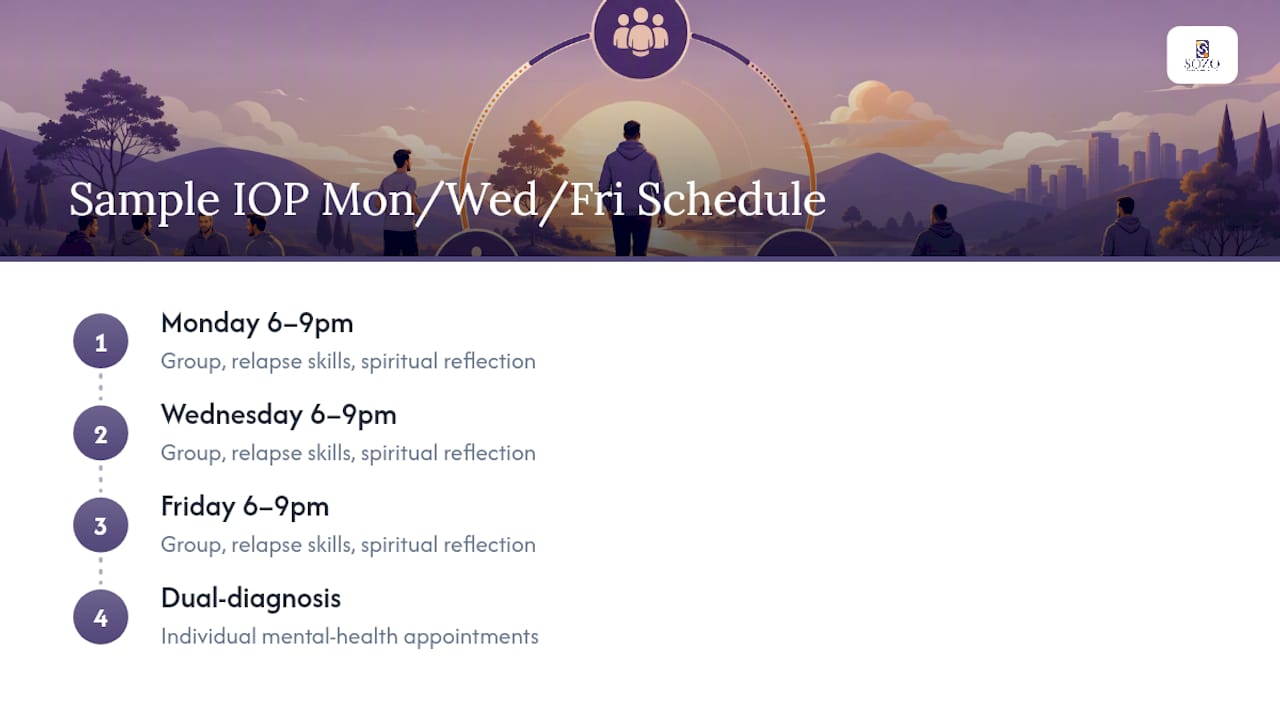
Dual diagnosis sessions are often provided as individual appointments rather than group time, so mental health needs receive direct attention alongside addiction work. Faith elements may be integrated within the weekly plan, alongside the 12-step model. Specific outcome data and staff credentials for programs may be available through admissions.
Choosing a Schedule That Fits Both Your Recovery and Your Life
The mistake I see men make most often is picking a schedule based only on convenience, then quietly falling behind clinically because the intensity didn’t match what they actually needed. The better approach is asking your intake counselor two questions directly: what level of care fits my history, and what evening or telehealth options exist within that level. Then request a written sample week before you commit to anything.
Ty
Get Started With SOZO’s Outpatient and IOP Programs
SOZO Recovery Center builds outpatient and IOP schedules around a man’s actual life, not a one-size-fits-all calendar, using ASAM-informed planning to set hours that match his clinical needs and his obligations at work or home.
Every plan folds in personalized care and dual diagnosis support, so mental health treatment runs alongside addiction work instead of waiting behind it. Men balancing a job or family responsibilities can ask directly about evening IOP options that keep daytime hours free, or step into standard outpatient care for ongoing maintenance after a higher level of treatment. If managing a nicotine habit alongside recovery is part of the picture, resources like this habit management guide can help round out the plan. Contact an admissions team to discuss your situation and request a sample week built around your schedule.
This article is general information, not a substitute for advice from a qualified doctor. Consult a qualified healthcare professional about your own circumstances before acting on anything here.
Sources
- Medication-assisted treatment | SAMHSA
- Review: Outpatient treatment intensity and outcomes
- Mapping the Healing Journey: Emmaus Program Schedule (SLI)
FAQ
How many hours a day is outpatient rehab?
Standard outpatient sessions usually last 1 to 2 hours a day. IOP typically runs 2 to 4 hours a day, and PHP often fills 5 to 6 or more hours daily, closer to a full workday.
What should I expect during outpatient rehab?
Expect a mix of group therapy, individual sessions, psychoeducation, and possibly medication management, depending on your treatment plan. Programs like SOZO’s outpatient track also build in adjunctive activities and, for faith-based programs, spiritual reflection alongside clinical work.
How many hours per day is IOP?
IOP sessions generally run 2 to 4 hours per day, scheduled three to five days a week for a weekly total between 9 and 20 hours. Many programs offer morning, afternoon, or evening blocks so the hours can fit around a job or school.
What is a 30 day outpatient program?
A 30 day outpatient program usually refers to a focused stretch of IOP or PHP care lasting about a month before stepping down to a lighter schedule. Actual length varies by clinical progress, since treatment planning is individualized rather than fixed to a calendar date.