


Christian trauma counseling for addiction works best as an integrated approach: licensed, trauma-trained clinicians treating both conditions together, with faith practices woven in as a source of grounding rather than a substitute for clinical care. If trauma and addiction are feeding each other, dual-diagnosis treatment is the recommended path, not a general counselor or a pastoral conversation alone. If you or someone you love is in crisis right now, call 911 or the 988 Suicide and Crisis Lifeline. Otherwise, the next right step is scheduling an intake assessment with a trauma-capable, licensed program.
TL;DR:
- Christian trauma counseling requires licensed clinicians with trauma-specific training who integrate faith as a grounding tool, not a substitute for clinical treatment.
- Dual diagnosis treatment must address both trauma and addiction simultaneously, prioritizing stabilization before trauma processing begins.
- Effective programs use evidence-based therapies like EMDR, TF-CBT, and DBT alongside biblical practices, with careful pacing and personalized care plans.
- Vetting providers involves confirming credentials, trauma-specific certifications, dual-diagnosis experience, and a transparent approach to faith integration.
- In crisis, immediate safety takes precedence through emergency services, while structured assessment, payment plans, and faith community support follow for ongoing recovery.
Table of Contents
- What Is Christian Trauma Counseling and How Does It Blend Faith With Clinical Care?
- Why Does Trauma Drive Addiction, and What Does Dual Diagnosis Mean?
- How Do You Choose a Christian Trauma Counselor or Faith-Based Program?
- What Treatment Pathways and Therapies Should You Expect?
- How Do You Start: Assessment, Payment, and Safety Planning?
- How Should Faith Communities and Pastors Support Recovery?
- What Happens When Faith Beliefs and Clinical Methods Seem to Conflict?
- What Self-Help Practices Support Trauma and Addiction Recovery Between Sessions?
- How Do You Address Stigma Around Addiction in Christian Communities?
- What Do Real Recovery Outcomes Look Like With This Approach?
- A Publisher’s Perspective on What Faith-Integrated Treatment Should Look Like
- How SOZO Recovery Center Approaches Faith-Integrated Treatment for Men
- Sources
- FAQ
What Is Christian Trauma Counseling and How Does It Blend Faith With Clinical Care?
Christian trauma counseling is clinical trauma treatment delivered by licensed professionals who also integrate a client’s faith into the healing process. It is not the same as pastoral counseling, which typically focuses on spiritual guidance without formal clinical training in trauma or addiction. A trauma-informed Christian counselor holds both roles: the clinical training to treat nervous-system dysregulation, and the theological literacy to help a client process where God was during their worst moments.
Faith gets integrated in a handful of concrete ways, not as decoration but as active parts of the treatment plan:
- Scripture used intentionally, tied to specific therapeutic goals rather than quoted generically
- Prayer offered as an option, never mandated, and shaped around the client’s own tradition
- Collaboration with a client’s pastor or church leadership, with consent, to align support outside sessions
- Connection to faith-based community groups and peer support that reinforce recovery between appointments
For many religious clients, this blend actually improves engagement. When faith integration happens alongside evidence-based clinical treatment, clients often stay in therapy longer and report feeling more understood, because the counselor isn’t asking them to set aside a core part of their identity to get well.
There’s a caution worth stating plainly here: faith should never function as a way to skip past emotional processing. A counselor who leans on Scripture or prayer to avoid the hard clinical work of trauma processing is doing a client harm, not good. The strongest programs use spiritual practices for grounding and meaning while clinical tools do the work of calming an overactive nervous system and changing behavior.
Why Does Trauma Drive Addiction, and What Does Dual Diagnosis Mean?
Trauma changes how the body and brain respond to stress long after the danger has passed. Hypervigilance, emotional numbing, dissociation, and sudden reactivity are survival adaptations, not character flaws or spiritual failures. The nervous system learned to protect itself, and it often keeps doing so years after the original threat is gone.
Addiction frequently grows directly out of these adaptations. Alcohol quiets hypervigilance. Opioids numb emotional pain that feels unbearable. Stimulants can temporarily override the fog of dissociation. The substance becomes a fast, effective, and ultimately destructive form of self-medication.
Dual diagnosis is the clinical term for co-occurring trauma (or another mental health condition) and a substance use disorder happening at the same time, each one reinforcing the other. Treating only the addiction while ignoring the trauma underneath it tends to produce short relapses followed by more relapses, because the underlying pain was never addressed. Treating only the trauma while active substance use continues rarely works either, since a dysregulated nervous system under the influence can’t engage fully in trauma processing.
The clinical sequence that actually holds up:
- Stabilization first: safety, sleep, basic nervous-system regulation
- Trauma processing second, paced deliberately so it doesn’t overwhelm the client
- Integrated treatment planning throughout, addressing both diagnoses in the same plan rather than two separate tracks
Trauma responses are survival adaptations that deserve treatment, not judgment, and effective care respects the pace the nervous system needs to heal.
How Do You Choose a Christian Trauma Counselor or Faith-Based Program?
Not every counselor who mentions faith is qualified to treat trauma or addiction, and not every addiction program that says “faith-based” has clinical depth behind it. Vetting a provider takes a few specific questions.
Steps to evaluate a counselor or program:
- Verify the license. Confirm the clinician holds a real credential: LPC, LCSW, or LMFT. This is the baseline, not a bonus.
- Check trauma-specific training. Ask about certifications like CCTP (Certified Clinical Trauma Professional) or formal EMDR training. General counseling experience is not the same as trauma expertise.
- Confirm dual-diagnosis experience. Ask directly whether they’ve treated clients with co-occurring addiction and trauma, and how they sequence that care.
- Ask how faith gets integrated. A good provider explains their approach to Scripture and prayer clearly and confirms that spiritual doubt or anger at God is welcome in session, not corrected.
- Ask about levels of care. Confirm whether the program uses ASAM-informed assessments to match you to outpatient, intensive outpatient, or residential care based on actual clinical need rather than a one-size-fits-all track.
- Ask about medical detox. If withdrawal risk is present, confirm the program has a referral network for medically supervised detox before therapy begins.
- Ask about telehealth. Confirm whether virtual sessions are available, which matters if in-person access is limited or if home itself is a trigger.
Pro Tip: Ask a prospective counselor this exact question: “What do you do when a client is angry at God?” Their answer tells you more about their trauma competence than any credential on the wall.
Red flags include a provider who can’t name a license, who treats prayer as a replacement for a treatment plan, or who can’t describe how they’d handle a client in active withdrawal.
What Treatment Pathways and Therapies Should You Expect?
Levels of care generally run along a continuum: outpatient counseling, intensive outpatient (IOP), partial hospitalization, residential treatment, and sober living as a step-down after residential care. The ASAM Continuum is the standard framework many clinical programs use to match a person’s assessed needs (withdrawal risk, co-occurring conditions, environment, motivation) to the right level, rather than defaulting everyone to the same track regardless of severity.
Inside that continuum, faith-integrated programs typically draw from a specific set of evidence-based trauma therapies:
- EMDR (Eye Movement Desensitization and Reprocessing), used to help the brain reprocess stuck traumatic memories
- TF-CBT (Trauma-Focused Cognitive Behavioral Therapy), which addresses distorted trauma-related thinking
- DBT (Dialectical Behavior Therapy), useful for emotional regulation and distress tolerance
- IFS (Internal Family Systems) and somatic approaches, which work with how trauma is held in the body
- Brainspotting, a newer body-based trauma technique gaining traction alongside EMDR
Supportive modalities round out the clinical work. Art therapy gives clients a non-verbal way to process pain that talk therapy alone sometimes can’t reach, and licensed Christian trauma counselors often combine trauma-focused CBT and EMDR with biblical integration to help clients rebuild both psychological safety and spiritual footing. Faith-based 12-step integration adds ongoing community accountability once formal treatment ends.
Realistic recovery rarely comes from one therapy alone. Most lasting outcomes come from combining two or three of these approaches over an extended period, not a brief one, with the sequence adjusted as stabilization improves.
How Do You Start: Assessment, Payment, and Safety Planning?
Getting started follows a fairly predictable sequence, even though the timeline varies person to person.
- Schedule a trauma-capable intake assessment. This should screen for suicide risk, co-occurring mental health conditions, and the appropriate ASAM level of care, not just ask about substance use history.
- Ask about insurance and payment. Confirm whether the program accepts your insurer, offers a sliding scale, or can coordinate a referral to medical detox if withdrawal risk is present.
- Build a safety plan before you need it. Know who to call, where to go, and what warning signs mean it’s time to act immediately, not wait until the next scheduled appointment.
If you’re in withdrawal or in immediate danger, that takes priority over any counseling appointment: call 911, go to an emergency room, or contact the 988 Suicide and Crisis Lifeline right now. For less urgent situations, many Christian counseling practices now offer secure telehealth options, which matters when in-person access is limited or when leaving home itself is a trigger tied to the trauma.
How Should Faith Communities and Pastors Support Recovery?
A pastor is rarely the right person to lead trauma or addiction treatment alone, but a faith community is often exactly the right place to sustain recovery once clinical treatment is underway. The two roles work best in parallel, not competition.
Pastoral involvement works when it’s coordinated, not improvised. With a client’s written consent, a treatment team can loop in a pastor to reinforce recovery goals outside of session, without that pastor attempting to manage clinical symptoms they aren’t trained to treat. A pastor who understands the treatment plan can pray with a client, check in weekly, and encourage church involvement without accidentally undermining the clinical work by suggesting that enough faith should be sufficient on its own.
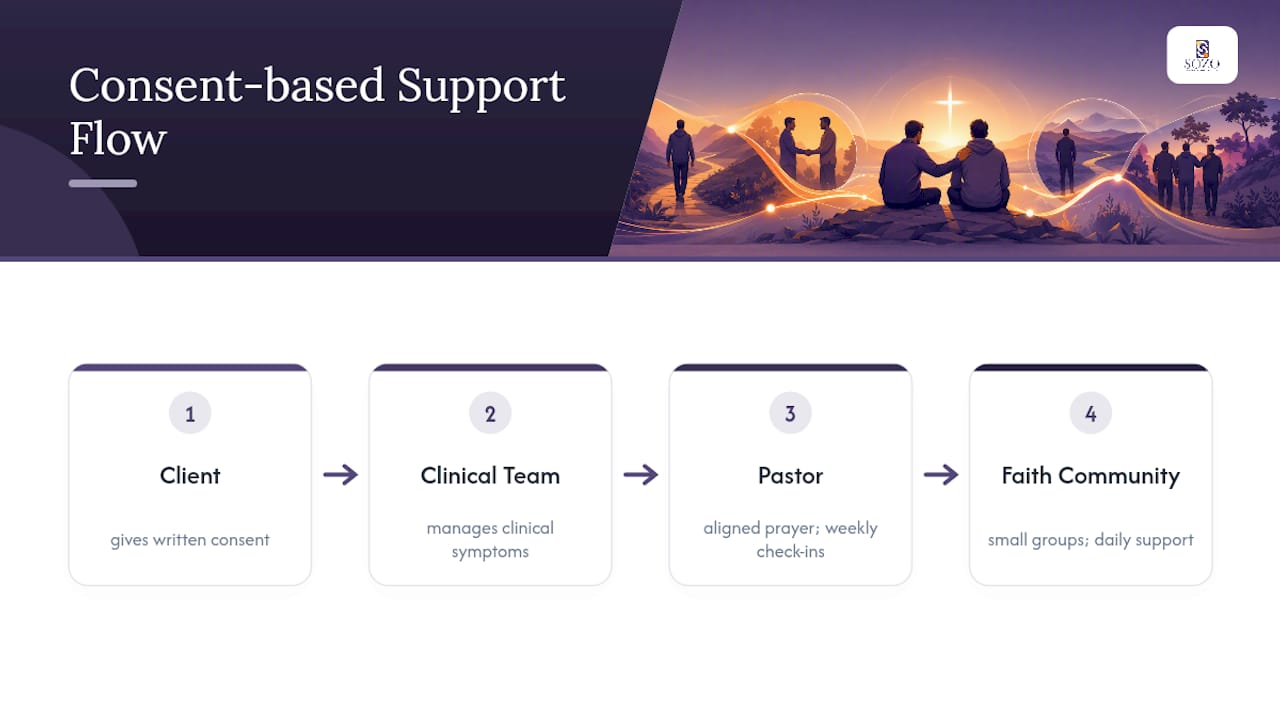
Church small groups, recovery ministries, and accountability partners fill a gap that clinical appointments can’t: daily presence. Community support and peer connection play a real role in sustaining sobriety long after formal treatment ends, particularly for men who need consistent relationships to stay accountable between sessions.
The practical move for families: ask the treatment program whether they’ll coordinate directly with a pastor or church recovery group, and give written permission for that communication to happen. Faith communities that understand the clinical plan tend to become genuine allies in recovery. Faith communities kept in the dark sometimes give well-meaning advice that conflicts with what a trauma-informed counselor is working toward.
What Happens When Faith Beliefs and Clinical Methods Seem to Conflict?
Tension sometimes surfaces between a client’s theology and a clinical technique, and it’s worth naming directly instead of pretending it never happens. A client might wonder whether EMDR’s focus on the body conflicts with a belief that healing should come through prayer alone. Another might feel guilt for needing medication alongside spiritual practice, as though that need reflects a lack of faith.
A skilled trauma-informed Christian counselor treats these moments as material for the work, not obstacles to route around. The clinical goal and the spiritual goal are usually not actually in conflict. EMDR doesn’t ask anyone to abandon their theology; it works with how memory is stored in the brain, regardless of what a client believes about its origin. Medication for co-occurring depression or anxiety isn’t a substitute for faith any more than insulin is a substitute for faith for someone with diabetes.
Where real friction exists, the counselor’s job is to name it openly and let the client decide how to hold both. That might mean adjusting language around a technique, incorporating prayer before or after a somatic exercise, or simply giving the client space to sit with a hard theological question rather than rushing to resolve it. Therapists working in this space report that spiritual questions like “Where was God during this?” surface constantly after trauma, and the counselors who make room for that question, instead of answering it too quickly, tend to see clients stay engaged in treatment longer.
What Self-Help Practices Support Trauma and Addiction Recovery Between Sessions?
Clinical sessions happen once or regularly. Recovery happens every day, which means the hours in between matter as much as the appointment itself.
A few practices consistently show up in what clients describe as helpful, alongside professional treatment:
- Grounding techniques, like naming five things you can see and four things you can hear, to interrupt hypervigilance or dissociation in real time
- Scripture meditation on specific passages tied to identity and worth, chosen deliberately rather than randomly
- Journaling, which gives trauma memories a container outside the body
- Physical movement, since trauma often lives in the body and gentle exercise helps discharge stored stress
- Structured prayer or contemplative practice, done consistently rather than only in crisis moments
- Peer support meetings, whether a 12-step group or a church recovery ministry, for daily accountability
None of these replace clinical treatment for someone with significant trauma or an active substance use disorder. They work as scaffolding around the clinical work, filling the gaps between sessions with practices that keep the nervous system regulated and the spirit anchored. A client who only shows up once a week and does nothing in between tends to progress more slowly than one who builds a handful of these habits into daily life.
How Do You Address Stigma Around Addiction in Christian Communities?
Addiction still gets treated as a moral failure in some churches, framed as a sin problem that prayer and willpower alone should fix. That framing does real damage. It keeps people quiet about their struggle out of shame, delays them from seeking treatment, and sometimes convinces families that professional help means a lack of faith.
The clinical reality contradicts that framing directly. Addiction changes brain chemistry and often grows out of trauma responses the person never chose. Sin and moral failure aren’t irrelevant to a Christian understanding of struggle, but treating addiction as purely a discipline problem ignores the neurological and psychological reality of what’s actually happening in a person’s body.
Churches that handle this well tend to do a few things differently. They talk about addiction from the pulpit instead of avoiding it. They treat a request for treatment as a sign of wisdom, not weakness. They partner with licensed treatment providers instead of trying to handle serious substance use disorders through counseling ministry alone. They make space for men and families to say out loud that they’re struggling without fear of being quietly judged afterward.
Families researching options for a loved one can help shift this by modeling the language they want their church to use: framing treatment as courage, not failure, and talking about recovery the same way they’d talk about treating any other serious health condition. Stigma loses power the moment enough people stop treating the subject as something to whisper about.
What Do Real Recovery Outcomes Look Like With This Approach?
Outcomes in faith-integrated trauma and addiction care tend to look less like a single dramatic turning point and more like a series of smaller, compounding shifts. Faith-based programs commonly treat single-incident trauma, complex developmental trauma, spiritual or church-related hurt, and co-occurring addiction together, and clients frequently report improved sleep, better emotional regulation, and a renewed sense of hope as integrated treatment progresses.
The pattern that shows up again and again: a man enters treatment believing his addiction is the whole problem, only to discover in trauma-focused sessions that the substance was never really the target. It was managing something underneath, often an experience from years or decades earlier that he’d never named out loud, sometimes not even to himself. Once that trauma gets addressed with the same seriousness as the addiction, the cravings that felt unbeatable start losing their grip, not because willpower improved, but because the nervous system finally has less to run from.
That doesn’t mean the process is quick or linear. Setbacks happen. Trauma processing can surface pain before it resolves it, which is part of why pacing and stabilization come first in any competent treatment plan. But the men who stay engaged through that harder middle stretch, supported by both clinical care and a faith community that doesn’t flinch at their story, tend to come out the other side with something more durable than sobriety alone: a coherent account of what happened to them and why, and a faith that survived contact with the hardest parts of their history.
A Publisher’s Perspective on What Faith-Integrated Treatment Should Look Like
The gap between how Christian addiction treatment gets marketed and how it should actually work is wide. A lot of faith-based programs lean on testimonials and Scripture without much clinical infrastructure behind them, which leaves men with real trauma undertreated no matter how sincere the spiritual care is. SOZO Recovery Center was built around the opposite premise: ASAM-informed individualized treatment plans, dual-diagnosis capability, and expressive modalities like art therapy sit alongside biblical principles and 12-step work, not instead of them.
Ty writes from experience with SOZO’s men’s-focused program, where faith functions as fuel for the hard clinical work rather than a way around it. The men who do best tend to be the ones who stop treating spiritual growth and clinical treatment as competing priorities. Programs that understand why faith and clinical care belong together don’t ask a man to choose. They build a plan around both.
— Ty
How SOZO Recovery Center Approaches Faith-Integrated Treatment for Men
The center offers a residential, faith-integrated path for men addressing addiction and trauma. Programming includes residential care, outpatient and intensive outpatient options, dual-diagnosis treatment, and sober living, shaped by individualized ASAM-informed plans rather than a fixed schedule.
Before an intake call, it helps to have a rough history ready: what’s been used, for how long, whether withdrawal has happened before, and any past mental health diagnoses or trauma history you’re willing to share. That information lets the intake team build an honest picture from the first conversation instead of guessing. If dual-diagnosis care sounds like where you or a family member currently stands, SOZO’s dual-diagnosis treatment program walks through what integrated assessment and treatment actually look like in practice, in Hot Springs, Arkansas. Reach out to schedule a consultation and get a clear answer on the right level of care, rather than carrying the question alone any longer.
Sources
For deeper reading on trauma’s clinical effects, see the NCBI overview of trauma and the nervous system. For faith-integrated counseling practice, see Grace Christian Counseling’s trauma resources.
This article is general information, not a substitute for advice from a qualified doctor. Consult a qualified healthcare professional about your own circumstances before acting on anything here.
- Understanding the impact of trauma on the nervous system (NCBI)
- Christian trauma counseling ultimate guide (Grace Christian Counseling)
FAQ
What Is Christian Trauma Counseling for Addiction?
It’s clinical trauma and addiction treatment delivered by licensed counselors who also integrate a client’s faith through Scripture, prayer, and pastoral collaboration, without replacing evidence-based methods like EMDR or TF-CBT.
Can Faith-Based Treatment Handle Serious Trauma and Addiction Together?
Yes, when the program has licensed, trauma-trained clinicians and uses ASAM-informed assessments to match treatment intensity to the person’s actual clinical needs; SOZO Recovery Center structures its men’s program around a program combining trauma-trained clinicians, licensed care, and ASAM-informed assessments.
Is EMDR Compatible With Christian Beliefs?
Yes. EMDR works with how the brain stores traumatic memory and doesn’t require a client to set aside any specific theology; many Christian trauma counselors use it alongside biblical integration.
How Do I Know if a Program Is Trauma-Informed?
Ask whether clinicians hold trauma-specific certifications like CCTP or EMDR training, whether they use paced processing rather than pushing too fast, and whether they screen for dual diagnosis at intake.
What if I’m in Crisis Right Now?
Call 911 or the 988 Suicide and Crisis Lifeline immediately; counseling and program intake can wait until you’re safe, but an active crisis or withdrawal risk cannot.