


The most relied-on scriptures for addiction recovery are 1 Corinthians 10:13, John 8:36, James 5:16, 1 Peter 5:8, and Romans 5:3-5, each addressing a different stage of the fight for sobriety. Below, you’ll find a working list of verses, grouped by the exact struggle you’re facing, along with daily practices for turning scripture into habit and a look at how scripture fits alongside clinical treatment.
TL;DR:
- The most critical verses for addiction recovery focus on temptation, identity, endurance, and confession, and should be paired with specific, rehearsed actions for effectiveness.
- Memorizing two key scriptures and linking each to a concrete behavior can help create automatic responses to cravings and triggers.
- Regular confession and accountability are essential to interrupt relapse patterns, with open sharing being more effective than secrecy.
- Scripture alone is insufficient; integrating biblical principles with clinical treatment and support maximizes recovery success.
- Using scripture as a timely mental or verbal anchor during moments of weakness strengthens long-term habits and prevents relapse.
Table of Contents
- Key Scriptures for Addiction Recovery You Can Use Today
- Which Verse Fits Your Struggle Right Now?
- How to Actually Use Scripture in Daily Recovery
- How Faith-Based Treatment Puts These Verses to Work
- Sample Prayers and Meditations for Recovery
- What Scripture-Centered Recovery Looks Like in Practice
- How to Read Scripture Without Misusing It in Recovery
- Get Support Beyond the Verses
- Why the List Isn’t the Point
- Sources
- FAQ
Key Scriptures for Addiction Recovery You Can Use Today
A man in early recovery doesn’t need a seminary degree. He needs a handful of verses he can call on the moment a craving hits, and he needs to know what to actually do with them. The list below pairs each verse with a plain application, not a theology lecture.
- 1 Corinthians 10:13 — God provides “a way out” of temptation. When the pull hits, name the way out: call your sponsor, walk outside, or say the verse out loud before you decide anything else. Faith-based counselors describe this verse as a literal promise of an exit, not a metaphor.
- John 8:36 — “If the Son sets you free, you will be free indeed.” Recite this when shame tells you sobriety isn’t really yours yet. This verse is often used in recovery teaching to reframe freedom as identity, not a reward you have to earn back.
- James 5:16 — Confess your struggles and pray for one another so you may be healed. Use this tonight: tell one trusted person the truth about today, not the polished version.
- 1 Peter 5:8 — “Be sober-minded, be watchful.” Set this as a mental checkpoint each morning: what am I watching for today?
- Romans 5:3-5 — Suffering produces endurance, character, and hope. Read this on the days recovery feels like nothing but loss.
- Proverbs 20:1 — Wine and strong drink lead astray. Use it as a plain, unromantic warning label when you’re tempted to minimize a substance’s grip.
- Ephesians 5:18 — Do not get drunk, but be filled with the Spirit. Pair this with a replacement behavior: prayer, a walk, a phone call, before the craving wins by default.
- 1 Corinthians 6:12 — “I will not be mastered by anything.” Say this when you catch yourself rationalizing “just this once.”
- 2 Corinthians 5:17 — The old is gone, the new has come. Use it when old labels (addict, failure) creep back into how you talk to yourself.
- Philippians 4:13 — “I can do all things through him who strengthens me.” Use it before a hard conversation, not just before a craving.
- Psalm 34:18 — The Lord is near the brokenhearted. Read this on the loneliest night of the week.
- Psalm 51:10 — “Create in me a clean heart.” A short prayer for mornings after a slip, without spiraling into self-punishment.
- Isaiah 41:10 — “Fear not, for I am with you.” Use it walking into a triggering environment (a funeral, a holiday, a former hangout).
- Galatians 5:1 — “For freedom Christ has set us free.” Say it when an old relationship or habit tries to pull you back.
- Matthew 11:28 — “Come to me, all who are weary.” Use it when exhaustion, not craving, is the actual threat.
- 2 Timothy 1:7 — God has not given a spirit of fear but of power, love, and self-control. Say this before a step meeting or a hard family visit.
- Psalm 121:1-2 — “My help comes from the Lord.” A one-line prayer for the drive past a liquor store or old dealer’s block.
- James 1:2-4 — Trials produce steadfastness. Read this during withdrawal or the flat, gray weeks of early sobriety.
- 1 John 1:9 — If we confess our sins, he forgives and cleanses. Use this the morning after a relapse instead of hiding.
- Hebrews 12:1 — Run the race with endurance. A verse for month six, when the newness has worn off and the work is just showing up.
Which Verse Fits Your Struggle Right Now?
Different moments call for different scriptures. Matching the verse to the actual feeling, craving, shame, exhaustion, or isolation, makes it far more useful than reading at random.
Temptation and the moment of craving:
- 1 Corinthians 10:13 — use when a craving hits and you need an actual exit plan, not just willpower.
- 1 Corinthians 6:12 — use when you’re rationalizing “just once.”
- James 4:7 — “Resist the devil, and he will flee from you.” Use as a direct command in the first ten seconds of a craving.
Freedom and new identity:
- John 8:36 — use when shame says sobriety isn’t real yet.
- 2 Corinthians 5:17 — use when old labels creep back in.
- Galatians 5:1 — use when an old relationship pulls at you.
Strength and endurance:
- Romans 5:3-5 — use on the days recovery feels like pure loss, not gain.
- Philippians 4:13 — use before something hard, not just before a craving.
- Hebrews 12:1 — use in the flat middle stretch of recovery, past the initial motivation.
Sobriety and self-control:
- Ephesians 5:18 — use as a daily replacement practice, not just a warning.
- 1 Peter 5:8 — use as your morning watchfulness checkpoint.
- Proverbs 20:1 — use as a blunt reality check when minimizing risk.
Comfort for the brokenhearted:
- Psalm 34:18 — use on the loneliest nights.
- Matthew 11:28 — use when exhaustion, not craving, is the threat.
- Psalm 51:10 — use the morning after a slip.
How to Actually Use Scripture in Daily Recovery
Reading a verse once doesn’t change a habit. Repetition does. Here’s a simple structure that turns these scriptures into something you actually lean on.
- Memorize one verse at a time. Pick the one that matches your worst moment of the week, not the one that sounds nicest.
- Put it where you’ll see it. A lock screen, a note on the bathroom mirror, a card in your wallet. The point is friction. It should interrupt you before a bad decision does.
- Do a morning check-in. Two minutes: read the verse, name today’s likely trigger, and decide the micro-action in advance.
- Match verses to HALT. Hungry, Angry, Lonely, Tired: each state has a different pull. Pair Psalm 34:18 with loneliness, James 1:2-4 with anger, Matthew 11:28 with exhaustion.
- Confess before it festers. James 5:16 isn’t abstract. It means telling your sponsor or group the real version of your day, not the edited one, because open confession is tied to lower shame and better long-term outcomes.
Pro Tip: Rehearse your verse and your action together, out loud, before you need them. “When I feel the pull toward the liquor store, I say 1 Corinthians 10:13 and I call my sponsor” works better in the moment than a verse alone.
If a craving turns into a plan to use, or if you experience thoughts of self-harm, treat that as a medical emergency: call 988 or go to the nearest emergency room. Scripture supports recovery; it does not replace crisis care or clinical treatment.
How Faith-Based Treatment Puts These Verses to Work
A verse memorized alone in a bedroom is a start. A verse practiced inside a structured program, with accountability and clinical oversight, tends to hold up better under real pressure. That’s the working theory behind SOZO Recovery Center’s faith-based rehab model in Hot Springs, Arkansas, which builds personalized treatment plans around ASAM criteria while integrating biblical principles with the 12-step model.
Inside that structure, scripture isn’t decorative. Confession groups apply James 5:16 directly. Identity work leans on 2 Corinthians 5:17, the old is gone, the new has come, as a working definition of who a man is becoming, not just what he’s stopped doing. Relapse prevention planning uses specific verses as rehearsed anchors, the same trigger-matching approach described above, but built with a counselor and reinforced daily.
Faith without structure can drift into good intentions. Structure without faith can feel hollow. The combination is what SOZO Recovery Center is built around:.
Sample Prayers and Meditations for Recovery
A short prayer works better than a long one when a craving is loud. Keep these close, and adapt the wording until it sounds like your own voice.
For the moment of craving: “Lord, you promised a way out. Show it to me right now. Give me the strength to take it instead of the substance.” (Rooted in 1 Corinthians 10:13.)
For morning check-in: “Today I choose to be sober-minded and watchful. Where I am weak, be my strength.” (Rooted in 1 Peter 5:8 and Philippians 4:13.)
For the morning after a slip: “I confess where I fell short. Create in me a clean heart, and help me tell the truth to someone today.” (Rooted in Psalm 51:10 and 1 John 1:9.)
For loneliness: “You are near to the brokenhearted. I don’t want to isolate today. Bring someone across my path, or bring me to them.” (Rooted in Psalm 34:18.)
For the long middle stretch: “This suffering is producing endurance in me, even when I can’t feel it yet. Give me hope for tomorrow.” (Rooted in Romans 5:3-5.)
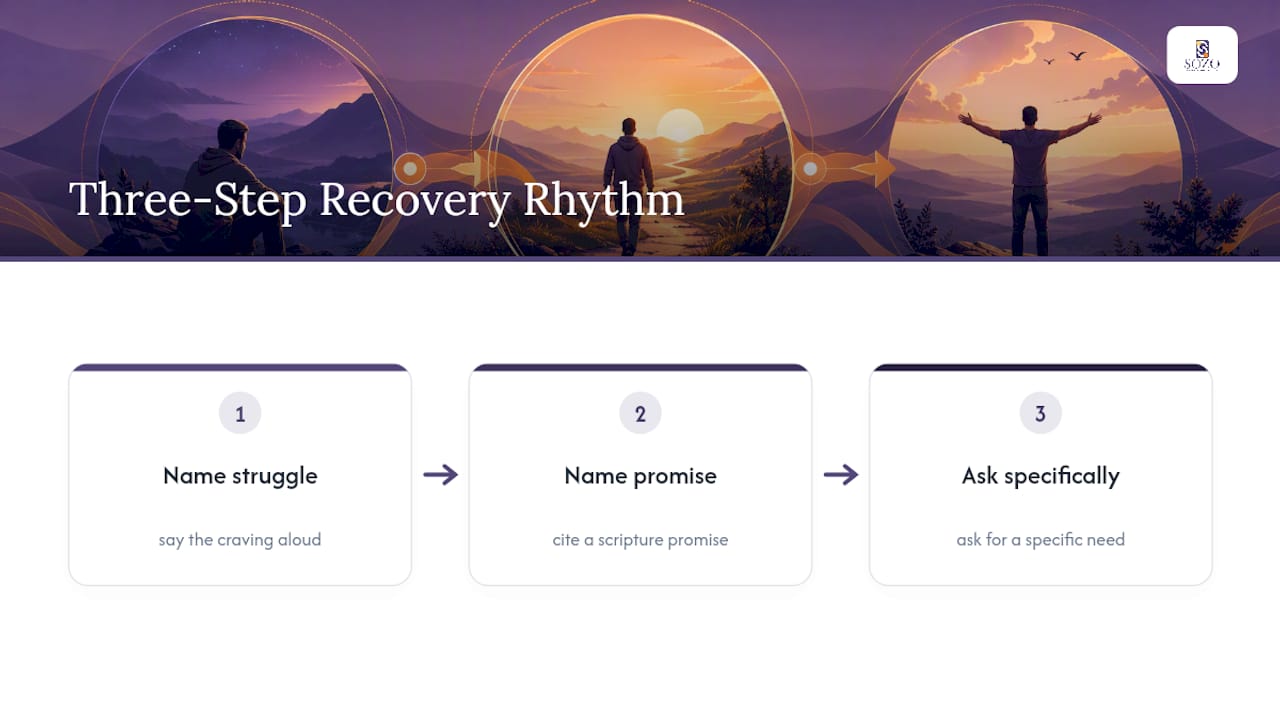
None of these need to be recited word for word. The goal is a rhythm: name the struggle, name the promise, ask for the specific thing you need. Five minutes with one of these, said out loud, tends to do more than twenty minutes of silent worry.
What Scripture-Centered Recovery Looks Like in Practice
The pattern shows up again and again in men’s recovery testimonies: a specific verse becomes the anchor at the exact moment willpower runs out. One man might describe gripping 1 Corinthians 10:13 in a parking lot outside a bar, repeating it until the urge passed enough to drive away. Another might point to James 5:16 as the verse that finally got him to tell his sponsor the truth about a near relapse instead of hiding it for another week.

What these stories share isn’t a dramatic conversion moment. It’s the ordinary, repeated act of reaching for the same verse under pressure until the response becomes automatic. Men who describe lasting change from faith-based programs, including those who’ve gone through SOZO Recovery Center’s program, often point less to a single breakthrough and more to the accumulation of small, scripture-anchored decisions made on ordinary Tuesdays.
That’s worth sitting with if you’re early in recovery and frustrated that a verse “didn’t work” the first time you tried it. Scripture functions more like a muscle than a switch. The story isn’t usually “I read this once and never struggled again.” It’s “I read this a hundred times, and by the fortieth time it started to hold.”
How to Read Scripture Without Misusing It in Recovery
Scripture can be twisted into something it was never meant to be, especially when someone’s in pain and looking for a shortcut. A few guardrails keep the reading honest.
Don’t use a verse as a magic formula. Philippians 4:13 doesn’t mean a craving will vanish the instant you recite it; it means strength is available as you take the next right action.
Don’t weaponize scripture against yourself. Verses about suffering and endurance (Romans 5:3-5, James 1:2-4) describe growth through hardship. They aren’t meant to justify staying in a harmful situation or to guilt yourself for struggling.
Don’t isolate a verse from its context to avoid accountability. James 5:16 calls for confession within community, not private reassurance that skips the hard conversation.
Don’t confuse conviction with condemnation. Scripture that names sin honestly is different from an inner voice that says you’re beyond help. If a verse leaves you feeling crushed rather than corrected, talk it through with a pastor, counselor, or sponsor before internalizing it.
Don’t substitute scripture for medical or psychiatric care. The Bible doesn’t use clinical language like “addiction,” but its descriptions of bondage and loss of self-control still point toward the same reality modern treatment addresses, just from a theological angle rather than a clinical one.
Get Support Beyond the Verses
Start with the treatment locator, then let scripture guide the daily work alongside it.
- SAMHSA’s National Helpline — free, confidential treatment referral and information, available around the clock.
- Way of Escape commentary on 1 Corinthians 10:13 — deeper background on the temptation verse used throughout this guide.
- 12 Steps and the Bible: A Faith-Based Recovery Guide — pairs each step with related scripture.
- Faith-Based Recovery at SOZO Center — program details for men ready to pursue structured, faith-informed treatment.
Why the List Isn’t the Point
Most guides to scriptures for addiction recovery stop at the list, twenty verses, a nice graphic, done. That’s the gap worth naming plainly: a verse without a rehearsed response is just a nice sentence. The men who actually change their patterns are the ones who pair a verse with a physical action, taken in the same second the craving arrives, rehearsed until it’s automatic.
The conventional advice undersells James 5:16. Confession gets treated as an emotional nice-to-have when it’s closer to a structural requirement. Secrecy is where relapse quietly builds; open, regular confession to a specific person is what interrupts that pattern before it becomes a crisis.
If you take one thing from this guide, prioritize this: pick two verses, not twenty, memorize them this week, and decide right now what physical action goes with each one. Do that before you worry about the other eighteen. Scripture paired with structure, and ideally with clinical support, holds up under real pressure in a way that scripture alone often doesn’t.
— Ty
This article is general information, not a substitute for advice from a qualified doctor. Consult a qualified healthcare professional about your own circumstances before acting on anything here.
Sources
- GotQuestions — Way of escape from temptation
- Proclamation Coalition — No longer bound: John 8:36
- BibleHub — James 5:16
- SAMHSA — Recovery
FAQ
What is the best scripture for recovering addicts?
There’s no single “best” verse, but 1 Corinthians 10:13 is the one most cited for its direct promise that God provides a way out of temptation, paired with a practical exit.
What is the best Bible for recovering addicts?
Any standard translation works if paired with a recovery devotional or step guide; what matters more than the edition is reading it alongside a specific plan, like the pairings in 12 Steps and the Bible.
Is there a psalm for addiction?
Psalm 34:18 and Psalm 51:10 are the two most used in recovery contexts, the first for loneliness and heartbreak, the second for confession after a setback.
What does Jesus say about addiction?
Jesus doesn’t use the word “addiction,” but John 8:36 records his promise that those he sets free are free indeed, a verse widely used in faith-based recovery to reframe sobriety as identity rather than willpower.
Can scripture replace professional addiction treatment?
No. Scripture complements clinical care but doesn’t replace it; SAMHSA and treatment locators like FindTreatment.gov exist specifically because spiritual support works best alongside medical and behavioral treatment, not instead of it.