


Yes, anger in recovery is common and it is not a character flaw. The single most important rule while you’re in the middle of it: do not make decisions while you’re activated. Take a timeout, use a safety script, and give your nervous system time to settle before you speak, text, or act. Everything else in this guide builds on that one habit.
TL;DR:
- Anger during recovery often stems from repressed grief, trauma, and learned behaviors that surface as substances no longer mask these emotions.
- Managing anger effectively requires avoiding decision-making in activated states by using timeouts, breathing exercises, physical discharge, and reaching out for support.
- Structured therapy such as CBT or DBT, along with support groups and relapse prevention plans, helps build lasting anger regulation skills beyond immediate de-escalation tactics.
- Addressing underlying trauma and co-occurring mental health issues is crucial, especially in faith-based or dual-diagnosis programs that integrate spiritual practices with clinical treatment.
- Rebuilding trust after anger damage involves consistent changed behavior over time, specific apologies, and respecting the other person’s pace without rushing forgiveness.
Table of Contents
- Why Anger Shows Up During Recovery
- How Unmanaged Anger Raises Your Relapse Risk
- Immediate Ways to De-escalate Anger in the First 15 Minutes
- Clinical Approaches That Build Lasting Anger Control
- Talking to Family Without Making It Worse
- What Faith-Integrated, Dual-Diagnosis Care Looks Like for Anger Work
- Rebuilding Trust After Anger Has Done Damage
- Why Self-Compassion Lowers Anger Instead of Excusing It
- The Role of Sponsors, Peers, and Therapists in Anger Recovery
- Building a Long-Term Anger Plan for Each Stage of Recovery
- Mindfulness Practices Built for Anger, Not Just Stress
- Ty’s Perspective: The Habit Worth Trying This Week
- Sources
- FAQ
Why Anger Shows Up During Recovery
Substances often did a kind of emotional labor for years, numbing grief, fear, and resentment before they ever had a chance to surface. When you stop drinking or using, that labor stops too, and everything the substance was covering starts to rise. Irritability during acute withdrawal usually eases within a few weeks, but the deeper emotional volatility of post-acute withdrawal can linger for months, according to clinician-authored research on early sobriety.
There’s a real difference between the two kinds of anger you’ll feel. A sudden surge, the kind that flares over a slow driver or a canceled plan, responds well to physical discharge and a bit of time. Long-simmering resentment, the kind built over years of broken trust or old wounds, needs a different approach entirely: writing, therapy, and the slower work of repair.
Trauma and co-occurring mental health conditions often sit underneath chronic anger, not just the occasional bad day. A SAMHSA anger-management manual built for clients with both substance use and mental health struggles makes this point directly: anger frequently signals that grief or trauma is resurfacing, and treating the anger alone without addressing what’s underneath leaves the job half finished. Common root causes include:
- Unprocessed grief over relationships, years, or opportunities lost to addiction
- Trauma responses that were never treated, only muted
- Learned anger habits modeled in childhood or reinforced during years of using
- Shame that curdles into irritability when it has nowhere else to go
Understanding why anger appears alongside trauma can take some of the sting out of the shame. You’re not broken. You’re unmasking something that’s been buried for a long time.
How Unmanaged Anger Raises Your Relapse Risk
Anger you don’t manage does not stay contained. It leaks into cravings, judgment, and relationships, and it does so on a predictable path. An activated nervous system narrows your thinking, cravings spike to quiet the discomfort, and impulsive decisions, including a drink or a hit, start to look reasonable when they otherwise wouldn’t.
Anger and substance use tend to feed each other in a loop that’s well documented across addiction treatment literature: anger triggers cravings, substance use lowers your tolerance for frustration, and the cycle tightens each time it repeats. Cleveland Clinic notes that people who go through structured anger-management therapy typically need several months of regular practice before the change holds, which tells you something important. This isn’t a one-time fix. It’s a skill you build in layers.
Watch for these red flags, which usually mean it’s time to bring in a clinician rather than handle it solo:
- Anger that leads to threats, property damage, or physical confrontation
- Rage that surfaces daily rather than occasionally
- Anger paired with active cravings or a near-miss with using again
- Withdrawal from sponsors, group, or family specifically to avoid conflict
If you’re noticing several of these at once, that pattern often overlaps with other relapse warning signs worth reviewing closely with someone you trust.
Immediate Ways to De-escalate Anger in the First 15 Minutes
When anger spikes, you have a short window of a few minutes before a surge either fades or turns into a decision you’ll regret. Use that window on purpose.
- Call the timeout out loud. Say it plainly: “I need fifteen minutes. I’ll come back to this.” You’re not walking away from the relationship or the argument, just from the risk of saying something in an activated state.
- Breathe on a count, not on a feeling. Box breathing, four seconds in, four held, four out, four held, works because it gives your nervous system a rhythm to follow instead of a feeling to fight. A few rounds of breathing exercises is usually enough to notice a shift.
- Move your body hard for sixty seconds. A short sprint, a set of push-ups, or a few minutes on a heavy bag burns off the adrenaline that talking alone can’t touch. Physical discharge downshifts the nervous system faster than cognitive strategies alone during an acute surge.
- Use cold water. Splash your face or hold ice water in your hands. The cold triggers a reflex that slows your heart rate almost immediately.
- Put the phone down. Do not text, call, or post while activated. Whatever feels urgent to say right now will still be true in fifteen minutes, said calmer.
- Postpone the decision, not the conversation. Tell the other person, or yourself, that you’ll revisit the issue once you’re steady, and mean it.
- Reach out if the surge doesn’t pass. Text a sponsor, a peer, or a therapist. You don’t need a crisis to justify the call.
Pro Tip: Write your timeout script down before you need it. In the moment, your brain is not great at generating calm language on the fly, but it’s excellent at reciting a line you’ve already memorized.
This sequence mirrors the immediate strategies laid out in the SAMHSA anger-management manual, which pairs timeouts and breathing with longer-term skill building for exactly this reason. In-the-moment tactics buy you time. They don’t replace the deeper work.
Clinical Approaches That Build Lasting Anger Control
The immediate tactics above stop the bleeding. Clinical treatment is what prevents the next wound. Cognitive behavioral therapy, often shortened to CBT, is the most researched approach for anger and it typically runs as a structured curriculum rather than open-ended talk therapy. The SAMHSA model, for example, spans twelve weekly ninety-minute sessions, moving through skills, homework, and an anger awareness record that helps clients spot their own patterns before they escalate.
Dialectical behavior therapy, or DBT, tends to serve people whose emotional swings are more intense or frequent, particularly when a co-occurring mental health condition is in the mix. DBT leans harder on distress tolerance and emotion regulation skills than CBT does, which makes it a good fit when anger feels less like a spike and more like a constant undertow. Research summaries consistently find CBT and DBT effective at reducing anger intensity and improving regulation, including among people in substance use treatment specifically.
Formats worth asking about include group therapy, peer support, and skills training:
- Anger-management groups, which normalize the experience and let you practice new responses in real time with peers who understand the stakes
- Mutual-help meetings and sponsorship, which offer accountability between clinical sessions
- Role-play and skills training, a Cleveland Clinic-documented technique that rehearses de-escalation before you need it for real
- Medication evaluation, worth raising with a clinician when anger is tangled up with depression, anxiety, or another diagnosis that talk therapy alone won’t fully address
If you’re managing anger in therapy for the first time, ask specifically whether the program treats co-occurring conditions alongside the substance use itself. Treating one without the other tends to leave gaps.
Talking to Family Without Making It Worse
The words you use in the first thirty seconds of a hard conversation usually decide whether it turns into repair or damage. “I” statements keep you out of blame territory: “I feel overwhelmed right now” lands very differently than “You always do this.”
A few scripts and boundaries worth having ready before you need them:
- Agree in advance with your partner or family that either of you can call a timeout, no explanation required in the moment
- Set a boundary around raised voices: “If either of us starts yelling, we pause and come back in twenty minutes.”
- After an outburst, apologize specifically and follow it with one concrete action, not just words. “I’m sorry I raised my voice. I’m going to call my sponsor tonight.”
- Keep the Substance Abuse and Mental Health Services Administration’s national helpline and the 988 Suicide and Crisis Lifeline saved in your phone, not just written down somewhere you’ll forget.
If anger ever turns physical, toward yourself, another person, or property, that is a 988 or emergency-services call, not a wait-and-see situation. Peer and family support structures work best when everyone involved already knows the plan before the crisis hits, not while it’s happening.
What Faith-Integrated, Dual-Diagnosis Care Looks Like for Anger Work
Anger work goes deeper when it’s treated alongside whatever else is driving it, and for many men that includes both a co-occurring mental health condition and a spiritual dimension they don’t want left out of treatment. Programs built around the ASAM Continuum criteria assess the full picture, substance use severity, mental health history, and readiness for change, before building a treatment plan rather than applying the same protocol to everyone.
Some faith-based programs combine clinical structure with spiritual practices like prayer, meditation, and the kind of self-examination built into 12-step work, particularly the reflection central to Step 11’s focus on awareness. Neither piece replaces the other. The clinical work gives skills; the spiritual work gives many men a framework for why those skills matter and where the strength to use them comes from.
A program worth your time on anger specifically should offer:
- Individual therapy that addresses anger’s roots, not just its symptoms
- Group CBT or skills training where you practice regulation with others in recovery
- Relapse-prevention planning that names anger explicitly as a risk factor
- Sober living support that extends the work past discharge, not just through it
When you’re evaluating any faith-based program, ask directly about its dual-diagnosis capacity, how it structures ASAM-informed assessment, and whether its testimonials and admissions process are transparent about what treatment actually involves.
Rebuilding Trust After Anger Has Done Damage
Trust doesn’t return because you apologize once and hope enough time passes. It returns because the people you hurt watch your behavior change and stay changed, over weeks and months, not a single conversation.
Start with a direct, specific accounting of what happened, not a vague “I know I’ve been difficult.” Naming the actual incidents, the night you slammed a door, the message you sent that you wish you hadn’t, tells the other person you’re not minimizing it. Vague apologies tend to read as self-protective even when they aren’t meant that way.
From there, consistency does more work than any grand gesture. Showing up to the same family dinner without an incident, three weeks running, tends to rebuild more trust than one long heartfelt letter. People who’ve been hurt by anger are watching for patterns, not promises.
Give the relationship room to heal at its own pace, too. Someone you’ve hurt gets to decide how quickly they let their guard down again, and pushing for faster forgiveness usually backfires. If a relationship feels stuck, a therapist trained in family systems or couples work can mediate conversations neither of you can have alone yet.
Some relationships also need a formal repair step, a written apology, a mediated conversation, or amends work that fits within step-based reflection. What matters most is that the repair is specific, ongoing, and backed by changed behavior rather than a single well-worded moment.
Why Self-Compassion Lowers Anger Instead of Excusing It
Self-compassion sounds soft until you notice how much anger is actually self-directed. Shame about relapse history, about what you did while using, about how long recovery is taking, often gets rerouted outward as irritability at the people closest to you.
Treating yourself with the same patience you’d offer a friend in early recovery tends to lower the baseline tension that makes outward anger so much easier to trigger. This isn’t about letting yourself off the hook. It’s about recognizing that shame spirals fuel the very behavior you’re trying to change, while a steadier, more forgiving internal voice actually makes it easier to take responsibility when you do mess up.
A simple practice: when you notice self-criticism spiking, ask what you’d say to someone else in your exact situation, then say that to yourself instead. It feels awkward at first. Most new skills do.
Self-compassion also makes it easier to return to your recovery plan after a hard day instead of spiraling into “I’ve already ruined it, so what’s the point.” That single reframe, from all-or-nothing to one bad moment in an otherwise long process, protects more sobriety than almost any other mental habit you can build.
The Role of Sponsors, Peers, and Therapists in Anger Recovery
You are not meant to manage this alone, and trying to is one of the more common reasons anger work stalls. A sponsor who’s walked through their own anger in recovery can spot your patterns faster than you can, precisely because they’ve lived a version of the same story.
Peer support groups offer something a one-on-one relationship can’t: the experience of hearing someone else describe the exact rage you felt last week, and realizing you’re not the only one who’s been there. That normalization alone reduces the shame that often makes anger worse.
Therapists bring structure and accountability that peer relationships, valuable as they are, typically can’t replace. A therapist trained in CBT or DBT can track your progress against specific skills over time, adjust the approach when something isn’t working, and treat co-occurring conditions that a support group isn’t equipped to address. The two roles complement rather than compete with each other.
Build your network before you’re in crisis, not during it. Know who you’ll call for a timeout, who you’ll process the deeper resentment with, and who’s tracking your clinical progress. If any of those three roles is empty right now, filling it is worth prioritizing this week.
Building a Long-Term Anger Plan for Each Stage of Recovery
Anger management in the first thirty days looks nothing like anger management two years in, and treating them the same is a common mistake. Early recovery calls for survival-level tactics: timeouts, breathing, and leaning hard on your support network because your own regulation skills are still under construction.
Around three to six months in, most people have enough stability to start the deeper work: naming the resentments underneath the surges, starting CBT or DBT if you haven’t already, and identifying the specific situations that reliably set you off. This is also when an anger awareness record, tracking triggers, intensity, and what worked, starts paying off, since patterns become obvious once you’ve logged a few dozen entries.
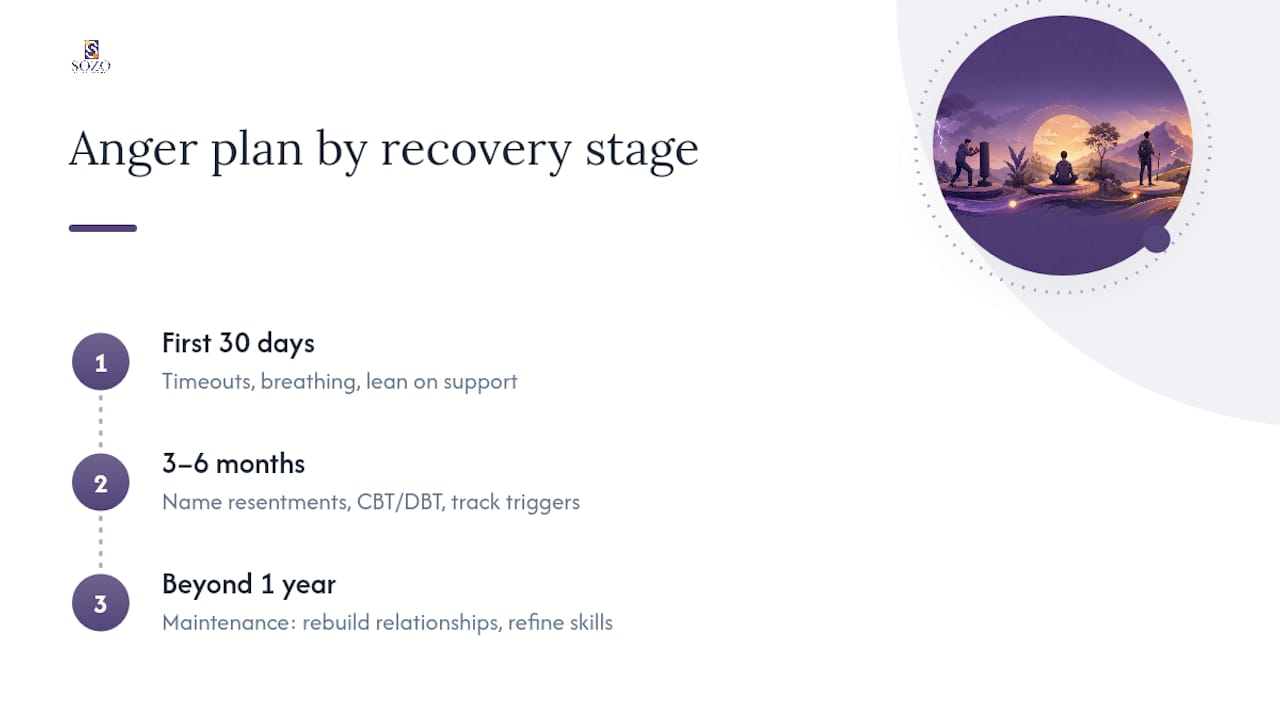
Long-term recovery, past the one-year mark, shifts the work toward maintenance and repair: rebuilding relationships damaged earlier, refining your skills under real-world stress rather than a controlled therapy setting, and staying alert to the fact that anger can resurface during major life stress even years into sobriety. Revisit your plan at each stage rather than assuming what worked at ninety days will still fit at two years.
Mindfulness Practices Built for Anger, Not Just Stress
Generic mindfulness advice tends to miss what makes anger different from ordinary stress: it moves fast and it wants a target. A meditation practice built for anger in recovery has to account for both.
A body scan done for five minutes each morning trains you to notice tension before it becomes a flare, which matters because most people feel anger physically well before they name it mentally, a tight jaw, a clenched fist, a fast heartbeat. Catching those cues early gives you a head start most reactive anger never allows.

Prayer or contemplative reflection, for those integrating faith into recovery, offers a similar function: a regular pause that interrupts rumination before it builds into resentment. The specific practice matters less than the consistency of returning to it daily, since mindfulness skills, like any other, fade without regular use. Pairing a structured mindfulness routine with your clinical anger work tends to produce steadier results than either approach alone.
Ty’s Perspective: The Habit Worth Trying This Week
Anger showing up isn’t a setback. It’s often a sign the deeper work of recovery is finally happening, since numbness was easier to manage but never actually healed anything. If you want one small experiment this week, try this: set a firm sleep goal each night, name one emotion out loud each morning before you leave the house, and pre-agree on a fifteen-minute timeout script with someone you trust. None of that fixes anger by itself. Together, over a week, it starts building the pause that makes everything else in this guide possible.
— Ty
This article is general information, not a substitute for advice from a qualified doctor. Consult a qualified healthcare professional about your own circumstances before acting on anything here.
Sources
- Anger Management for Substance Use Disorder and Mental Health Clients (SAMHSA)
- Anger management – patient information (MedlinePlus)
- Anger management: What it is, skills & techniques (Cleveland Clinic)
- Anger management: Tips to take control (Mayo Clinic)
FAQ
Why Do People in Recovery Get Angry?
Stopping substances removes what was often numbing grief, trauma, and stress for years, so those emotions surface as irritability while the brain and body relearn how to regulate without a chemical buffer.
Is Anger a Normal Stage of Healing in Recovery?
Yes. Anger commonly appears as buried emotions resurface, and it often signals that deeper healing work, rather than a setback, is underway.
What Are Healthy Ways to Release Anger in Recovery?
Short bursts of exercise, box breathing, cold water on the face, and talking it through with a sponsor or therapist are all backed as practical anger-control tips that don’t require confrontation to work.
Why Does Getting Sober Make Me Feel Angrier Than Before?
Substances muted your emotional range for years, and sobriety returns the full range at once, including anger that had nowhere to go while you were using. This surge typically eases over weeks, though it can take months for full emotional stability to return.
When Should I Get Professional Help for Anger in Recovery?
Seek help when anger leads to threats, damage, or harm, happens daily, or pairs with cravings, since professional guidance recommends treatment once anger feels out of your control.