


Yes, many men can get real addiction treatment without walking away from their job. The right fit depends on the level of care your clinician recommends and whether your role is safety-sensitive. Evening IOP, standard outpatient, and telehealth options let a lot of working men stay employed while they recover. The first step is a clinical assessment to find out which level of care actually matches what you need.
TL;DR:
- Evening intensive outpatient programs and telehealth options allow employed men to maintain work during recovery, provided their treatment matches their clinical needs.
- Federal laws like FMLA and ADA offer job protection and accommodations, but they require proper documentation and depend on employer size and specific job role.
- Detox from alcohol or benzodiazepines requires medical stabilization before scheduling work, with step-down care typically including evening IOP or outpatient services.
- Treatment planning should start with a clinical assessment and involve coordination of documentation to protect privacy while facilitating leave or accommodations.
- Many men underuse benefits like EAPs and insurance coverage, which can provide confidential support, legal protection, and help manage treatment without disclosing details to employers.
Table of Contents
- What Levels of Care Work Best for Employed Men?
- What Program Features Actually Support Working Clients?
- What Do FMLA, ADA, and Confidentiality Rules Actually Protect?
- How Should You Plan Treatment Around a Work Schedule?
- When Should You Stop Trying to Work Through Treatment?
- How Do You Request Leave or Accommodations Without Oversharing?
- What Employer Resources Can You Actually Use?
- How Does SOZO Approach Care for Employed Men?
- A Short Reflection on Work, Faith, and Recovery
- Get a Confidential Assessment That Accounts for Your Job
- Where to Find Official Guidance
- Sources
- FAQ
What Levels of Care Work Best for Employed Men?
Not every level of care bends around a work schedule. The four main tiers of treatment carry very different time demands, and matching the right one to your job is where recovery planning either works or falls apart.
- Standard outpatient: One to a few hours weekly, often just one or two sessions. Easiest to fit around full-time work.
- Intensive outpatient (IOP): Commonly 3 to 5 sessions weekly, roughly 2 to 4 hours each, frequently scheduled in the evening specifically so people can keep working days.
- Partial hospitalization (PHP): Daytime, multi-hour sessions most days of the week. This usually collides head-on with a full workday.
- Inpatient/residential: Round-the-clock structure. Requires a leave of absence, though some programs allow limited remote work later in a stay.
Withdrawal severity and co-occurring mental health conditions push the decision toward higher intensity, at least at first. A man detoxing from alcohol or benzodiazepines needs medical stabilization before any conversation about work schedules makes sense. Once stabilized, stepping down to evening IOP or outpatient care becomes realistic for many men.
What Program Features Actually Support Working Clients?
A program built for employed men looks different from one built purely around residential timelines. Before you enroll anywhere, ask intake staff about the specifics that determine whether treatment and your job can coexist.
- Does the program offer evening or telehealth tracks for IOP or outpatient sessions?
- Are make-up sessions available if a work shift or on-call rotation conflicts with a scheduled group?
- Can staff provide documentation for an employer or HR department without disclosing clinical details?
- What are the device, internet, and privacy policies for telehealth sessions attended during a workday or from a work location?
- How does the program coordinate FMLA or accommodation paperwork while protecting your treatment records?
Pro Tip: Ask specifically how a program handles “documentation of treatment” versus “diagnosis disclosure.” A well-run intake team will draft leave letters that confirm you’re in treatment without naming your diagnosis, which is exactly what federal privacy rules intend.
Programs that coordinate this well usually have a designated case manager, not just a therapist, handling the employer-facing side of your care; explore the best clean living addiction support products to complement your recovery journey.
What Do FMLA, ADA, and Confidentiality Rules Actually Protect?
Federal law gives working men real leverage here, but the protections have limits worth understanding before you assume too much or too little. The Family and Medical Leave Act lets eligible employees at covered employers take up to 12 weeks of unpaid, job-protected leave for treatment of a serious health condition, and substance use disorder qualifies. FMLA covers treatment itself, not absences caused by ongoing illegal drug use.
Eligible employees can take up to 12 weeks of unpaid, job-protected leave under FMLA for treatment of a serious health condition, and this leave can often be used intermittently for outpatient sessions.
Beyond FMLA, other protections and limits matter just as much:
- The ADA can require reasonable accommodations for men in recovery, such as adjusted schedules for therapy, unless the accommodation causes undue hardship for the employer.
- FMLA only applies to employers with 50 or more employees within 75 miles, and it requires 12 months of employment plus 1,250 hours worked.
- Safety-sensitive jobs (aviation, transportation, some healthcare and licensed professions) may trigger separate reporting or monitoring requirements regardless of these protections.
Small employers and licensed professions are where these protections get complicated fastest. Know your employer’s size and your profession’s regulatory rules before you plan around FMLA alone.
How Should You Plan Treatment Around a Work Schedule?
A phased approach protects both your recovery and your paycheck. Rather than treating “rehab” as one fixed block of time, think of it as a sequence that adjusts as you stabilize.
- Start with a clinical assessment to determine whether detox or medically supervised stabilization is necessary first.
- If stabilization is needed, use short-term leave, continuous or intermittent, to get through the highest-risk period safely.
- Step down into PHP or daytime IOP once medically cleared, adjusting work hours as needed.
- Move to evening IOP as intensity decreases, allowing a return to a normal workday.
- Transition to outpatient maintenance and aftercare, which most men can sustain alongside full-time employment.
Verify insurance coverage for each level of care early. Coordinate with your EAP or HR contact while keeping actual medical details private. This kind of step-down planning tends to preserve recovery gains better than jumping straight from residential care back into a 40-hour week.
When Should You Stop Trying to Work Through Treatment?
Pushing to stay employed during every phase of recovery isn’t always the wise move, and sometimes it’s outright dangerous. Certain situations call for leave, not accommodation.
- Withdrawal from alcohol or benzodiazepines carries real medical risk and requires supervised detox, not a modified work schedule.
- Active use or visible impairment on the job signals a relapse risk that outpatient scheduling won’t solve.
- Safety-sensitive or licensed roles, aviation, healthcare, commercial driving, may require formal monitoring or reporting that supersedes a simple return-to-work plan.
- A workplace that functions as a constant trigger (access to substances, high-stress culture tied to your use) needs to be addressed directly in your treatment plan, not worked around quietly.
If any of these apply to you, a short leave for stabilization protects your job far better than trying to white-knuckle through a schedule that isn’t built for where you actually are.
How Do You Request Leave or Accommodations Without Oversharing?
The order you approach this in matters almost as much as what you say. Start with your Employee Assistance Program if one exists, since EAPs typically offer confidential assessments without creating a formal personnel record. From there, loop in your treating clinician and HR in that sequence.
- HR generally needs medical certification of a serious health condition, not a diagnosis or treatment specifics.
- 42 CFR Part 2 and HIPAA both limit what your provider can disclose without your written consent.
- Sample phrasing that preserves privacy: “I’m requesting FMLA leave for treatment of a medical condition; my provider will submit the required certification directly.”
- Intermittent leave works well for ongoing IOP sessions that recur weekly rather than one continuous block.
- Keep copies of every certification, accommodation request, and return-to-work agreement for your own records.
Pro Tip: Never volunteer your specific substance or diagnosis to HR in writing. The certification form your clinician submits is legally sufficient, and oversharing creates information your employer never needed and can’t unlearn.
What Employer Resources Can You Actually Use?
Most employed men underuse the resources already sitting inside their benefits package. A few are worth checking before you assume you’re on your own.
- EAPs offer confidential short-term counseling and referrals that don’t touch your personnel file.
- Behavioral health parity laws generally require insurance plans to cover IOP and PHP similarly to other medical care, so verify your specific plan’s coverage before committing to a program.
- HR handles FMLA paperwork and insurance continuation during leave, but they don’t need clinical details to process it.
- If your employer is too small for FMLA to apply, check your state’s own leave laws or your company’s internal policy, since many exceed the federal minimum.
How Does SOZO Approach Care for Employed Men?
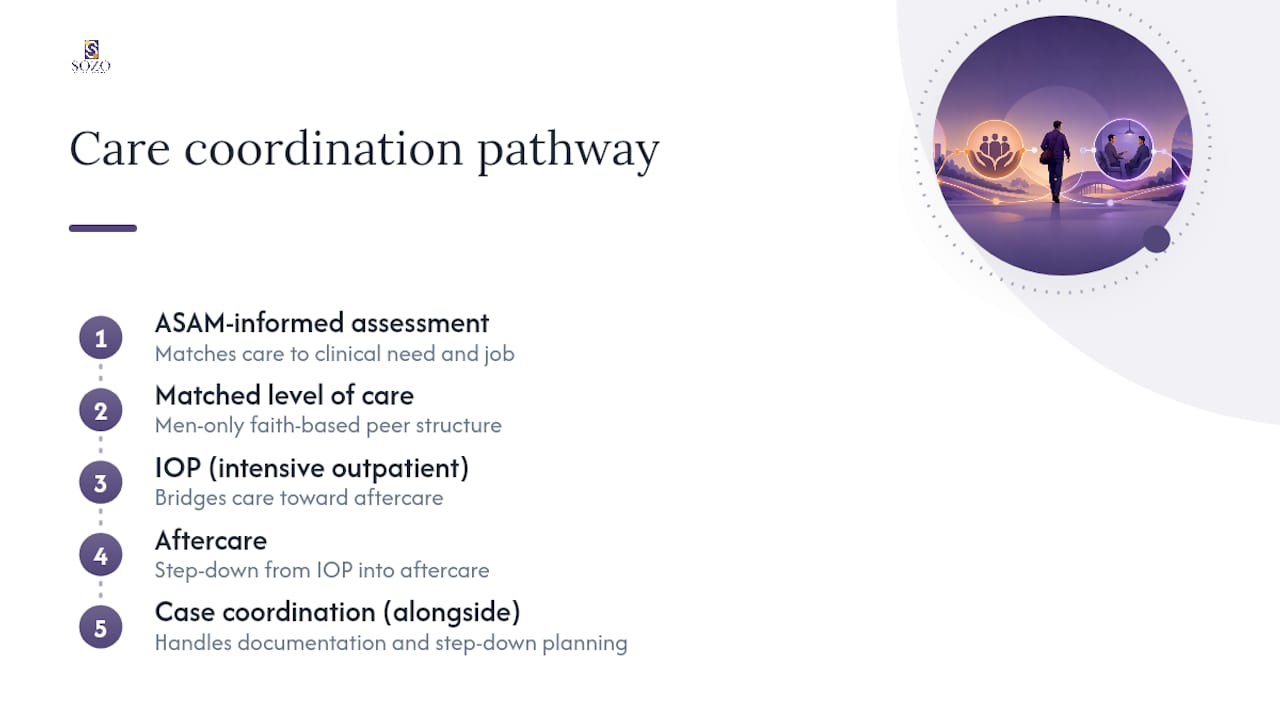
SOZO Recovery Center uses ASAM-informed assessments to match level of care to both clinical need and real-world responsibilities, including a job. A faith-based, men-only setting adds peer structure that some men find steadies them through a demanding stretch of dual diagnosis or outpatient care. Case coordination handles documentation and step-down planning, from IOP into aftercare, so employed clients aren’t managing paperwork alone while trying to recover.
A Short Reflection on Work, Faith, and Recovery
Stabilization comes first. A career worth protecting is still there after treatment, but it isn’t there if the addiction wins first. Get the clinical assessment, use the protections available to you, and trust that confidentiality rules exist for exactly this situation. The next right step is smaller than it feels.
— Ty
Get a Confidential Assessment That Accounts for Your Job
SOZO Recovery Center is built around ASAM-informed assessments that weigh your job, not just your diagnosis, when recommending a level of care. That means the intake conversation covers your work schedule, your role’s safety demands, and your insurance coverage before anyone talks treatment intensity.
For men balancing employment with early recovery, SOZO’s intensive outpatient program is structured with evening scheduling in mind, and telehealth options reduce the need to be on-site for every session. Dual diagnosis care is built into the assessment from day one, so co-occurring anxiety or depression doesn’t get missed while everyone focuses on substance use alone. If you’re carrying a demanding job and wondering whether treatment is even feasible right now, request a confidential assessment through SOZO’s admissions team. Insurance verification happens as part of that same conversation, before you commit to anything.
Where to Find Official Guidance
For the legal and clinical details that matter most, go straight to the source. The Department of Labor’s FMLA leave process page covers eligibility and intermittent leave rules. The EEOC’s ADA guidance explains accommodation standards. SAMHSA details confidentiality protections, and NIDA’s treatment and recovery overview covers step-down care models.
This article is general information, not a substitute for advice from a qualified doctor. Consult a qualified healthcare professional about your own circumstances before acting on anything here.
Sources
- DOL FMLA guidance: Leave for treatment of a serious health condition
- EEOC enforcement guidance on reasonable accommodation and undue hardship under the ADA
FAQ
How do I go to rehab when I have a full-time job?
Get a clinical assessment first, since it determines whether evening IOP, standard outpatient, or telehealth care fits your situation, then use FMLA intermittent leave for sessions that fall during work hours.
Do I have to tell my employer I’m going to rehab?
No. You generally only need to provide medical certification of a serious health condition for FMLA leave; your provider handles that paperwork without disclosing your specific diagnosis.
Can I take time off work to go to rehab?
Yes, if you’re eligible, FMLA provides up to 12 weeks of unpaid, job-protected leave for treatment of a serious health condition, and this can often be taken intermittently around IOP sessions.
Can I lose my job if I go to rehab?
FMLA and ADA protections generally guard your job during treatment for a diagnosed condition, though these protections have limits tied to employer size, tenure, and whether use is current and illegal rather than past use now in treatment.