


Meth withdrawal typically starts within 24 hours of the last use, with symptoms peaking in that same first day and the acute phase lasting 7 to 10 days, according to peer-reviewed research. A subacute stage follows, often stretching into weeks or months as sleep, mood, and cravings slowly settle. Every man’s timeline looks a little different, and symptoms like suicidal thoughts or psychosis mean it’s time to call for medical help right away.
TL;DR:
- Withdrawal symptoms peak within the first 24 hours and generally improve significantly by the end of the first week, but some symptoms like cravings and sleep issues may persist for weeks or months.
- Physical symptoms like fatigue and appetite changes resolve fastest, usually within two weeks, while psychiatric symptoms such as depression can last beyond a week and cravings may remain up to five weeks.
- The acute withdrawal phase lasts approximately 7 to 10 days, with the most severe symptoms occurring in the first 72 hours, requiring close monitoring if severe depression, psychosis, or suicidal thoughts develop.
- Longer-term subacute symptoms include disrupted sleep, low motivation, and intermittent cravings, significantly increasing the risk of relapse during weeks to months after detox.
- Personal history factors like the length and route of meth use, co-occurring mental health issues, and support systems substantially influence the length and severity of withdrawal.
Table of Contents
- How Long Does Meth Detox Take: A Timeline at a Glance
- What Happens in Each Stage of Meth Withdrawal?
- Which Meth Withdrawal Symptoms Last the Longest?
- What Determines How Long Your Detox Will Take?
- When Do You Need Medical Detox or Emergency Care?
- How Does SOZO Approach Detox Referrals and Early Recovery?
- What Detox Prep Actually Looks Like
- Ready to Start the Admissions Process?
- Where to Verify This Information
- A Note on Why the Timeline Gets Oversimplified
- Sources
- FAQ
How Long Does Meth Detox Take: A Timeline at a Glance
The honest answer to “how long meth detox takes” isn’t a single number. It’s a sequence of overlapping phases, each with its own rhythm.
Researchers who tracked 21 inpatients through withdrawal found a predictable pattern: symptoms hit hard almost immediately, then eased off in stages rather than all at once. That same study found withdrawal severity peaked within the first 24 hours and dropped to near-baseline levels by the end of week one for most measures, though a smaller cluster of symptoms lingered well beyond that.
Here’s what that looks like broken into phases:
- The crash (first 24 to 48 hours): Exhaustion, oversleeping, and a sudden spike in appetite as the body tries to recover from days or weeks of stimulant-driven sleep deprivation.
- Acute withdrawal (roughly days 3 to 10): The heaviest stretch of depression, irritability, drug cravings, and cognitive fog, with peak intensity in the first 24 to 72 hours before a gradual decline.
- Subacute or protracted withdrawal (weeks to months): Milder but persistent issues like disrupted sleep, low motivation, and intermittent cravings that can resurface without warning.
Withdrawal severity is highest in the first 24 hours and drops sharply within the first week, but a second, slower recovery curve for mood and sleep can run for weeks or months after that, per the same clinical findings.
“Detox complete” usually means the body has cleared the drug and the most dangerous physical symptoms have passed. It rarely means the person feels normal again. That distinction matters for anyone planning what comes next.
What Happens in Each Stage of Meth Withdrawal?
Understanding the shape of each stage helps you know what’s normal and what’s a warning sign.
The crash: the first day or two
The crash hits fast, usually within hours of the last dose. After a run of meth use, the body has been starved of real sleep, sometimes for days at a stretch. Once the stimulant clears, the nervous system essentially forces a shutdown. Expect deep, extended sleep, sometimes 12 hours or more at a stretch, along with intense hunger and flat, low mood. This stage is uncomfortable but rarely dangerous on its own. The bigger risk is what a person does to avoid it, since some will use again specifically to stop the crash from happening.
Acute withdrawal: days three through ten
This is the stage most people mean when they ask how long meth withdrawal lasts. The same peer-reviewed study that mapped the crash also found that acute withdrawal runs about 7 to 10 days, with the sharpest symptoms concentrated in the first 24 to 72 hours.
During this window, expect:
- Depressed mood that can feel sudden and severe, sometimes described as flatter and heavier than typical sadness.
- Strong drug cravings, often triggered by boredom, stress, or memories tied to past use.
- Anxiety, irritability, and difficulty concentrating.
- In some cases, paranoia or psychotic symptoms, particularly for men with a history of heavy or prolonged use.
NIDA’s clinical overview confirms that symptom severity and duration vary considerably from person to person, which is why supervised care matters more here than in almost any other stage.
Pro Tip: If cravings spike hardest in the late afternoon or evening, that’s not random. Many men in early detox notice a pattern tied to when they used to use, and naming that pattern out loud to a counselor or peer can defuse it before it turns into a relapse decision.
Subacute and protracted withdrawal: weeks to months
Once the acute phase fades, a quieter but longer stage begins. The original withdrawal study found this subacute period lasted at least two additional weeks in its sample, and other clinical reviews describe symptoms like disrupted sleep and periodic cravings extending for months in some cases.
This is the stage that surprises people. The dangerous-feeling symptoms are gone, but sleep may stay fragmented, motivation may stay low, and cravings can appear out of nowhere weeks after the last use. This is also, statistically, the highest-risk window for relapse, precisely because it doesn’t feel urgent anymore.
Which Meth Withdrawal Symptoms Last the Longest?
Not every symptom clears on the same schedule, and knowing which ones tend to outlast the others helps you plan for the right kind of support at the right time.
Physical symptoms resolve fastest. Fatigue and appetite changes are sharpest during the crash and usually normalize within the first one to two weeks as the body’s sleep and hunger signals recalibrate.
Psychiatric symptoms often ease within about a week, but not always. Clinical reviews note that depression and psychotic symptoms improve within roughly seven days for many patients, though a meaningful subset continues to struggle with mood disturbances well past that point, especially men with a co-occurring mental health diagnosis.
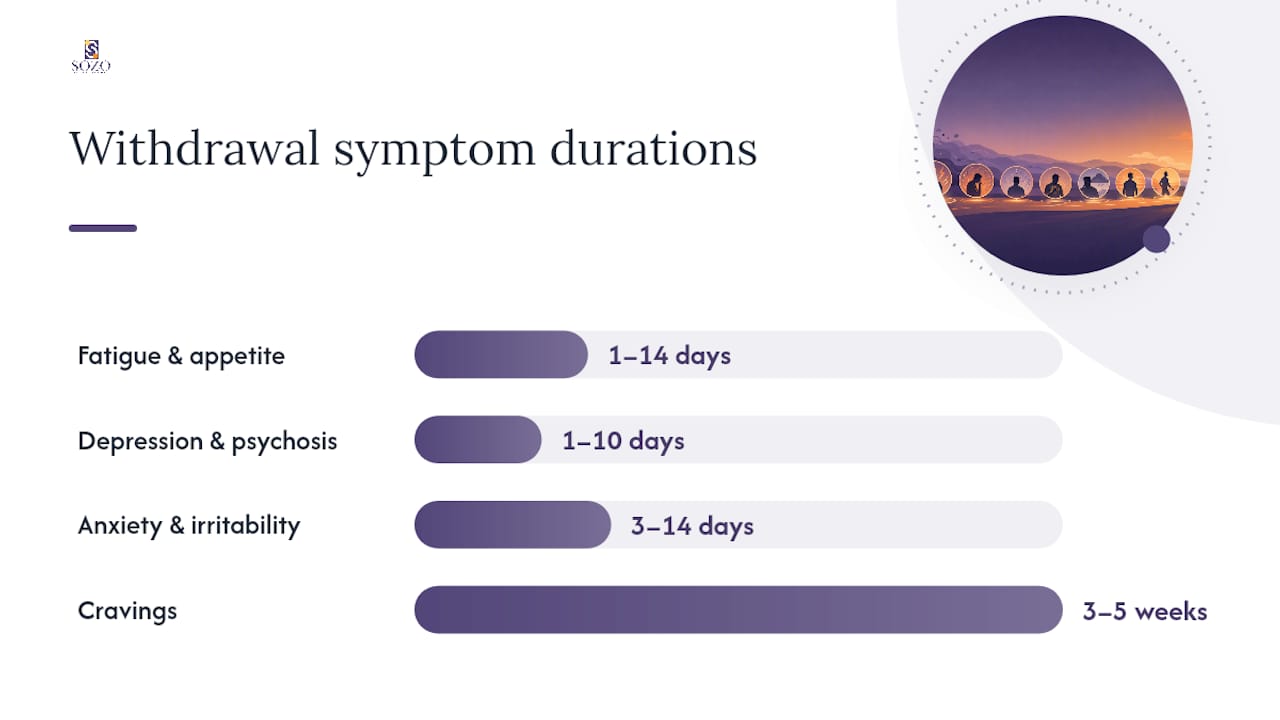
Cravings are the slow burn. Follow-up research on withdrawal trajectories found cravings can remain measurable for several weeks, with relapse risk staying elevated for up to five weeks in some groups studied.
Sleep is the sneaky one. Even after total sleep time increases during the crash, sleep quality itself often stays fragmented and poor for weeks, a pattern documented in clinical summaries of meth withdrawal. Poor sleep and lingering cravings tend to feed each other, which is why sleep support deserves as much attention as mood in the weeks after acute withdrawal ends.
- Fatigue and appetite shifts: days 1 to 14
- Depression and psychosis risk: peaks days 1 to 10, often eases within a week
- Anxiety and irritability: days 3 to 14, tapering gradually
- Cravings: can persist 3 to 5 weeks or longer
- Sleep disruption: weeks to months, even as symptoms otherwise improve
What Determines How Long Your Detox Will Take?
No two men detox on exactly the same schedule, and a handful of factors reliably shift the timeline longer or shorter.
Use history matters most. Someone who used meth heavily for years, smoked or injected it rather than took it orally, or used daily rather than occasionally will typically face a longer and rougher withdrawal than someone with a shorter or lighter history.
Physical and mental health status plays a close second. A co-occurring mental health condition, whether that’s depression, anxiety, or a trauma history, tends to intensify and extend psychiatric symptoms during withdrawal. Poly-substance use, especially combining meth with alcohol, opioids, or benzodiazepines, complicates the picture further and often requires more careful medical management.
Support and environment can shorten the road, even if they can’t shorten biology. Consistent sleep, real nutrition, and access to supervised medical care all improve how a man moves through each stage.
- Length and intensity of past meth use
- Route of use (smoked, injected, or oral)
- Co-occurring mental health conditions
- Other substances or medications in the system
- Access to sleep, nutrition, and medical supervision
When Do You Need Medical Detox or Emergency Care?
Medical detox exists because withdrawal, even when it’s not physically life-threatening in the way alcohol or benzodiazepine withdrawal can be, still carries real psychiatric risk. There’s no FDA-approved medication that cures meth withdrawal itself. Medical detox instead focuses on assessment, close monitoring, symptom management (sleep aids, anti-nausea medication, or agitation control when clinically appropriate), hydration, nutrition support, and psychiatric stabilization for men experiencing severe depression or psychosis.
Certain signs mean this isn’t a wait-and-see situation:
- Suicidal thoughts or statements about self-harm
- Psychosis, including hallucinations or severe paranoia
- Extreme agitation or aggression that feels out of control
- Chest pain, irregular heartbeat, or signs of severe dehydration
Pro Tip: If you’re a family member trying to judge whether a situation is an emergency, trust the behavior change over the excuse. A man who suddenly stops making sense, becomes terrified of people he trusts, or talks about not wanting to be alive needs emergency evaluation immediately, not a wait-and-see approach.
After detox stabilizes, care usually shifts toward residential treatment, outpatient programs, or dual-diagnosis care, guided by ASAM placement criteria that match the level of care to the person’s actual risk and needs. Coordinating a medical detox referral before residential admission is standard practice for anyone with a heavier use history or psychiatric symptoms.
How Does SOZO Approach Detox Referrals and Early Recovery?
The program uses an ASAM-informed assessment process to determine whether a man needs medical detox placement before starting residential care, and whether a co-occurring mental health condition needs to be addressed alongside the addiction itself. That dual-diagnosis lens matters, since untreated depression or anxiety is one of the biggest drivers of relapse in the weeks after acute withdrawal fades.
Once a man is medically stable, the program coordinates the transition into residential or outpatient programming rather than leaving that handoff to chance. If you’re evaluating any program, not just this one, ask these questions first:
- What are the credentials of the medical and clinical staff?
- How is withdrawal monitored, and what happens if symptoms escalate?
- What’s the program’s actual experience with dual-diagnosis cases?
- How does the program manage the handoff from detox into ongoing treatment?
What Detox Prep Actually Looks Like
Walking into intake, whether it’s your own or a son’s or husband’s, bring identification, a current list of medications, and emergency contact information. Beyond paperwork, the real preparation is simpler: protect sleep as much as possible, plan for real meals rather than skipped ones, and remove access to whatever made using easy.
Detox is the opening chapter, not the whole story. It clears the way for the harder, more lasting work of recovery. Professional supervision during those first days doesn’t just add comfort. It genuinely reduces risk during the window when judgment is most impaired.
Ready to Start the Admissions Process?
If you’ve read this far, you already understand something most men in active addiction never get the chance to see clearly: withdrawal has a shape, and knowing that shape is the first step toward getting through it safely. This center exists for the next step, a faith-based, men-only program built on ASAM-informed clinical assessment and dual-diagnosis care, with coordination for medical detox placement built into the admissions process rather than treated as an afterthought.
What that means practically: a man doesn’t have to figure out on his own whether he needs medical detox first or can move straight into residential care. That assessment happens at intake, guided by clinical staff who also understand how faith can play a role in sustained recovery as part of the treatment model. If you’re weighing options for yourself or a man you love, the admissions team at SOZO can walk through what detox placement and early treatment would look like for his specific situation, confidentially and without pressure to commit on the first call.
Where to Verify This Information
For readers who want to check these timelines against primary sources or need immediate treatment resources, these organizations maintain current, authoritative guidance:
- SAMHSA for treatment locators and detox referral guidance
- MedlinePlus: Methamphetamine for consumer-facing symptom summaries
- The original withdrawal timeline study for the clinical data behind this article’s timeline
A Note on Why the Timeline Gets Oversimplified
Most articles on this topic reduce meth detox to a single number, “it takes about a week,” because that’s easier to write and easier to search for. That number isn’t wrong, exactly. It’s just incomplete in a way that sets people up to feel like something is broken when week two arrives and the cravings haven’t fully disappeared.
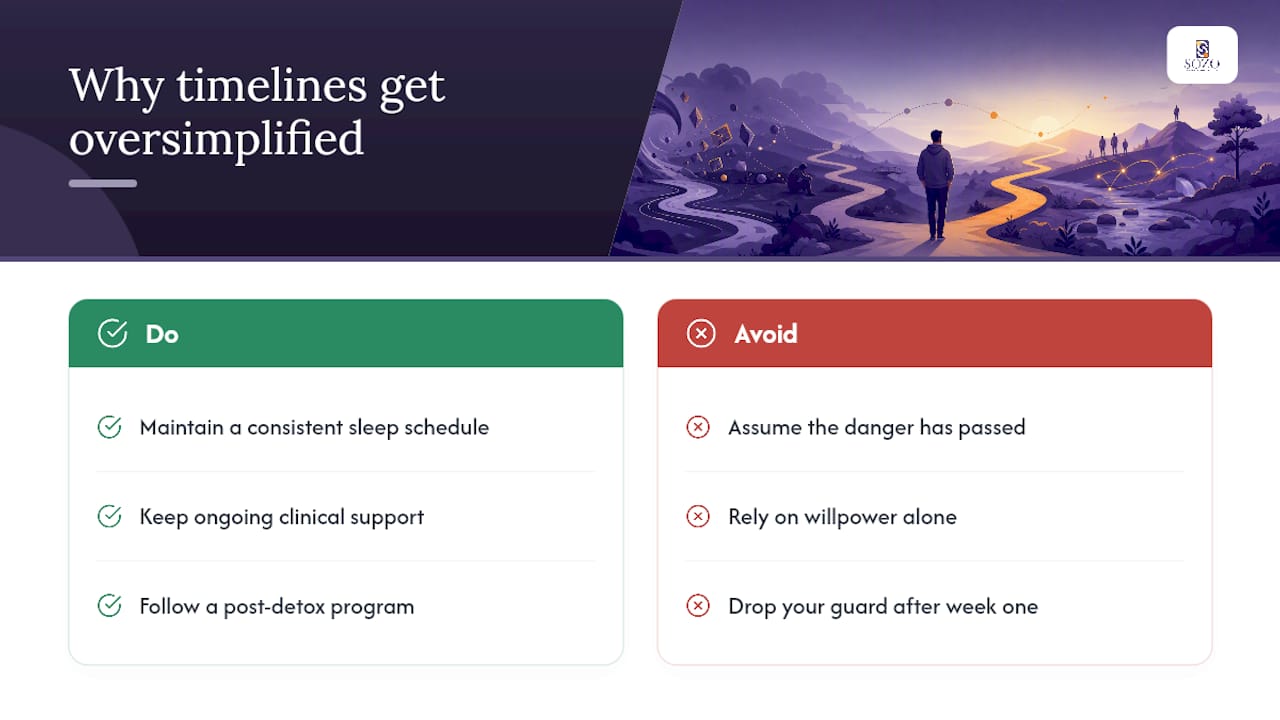
The subacute phase gets the least attention online, and it’s arguably the most important one to understand. It’s the stage where a man feels physically fine, maybe even proud of getting through the worst of it, right as his guard drops and his risk of relapse is quietly at its highest. Families make the same mistake, assuming that once the visible crisis passes, the danger has passed with it.
What actually protects someone during that stretch isn’t willpower. It’s structure: consistent sleep, ongoing clinical support, and a program that treats the weeks after detox as seriously as the detox itself. That’s the gap between a timeline that sounds reassuring and one that’s actually useful.
— Ty
This article is general information, not a substitute for advice from a qualified doctor. Consult a qualified healthcare professional about your own circumstances before acting on anything here.
Sources
- The nature, time course and severity of methamphetamine withdrawal
- SAMHSA
- MedlinePlus: Methamphetamine
- Clinical review on methamphetamine dependence and treatment
FAQ
How Long Does It Take to Fully Detox From Meth?
Acute withdrawal typically resolves within 7 to 10 days, but subacute symptoms like disrupted sleep, low mood, and cravings can persist for weeks to months before a person feels fully recovered.
What Is Methamphetamine Neurotoxicity?
Neurotoxicity refers to meth’s damaging effect on brain cells and neurotransmitter systems from repeated heavy use, which NIDA notes can contribute to lingering cognitive and mood symptoms that outlast the acute withdrawal period.
How Long Does It Take for Meth to Fully Clear Your System?
Meth itself typically clears from the body within a few days, but the withdrawal symptoms it triggers, especially sleep and mood disturbances, often continue for weeks after the drug is gone, according to MedlinePlus.
What Enzyme Breaks Down Meth in the Body?
Methamphetamine is primarily metabolized by liver enzymes in the cytochrome P450 system, though exact clearance speed varies by individual metabolism, dose, and frequency of use.
Is Medical Detox Necessary for Meth Withdrawal?
Medical detox isn’t always required, but it’s strongly recommended for anyone with psychiatric symptoms, a heavy use history, or co-occurring conditions, since SAMHSA notes that supervised detox and coordinated follow-up treatment improve safety and outcomes.