


If someone you love is heading into treatment, call the SAMHSA National Helpline or search FindTreatment.gov today, gather his insurance and medical details, and plan a calm, non-confrontational invitation to get help. Some programs offer men-focused, family-engaged approaches built on the principle that the family’s presence, not just the man’s willpower, moves recovery forward. Start with a phone call to admissions.
TL;DR:
- Family involvement in men’s rehab improves treatment engagement and retention, but it is not a guarantee of sobriety.
- Programs often use psychoeducation, family therapy, and peer specialists to support families, excluding those who may pose risks or create conflicts.
- Preparing for treatment involves safety checks, documentation, and a calm invitation, which is more effective than confrontation.
- Post-rehab, families should focus on relapse prevention, stabilizing living and working conditions, and continuing to attend recovery meetings.
- Faith-based programs tailor family engagement to spiritual frameworks, but recovery outcomes depend on realistic expectations and community support.
Table of Contents
- What Does Family Support Look Like in Men’s Rehab?
- Does Family Involvement Actually Improve Treatment Outcomes?
- What Should Families Do Before, During, and After Rehab?
- Which Family-Based Treatment Approach Fits Your Situation?
- What Legal and Safety Issues Should Families Know About?
- Where Can Families Find Legitimate Help Right Now?
- Faith-Based Family Support: What Families Should Realistically Expect
- How SOZO Recovery Center Involves Families From Day One
- Sources
- FAQ
What Does Family Support Look Like in Men’s Rehab?
Family support in men’s rehab isn’t a single event. It’s a set of roles that shift as treatment moves forward, and most families are never told what those roles actually are.
Programs that take family involvement seriously usually offer it in a few distinct formats. Psychoeducation teaches families how substance use disorder works as a chronic, relapsing condition rather than a moral failure. Family therapy sessions, sometimes one family at a time and sometimes in multi-family groups, work through communication patterns and trust rebuilding with a licensed clinician in the room. Family peer specialists, who often have lived experience with a loved one’s addiction, help relatives navigate the system and their own emotions without the clinical distance a therapist maintains.
“Family” deserves a wider definition than blood relatives. A sponsor, a pastor, a mentor from a men’s Bible study, or a longtime friend who has stayed sober himself can all function as family in the recovery sense. Clinical teams often conduct family interviews early in treatment to map out who actually supports a man’s recovery and who might need to be temporarily excluded from sessions if their presence creates risk or active conflict.
Not every well-meaning gesture helps. Some behaviors build a man up during recovery. Others quietly undermine it.
Supportive habits families can practice right away:
- Keep household routines predictable. Chaos at home makes early recovery harder.
- Handle logistics: rides to appointments, insurance paperwork, childcare during sessions.
- Notice and name small wins out loud instead of only flagging problems.
- Ask the clinical team direct questions instead of guessing what’s allowed.
- Attend the family sessions offered, even when it feels awkward at first.
Enabling habits work against the same goal, even when they come from love. Covering for missed obligations, handing over money without accountability, or avoiding hard conversations because “he’s stressed enough already” all send the same message: consequences are negotiable. SOZO’s family guide walks through how to tell the two apart in real situations, not just in theory.
One reframe changes how most families approach this: think of yourself as a gardener creating the conditions for growth, not a police officer patrolling for violations. That shift alone reduces the blame cycle that derails a lot of early recovery attempts.
Does Family Involvement Actually Improve Treatment Outcomes?
Yes, and the evidence is stronger than most families expect. Family counseling is positively associated with higher treatment engagement, better retention, and improved long-term outcomes, according to SAMHSA’s TIP-39 guidance on substance use disorder treatment and family therapy.
Family counseling increases treatment engagement, retention, and cost effectiveness while improving outcomes for both the client and the family unit, according to TIP-39.
That finding matters because engagement is the real bottleneck. Only a minority of people with substance use disorders ever make it into treatment in the first place, and family involvement is one of the few levers that reliably moves someone from resistance to admission. A structured invitation from people he trusts tends to work where an ultimatum fails.
Researchers organize family interventions into three broad categories, and understanding them helps families ask for the right thing. The first category covers efforts to engage family in promoting treatment entry, meaning techniques that get a reluctant man into a program at all. The second involves family directly in treatment itself through joint therapy sessions. The third provides services to family members as their own clients, recognizing that a mother, wife, or son carrying years of stress needs support independent of the man’s diagnosis.
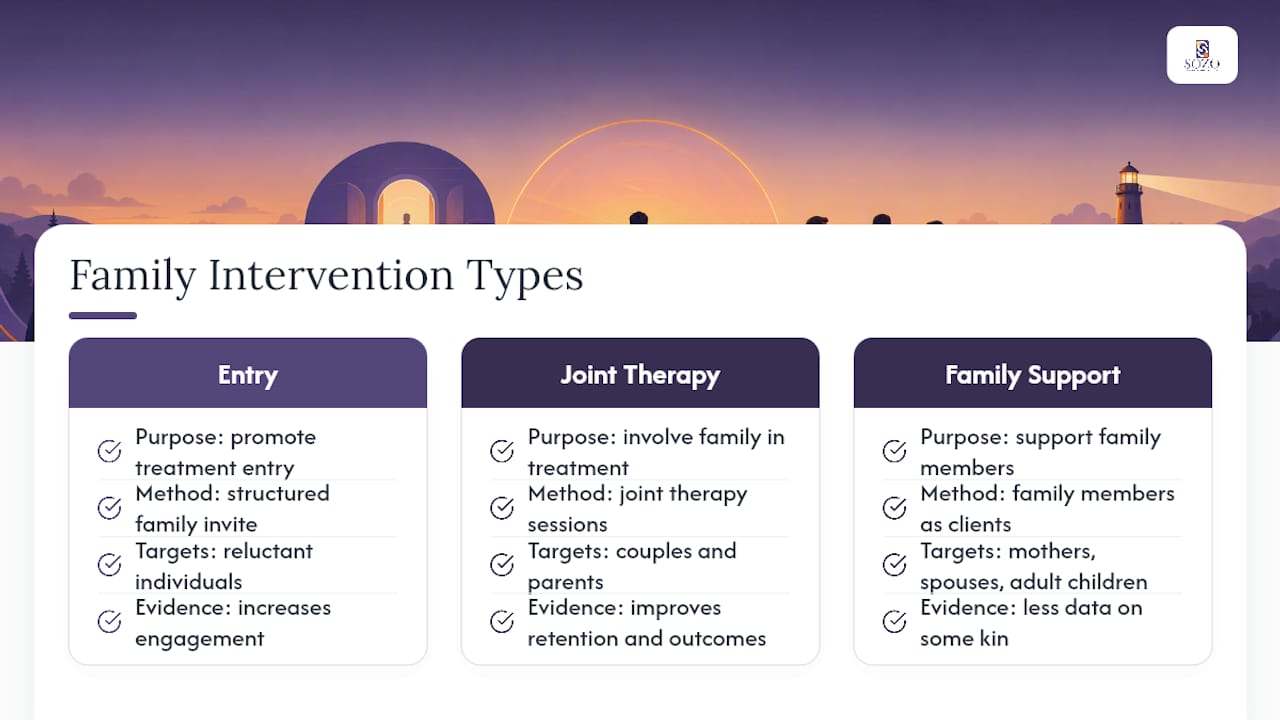
Here’s where families need realistic expectations. Family involvement improves the odds of engagement and retention. It does not guarantee sobriety, and it does not erase the man’s own responsibility for his recovery. Research reviews also note real evidence gaps: much of the literature focuses on couples and parents, with far less data on siblings, adult children, or chosen family. Programs that claim family therapy “cures” addiction are overselling a genuinely useful tool.
Pro Tip: Ask any program directly what percentage of its family sessions are structured therapy versus informal visiting hours. The two are not interchangeable, and some facilities market “family weekends” that offer little more than the latter.
What Should Families Do Before, During, and After Rehab?
Timing matters as much as intention. What helps in week one can backfire in month six, and families who plan ahead avoid a lot of the panic that derails good decisions.
Before treatment starts, the priority is safety and preparation, not persuasion.
- Check for immediate safety risks: weapons in the home, overdose history, or threats of self-harm that need emergency intervention before anything else happens.
- Gather documentation in advance: insurance cards, ID, a list of current medications, and any legal paperwork tied to court-ordered treatment.
- Practice a calm invitation instead of a confrontation. CRAFT-based techniques, which rely on positive reinforcement and structured invitations rather than ultimatums, consistently outperform confrontational interventions at getting someone into a program.
- Confirm logistics: transportation to intake, time off work if needed, and who covers responsibilities at home while he’s away.
- Review common warning signs together as a family so everyone is working from the same understanding of what’s actually happening.
The invitation conversation deserves extra care. Skip the laundry list of past failures. Instead, name one specific concern, state what you’re offering (a ride, a call to admissions, help with the kids), and stop talking. Our advice on how to get him to go to rehab helps you keep the offer to one call.
During treatment, the family’s job shifts from persuasion to participation.
- Attend every family or psychoeducation session the program offers, even the ones that feel repetitive. Consistency is the point.
- Agree on household boundaries before he’s discharged, not after. Decide together what happens if a boundary gets crossed, and write it down.
- Coordinate directly with the clinical team about what’s appropriate to discuss on calls or visits. Some early-stage rules exist for good clinical reasons, not to punish the family.
- Use this window to prepare the home environment: remove substances or paraphernalia, and consider whether household routines need to change before he returns.
- If a family peer specialist is available through the program, use that resource. Peer support specialists with lived experience can translate clinical language into something a stressed family member can actually absorb.
After treatment, the risk of relapse doesn’t disappear, and neither should the family’s involvement.
- Build a relapse-prevention plan together that names specific warning signs and who does what if they appear.
- Help stabilize housing and employment; unstructured time and financial pressure are two of the most common relapse triggers.
- Connect him, and yourselves, to local recovery meetings rather than assuming rehab was the finish line. SOZO’s guide on supporting a loved one long-term breaks this stage down in more detail.
- Keep attending your own family support meetings even after his formal treatment ends. Recovery for the family doesn’t run on the same calendar as his program.
Which Family-Based Treatment Approach Fits Your Situation?
Not every family needs the same intervention, and asking for the wrong one wastes valuable time during intake. A few models show up repeatedly in clinical literature, each built for a different relationship dynamic.
- Behavioral couples therapy (BCT) works specifically with a man and his partner, pairing sobriety-focused daily check-ins with structured communication exercises. It fits best when the primary relationship strain is a marriage or long-term partnership.
- Behavioral family therapy (BFT) broadens that same framework to parents, adult children, or a full household, focusing on shared routines and reducing conflict at home.
- CRAFT (Community Reinforcement and Family Training) targets the specific problem of getting a resistant man into treatment in the first place, using reinforcement rather than confrontation. It’s the right ask when he hasn’t agreed to treatment yet.
- Psychoeducation is the lowest-barrier entry point. It requires no commitment to ongoing therapy and often becomes the bridge that connects a hesitant family to more intensive services later.
- Multi-family group therapy brings several families together at once, which tends to work well in residential settings where men are building peer accountability alongside clinical care.
Approaches described in clinical guidance tend to combine psychoeducation with one deeper therapy model rather than offering just one in isolation.
When you call a program’s admissions line, ask specifically: “What family therapy models do you offer, and can we access them by phone if we live out of state?” A program that can’t answer that question clearly probably isn’t structured around family involvement in any meaningful way.
What Legal and Safety Issues Should Families Know About?
Confidentiality rules trip up more families than any other part of this process, mostly because nobody explains them ahead of time. Federal privacy law (governed by HIPAA and, for addiction treatment specifically, 42 CFR Part 2) means clinical staff generally cannot confirm a man is even in treatment without his signed release of information. Ask him, ideally before admission, to sign a release naming the family members who should be included in updates and sessions. Without it, staff legally cannot speak with you, no matter how worried you are.
Child welfare concerns come up more than families expect, particularly when kids are in the home. Proactive documentation helps: keeping records that show the man is actively engaged in treatment, attending sessions, and cooperating with a care plan can matter significantly if a welfare inquiry ever opens. Engagement, visible and documented, is the best protection a family has.
Naloxone deserves a place in every family’s plan when opioids are involved at all, past or present. Recovery-ready families keep naloxone accessible and know how to use it, according to a National Council for Mental Wellbeing brief on family preparedness. Most pharmacies stock it without a prescription in many states, and community health departments often run free training sessions. Call emergency services immediately in any suspected overdose, even after administering naloxone. It buys time; it doesn’t replace medical care.
None of this works if the family runs on empty. Burnout among relatives of people with substance use disorder is common and rarely discussed.
- Join a peer group built specifically for family members, not just for the person in recovery.
- Set a personal boundary for how much of your day gets consumed by his crisis, and hold it.
- Talk to your own therapist or a family peer specialist if guilt or resentment starts to feel constant rather than occasional.
Where Can Families Find Legitimate Help Right Now?
Start with resources built for exactly this moment. SAMHSA’s National Helpline runs free and confidential, 24 hours a day, and connects families to local treatment options and support services. Have basic information ready before you call: general location, insurance provider, and a short, honest description of what’s happening, including any safety concerns.
FindTreatment.gov works alongside the helpline as a searchable directory of licensed programs, filterable by location, payment type, and specialty (including men-only or faith-based options). Search using the man’s actual insurance plan and zip code rather than a general area to get results that are realistic for your situation.
Family peer support groups matter just as much as clinical referral lines. Al-Anon serves families affected by someone else’s alcohol use, and Nar-Anon serves those affected by drug use. Both run local, in-person and virtual meetings, typically found through a quick search of their respective official sites.
A few checks help families avoid wasted time or worse:
- Verify a program’s state licensing and accreditation before scheduling intake, not after.
- Be skeptical of any facility that guarantees a specific outcome or timeline. Recovery doesn’t work that way.
- Confirm what insurance the program actually accepts before assuming coverage.
- Ask directly whether family sessions are structured therapy or informal visits. The difference is significant.
SOZO’s overview of peer and family roles in treatment covers how these community resources typically connect to clinical care once a man is admitted.
Faith-Based Family Support: What Families Should Realistically Expect
Family involvement in a faith-based, men-only setting works a little differently than in a general clinical program, and families deserve to know why before they commit. A man’s relationship with his family often carries as much weight in recovery as his relationship with a therapist. In a faith-based setting, that dynamic gets layered with a spiritual component: prayer, accountability rooted in shared belief, and a 12-step framework that many families already recognize from Al-Anon or their own church community.
SOZO builds its program around gender-specific care, trauma-informed practices, and treatment plans grounded in the ASAM Continuum, which means family involvement gets tailored to what a specific man actually needs rather than a one-size template. That combination, clinical structure with a faith foundation, tends to give families a shared language they already trust, which lowers the barrier to showing up for sessions.
None of this replaces honest limits. Faith and clinical care together improve engagement; they do not guarantee an outcome, and families who expect a straight line from admission to lasting sobriety will be disappointed. What faith-based, family-engaged care actually offers is a stronger foundation and a community that doesn’t disappear once treatment ends.
Ty
How SOZO Recovery Center Involves Families From Day One
Most rehab searches turn into a maze of hotlines, directories, and programs that treat family involvement as an afterthought. SOZO Recovery Center builds family engagement into the program itself, not as an add-on, through a men-only, faith-based model that pairs biblical principles with dual-diagnosis-capable clinical care and gender-specific treatment designed for how men actually respond to recovery work.
When you call admissions lines at some programs, expect a straightforward conversation including insurance verification, an intake overview, and scheduling for family sessions as part of the treatment plan from the start rather than weeks later. Have his insurance information, a general sense of his situation, and your own questions ready. The team will walk through the rest.
Before that call, it helps to know what you’re walking into. Review how men’s-only treatment changes the recovery dynamic, then reach out to SOZO admissions to schedule an intake conversation and ask directly about family session scheduling.
Sources
- SAMHSA’s National Helpline
- Family-focused practices in addictions: a scoping review protocol (PMC)
- Recovery-ready Families (National Council for Mental Wellbeing)
This article is general information, not a substitute for advice from a qualified doctor. Consult a qualified healthcare professional about your own circumstances before acting on anything here.
FAQ
Can Family Members Go to Rehab Together?
Some programs offer joint sessions, such as behavioral couples therapy for partners or multi-family group therapy, but full “co-admission” as clients together is uncommon. Ask a program directly what conjoint family formats it offers before assuming.
How Do I Help a Family Member With Addiction Get Into Rehab?
Use CRAFT-based techniques: a calm, specific invitation backed by positive reinforcement works better than confrontation or ultimatums. Prepare his insurance information and call the SAMHSA National Helpline or search FindTreatment.gov to identify programs before that conversation.
What Is the Support Group for Families of Alcoholics?
Al-Anon is the established mutual-help group for families and friends affected by someone else’s alcohol use, while Nar-Anon serves families affected by drug use. Both run free local and virtual meetings.
Are There Sober Living Options for Couples?
Sober living availability for couples varies significantly by city and provider, and specific local listings change frequently, so confirm current availability directly with programs in your area. FindTreatment.gov’s directory lets you filter by housing type when searching.
Does Family Therapy Guarantee He Won’t Relapse?
No. Family involvement improves engagement, retention, and treatment outcomes, but it doesn’t eliminate relapse risk. Ongoing family support after treatment ends matters as much as involvement during the program itself.