


Arkansas rehab programs admit a man once four things are in place: a standardized screening like the Addiction Severity Index, an ASAM-based level-of-care decision, valid ID and insurance information, and medical clearance if he’s showing signs of dangerous withdrawal. State licensure rules under OADAP/DBHS and Medicaid’s SATS prior authorization process shape how fast that happens. The fastest path forward is a direct call to an Arkansas-licensed, faith-based program’s admissions line, or to a Regional Alcohol and Drug Detoxification (RADD) facility first if withdrawal risk is severe.
TL;DR:
- A thorough addiction assessment, including medical clearance if needed, is required within 24 to 72 hours of initial contact for Arkansas rehab admission.
- Insurance authorization, especially for Medicaid, usually takes about two business days once all documentation is submitted and verified.
- Prior treatment records can streamline the intake process and reduce repeat testing, speeding up placement and care planning.
- Faith-based programs follow the same licensure and clinical protocols as secular facilities, with additional spiritual assessments that do not affect insurance coverage.
- Immediate detox placement through the RADD network is available for severe withdrawal risks, while non-emergency admissions may take several days depending on insurance verification.
Table of Contents
- What Are the Pre-Admission Screening and Documentation Requirements?
- How Does ASAM Placement Decide the Level of Care?
- What Medical Conditions Require Clearance Before Admission?
- How Do Insurance and Medicaid Prior Authorization Work for Rehab?
- What Should You Bring on Intake Day?
- How Do You Start an Admission at SOZO Recovery Center?
- What Documents Do Faith-Based or Men-Only Programs Require?
- Does Insurance Cover Faith-Based Rehab Admissions?
- How Long Does Admission Take From First Call to Arrival?
- Where Do You Find Help Starting Admission in Arkansas?
- Why Faith-Based Care Works Alongside Clinical Placement
- Start Your Admission Process With SOZO Recovery Center
- Sources
- FAQ
What Are the Pre-Admission Screening and Documentation Requirements?
Before anyone in Arkansas gets a bed assignment, they get a conversation. It’s called the Addiction Severity Index, or ASI, and it’s the backbone of every legitimate intake process in the state. Arkansas licensure standards require this pre-admission screening to document substance use history, medical and psychiatric background, current medications, allergies, legal history, and where the person will live after treatment.
This isn’t paperwork for paperwork’s sake. It’s how a clinician figures out whether a man needs detox first, residential care, or something less intensive. Arkansas guidance expects the addiction assessment to be completed within 24 to 72 hours of initial contact, so families shouldn’t expect a long waiting period once the process starts.
Here’s what to have on hand before that call:
- Photo ID and Social Security number
- Insurance card (front and back, if applicable)
- Current medication bottles or an accurate list with dosages
- Any court paperwork, probation conditions, or employer referral documents
- Contact information for prior treatment providers or therapists
Pro Tip: If a loved one has been through treatment before, call that facility ahead of time and ask them to fax or email records. Prior treatment history speeds up ASAM placement and often prevents a program from repeating tests that were already done elsewhere.
How Does ASAM Placement Decide the Level of Care?
The American Society of Addiction Medicine (ASAM) criteria is the clinical yardstick every licensed Arkansas program uses to decide where someone lands: detox, residential, partial hospitalization, intensive outpatient, or standard outpatient. It isn’t a preference form. It’s a multidimensional assessment covering six areas, and the results determine what kind of admission is even possible.
- Acute intoxication or withdrawal potential — does the body need medical monitoring right now?
- Biomedical conditions — untreated diabetes, cardiac issues, or other complications that need attention alongside addiction care.
- Emotional, behavioral, or cognitive conditions — co-occurring depression, PTSD, or psychosis that changes the treatment plan.
- Readiness to change — is the person willing to engage, or resistant to the point that motivation-focused work has to come first?
- Relapse or continued use risk — has he tried outpatient before and relapsed within days?
- Recovery environment — is home safe, or would returning there undo any progress made in treatment?
Clinical necessity drives this decision, not personal preference, and that’s a distinction families sometimes wrestle with. A man who wants residential care, but scores low-risk across all six dimensions may be placed in outpatient instead, because that’s what the ASAM criteria actually support. Inpatient and residential admissions typically require prior authorization built on this documentation before a Medicaid claim moves forward. Once placement is set, the outcome is a written treatment plan, an estimated length of stay, and a supervising clinician’s signature authorizing admission.
What Medical Conditions Require Clearance Before Admission?
Not every man walks straight into residential treatment. Some conditions have to be stabilized first, and Arkansas facilities take this seriously because getting it wrong can be fatal. Watch for these red flags that typically trigger a medical referral before rehab admission:
- Active seizures or a recent seizure history tied to alcohol withdrawal
- Uncontrolled bleeding or visible trauma
- Vital signs far outside normal range (extreme blood pressure spikes, irregular heart rate)
- High fever alongside confusion or disorientation
- Severe withdrawal symptoms like hallucinations or delirium tremens
RADD program guidance sets clear boundaries for detox admissions: no one under 18, admission priorities based on medical urgency, and a distinction between voluntary and involuntary entry. One detail families often don’t expect: RADD guidance notes that intoxication alone is not grounds for denial, though a true medical emergency still gets referred out and documented. On intake, staff record vital signs and complete a withdrawal-risk form as part of the permanent clinical record.
How Do Insurance and Medicaid Prior Authorization Work for Rehab?
Insurance rules in Arkansas aren’t a footnote. They’re often the difference between admission this week and admission next month. Under SATS regulations, providers billing Medicaid must be properly certified and enrolled, and every new Medicaid beneficiary needs a completed Addiction Assessment before treatment can proceed.
Here’s how the timing usually plays out:
- The Addiction Assessment (billed as H0001) is often completed within 24 hours of intake contact.
- Once full documentation reaches the utilization reviewer, prior authorization decisions for inpatient stays generally arrive within about two business days.
- Treatment planning services are billed under a separate code, commonly T1007, which insurers expect to see alongside the assessment.
Practical steps matter here. Have the insurance card ready, call the insurer directly to confirm active coverage, and ask admissions staff for help filing prior authorization paperwork rather than trying to navigate it alone. SOZO Recovery Center has direct experience verifying coverage with Ambetter, BlueCross BlueShield, and QualChoice, and can walk a family through what a specific plan will and won’t cover before a bed is confirmed.
Pro Tip: Ask the admissions coordinator whether your specific clinician, not just the facility, is enrolled with your insurer. A facility can be in-network while an individual provider isn’t, and that mismatch is a common source of claim delays.
What Should You Bring on Intake Day?
Arrival day goes smoother when a man shows up prepared, and slower when he doesn’t. Pack these items in advance:
- Photo ID and Social Security card
- Insurance card
- Up to a 30-day supply of prescription medications in their original containers
- Emergency contact information for a family member
- Any court, parole, or employer referral paperwork tied to the admission
Once he arrives, expect a structured process: an intake interview, vital signs check, a withdrawal-risk screening if applicable, and a counselor assignment within the first 24 hours. Staff will walk through client rights and program rules, including policies on visitation, contraband, and personal devices. Most faith-based, residential programs restrict phones during the early stabilization period, so it helps to tell family members ahead of time when to expect the first call.
How Do You Start an Admission at SOZO Recovery Center?
Getting a man into treatment shouldn’t require a law degree or a week of phone tag. Here’s how the process runs at SOZO Recovery Center in Hot Springs, Arkansas.
- Call SOZO admissions. Have basic information ready: name, date of birth, insurance details, and a brief description of substance use history. This first call is where the admissions team starts screening for fit and urgency.
- Complete the pre-admission screening. SOZO coordinates the ASI-style assessment and, if medical withdrawal risk is present, arranges detox placement before residential care begins.
- Verify insurance and prior authorization. SOZO requests the necessary documentation and works directly with insurers like Ambetter, BlueCross BlueShield, and QualChoice to move prior authorization forward.
- Confirm arrival and prepare. Once a date is set, SOZO tells families exactly what to bring and what day one looks like, including counselor assignment and the first treatment planning session.
SOZO’s approach layers ASAM-informed clinical placement with a faith-based recovery model, so the same clinical rigor other Arkansas programs follow comes paired with spiritual support from day one.
What Documents Do Faith-Based or Men-Only Programs Require?
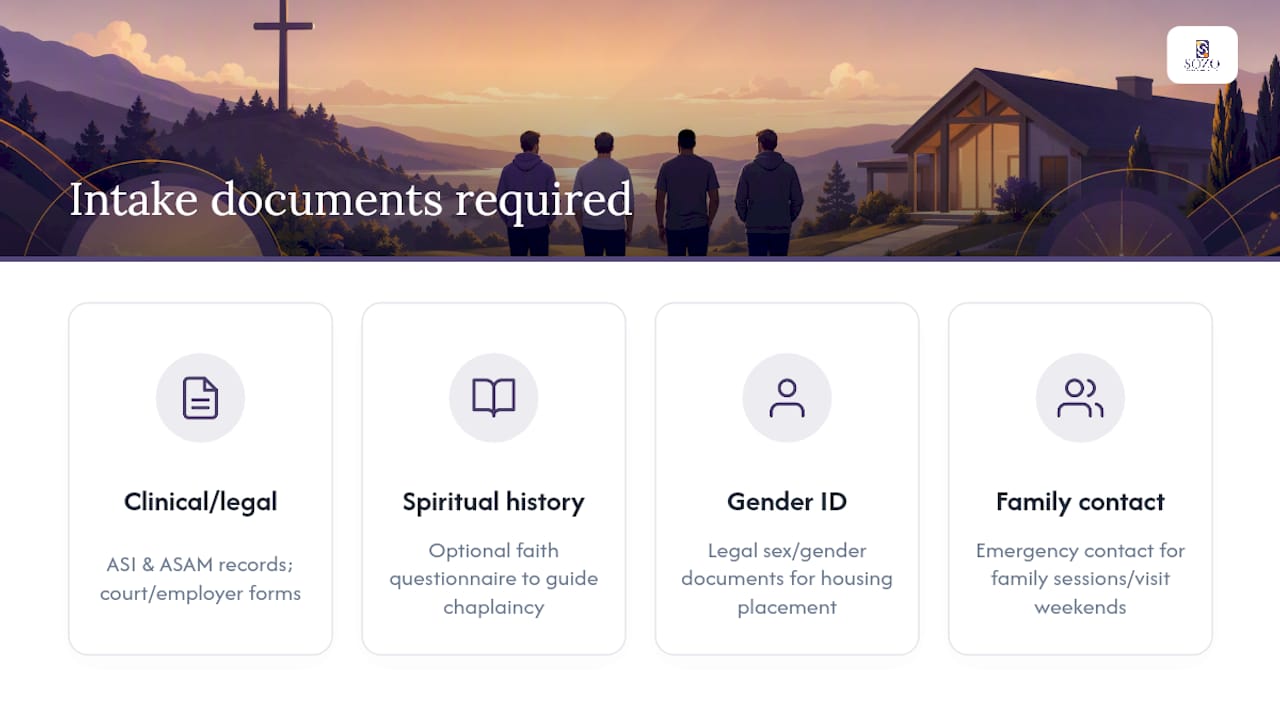
Faith-based and gender-specific programs follow the same state licensure rules as any other Arkansas facility, but they often ask for a few additional pieces during intake. Some request a brief spiritual history or faith background questionnaire, not as a requirement for admission, but to help staff tailor chaplaincy and small-group support to the individual.
Gender-specific programs, including men-only facilities like SOZO, typically confirm legal sex and gender identity documentation for housing assignment purposes, since dormitory and room placement depends on it. Programs also ask about prior participation in 12-step work, church involvement, or previous faith-based treatment attempts, because that history shapes how counselors introduce biblical teaching alongside clinical care.
Family involvement paperwork tends to run deeper in faith-based settings too. Many programs ask for an emergency contact who can participate in family sessions or visitation weekends built around the program’s spiritual programming. If a man is coming through a court referral or employer intervention, that paperwork still applies exactly as it would anywhere else. The faith component adds to the standard intake, it doesn’t replace any of the clinical or legal documentation Arkansas requires.
One detail families sometimes miss: if a man is transferring from a secular program, his prior treatment records still matter. Faith-based programs use that same ASI and ASAM information to build a treatment plan; they simply add a spiritual dimension to how the goals get pursued.
Does Insurance Cover Faith-Based Rehab Admissions?
Insurance companies in Arkansas don’t evaluate faith content when approving a claim. They evaluate medical necessity, which means the same ASAM documentation and prior authorization rules apply whether a program is secular or faith-based. That’s good news for families worried that choosing a Christian-centered program might complicate coverage.
What insurers do care about is licensure and clinical credentials. A faith-based facility has to carry the same OADAP/DBHS licensure and staff certification as any other provider to bill Medicaid or private insurance. SOZO Recovery Center, for example, structures its treatment plans around ASAM criteria specifically so that insurance verification runs through the standard process, not a separate track for religious programs.
Where things can get complicated is coverage for adjunct services some faith-based programs offer, like chaplaincy sessions or spiritually focused group work. These are often bundled into the daily rate rather than billed separately, so they usually don’t create a coverage gap on their own. The clinical core of treatment, detox referral, individual counseling, group therapy, medication management, is billed the same way it would be at any licensed Arkansas facility.
The practical move for families: call the insurer and ask specifically whether residential substance use treatment is covered, then confirm the facility’s licensure status separately. Coverage decisions come down to medical necessity documentation, not the presence of a chapel on-site.
How Long Does Admission Take From First Call to Arrival?
Families calling in crisis want one number: how many days. The honest answer is that it depends on urgency and payer, but a general pattern holds across Arkansas facilities.
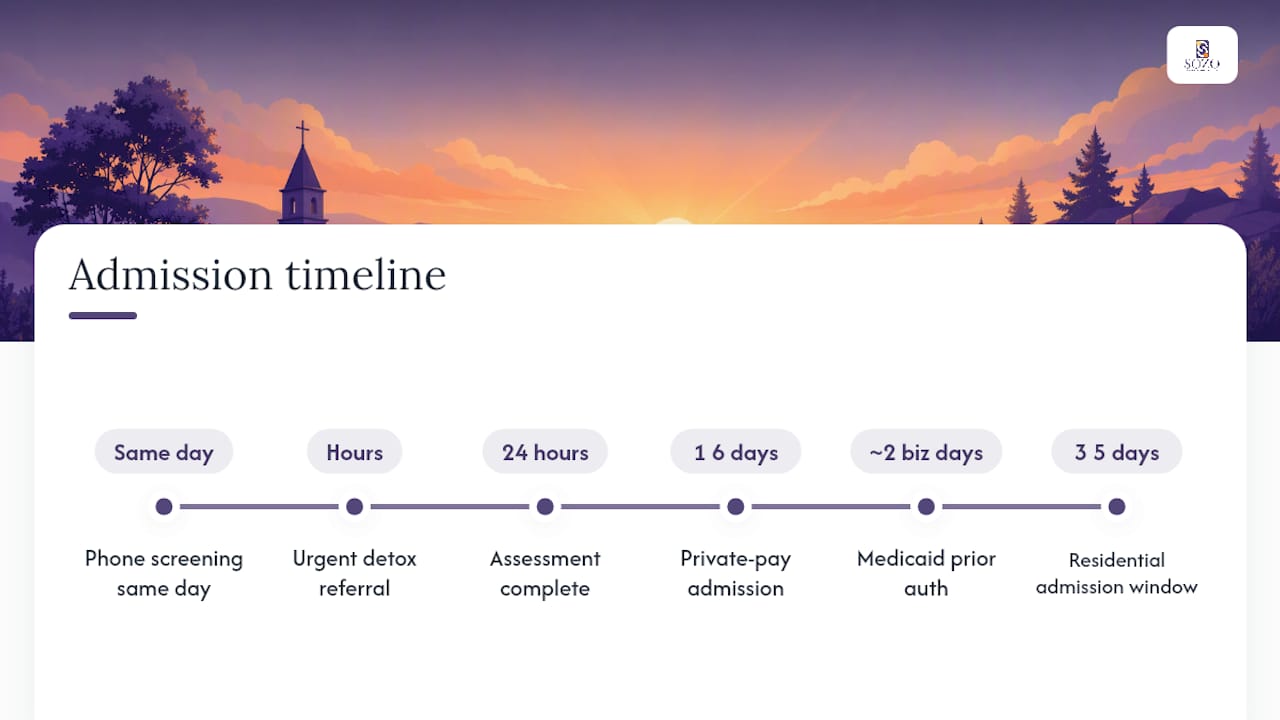
A phone screening usually happens the same day someone calls. If withdrawal risk looks significant, referral to a RADD detox facility can happen within hours, since those programs prioritize admissions by medical urgency rather than a waiting list. The addiction assessment itself is often finished within 24 hours of that first contact, matching the timing built into state licensure standards.
Where the clock slows down is insurance. If a man is privately insured or paying out of pocket, residential admission can often happen within a day or two of completing screening. If Medicaid is involved and the placement is residential, prior authorization decisions generally arrive within about two business days once full documentation, diagnosis, treatment plan, and clinical justification, reaches the utilization reviewer. That means a realistic window from first call to admission runs anywhere from same-day for urgent detox cases to three to five days for a fully insurance-verified residential placement.
The biggest variable families control is documentation speed. Programs that get insurance cards, medication lists, and prior records quickly move authorization faster than programs still chasing paperwork on day three.
Where Do You Find Help Starting Admission in Arkansas?
Knowing where to call first matters as much as knowing what to bring. If withdrawal is severe or medically dangerous, the RADD network is the front door, since those facilities are built specifically for detox stabilization before any other treatment begins. If the situation isn’t a medical emergency but a man needs residential or outpatient care, calling a licensed program’s admissions line directly is the fastest route.
Arkansas’s Department of Human Services maintains licensure oversight through OADAP/DBHS, which is the regulatory body confirming a facility is legitimate before a family commits time and money. Checking that a program carries current state licensure takes a phone call and protects against unlicensed operators that don’t follow ASAM placement standards at all.
For men specifically seeking faith-based, dual-diagnosis care, SOZO Recovery Center’s admissions team handles the screening, ASAM placement, and insurance verification in one coordinated process, which removes the burden of calling multiple offices separately. Family members are often the ones making that first call, and admissions staff expect that. Coming prepared with basic information (name, insurance, a rough description of substance use) is enough to get the process moving.
Why Faith-Based Care Works Alongside Clinical Placement
ASAM criteria tells you what level of care a man clinically needs. It doesn’t tell you what will actually keep him engaged in that care for the weeks it takes to matter. That’s where faith-based programming earns its place, not as a replacement for clinical rigor, but as the thing that gives a man a reason to stay in the chair after the withdrawal symptoms fade and the real work of the 12 steps begins.
I think the field undersells this. Plenty of men have been through secular treatment once, sometimes twice, and left with the clinical knowledge but none of the internal motivation to apply it. Pairing ASAM-informed placement with spiritual community and biblical teaching addresses both halves of the problem at once. Families should lean toward this model when a man responds to purpose-driven language, has some prior faith background, or has cycled through clinical-only programs without lasting change. When active psychiatric instability or severe medical risk is present, prioritize the highest level of medical oversight first; faith-based support works best once a man is medically stable enough to engage with it.
— Ty
Start Your Admission Process With SOZO Recovery Center
Most Arkansas rehab searches turn into a maze of insurance calls, waitlists, and generic intake lines that treat every caller the same. SOZO Recovery Center is different because admissions staff handle the ASAM screening, insurance verification, and faith-based program fit in one coordinated conversation, so a family isn’t juggling three separate offices during an already stressful week.
Before calling, have three things ready: a photo ID, insurance card, and a brief, honest description of the substance use history involved. SOZO’s team will walk through the ASAM-informed placement process, confirm coverage with plans like Ambetter, BlueCross BlueShield, or QualChoice, and explain what to expect on arrival day at the Hot Springs facility. If you’re evaluating whether faith-based rehab in Arkansas is the right fit for a son, husband, or brother, the admissions line is the fastest way to get a direct answer. Reach out to SOZO’s admissions team today to begin the screening conversation.
This article is general information, not a substitute for advice from a qualified doctor. Consult a qualified healthcare professional about your own circumstances before acting on anything here.
Sources
- Licensure standards for alcohol and other drug abuse treatment programs — Arkansas Department of Human Services
- 016.06.11 Ark. Code R. 017 – Substance Abuse Treatment Services (SATS) — Legal Information Institute
- Exhibit C — Hospital based residential treatment for substance use disorder (Arkansas emergency rules/summary)
FAQ
What documents do I need to enter rehab in Arkansas?
You need a photo ID, Social Security number, insurance card, current medication list or bottles, and any relevant court or referral paperwork.
How long does the addiction assessment take?
Arkansas guidance expects the addiction assessment to be completed within 24 to 72 hours of initial contact.
Does Medicaid require prior authorization for residential rehab?
Yes, inpatient residential treatment in Arkansas requires prior authorization based on ASAM documentation, medical history, and a treatment plan submitted to the Medicaid reviewer.
Can someone be denied rehab admission for being intoxicated?
Under RADD guidance, intoxication alone isn’t grounds for denial, though a genuine medical emergency requires referral and documentation before admission proceeds.
Does SOZO Recovery Center help with insurance verification?
Yes, SOZO Recovery Center assists families with verifying coverage and prior authorization for plans including Ambetter, BlueCross BlueShield, and QualChoice.